

Christine Lorenz
Christine Lorenz uses the tools of macro photography to explore the ways we find meaning in materials. Her photographs have been exhibited at photo-eye gallery, Santa Fe; Photographic Exploration Project, Berlin; Silver Eye Center for Photography, Pittsburgh; and the Brooklyn Waterfront Artists Coalition. Her work has been featured by Lenscratch, Photolucida, Refract Journal, Der Greif, and Fraction Magazine. Her photographs are featured in the architectural glass of Pittsburgh International Airport. Collections include UPMC Kamin Tower, Duquesne University, Community College of Allegheny County, and the Tomayko Foundation. She was a 2025 Gilbert Fellow at Cold Spring Harbor Laboratory, New York. Her writing has been published in Refract Journal, University of California, Santa Cruz, and in Critica: The Newsletter of the Psychoanalytic Institute of Northern California. She was a selected photographer for Review Santa Fe in 2021 and was a finalist for Photolucida Critical Mass in 2023. In addition to her self-published photobooks, she has served as publication editor and designer for The Earth Of workshops of Arts Letters and Numbers. She is a founding member of Flock Artist Collective, cultivating the intertwined work of artmaking and parenting. She is represented by the Shiftworks Pittsburgh Creative Corps and serves as the exhibition committee chair of Associated Artists of Pittsburgh. She holds an MFA from the University of California, Santa Barbara, and a BA from The Ohio State University. She lives with her family in Pittsburgh, PA, where she teaches art writing and the history of photography at Duquesne University and Point Park University.
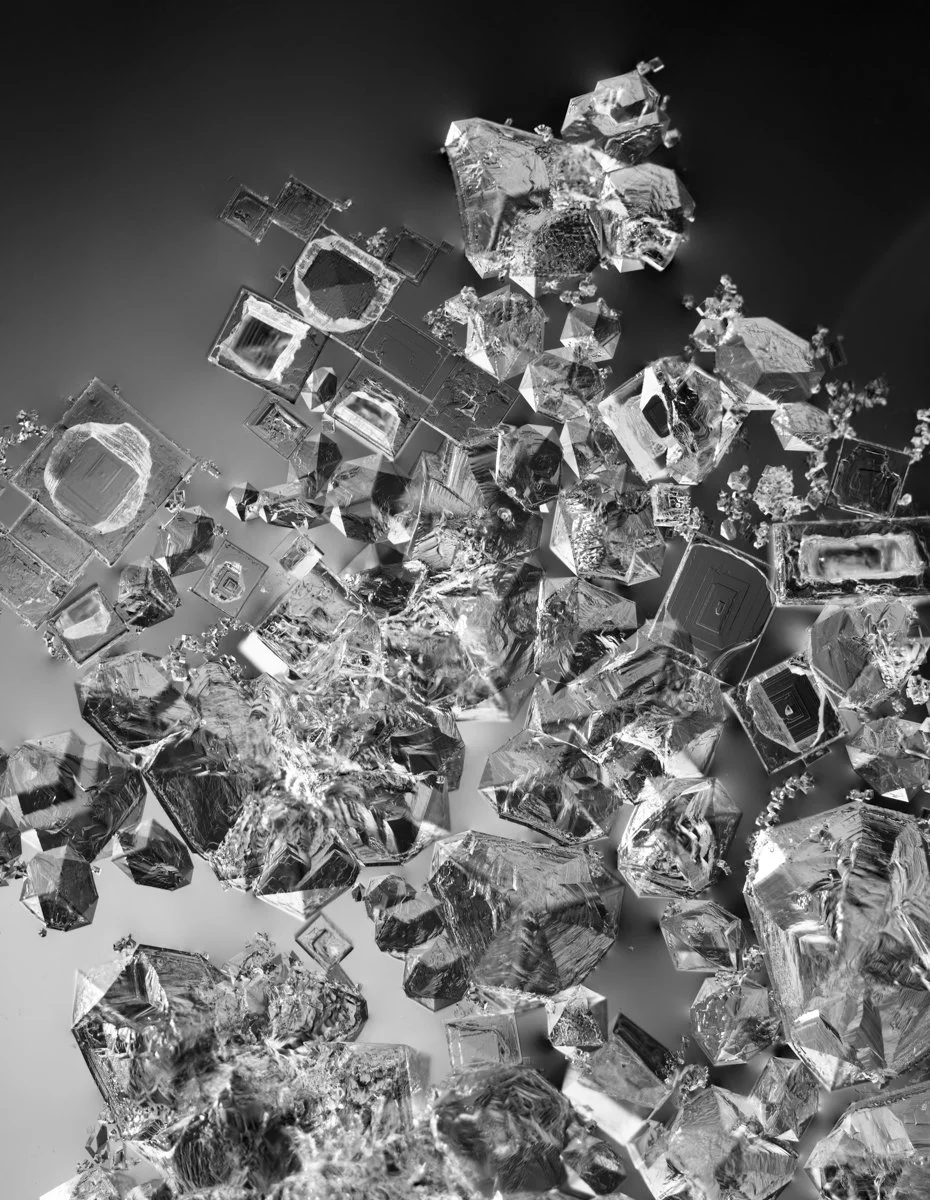
Christine Lorenz, Salt 4137, 2024
At GroundTruth Institute, we are drawn to practices that ask us to look more closely; to attend to the materials, histories, and places that compose the world around us. Artist Christine Lorenz’s macro-photographic investigations of salt offer precisely this kind of attentive encounter. In her work, salt becomes at once matter and metaphor; a crystalline substance shaped by geological and human histories, and a material through which questions of transformation, perception, and time emerge. In the following conversation, we explore salt as subject matter, archive, and landscape, and consider how sustained attention to a seemingly ordinary material can expose deeper ways of seeing our entanglement with the environments and places we inhabit.
Margaret LeJeune: You often write that "to be human is to recognize salt," suggesting that salt precedes language as a form of knowledge. Before it became the central material of your artistic practice, what did salt mean to you personally? Can you trace how an everyday substance gradually transformed into an intellectual, historical, and artistic companion?
Christine Lorenz: Of the many minerals our bodies need to function, this is one that we need a lot of, all the time. We are adapted to like the way it tastes, and we are aware of how it accumulates on our skin and leaks from our eyes. Those physical, sensory associations with salt are part of our experience of the world at the earliest moments of our consciousness, before we even know that salt comes from the ocean or is drawn up from the ground.
In my own experience, I wouldn’t say that salt meant anything in particular to me before I started photographing it. But all along, it served its role in keeping my physical systems functioning properly, regardless of any particular conscious attention. And as it did so, it was composed of particles that had been cycling through the earth, at one time through oceans. I have consumed it as part of a vast network of humans that dig this material out of the ground, and disperse it across the surface where it recombines with the ecosystem. This is part of what I’m interested in exploring through the process of making art with this material: we are all more than what we know or think about. On the individual level, systems operate within our body independently of whether we are conscious of them; on a larger, geological scale, we are part of processes of transforming the earth. Elements of the earth move through us; we embody the earth in every ongoing moment just by virtue of living.
The familiarity of this material makes for an entrance point where the viewer can easily feel a sort of stable footing in approaching the photographs. There is an accessibility factor that is important to me, in a time when photography seems quite driven to reach for dazzling and never-before-seen experiences. Our culture celebrates photography that can bring us things we have never encountered, works of heroic effort or rarified capture technology that overwhelm the senses. As much as I love those experiences in photography, I think there is plenty of room for what attends to the commonplace and the incredible value of small things. The meaning we find in the everyday is the human-facing aspect of much larger things.
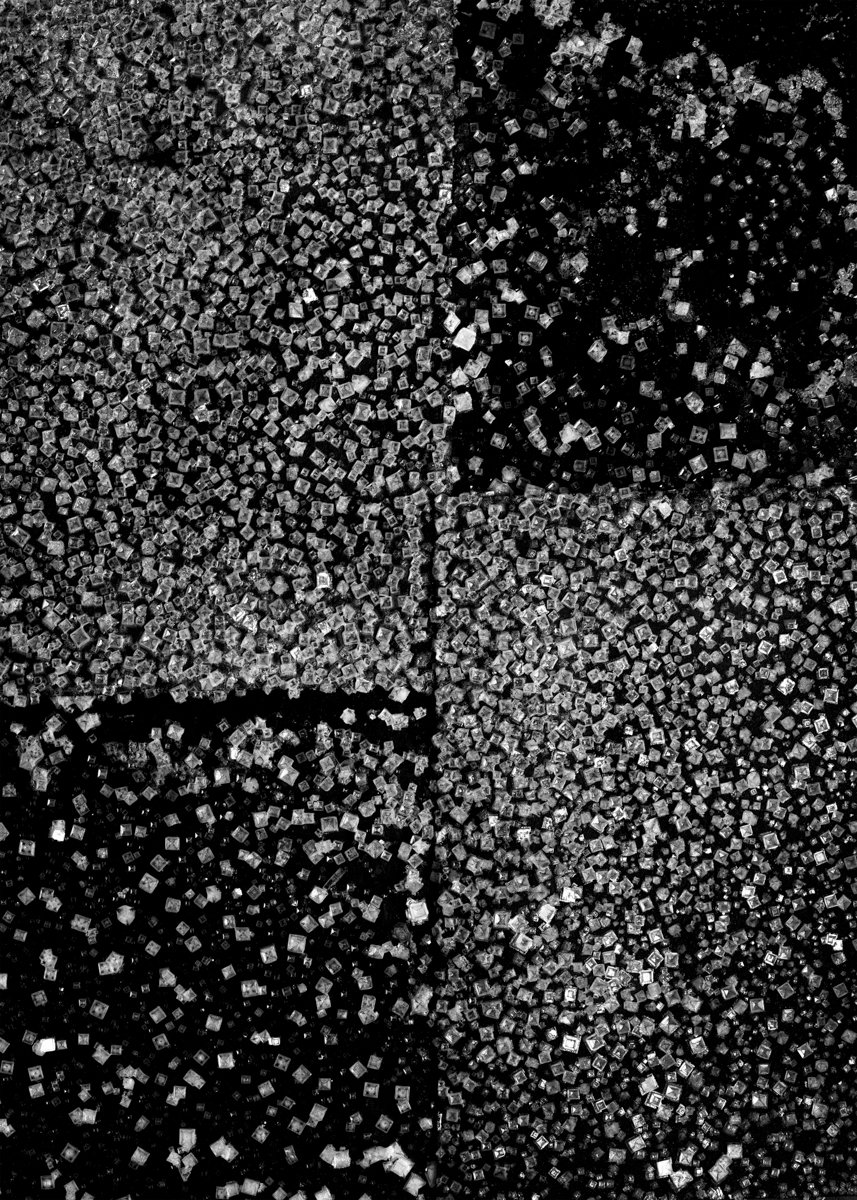
Christine Lorenz, KS-8551 from Kanawha Salines, 2025
ML: Throughout your writing, you resist describing your photographs as documents of static objects. Instead, you describe crystal growth almost as a collaboration between yourself and a nonhuman participant. How has working with salt changed your understanding of authorship? At what point does the photograph become less an image you make and more a record of a negotiation between your intentions and the agency of the material?
CL: There is a lot to these photographs that goes beyond my control. After image capture, there’s a lot of working with the images digitally, including the stacking of the macro exposures, finessing the color balance, getting rid of dust, and the kind of general cleaning-up that is part of the craft of photography. That part is more or less my job, but the collaboration with nature has to happen first. In the process of photographing, there are a lot of delicate material aspects involved. I can’t know in advance what kind of colors I’m going to see, and when I find good combinations, catching them is another challenge. Various components are always shifting under the camera. The crystals typically change over the course of a shoot, as the heat from lights affects their structure, while new crystals start forming and floating around on the solution’s surface.
And on the road to that point, the crystals have been growing the way they are going to grow, in patterns I’ve come to anticipate in certain ways, but that are driven by factors that are not up to me. Observing this takes time. I might describe the process in terms of a kinship, but it’s a funny one in that I don’t feel like the material has any particular concern with my goals. It wants to grow in certain ways that feel very much like agency. It all brings home the kind of enchantment of the natural world that is expressed through alchemy, where the elements of the world are treated as having enduring significance on a level that is more elusive.
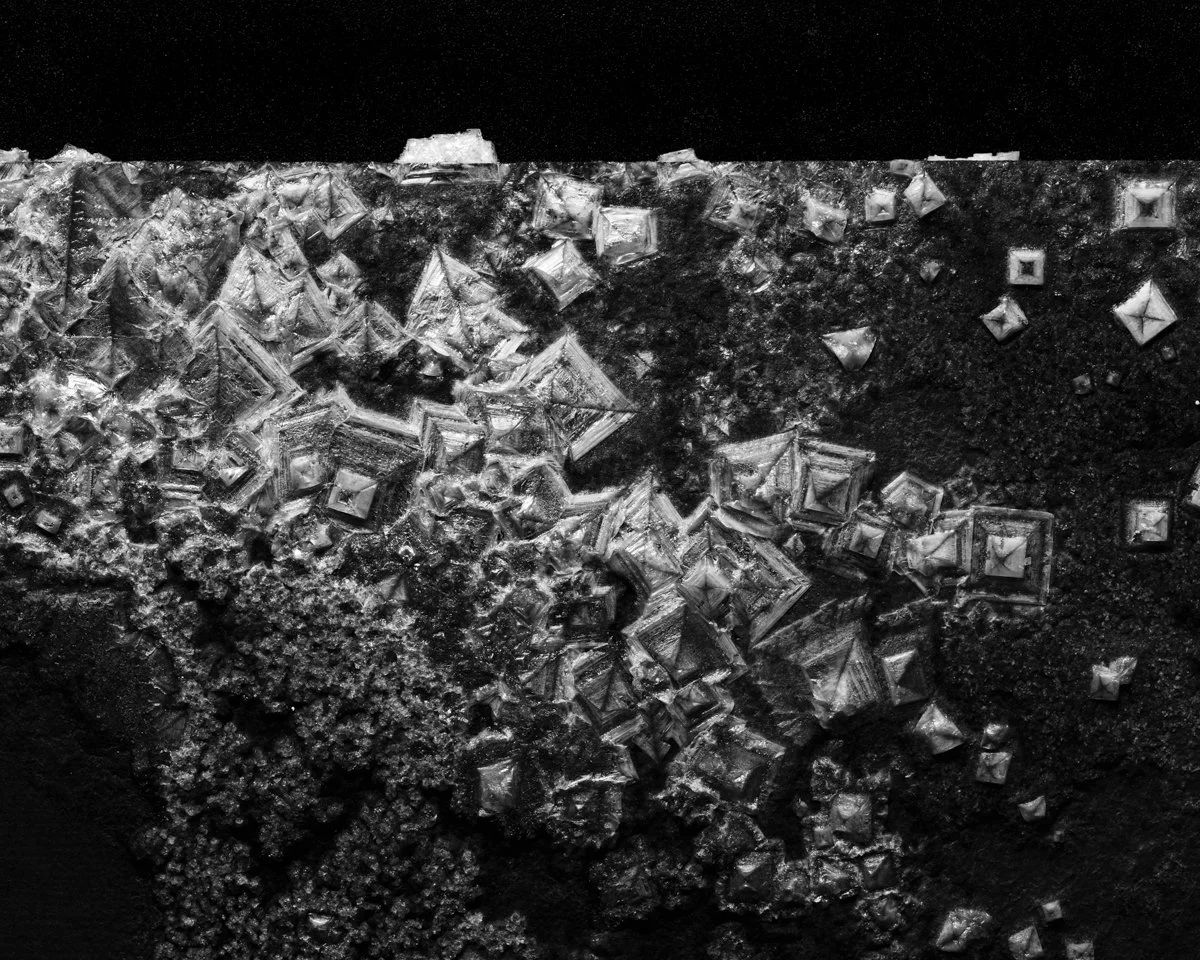
Christine Lorenz, KS-8578 from Kanawha Salines, 2025
ML: Macro photography functions in your work as more than a technical tool; it seems to become a way of thinking. How has sustained attention to microscopic scales reshaped the way you perceive ordinary life? After years of working this closely with crystals, plastics, paper, and light, do you find that your everyday perception has fundamentally changed?
CL: If I’m not careful, I can get a little myopic. My father used to call this “majoring on the minors.” It can be easy to lose sight of what the big picture demands of us when minding the details. But the reverse is also true; the smaller parts are often overlooked, and I can’t help but see this as related to power dynamics that are often gender-related. I think many of us have worked with people who see themselves as visionaries: idea-driven people who get big things going, and then dash on to the next thing, leaving other people who work with them to organize, delegate, problem solve, and make sure that every little thing gets done to make the plan come to life. That kind of work is easy to dismiss or denigrate. I think hands-on, detail-oriented work is worth lifting up.
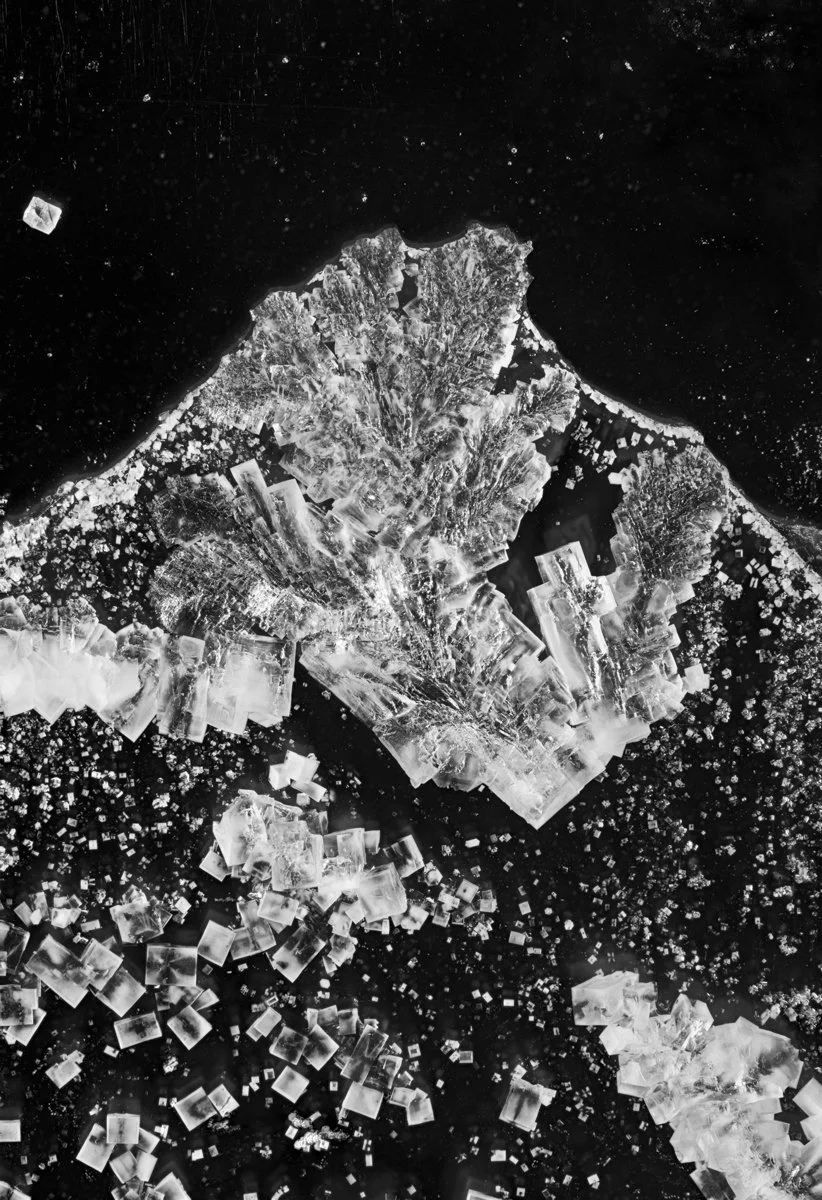
Christine Lorenz, KS-5808 from Kanawha Salines, 2024
ML: Your project Kanawha Salines brings together deep geological time, nineteenth-century industrial history, contemporary extraction, and present-day communities. How did your understanding of the Kanawha Valley evolve as you moved from photographing crystals to researching the history of salt production, labor, industry, and environmental transformation? Was there a moment when you realized this project had become about much more than the mineral itself?
CL: When I visited the J. Q. Dickinson salt works and started to learn about the history of the industry, it altered how I was looking at the material. It came to feel like I was reaching my hand into a tidal pool, where I could start to touch the edges of all these different creatures that grew there, and at the same time realize that there was so much more on the other side of where I was standing, and my reach seemed so short where the span of what I was touching was so vast. A number of regional historians have done the research to bring the history of that industry into the public eye in our time. I have worked around historians enough in an academic context to recognize the rigor they bring to their work, seeking out primary sources, using great care with language, building the context that is necessary at every step. I’m not equipped to do that work. But I do think it’s part of my role to raise the visibility of that historical research, and try to keep the knowledge of history alive and active.
The question becomes how to do this in the context of visual art, where people who see the work don’t necessarily want to read much text on the wall, and where I don’t necessarily want the encounter with the photographs to feel like a homework assignment. I look for ways to build context in the periphery, whether by telling stories on social media or in events, by publishing zines with additional site-based photos, or by having elements of background take some form in a gallery context. And I want to open the door for people who become curious to be able to learn the way I did. My goal is for this project to reach the form of a photobook, which would include a bit more contextual writing, possibly including poetic narrative form as well as more historically grounded material. People will read such a thing in their own way, as much or little of it as they wish. I don’t always read all the way through the essays, even in photobooks I love. Skipping through can be a form of reading too. Sometimes we just brush the surface and register that there is more to return to when the time comes, and things can unfold over time for us that way.
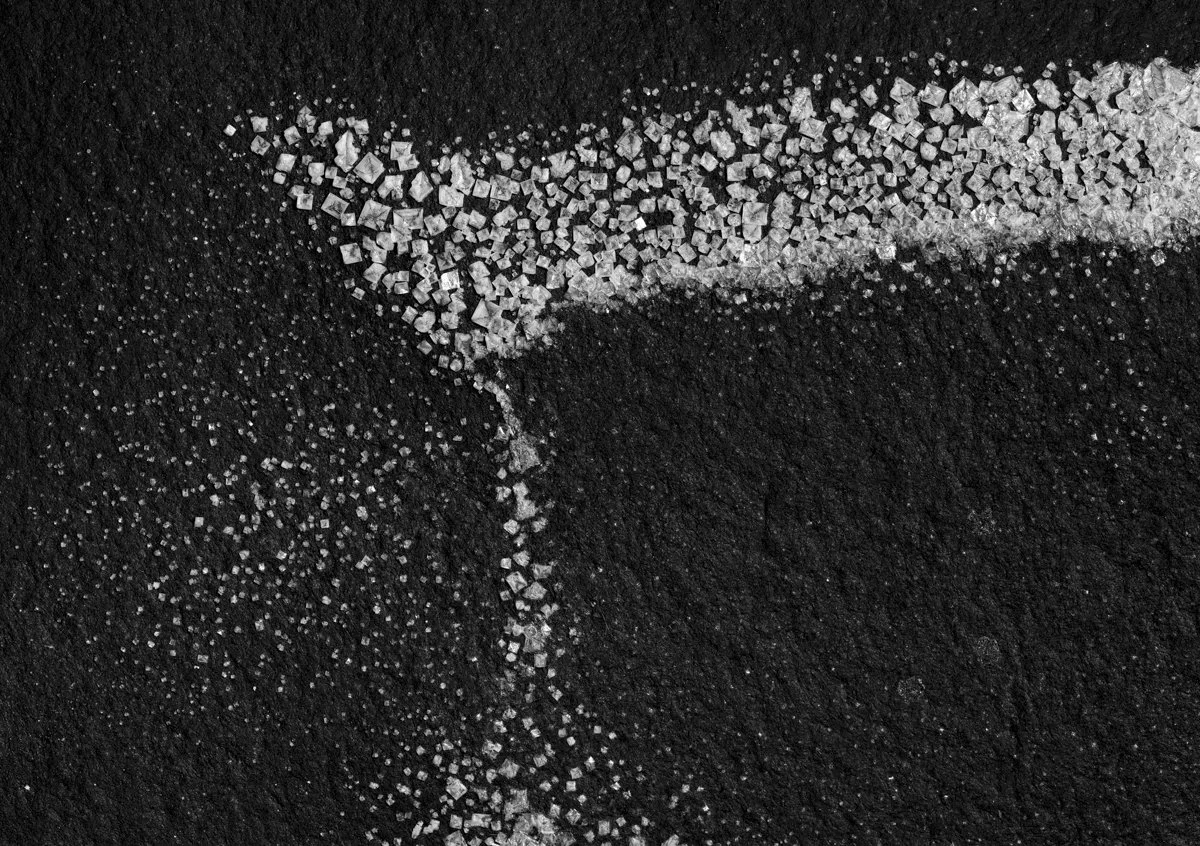
Christine Lorenz, KSM-57 (Lillian), from Kanawha Salines, 2025
ML: Your photographs are extraordinarily beautiful, yet they point toward histories of extraction, pollution, petrochemicals, and ecological instability. How do you navigate the ethical tension between aesthetic seduction and environmental critique?
CL: It is hard to move through these times with love and openness. I am not, by nature, an optimistic person. But a certain level of positivity is necessary to function in society and connect with people. So I reach for light, on an ongoing basis. I am trying to make things that reflect something enduring, even if there are contradictions in their implications. There are so many internal conflicts in our relationship with the everyday materials that extend our presence in the world, let alone with our relationship to photographs. These are challenges all of us dwell within, and it’s hard once we recognize the entanglements of the capitalist system that we are a part of. Part of how we address that is to not take it all in at once, but to focus attention in different places, and explore the wide range of dimensions of these worlds we participate in. Not all at once, but a little at a time.
To bring other people into that act of looking, I think it’s both honest and strategic to move through a range of emotional tenors. In the series On a Molecular Level, these lean towards more playful and energetic visual experiences. These invite people to enter and linger, and I hope that there is some subtlety there and a sense of there always being more to the connection they open with the material world. Its partner series, Also, There Was No More Sea, brings forward a more disorienting, apocalyptic sensibility. These are less weightless skies, more heavy landings. The colors are less harmonious, more jarring, in their ruminations on the future that our way of life is creating. I see both of these bodies of work as kind of fantastical departures opened up by the strange relationships among the materials we live with.
Other projects that are regionally specific have their own narrative or aesthetic directions, and the black and white salt images are often just following the patterns of growth and dissolution of the materials themselves. The forms that they create are endlessly fascinating, and sometimes I just want to bring that beauty out into the world, in a way that reorients our sense of scale.
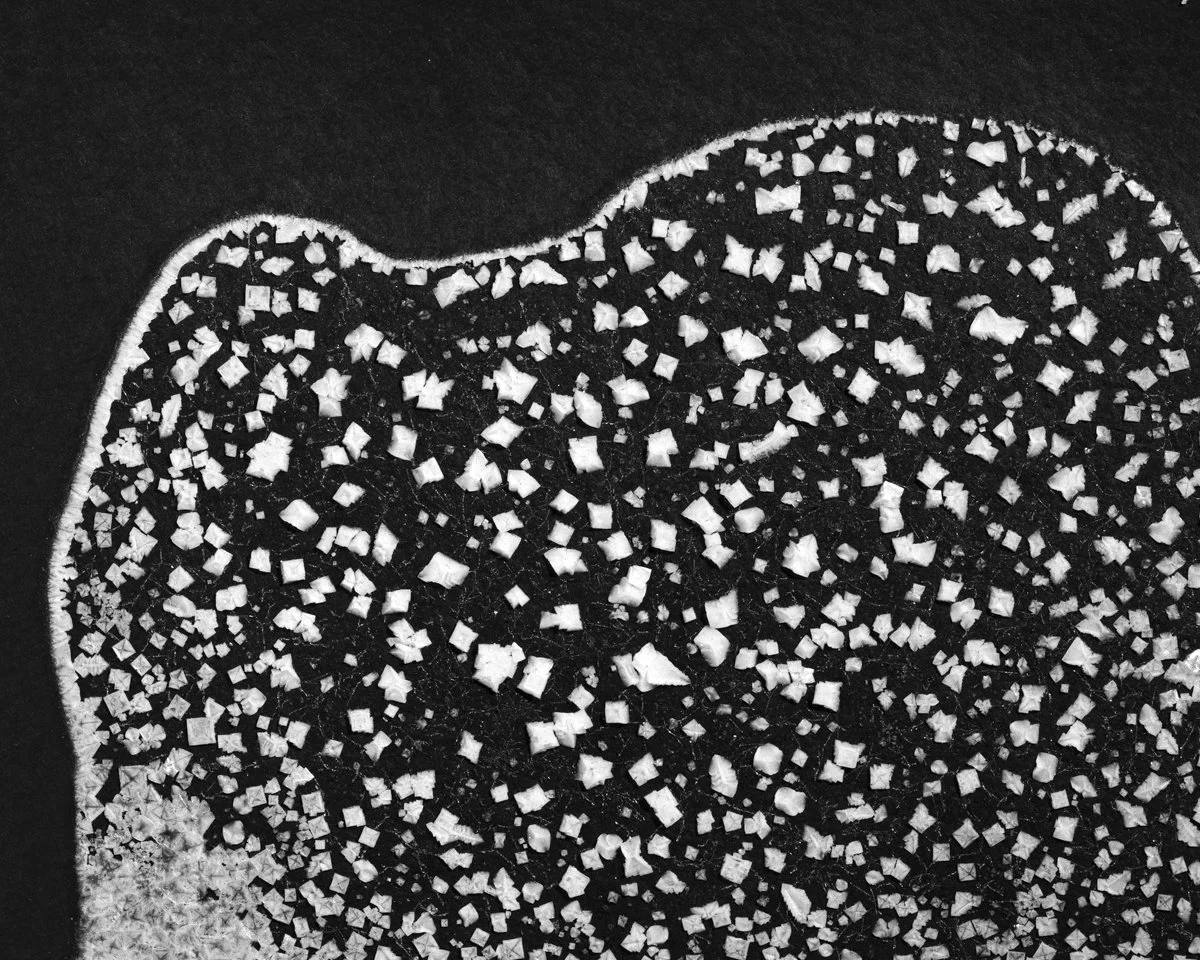
Christine Lorenz, KSM-21 (diapir, to pierce), from Kanawha Salines, detail, 2025
ML: Across your writing you draw together alchemy, Jungian psychology, scripture, geology, chemistry, infrastructure, and everyday language. Salt seems to operate simultaneously as matter, metaphor, and history. What have you learned about the relationship between physical materials and cultural meaning? Do you think materials accumulate stories in ways that resemble how they accumulate physical traces?
CL: This material has played so many roles over time and across cultures. It took me a long time to warm up to alchemical writings, because Jung’s writings seem driven to get to a clearly defined heart of the matter: to be definitive, complete, and archetypal. I am resistant to a totalizing approach, but there is a lot of insight on human experience there, if it can be taken in a poetic sense. The lore of salt in alchemy is always about transformation. One figure that Jung lays out identifies salt as a bridge from bitterness to wisdom. I think that’s highly relatable regardless of where one comes from. Another of the great writers in depth psychology, James Hillman, recognizes the value of reflecting on that kind of figurative language, with the expectation that the individual must determine for themselves how well it fits their own experience. He wrote that as the basis of human connection with the elements of the earth, salt “… makes events sensed and felt, giving us each a sense of the personal: my tears, my sweat and blood, my taste and value. The entire alchemical opus hangs on the ability to experience subjectively.”(1)
What I have come to love in alchemical thought is the sense of enchantment with the elements of the earth, and the pursuit of living purpose in what is found there. From my own perspective, the encounter with the tiny bits of the earth that I can grasp, at its best, brings to the senses the workings of an impossibly vast expanse. The earth, in the perpetual motion of its countless cycles, may not be concerned with me. But it goes through me, and I am a part of it, as are we all.
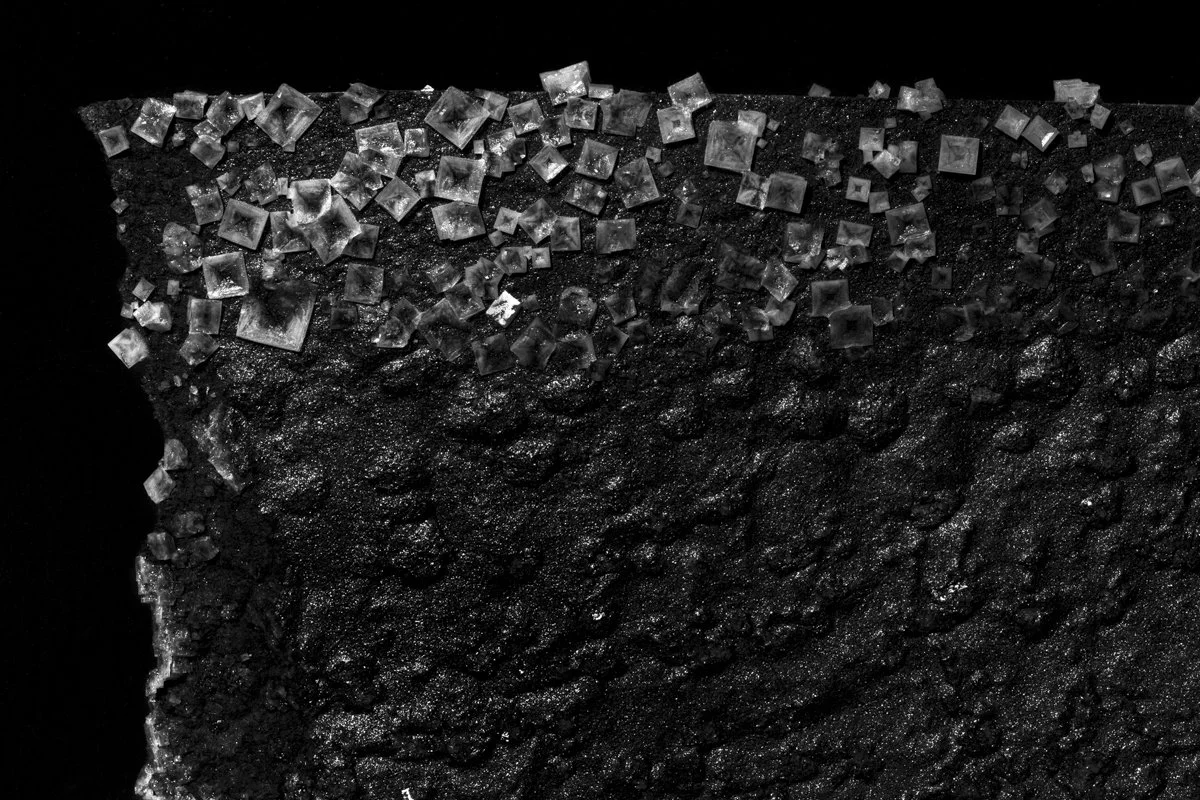
Christine Lorenz, KS-8976 from Kanawha Salines, 2025
ML: Your work emerges from western Pennsylvania and West Virginia, regions that are frequently represented through narratives of extraction or decline. Kanawha Salines offers a much slower and more layered account of place. What responsibilities do you feel as an artist working within Appalachia and how do you hope your work complicates narratives about the region?
CL: I grew up in a part of Ohio where the terrain is flat and the horizon is distant, and where the North star is ongoing economic growth. The sense of the place there always felt focused on the present, and on what is being built on that flat expanse. Then I moved to Pittsburgh, where part of the sense of identity is an ongoing relationship with the history of the place. When people give directions, the reference points are things that used to be there; every neighborhood has a particular history that people take pride in knowing about. And so much of the history of this place is rooted in the terrain, in the mountains and the rivers that are used to navigate them, on what was mined from those mountains, on the empires that were built on that material and that labor. The presentness of the past is a part of daily life here, and as in Appalachia more broadly, it’s anchored in the sense of the ground and what’s beneath it.
Industrial extraction is the economic basis of how this region grew and urbanized, and it’s shaped how people live in ways that are brutally unequal. The exploitation of the people here, and the ruination of the land, are very difficult to talk about. We can’t let what has been destroyed be forgotten. As a reader of history, I can draw people towards the work that historians have done. And I can try to bring home on a sensory, experiential level a little bit of how I experience this place, and the mystery that flows through its solid ground.
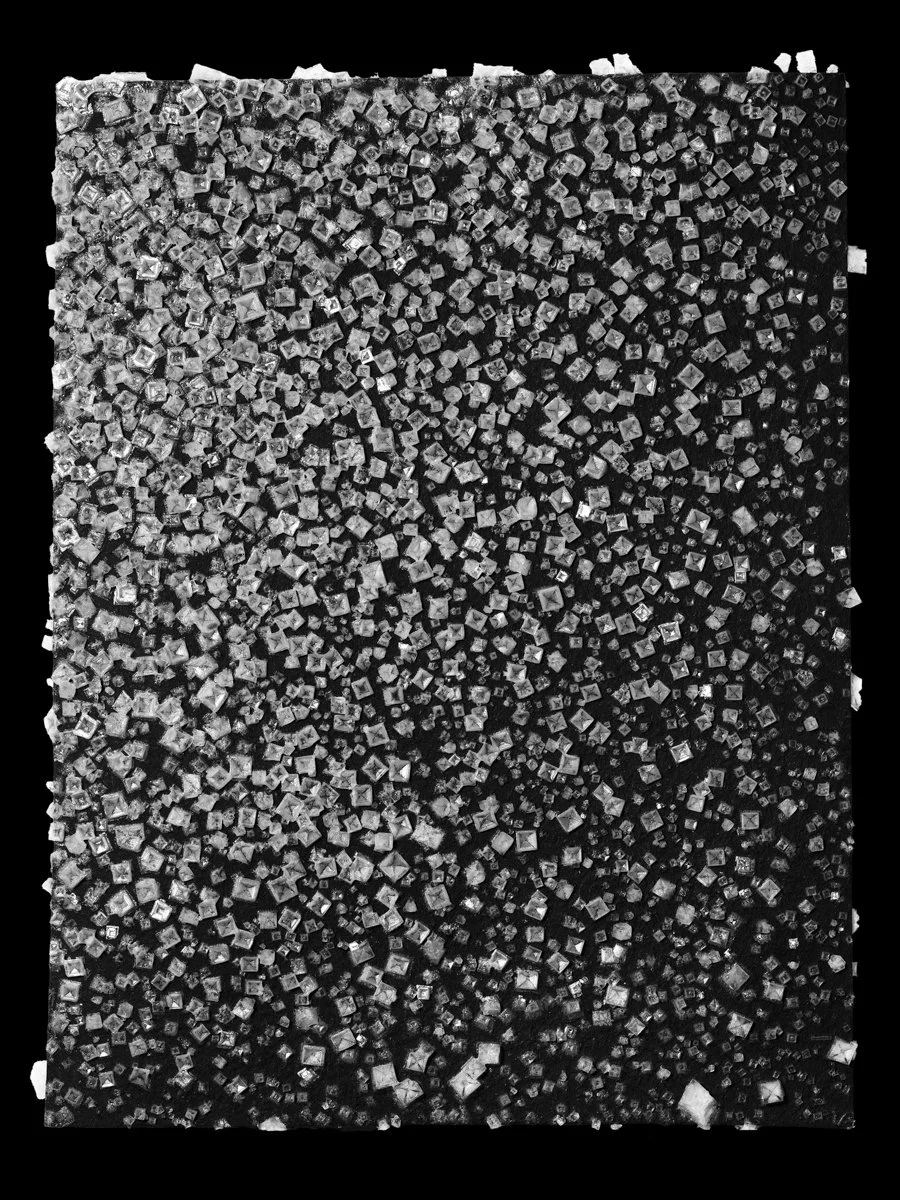
Christine Lorenz, KSM-15 (So Many Bright Lights that Cast a Shadow), from Kanawha Salines, 2026
ML: The Halophilic series places salt and plastics into the same visual field, revealing surprising formal and historical relationships. What first convinced you that these two materials belonged together artistically? Have their relationship, and your thinking about them, changed as the series has evolved over several iterations?
CL: I had been photographing the two materials separately for a few years before I brought them together. For a while, anytime I talked about one body of work, the other would eventually enter the conversation. They are both products of extraction that have intertwined geological origins. Salt tends to suggest organic things, with welcoming connections to the earth and the oceans, while plastics are the ultimate synthetic material that indicate both the conveniences of modern life and catastrophic implications for the future. But in front of the camera, their different material characteristics take over, and both are shape shifters that open up surprising spatial experiences. And the ways that they work together in the same visual field suggest a little bit of a different angle on dividing the organic and the synthetic. They are both extensions of human action; they are both a part of what we are in the world.
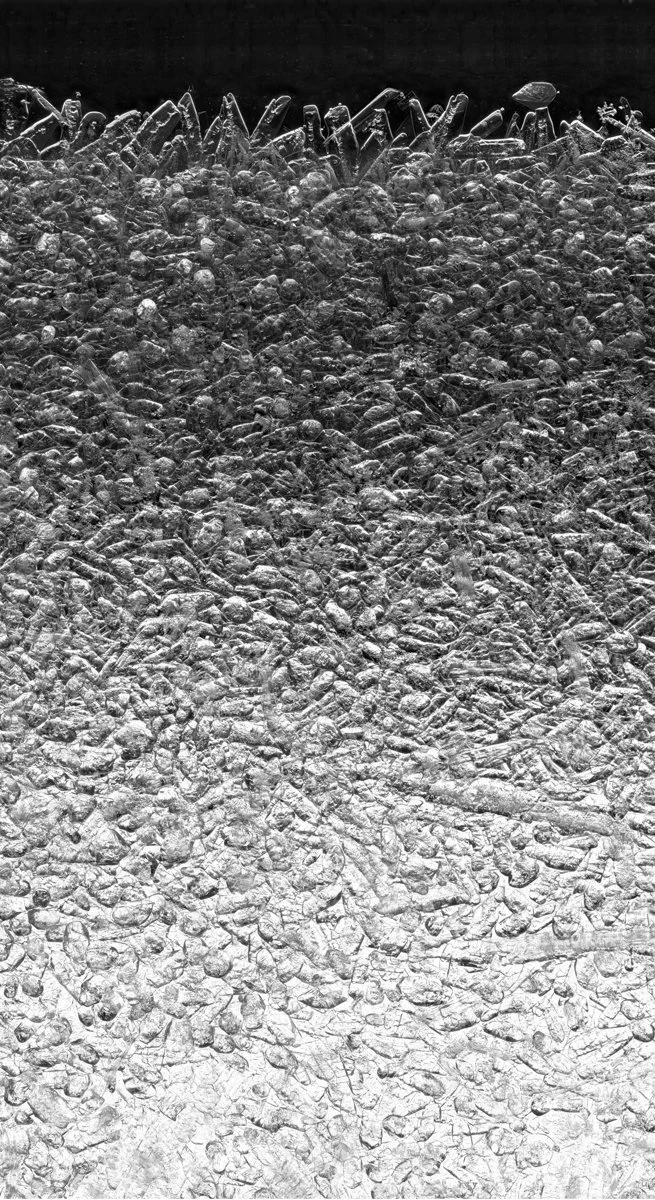
Christine Lorenz, KS-6269 (Nigari), from Kanawha Salines, 2025
ML: You frequently remind viewers that photography itself emerged from the same nineteenth-century industrial world that accelerated extraction and eventually made plastics possible. Has this realization changed how you think about photography as a medium? Can photography critique industrial modernity while remaining one of its products?
CL: Certainly, photography as a medium originated and grew as an extension of the industrially extractive processes we’ve come to know today. I try to use this medium to turn attention towards different aspects of our entanglements with the world, making little distinction between organic and synthetic. The salt that activated silver in the first positive-negative prints is not itself visible in those photographs, as the plastics that form the substance of modern prints and negatives try to disappear into the image. They are visible when something goes wrong, when something undermines their function as pictures. Doing things wrong can bring the invisible to light. I’m not sure that my photographs function as critique so much as they nudge us into different angles of view.
ML: Your projects move fluidly between moments measured in seconds, such as the instant a photograph is made, and processes unfolding over millions of years from ancient salt deposits to the persistence of microplastics into the future. How do you think about photography as a medium capable of holding these radically different temporal scales together?
CL: A photograph holds still. Through a photograph we can try to hold onto a time frame that we may not have otherwise experienced. When it comes to the perception of time and its pace, when we stick with what comes naturally, it’s at our own peril. We move between different perceptions of time’s passing all the time; we might be singing “Sunrise, Sunset” one minute, and the next have to floor it through freeway traffic to catch a flight—but it’s a different thing entirely to try to imagine an experience of time like an iceberg, or like a neuron. Our culture is driven by forceful incentives to think in terms of short term profits, one cycle after another in pursuit of endless growth, and the consequences of that sense of time are all around us.
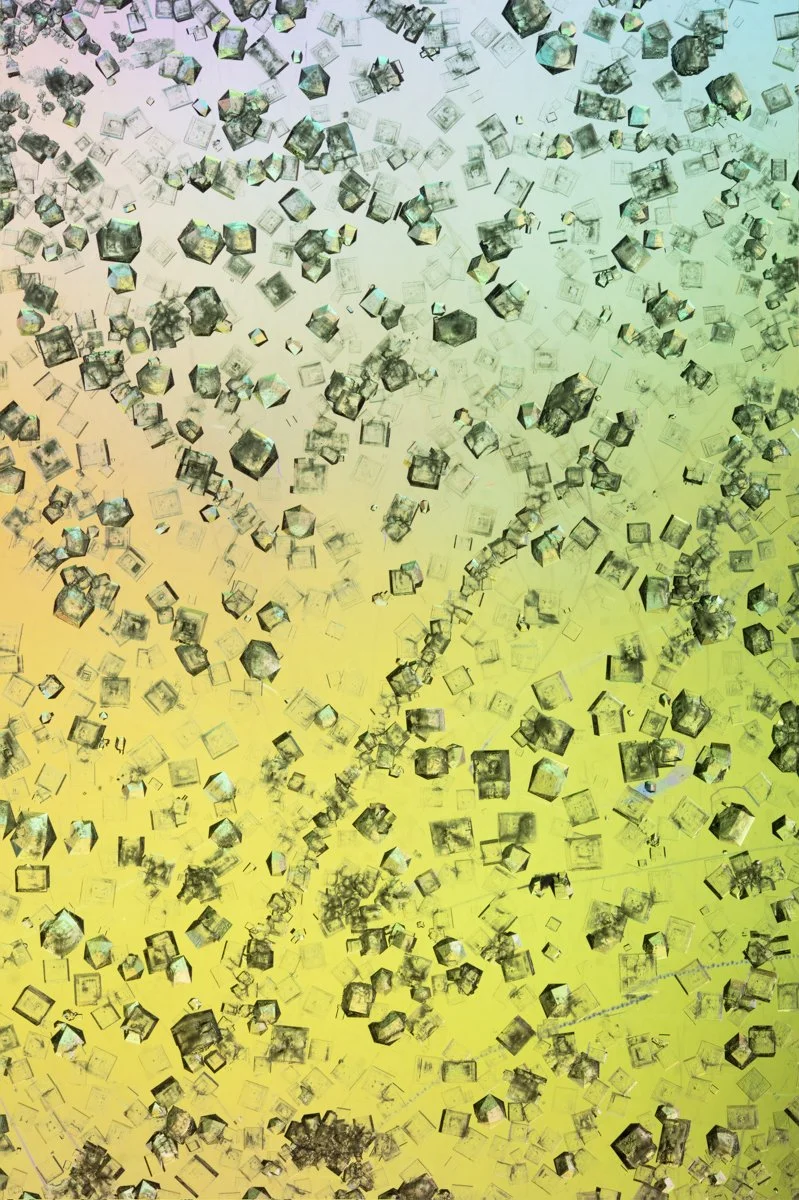
Christine Lorenz, Halophilic 2-2511 (On a Molecular Level), 2022
ML: You describe cultivating crystals in terms that resemble gardening more than laboratory experimentation. What has this slower, attentive process taught you about patience, observation, and the rhythms of making? How does working with materials that refuse complete control influence your broader creative philosophy?
CL: More than anything, I feel lucky to have the time to be able to pay attention to these cycles of the natural world. Humans are meant to have the time to garden, to make art, to be completely in the moment with children and animals, to spend time among trees without having to watch the clock. Do you remember a moment very early in the pandemic, when there wasn’t an official narrative yet, and people all over suddenly discovered they enjoyed baking bread and making musical collaborations with strangers and building dioramas? Not everyone had the luxury of time then, but for a lot of people there was a sudden discovery that things didn’t have to be the way they had always known them. The demands of day to day life in this economy work against a level of basic connection with things that sustain us in life. One of the reasons that art is so wonderful is that it can give time: an encounter can make us suddenly shift gears inside, and have a different sense of identification with the matter of the world. Sometimes we get a chance to create openings for those kinds of experiences.
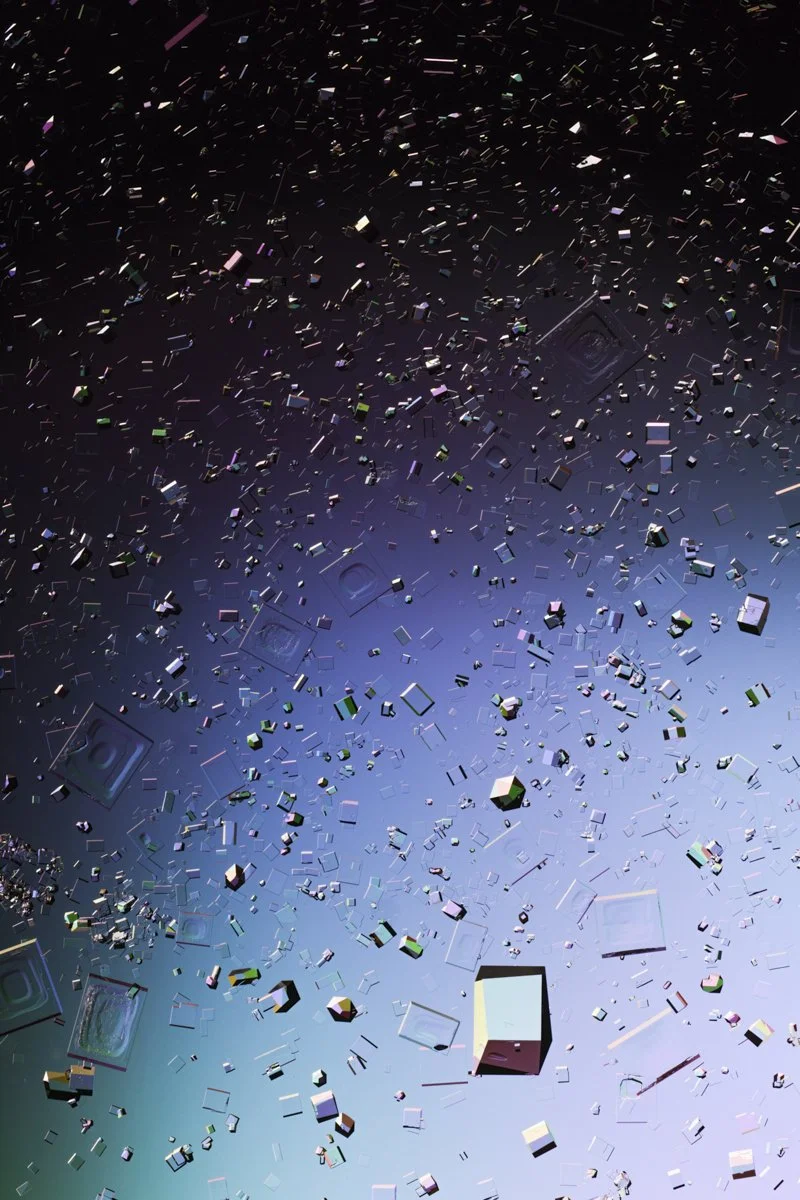
Christine Lorenz, Halophilic 2Lab-0579 (On a Molecular Level), 2026
ML: You have written that your work with salt crystals began while helping one of your children with a science experiment, and your involvement with Flock Artist Collective reflects your commitment to integrating parenting and artistic practice. How has parenthood shaped the questions you ask as an artist? Are there forms of curiosity or attentiveness that emerged specifically through raising children?
CL: The day to day work of parenting can cultivate the kinds of openness to the world that dovetail with our work as artists. Observing crystallization and accretion has become, for me, a sustained reflection on the passage of time. In a certain moment, I was captivated by a glimpse of harmony between vast scales and microscopic ones, reflected in the most common of everyday things. That moment grew from helping a ten year old cultivate salt crystals in our kitchen, and it’s a long way behind us now; as that child has grown to a young adult, I have continued to pursue what this material has to show me about cycles of transformation. It’s not just an abstraction. As a parent, that lifelong commitment to other lives is a part of me every day, and as time goes on, it intensifies a sense of connection to the environment. The material reality of care, and all that it entails, is vital to contemporary art. I continue to work with a multi-generational artist/mother collective, where we share resources and amplify each others’ work. It would have made a world of difference to me to have found that kind of support network years ago, when I was in the thick of balancing those roles of artist and parent. These artists’ work needs to be an active part of the conversation, and I do what I can to bring it forward.
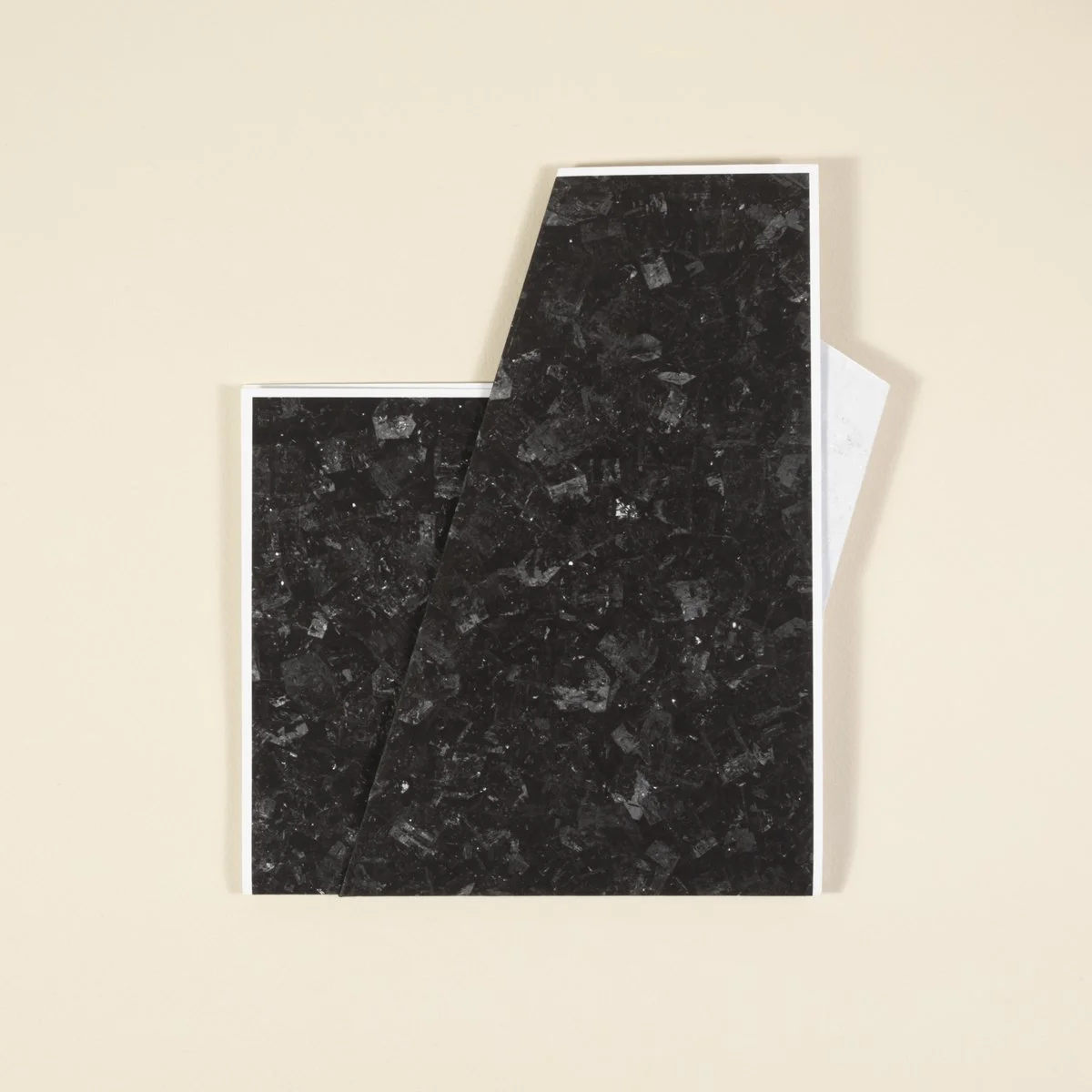
Christine Lorenz, Fold 4493/9686, Two-sided folded archival inkjet print on mat board, 24”x24” framed, 2021
ML: In Folded, the physical act of folding photographic prints transforms the image into an object and stages a conversation between different crystal formations. What possibilities did folding open that traditional photographic presentation could not? How does physically manipulating the print change your understanding of what a photograph is?
CL: The act of folding these prints grew from a sort of reflection on the role of the frame. The crystals are constantly in a process of transition through different forms, and I see each photograph of them as a trace of a temporary state. The act of framing puts a boundary around a view that anchors them in space, creating a visual structure that could have been otherwise. Bringing two of them together, by printing two different views on opposite sides of the paper, suggests some of that flux in space and time. The particular folds tend to start with a relationship between the dimensions of a square and those of the sheet of paper. In the process, the right angles and not-quite-right angles of the crystals on each side of the print build new compositions with one another, and with the shapes the folded prints construct.
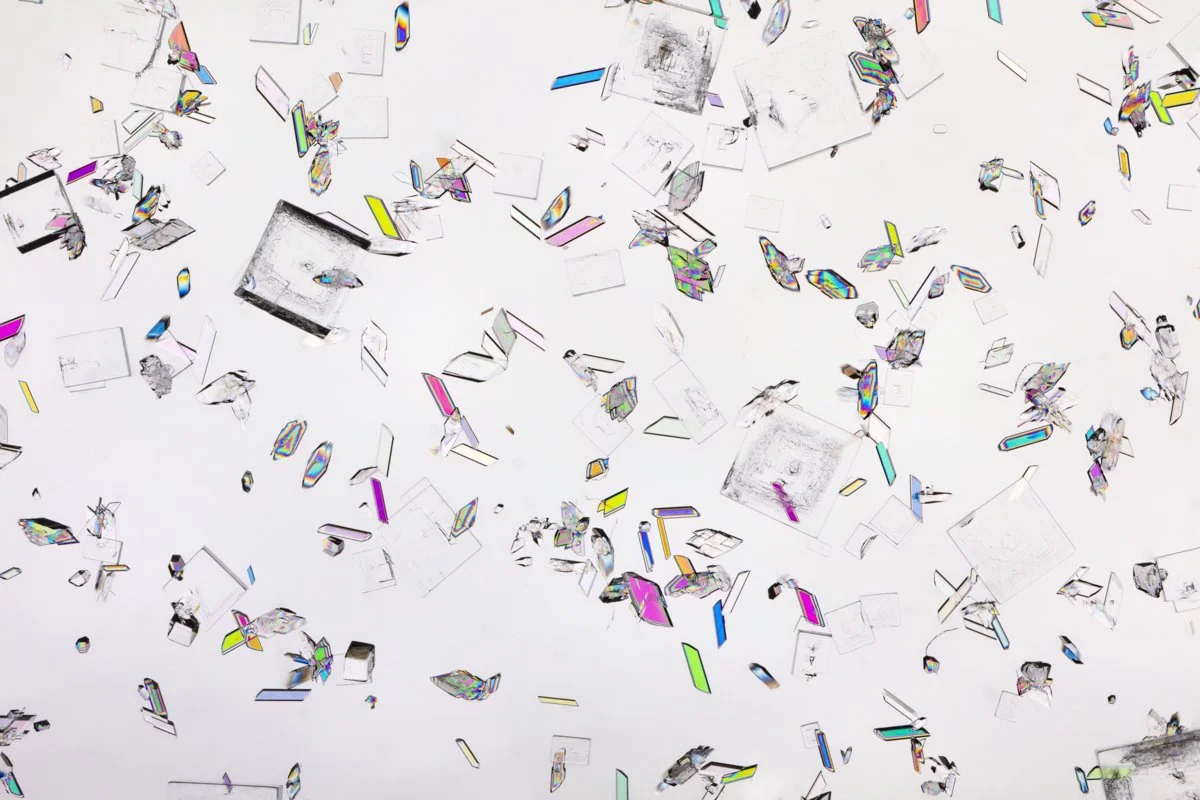
Christine Lorenz, Halophilic 2CH-0497 (On a Molecular Level), 2024
ML: Many of your projects engage phenomena that are difficult or impossible to perceive directly including microscopic structures, polarized light, geological time, chemical processes, and environmental contamination. What do you think artists can contribute to public understanding of invisible systems that scientists, historians, or journalists cannot?
CL: Berenice Abbott spent years devoting her tremendous skills to photographing principles of physics. She described her goal in this as “endowing this material, so strange and unfamiliar to the public, with the poetry of its own vast implications.”(2) I think we all find our love of the natural world to grow more and more as we encounter aspects of it that we had not seen before. There is a lot that’s harrowing about the technological advances that surround us now, but they have brought us the ability to extend our perception of this world. We can redirect those tools and turn them against the grain of productivity and consumption.
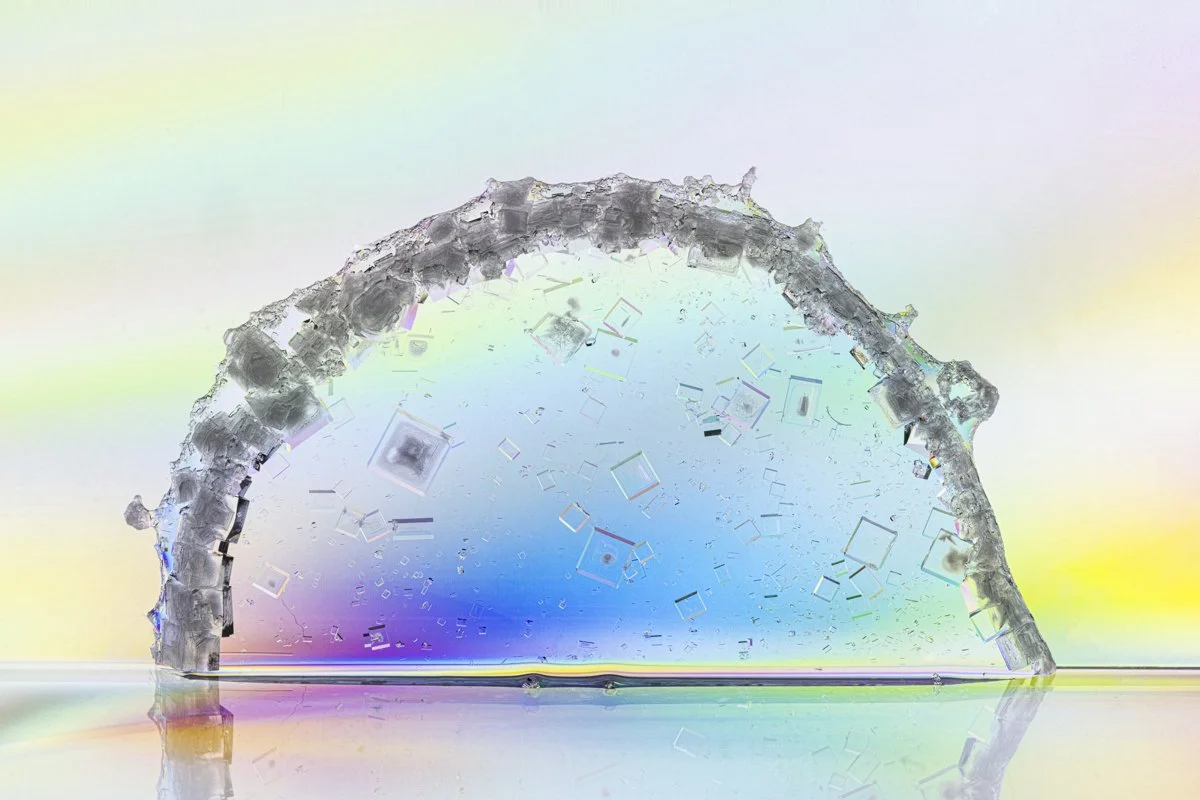
Christine Lorenz, Halophilic 3Lab-0159 (Also, There Was No More Sea), 2026
ML: The research behind Kanawha Salines spans industrial history, environmental history, geology, economics, photography, and local memory. Would you discuss your creative process and how the research informs your work? How do you decide which histories remain in the archive of your thinking and which enter the finished work?
CL: The Kanawha Salines is a work in progress, and it’s true that the connections in this material keep on going. My process of learning about these connections has ranged from a little bit of methodical research to a lot of running across references and learning from things people tell me. Every channel that you follow leads to others. When it comes to putting things in front of an audience, I don’t want to suggest that any story I have to offer is a complete thing. Once when someone asked her how she knows when something she’s doing is complete, Laurie Anderson answered with her usual wit, “A song is finished when I run out of time.” This fits for me in two ways: from one side, her medium has a structure that unfolds in time, and when she has performed through it from beginning to end, the song is finished. In my case, a structure may be externally imposed by the limitations of an exhibition, a publication, or a commission, and the planning will involve a negotiation with that structure. And from the other side, the reality is that you work and work, and eventually you run out of time, so there it is, you’re done. (For that instance, at least.)
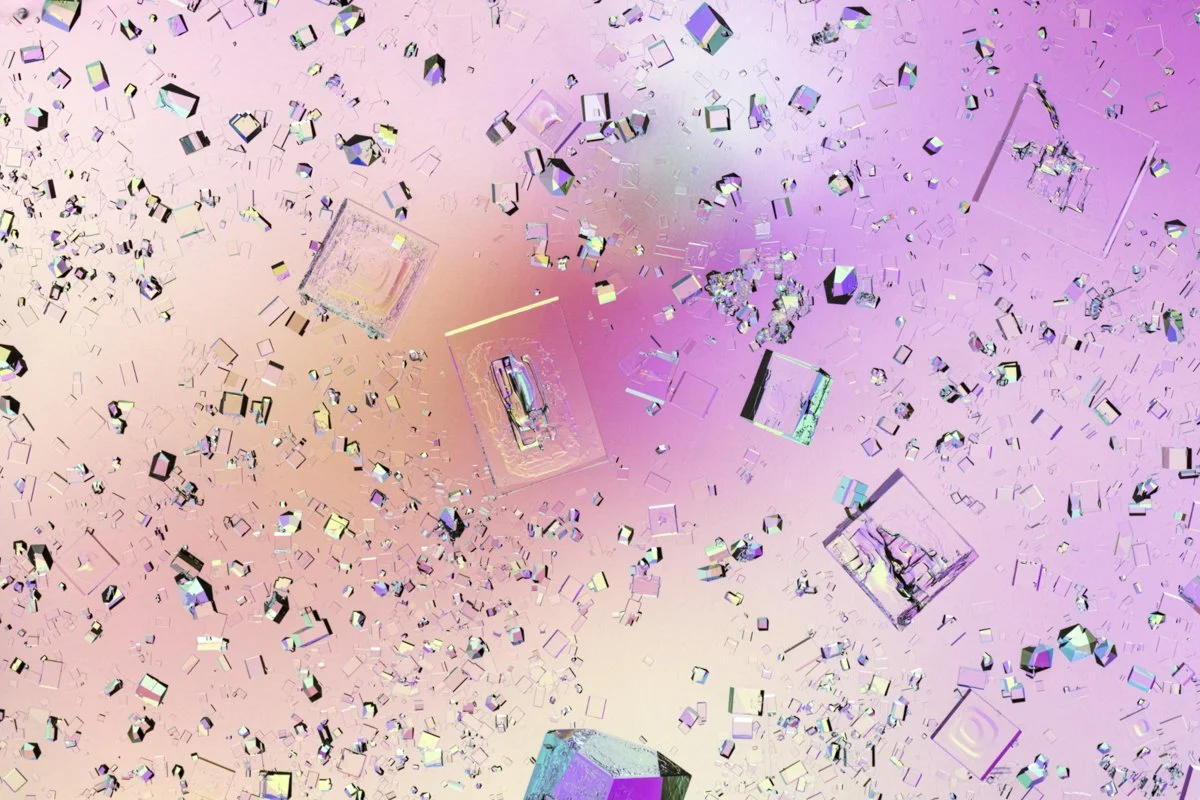
Christine Lorenz, Halophilic 2Lab-0600 (On a Molecular Level), 2026
ML: You have exhibited this series both within the Kanawha Valley itself and in broader contemporary art contexts. Did presenting the work in the place where the salt originated change your understanding of the project? Were there conversations with local communities that reshaped your thinking about the photographs?
CL: It was a real joy to be able to show some of the photographs from this series in Malden, West Virginia, where the salt is cultivated. The people at J. Q. Dickinson are quite committed to keeping the history of the place alive through their work, and they enjoyed seeing this perspective on it. To speak from my perspective as an Appalachian is one thing; it is really another to take a position of speaking for a place in West Virginia. That’s not my role. I can shine a light on that history, and I can amplify the voices of the people whose lives and families are rooted in this place, through the connections I have with the physical material.
ML: Your writing engages thinkers such as Donna Haraway and Timothy Morton to grapple with systems that exceed human perception, from geological processes to global plastic pollution. How do you balance these vast theoretical frameworks with the intimate experience of looking closely at a single crystal? Is close attention itself a form of environmental ethics?
CL: On a basic human level, the things that we know structure the way we see things in the world, in an ongoing process. This something I enjoy about teaching the history of photography; I’m able to watch students come to see more in photographs than they had seen before, even when they are looking at exactly the same pictures. So much of what we do as artists is the creation of a context. That’s not necessarily about writing statements or labels or titles, but putting things we do in the company of things others have done, so that our ideas grow together. When we get to make art in an ongoing conversation with others who care about the same kinds of things, we are building networks of ideas together that allow us to see more in the things of the world than we had before. And we can do it in a way that is fun and playful; it doesn’t feel like being taught lessons, it feels like following your curiosity, and finding other people who find it interesting too.
Timothy Morton argues that when we take a real interest in the fundamental strangeness of things, it takes us outside of ourselves, and thereby opens us up to the true power of being a part of this world.(3) He uses the term more-than-human, instead of natural, because this experience of contact and connection isn’t limited to beings that are alive in a biological sense. I went to see an exhibition of Martin Puryear’s work recently and I was honestly brought to tears by specific objects, by certain textures, curves, scale relationships, materials, the unique and uniquely loved particular things that now were here in this world. I can be this moved by the particular shine of one facet of a salt crystal that is fused in a specific way to black paper, which grew that way because it carried certain minerals up with it from underneath rock hundreds of feet deep, and is now forming a solid shape in daylight for the first time in millions of years. And I may know those things about it now, but it’s not because I know them that they matter, and it’s not because of a quality that I can explain or grasp. I have to be open to that ambiguity. It is part of how all of us human beings are entwined with the nonhuman world, on a molecular level.
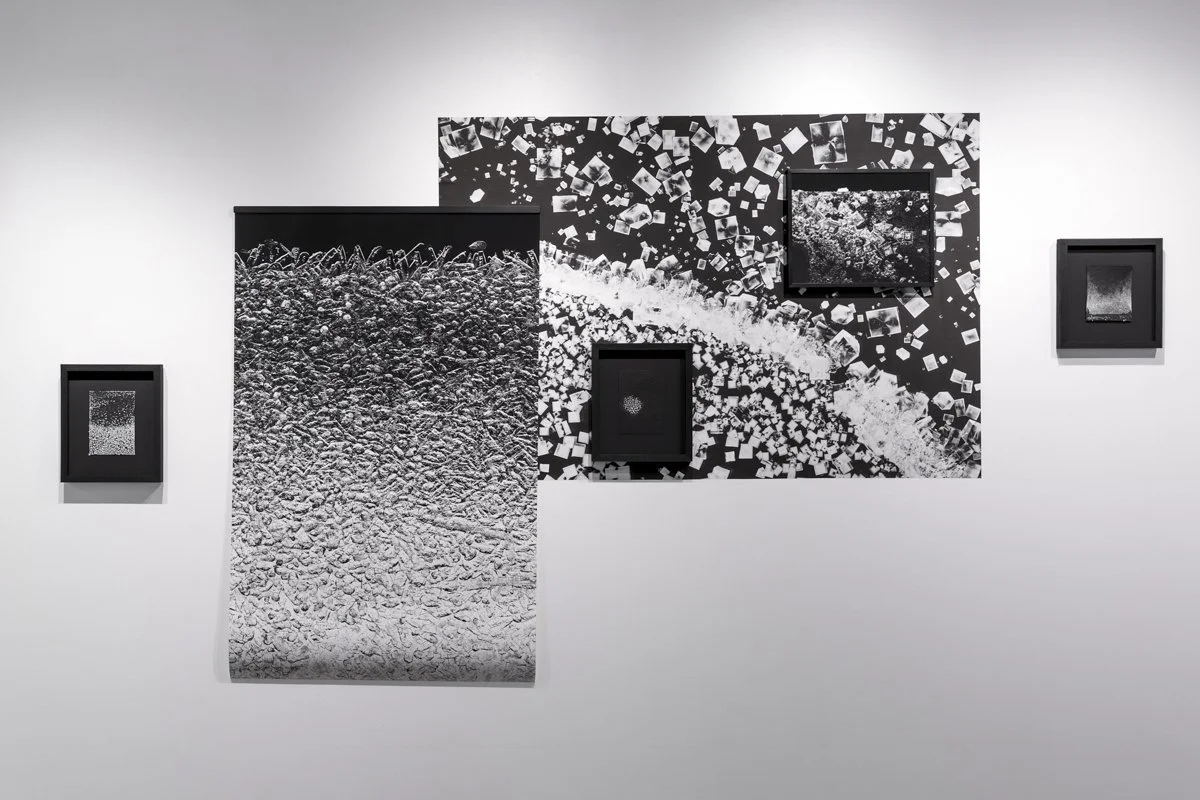
Christine Lorenz, Installation view of Kanawha Salines as seen in Radial Survey V4, Silver Eye Center for Photography, 2025. Photograph by Sean Carroll
ML: Looking across Salt, Folded, the various Halophilic series, and now Kanawha Salines, there is a remarkable continuity of inquiry, even as each project expands the questions of the previous one. When you look back over this trajectory, what themes do you now recognize that you could not see while making the work? Are you surprised by where salt has led you?
CL: I was in love with language poetry before I started making photographs. All along, the sense that all of this has made to me has to do with the ways language works, and what may or may not be outside of it. In terms of writing about it, the kind of language that it takes to articulate those things does not come very naturally to me. I never really know whether what I am doing embodies for other people the kinds of things that keep me coming back.
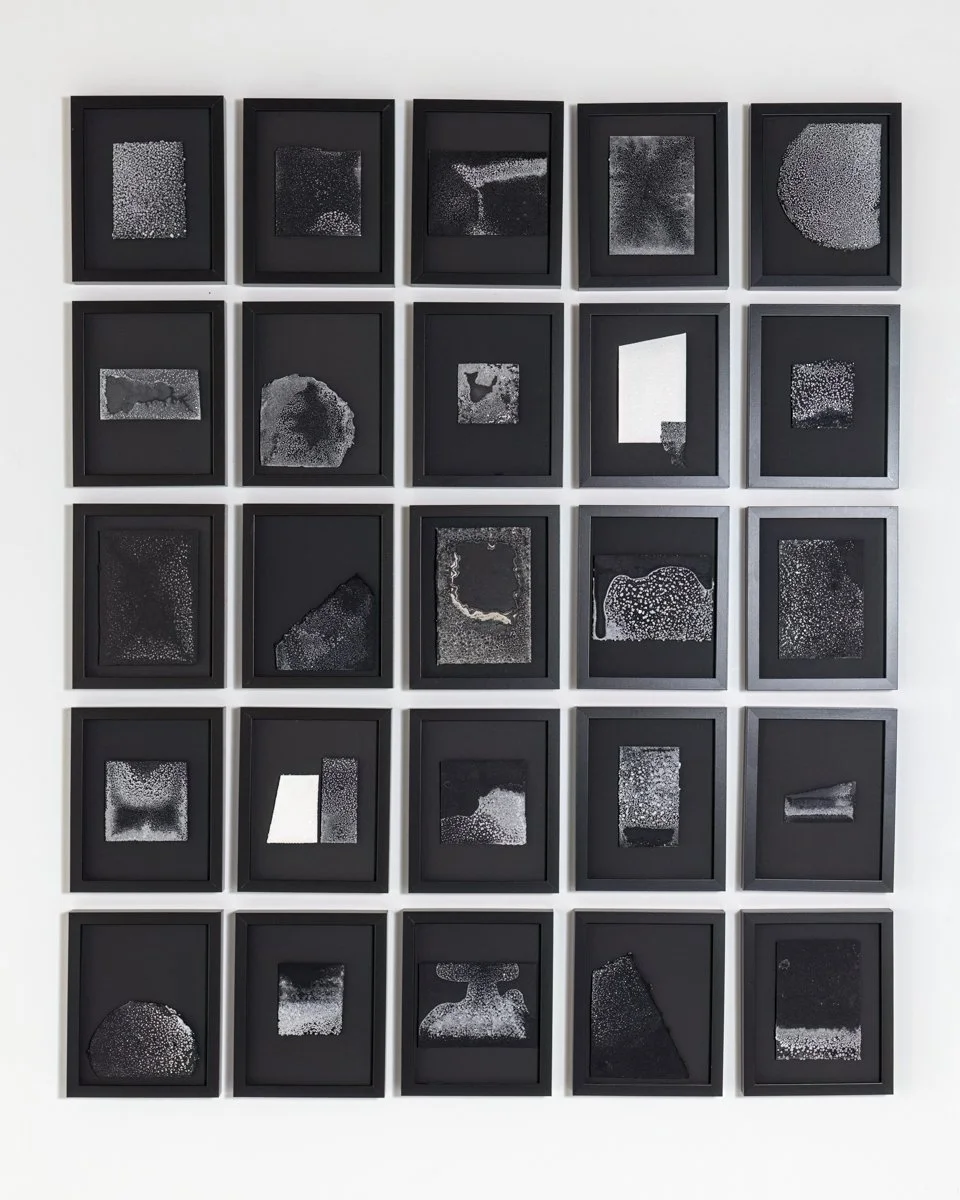
Christine Lorenz, Installation view of Kanawha Salines: Alchemy After All, Mark Rengers Gallery, 2026
ML: Kanawha Salines exists not only as photographs but also as a growing archive of historical research, writing, contextual images, unique salt-on-paper works, and an envisioned photobook. Thinking as both an artist and a historian of photography, what do you hope future viewers perhaps fifty or one hundred years from now will understand through this archive? What kinds of questions do you hope your work will still be asking long after the photographs were made?
CL: This is a difficult question to answer. I have only ever seen the art that I make as ephemeral. In this moment, it’s hard to imagine how many more human generations will go on, or what our libraries, museums, and universities will look like in even another fifty years. In our moment of climate catastrophe, a contemplation of geological time scale can feel strangely reassuring. Cycles that far exceed human generations will continue at their own pace.
Hillman, James. “Salt: A Chapter in Alchemical Psychology.” In Salt and the Alchemical Soul: Three Essays, edited by Stanton Marlan, 145–179. Woodstock, CT: Spring Publications, 1995.
Abbott, Berenice. “Photography and Science.” April 24, 1939.
Morton, Timothy. All Art Is Ecological. London: Penguin Books, 2021, 58–60.