
Julianna Foster
Julianna Foster (she/her) is a Philadelphia-based artist whose photographic practice explores landscape, transformation, and the shifting boundaries between the observed and the constructed. Her ongoing project, Geographical Lore, examines geological sites across the United States, from desert formations and mountainous terrain to changing coastlines, and considers how natural forces and human intervention shape landscapes. Foster combines photographs of actual sites/locations with constructed scenes created through cutting, layering, folding, and rephotographing. These physical interventions echo processes of erosion, fragmentation, and instability, creating works that teeter between documentation and invention.
Foster’s work has been exhibited nationally and internationally at venues including the Houston Center for Photography, Modern Art Oxford, Maguire Art Museum, Filter Photo, Medium Photo Festival, Fleisher Art Memorial, and Vox Populi Gallery. Recent exhibitions include Currents at Fairmount Waterworks and an installation of Geographical Lore at the 20/20 Photo Festival. Her work has received a LensCulture Critics’ Choice Award, a Juror’s Choice Award from Filter Photo, and recognition from the San Francisco Bay International Photography Awards and Tilt Institute for the Contemporary Image (formerly Philadelphia Photo Arts Center). Her photographs have been featured in Lenscratch, Create Magazine, Conveyor Magazine, Frame/Sequence and The Real Photo Show, and included in the book Constructed: The Contemporary History of the Constructed Image in Photography since 1990, published by Routledge Press.
In addition to her studio practice, Foster has maintained a longstanding commitment to photographic education. She served as Associate Professor in the School of Art, Photography Program at The University of the Arts in Philadelphia, where she received the President’s Distinguished Teaching Award. She has taught at Dartmouth College as a Visiting Associate Professor of Studio Art in Photography and at Moore College of Art and Design. Foster earned an MFA in Book Arts/Printmaking from The University of the Arts and a BFA in Design from the University of North Carolina at Greensboro.
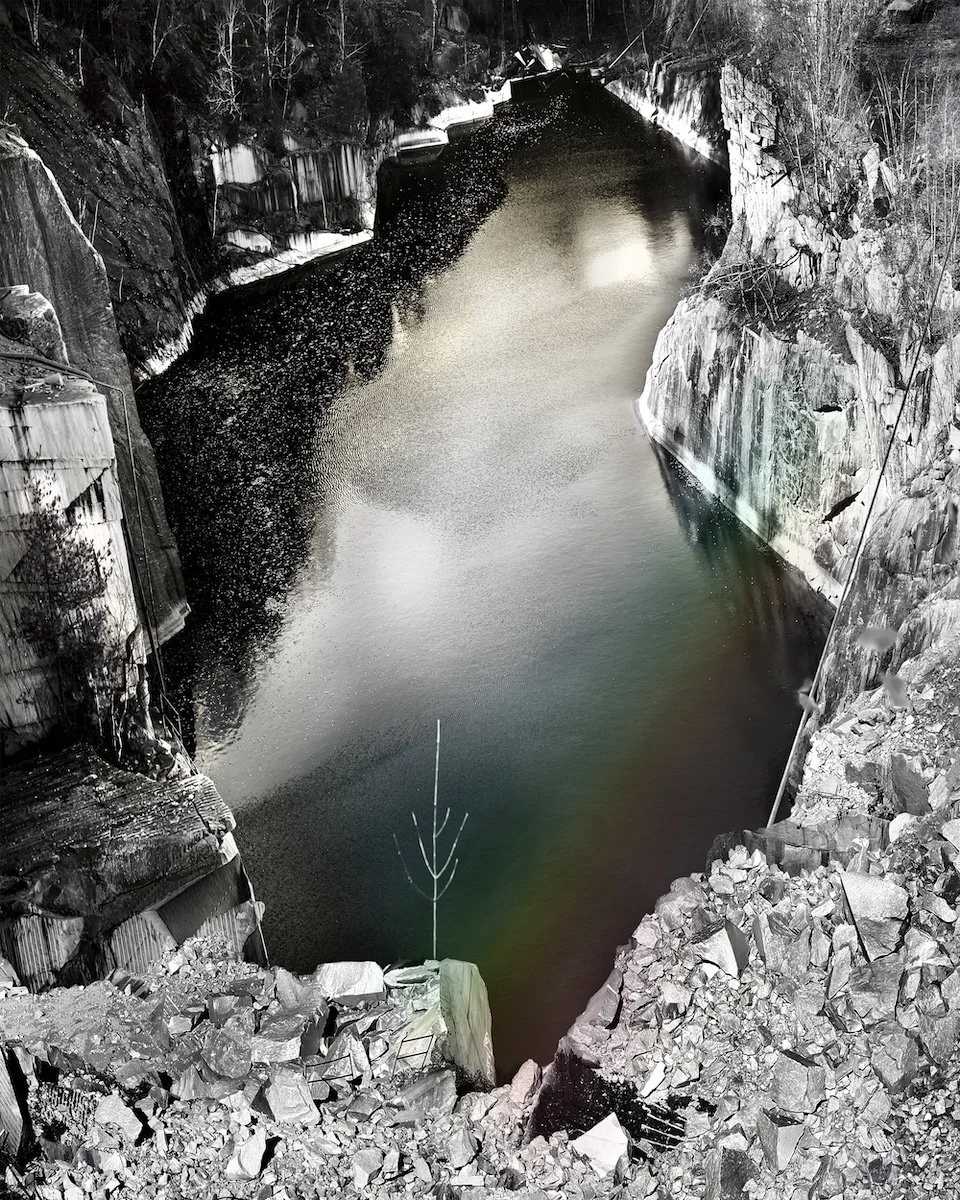
Julianna Foster, Repository from the series Geographical Lore, digital inkjet print on aluminum, 42” x 36”, 2026
In this conversation with artist Julianna Foster, we explore how the idea of “lore” - with its associations of folklore, myth, memory, and storytelling - shapes her approach to landscape and image-making. Foster discusses her process of transforming photographs of the natural world into new, fabricated terrains through collaging, cutting, layering, and rebuilding images in the studio before rephotographing them as invented landscapes. Her work asks us to consider how images can become more than records of place, opening imaginative and emotional pathways into questions of environmental transformation.
Margaret LeJeune: Can you take us back to the beginning of your journey as an imagemaker? What first drew you to photography and what experiences/influences shaped the way you came to see it as a way of understanding and engaging with the world?
Julianna Foster: I was first drawn to photography because I liked that making an image was a process. Working with film, negatives, and the darkroom made me aware of how much could happen between the latent image and final image. That got me thinking about photography’s relationship to what’s real. I studied photography of the 1960s and ’70s, when postmodernism began questioning truth, authorship, and representation. Photography functioned differently at this time and was constructed, performative, sequenced, and at times, reworked. This expanded how I understood the medium. It opened up the possibility that a photograph didn’t have to be completely descriptive; it could complicate what we think we know.
That’s still what interests me most, starting with something familiar and using the photographic process to make it less certain. I move between analog and digital processes. I work with my hands by printing, collaging, assembling, and making material interventions to take the photograph apart and re-form it. Whether it becomes a new image, an object, or a book through sequence and text, each form offers a different way of considering what a photograph means and changes through its transformation.
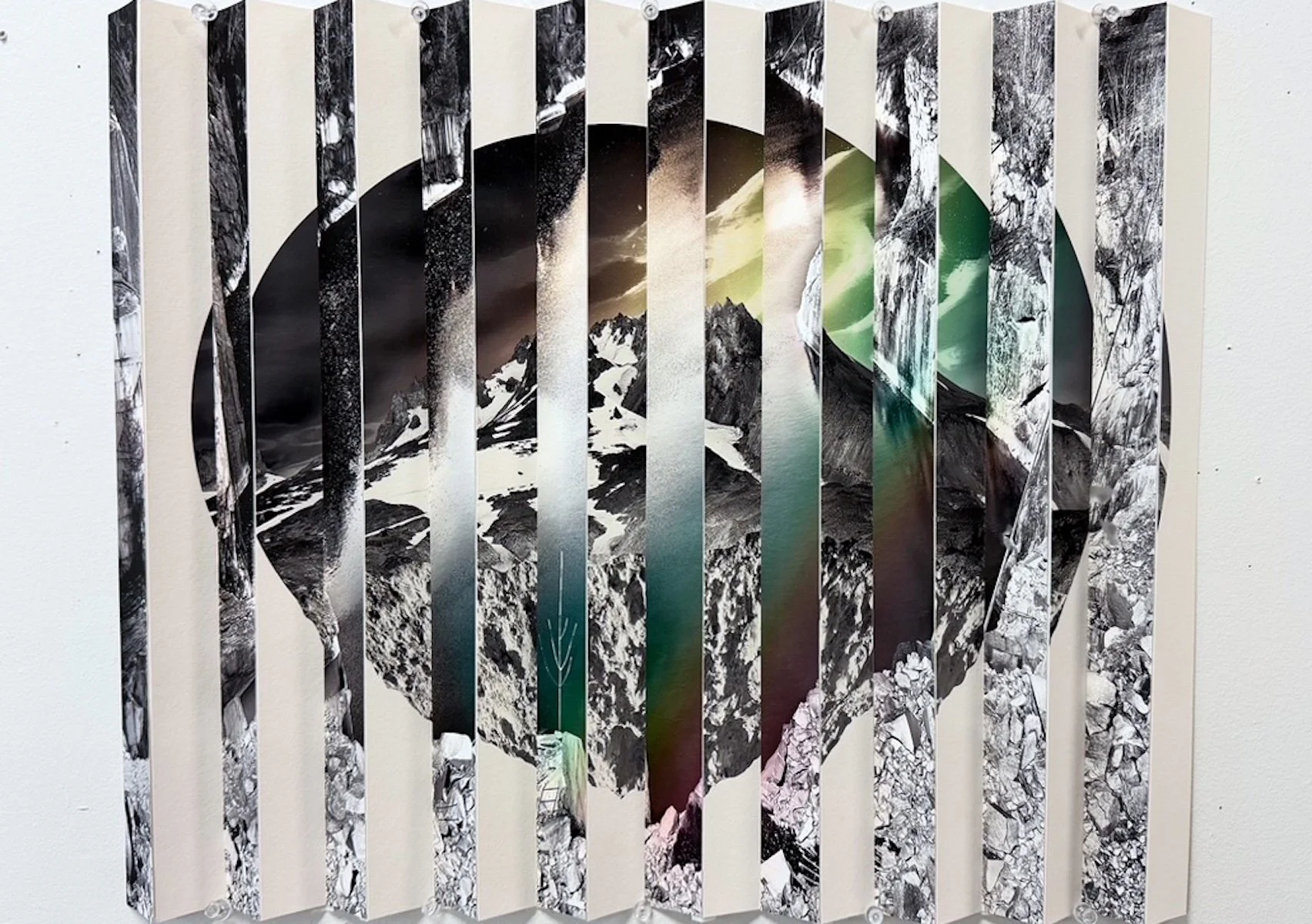
Julianna Foster, Lenticular, Aurora Borealis from the series Geographical Lore, photographic print on watercolor paper, cut/folded 30”x 20”, 2026
ML: You describe photography as something that can be “repositioned” as material rather than understood solely as an image. What happens to the photograph, conceptually and materially, when it moves from being a surface that records the world to an object that can be cut, layered, folded, reconstructed, staged, and photographed again?
JF: The process of working with a variety of materials allows me to disrupt the photograph’s sense of stability because nuances become more apparent, perspectives don’t quite line up, and the image begins to move away from a believable view of the world. The material itself, like the paper, edges, shadows, folds, and seams, comes to the surface, and these elements carry meaning. Those interventions or imperfections are important because they reveal fragmentation and change, which are also in the landscapes I’m photographing.
Rephotographing the constructed image reframes it again. The camera takes something tangible and turns it back into a flat image and then I turn it into an object with dimensional qualities. I like that back-and-forth between image and object because you’re never completely sure where the original landscape ends and the fabricated one begins. Although there are some clues the more you look.
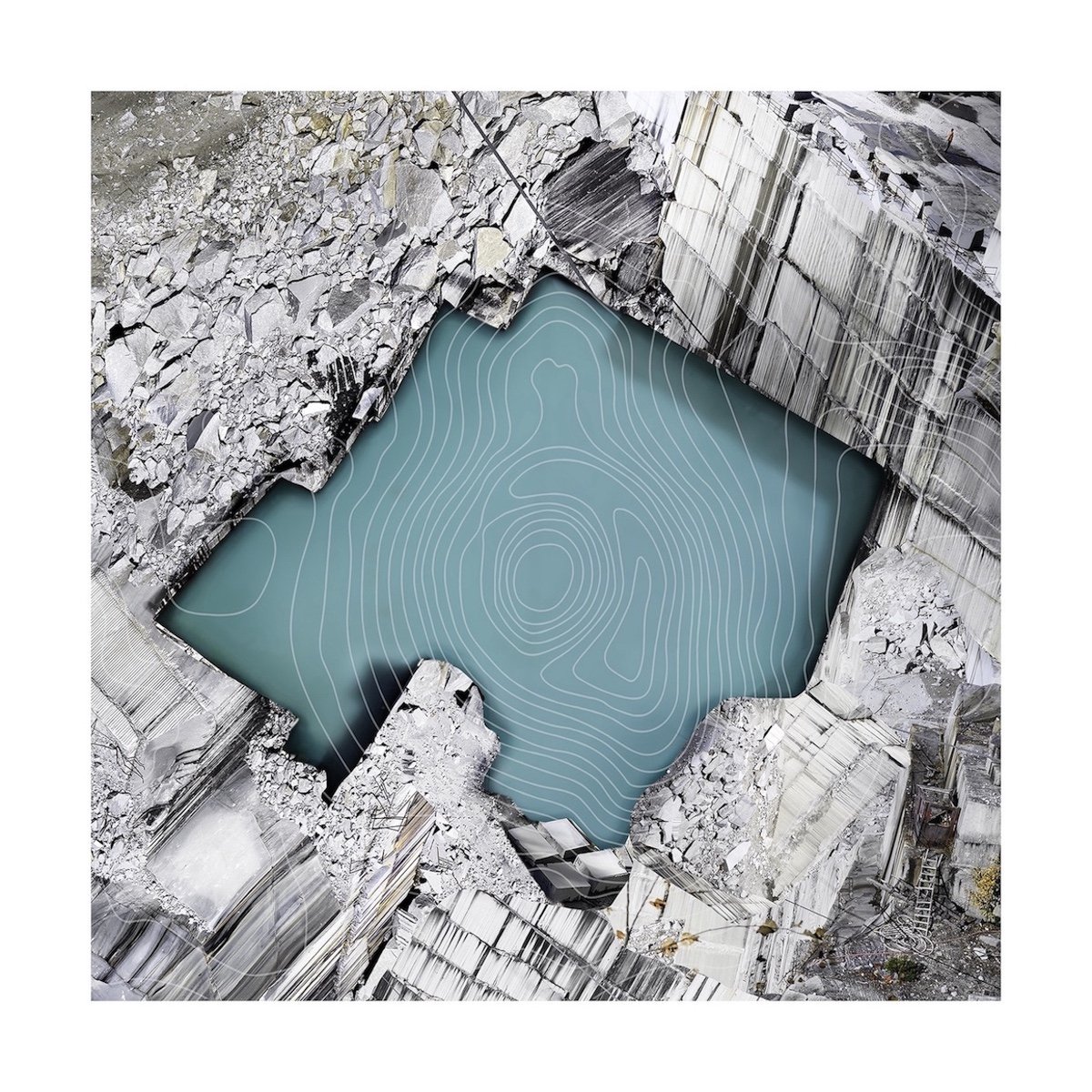
Julianna Foster, Pit Lake from the series Geographical Lore, digital inkjet print, etched acrylic, 20” x 20”, 2025
ML: In Geographical Lore, you translate observations from expansive landscapes of the American West into intimate, handmade studio environments. What is gained, and what is necessarily lost, when an immense landscape is compressed into a constructed space?
JF: Photographing these vast landscapes immediately compresses the experience with the scale, weather, changing light, and the physical sense of being there. That compression becomes part of the process. When I use the photographs from various locations back in the studio, I work with methods that alter them, and the expansive landscape becomes something much smaller and more controlled, manageable.
For example, a photograph of a rock formation or desert landscape that is physically cut and layered reveals parts of the image that exaggerate its fractures or shifts in terrain. Or I’ll fold and combine images so the landscape starts to feel less stable. Those gestures connect back to what I’m seeing in the places themselves, like erosion, drought, and other natural and human changes.
In the studio, I gain the freedom to move beyond documenting a place. The landscape is a starting point, a source to respond to, that I can take apart and rebuild. The final image, or in some cases the object, exists somewhere between the place I experienced and a landscape I’ve imagined from it.
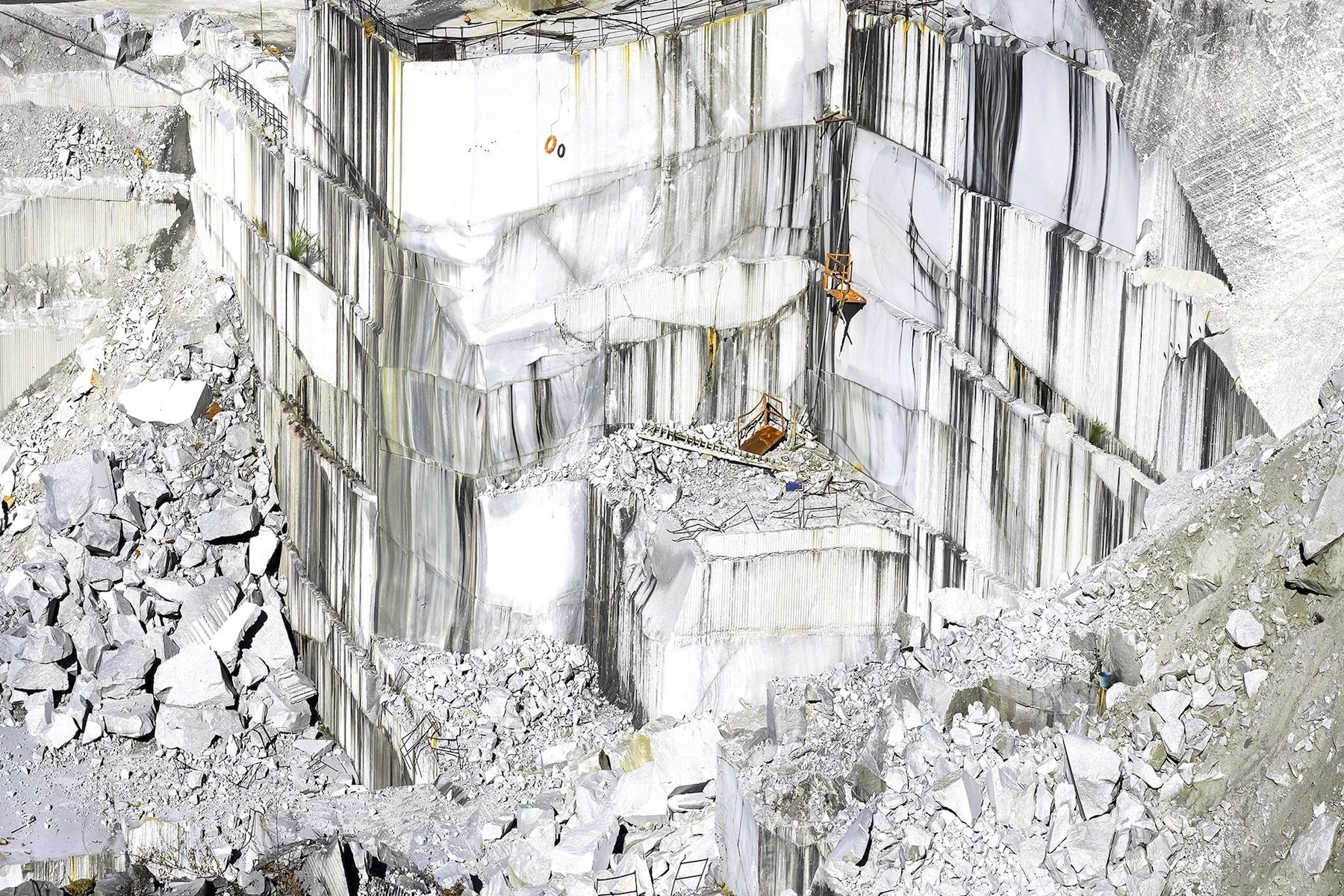
Julianna Foster, Granite Quarry from the series Geographical Lore, digital inkjet print, 36” x 24”, 2025
ML: The word “lore” in your project title Geographic Lore suggests inherited knowledge, folklore, speculation, and stories that accumulate around places. What kinds of knowledge are you interested in when you use the word Lore?
JF: When I use the word “lore,” I’m thinking about how we come to know a landscape through experience. In the American West, ideas of wilderness and the sublime have shaped how these places are imagined, but these landscapes also hold Indigenous histories that long predate photography.
Photography adds another layer through images of preservation, tourism, recreation, and development. In Geographical Lore, I’m interested in how all of these histories overlap. Rebecca Solnit writes about this in her book Savage Dreams (1), that representation landscapes don’t simply show us the natural world; they shape what we imagine wilderness to be and can obscure the human histories already embedded within it.
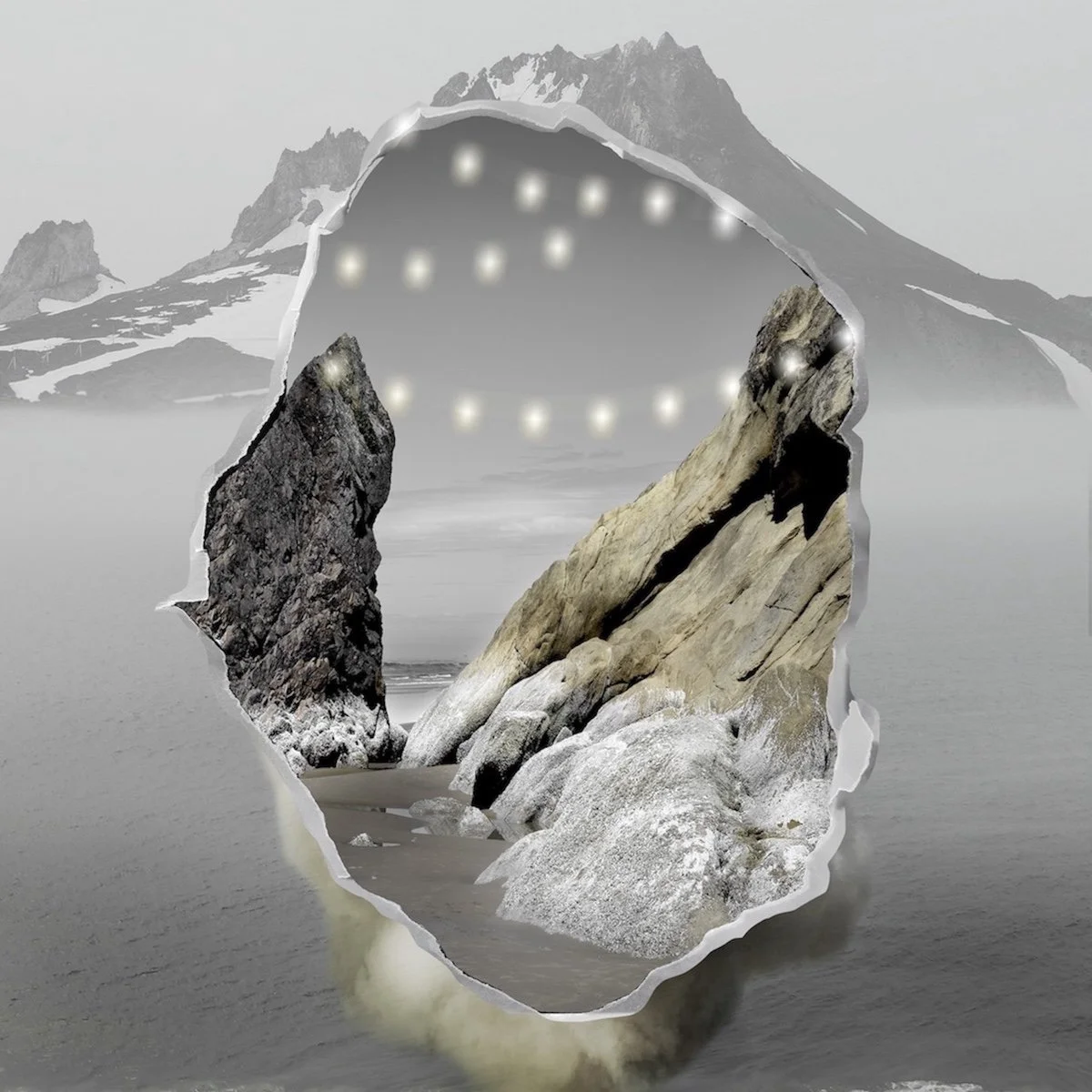
Julianna Foster, Breakthrough Portal from the series Geographical Lore, digital inkjet print mounted on wood panel, 34” x 34”, 2024
ML: Your landscapes are neither entirely natural nor entirely fabricated. They seem to occupy a third condition, a hybrid terrain in which geology, photography, craft, and imagination become difficult to separate. Can you speak to this ambiguity?
JF: In the work, I tend to use photos as source material. I change the context enough that they become harder to place. A fold of a print might resemble a fault line, while a crease or edge can start to read as a river or coastline. Something can feel monumental and intimate, natural/constructed, stable and unstable at the same time. I’m in search of the moment when recognition starts to slip. Where you may have to look again. I guess in some ways, it reflects how I think about nature. What appears solid or permanent is continually moving, eroding, accumulating, and being redefined.
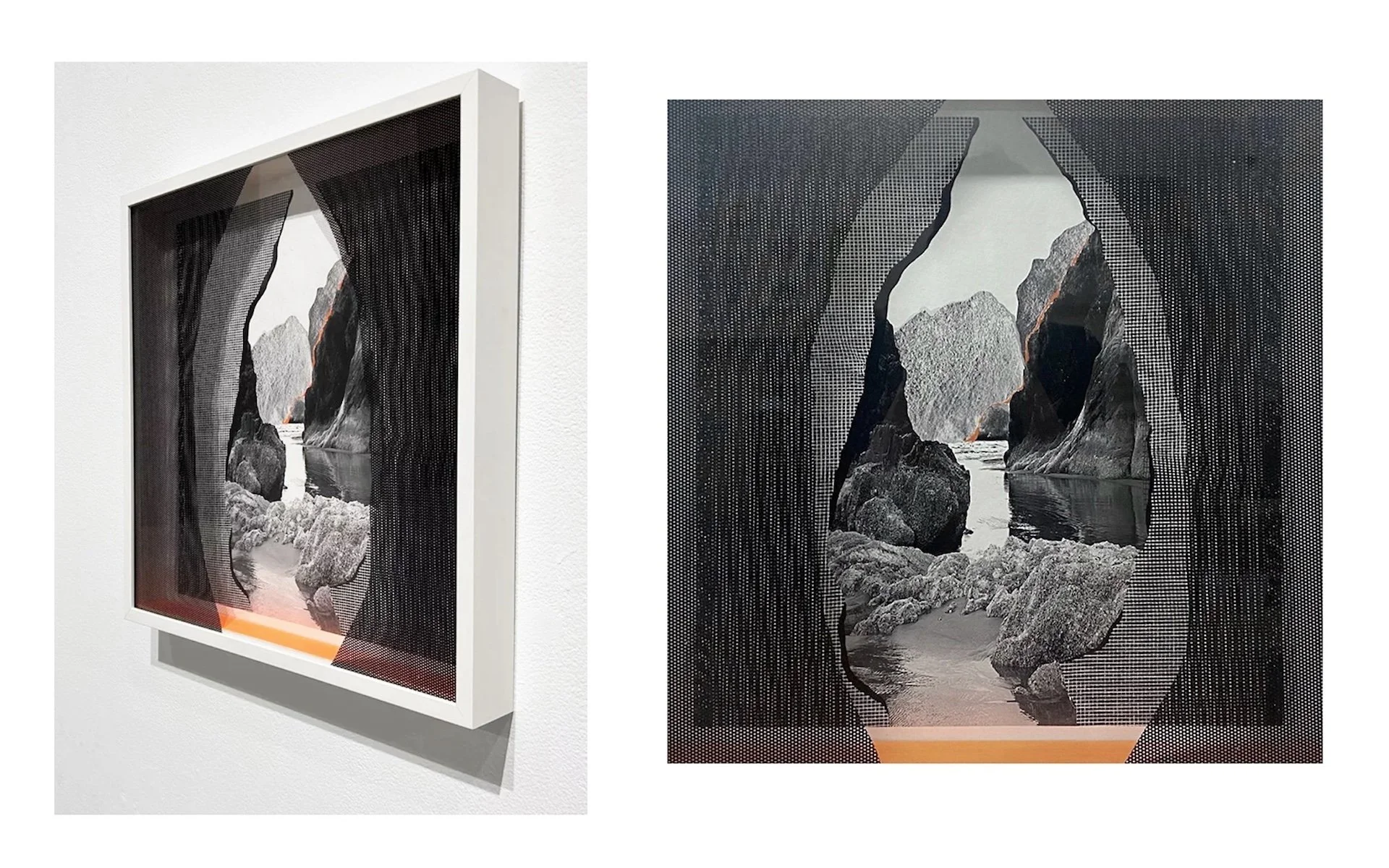
Julianna Foster, Portal Break I from the series Geographical Lore, digital inkjet print, screen adhesive, orange tape, 20” x 20”, 2023
ML: You speak about transformation and chance as generative forces. Could you describe a moment when an accident, material failure, unexpected photographic result, or unforeseen distortion fundamentally redirected a work? What can chance reveal that intention cannot?
JF: Much of the work is through making rather than starting with a specific thought/idea in what the result should be. I make prints, small-scale studies before something moves to a larger scale. Many of these experiments never become finished works. But they tend to leave traces, small discoveries that lead the work somewhere I couldn’t have anticipated or planned. And sometimes they just don’t go anywhere, and I’m learning from those too, even in disappointment.
Different materials also create their own kinds of unpredictability. Backlit film can make an image feel more atmospheric; mirrors or reflective surfaces fracture and repeat the landscape or natural forms, or bring the surrounding space into the image. Combined images can be modified depending on the light and point of view. Sometimes what begins as a small collage ends up as an installation or a completely different way of photographing the landscape.
That iterative process feels connected to Geographical Lore because the landscapes themselves are never fixed. Tidal pools regenerate, rivers change course, rock erodes, and environments respond to both natural forces and human intervention. I don’t want the process to feel completely controlled. Knowing that failed attempts, repetition, and chance give the work a way that shows instability. I pay attention to moments when the work resists what I intended. At times, that is where something can happen.
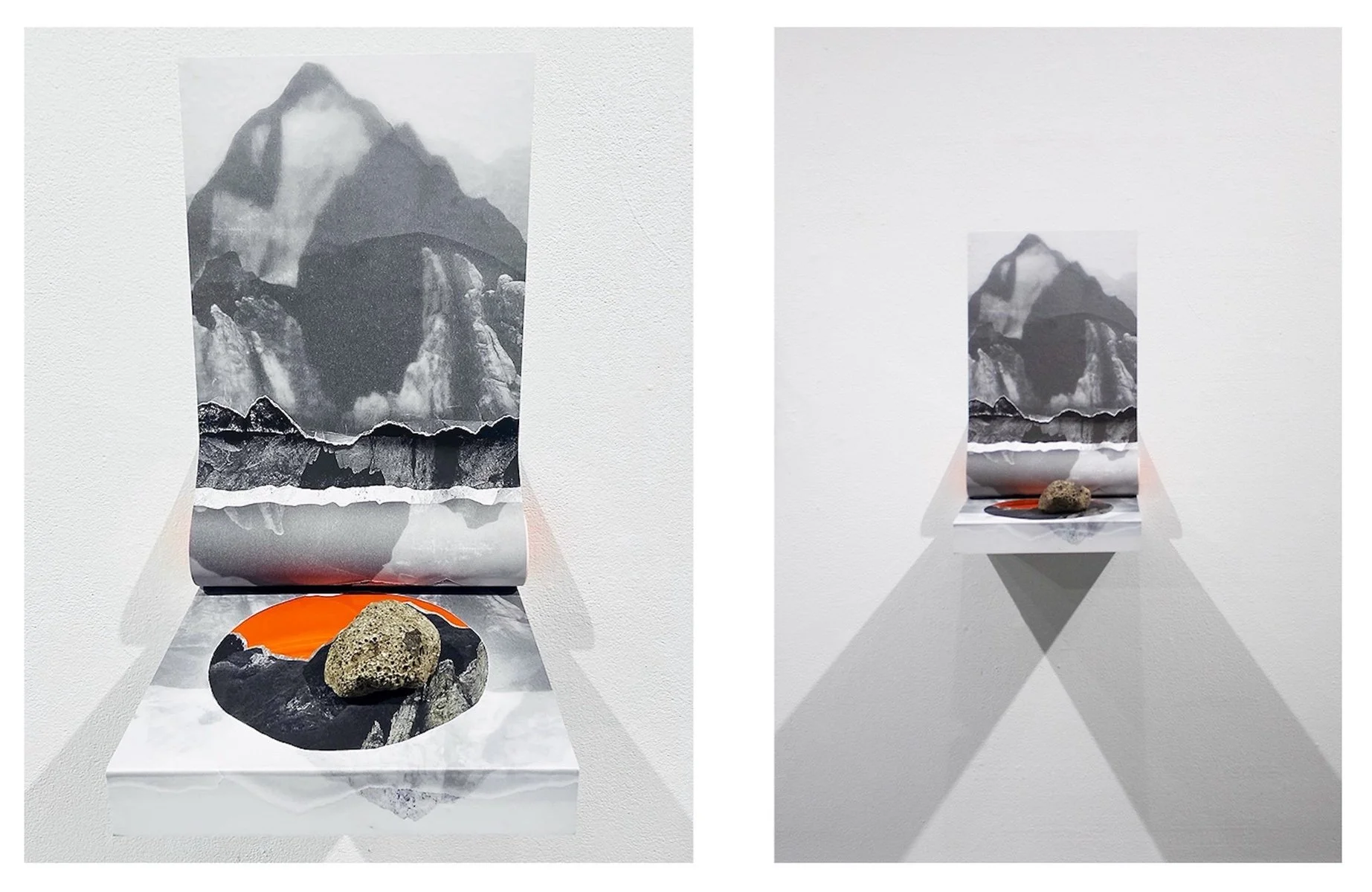
Julianna Foster, Sandstone Gardens I from the series Geographical Lore, digital inkjet print on vinyl, orange tape, wood shelf, rock, 19” x 12”, 2023
ML: Memory appears to operate almost like another photographic process in your work - selective, unstable, layered, and susceptible to alteration. How do you see memory functioning within your work?
JF: I think of memory as a vessel. In the studio, I work from what has remained with me, the light, movement, and tangible qualities of a place. Joy Harjo’s line from her poem Remember, “Remember the earth whose skin you are,” resonates with me because it speaks to the idea that our relationship to land is what we carry with us.(2) When I reconstruct a photographic work, I draw from that internal experience and what I remember.
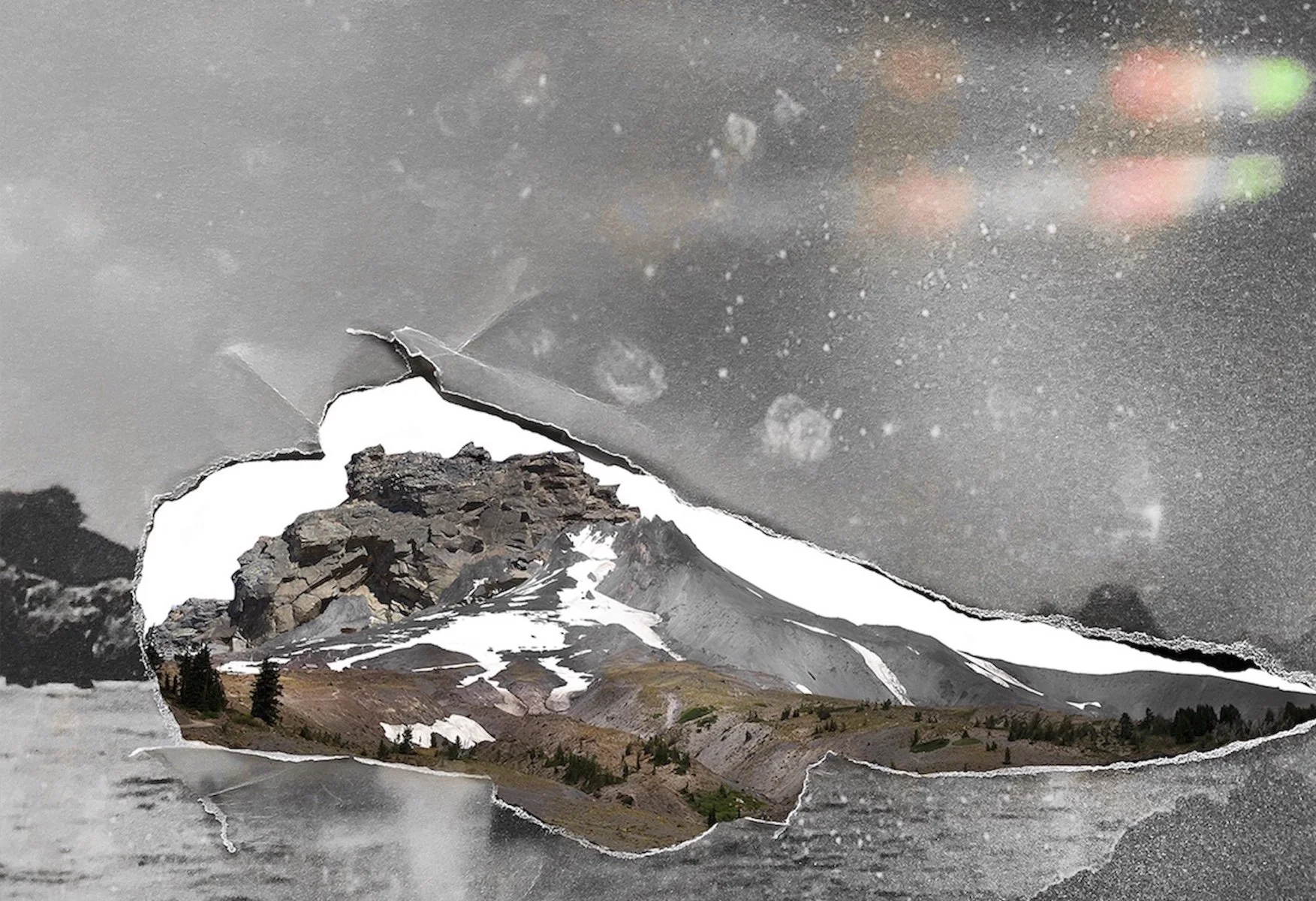
Julianna Foster, Salt Mountain from the series Geographical Lore, digital inkjet print, 36” x 24”, 2023
ML: Your images can initially invite the viewer to believe in the world they depict before gradually revealing evidence of their construction. At what point do you want the viewer to become aware of the artifice and what do you hope happens psychologically when that realization occurs?
JF: I’m interested in the moment when the image starts to feel less believable, but I want that realization to happen gradually. That shift in perception connects to climate change and the growing gap between how we imagine the natural world and the environmental conditions that actually exist.
We may still hold onto an idealized idea of nature, even as it becomes harder to sustain. In the work, recognizing the artifice creates a similar shift, from familiarity and beauty toward uncertainty and possibly unease.
My own understanding comes from spending time in these places, photographing them, and then continuing to learn through research. What becomes invented images is a way of unsettling an idealized view of nature. I’m holding onto its allure while also recognizing that the world those images refer to is vulnerable. There is evidence of this in the work titled Salt Mountain that is both an archival image and a photograph of the same landscape in the present. The surface of the image is physically torn away to reveal the landscape underneath, creating tension between past and present. The tearing becomes a kind of excavation. Exposing what has changed while also suggesting what remains embedded within the landscape.
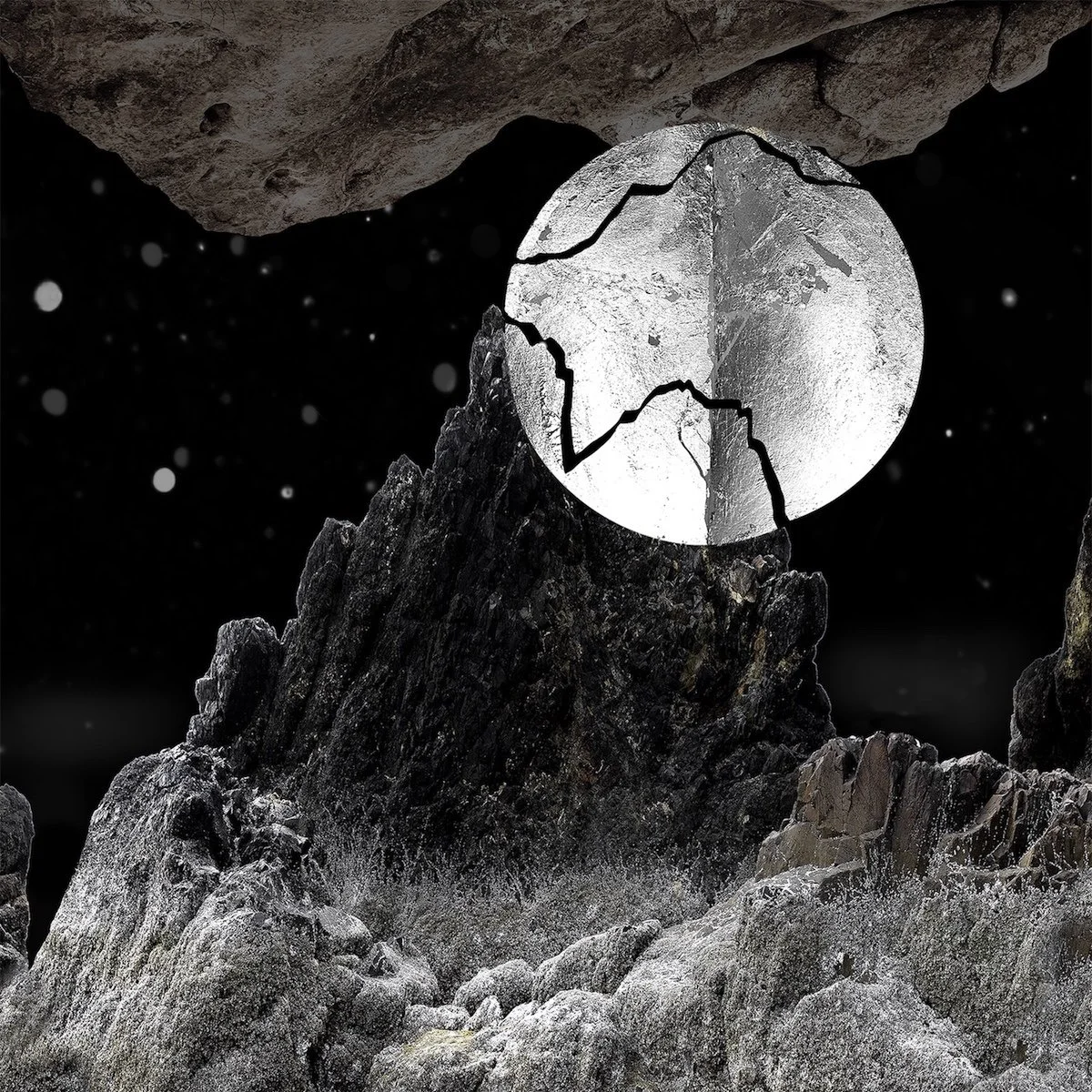
Julianna Foster, Silver Moon Digital Inkjet Print from the series Geographical Lore, silver leaf, mounted on wood panel, 36” x 36”, 2023
ML: We’re living through a moment of profound environmental crisis, but also one of visual saturation. What do you think photography can uniquely contribute to our understanding of climate change and ecological loss that words, data, or scientific imagery might not?
JF: At its core, Geographical Lore is connected to current issues, navigating between a critical viewpoint and a romanticized vision. This act of manipulating and recombining these geographic images, as it relates to our imagination and relationship to the American landscape, into something beautiful, but artificial and contrived, is also a critique of our relationship with the earth.
Words and data can explain and measure ecological change, photography can give it an emotional and imaginative presence. What I hope to communicate in this work is a more subjective encounter with environmental loss. Maybe one that asks viewers not only to understand what is changing, but to consider their own relationship to what may be disappearing or revealed.
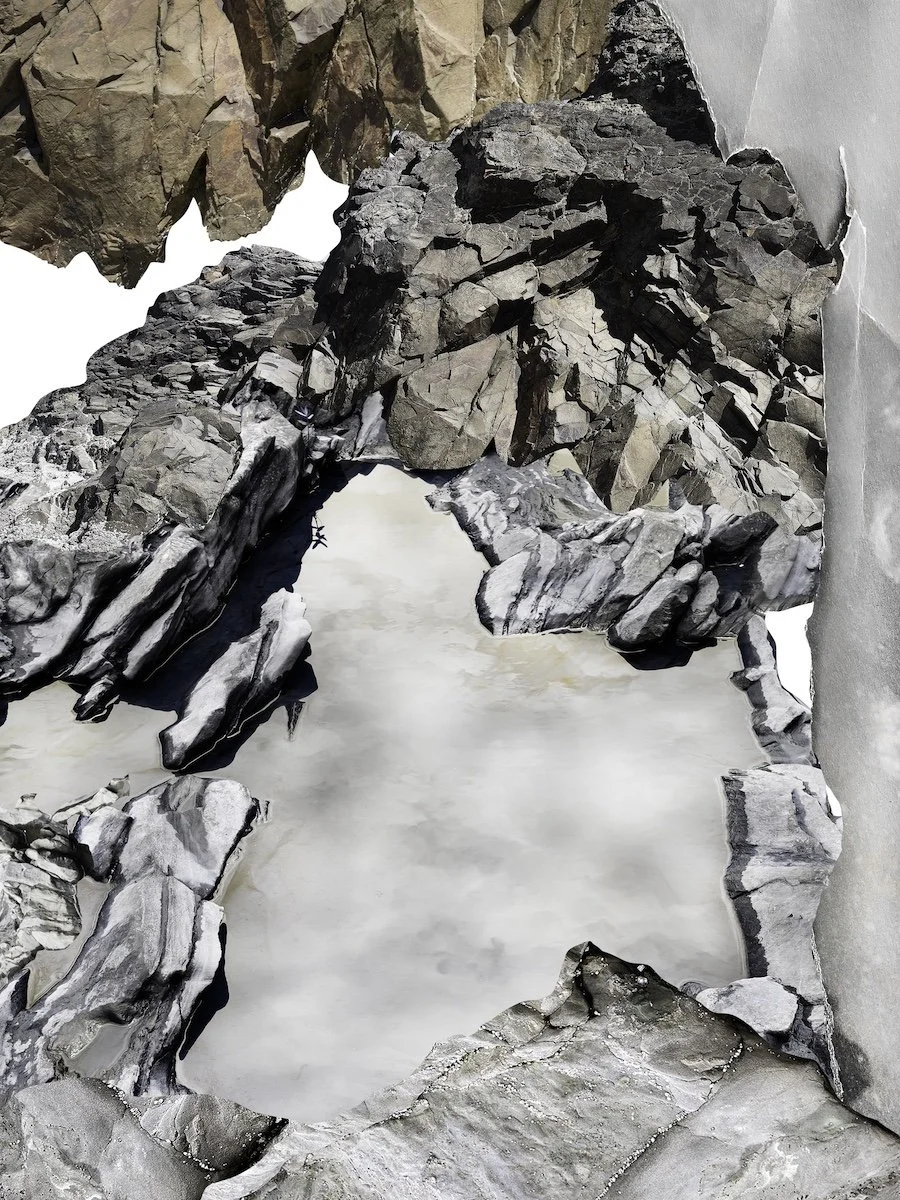
Julianna Foster, Gorge II from the series Geographical Lore, digital inkjet print, 36” x 24”, 2025
ML: Your work suggests that a landscape is never static, that it is geological, ecological, cultural, and psychological all at once. How do you approach the idea of landscape as something continually becoming rather than something fixed and wholly knowable?
JF: My practice relies on an iterative process. The printed image transforms into third or fourth generations, revealing an emerging landscape, like a vestige or echo of the original photographs. I blend analog and digital media. These vary from sun prints, handmade negatives from composites, contact prints developed in the darkroom, and digitally manipulated prints on various surfaces. By blending processes, I combine these prints with objects that I create or find (natural materials, rock, and land formations made with clay, handmade paper), build tableaus, light them, and then re-photograph them. Through reworking, the landscape becomes more elusive, resisting a single way of being understood. Like in the work Scenes from the Quarry, Pit Lake, photographs of a granite quarry are reconstructed into an overhead view, with an etched acrylic bathymetric map suspended above the surface. Light casts the map’s shadow onto the photograph, creating an alternate topography. The work connects extraction with reconstruction, the removal of material from the earth and the remaking of its image. Everchanging.
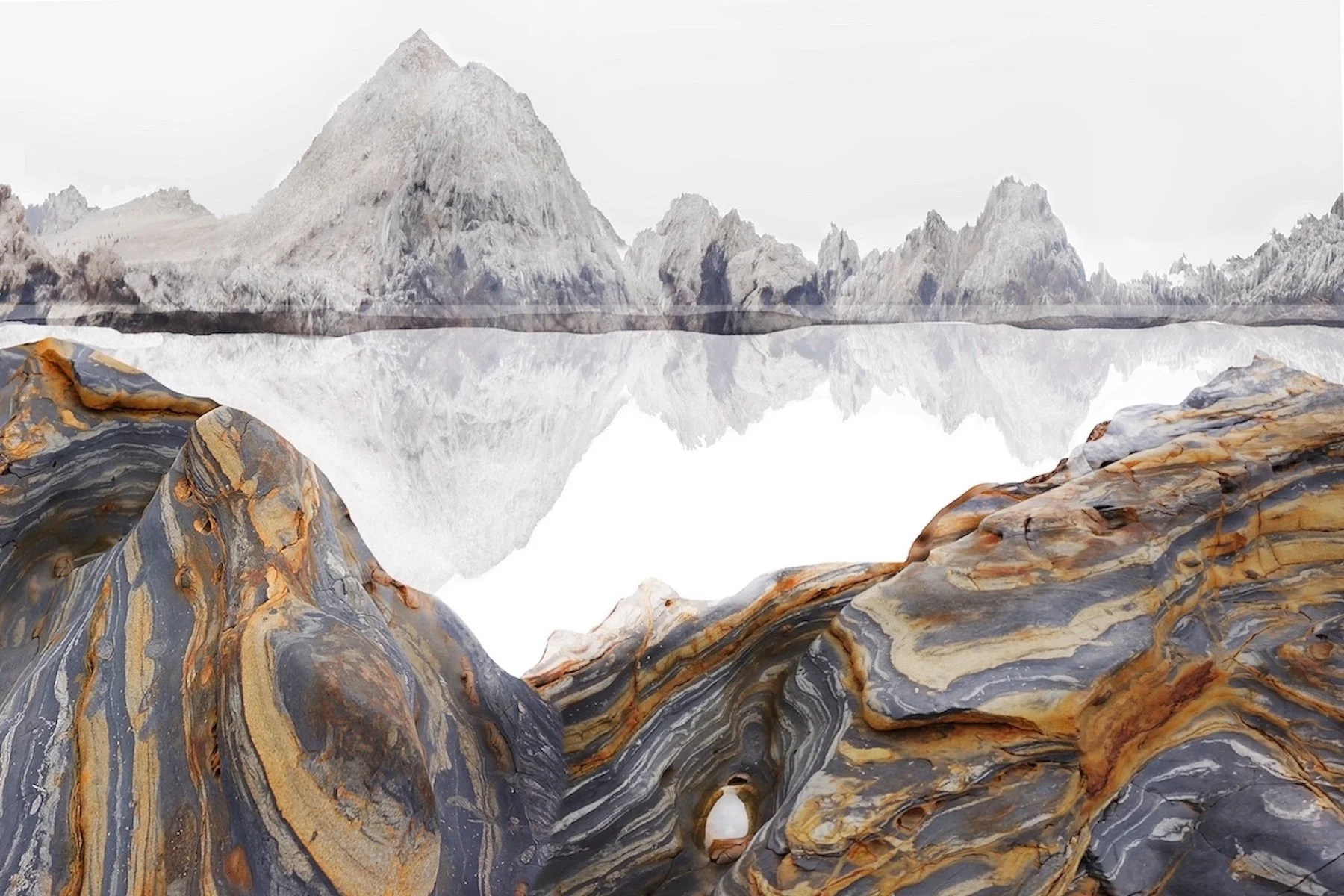
Julianna Foster, Tidal Pool from the series Geographical Lore, digital inkjet print, 36” x 24”, 2022
ML: Your landscapes are beautiful but that beauty is accompanied by an awareness of fragility. How do you negotiate the tension between the aesthetic pleasure of landscape photography and the ecological crises affecting the landscapes you photograph?
JF: Beauty is important to the work because it reflects what draws me to these places to begin with and areas I want to explore. But I also want to complicate that beauty. In Tidal Pool, I used collaged photographic vinyl directly on the wall to reconstruct the coastal waterway I photographed at Point Lobos Natural Reserve in California. I removed the blue of the sky and water, allowing the neutral wall to take its place. What would normally give the image atmosphere, depth, and a sense of openness becomes an absence.
That absence interrupts the image of the coast and points to what is less visible, the vulnerability of air and water to pollution, erosion, and environmental change. It also connects to ongoing efforts to restore eroded areas of the landscape. Rather than depicting ecological damage, I use what is missing to question what is most at risk at the reserve.
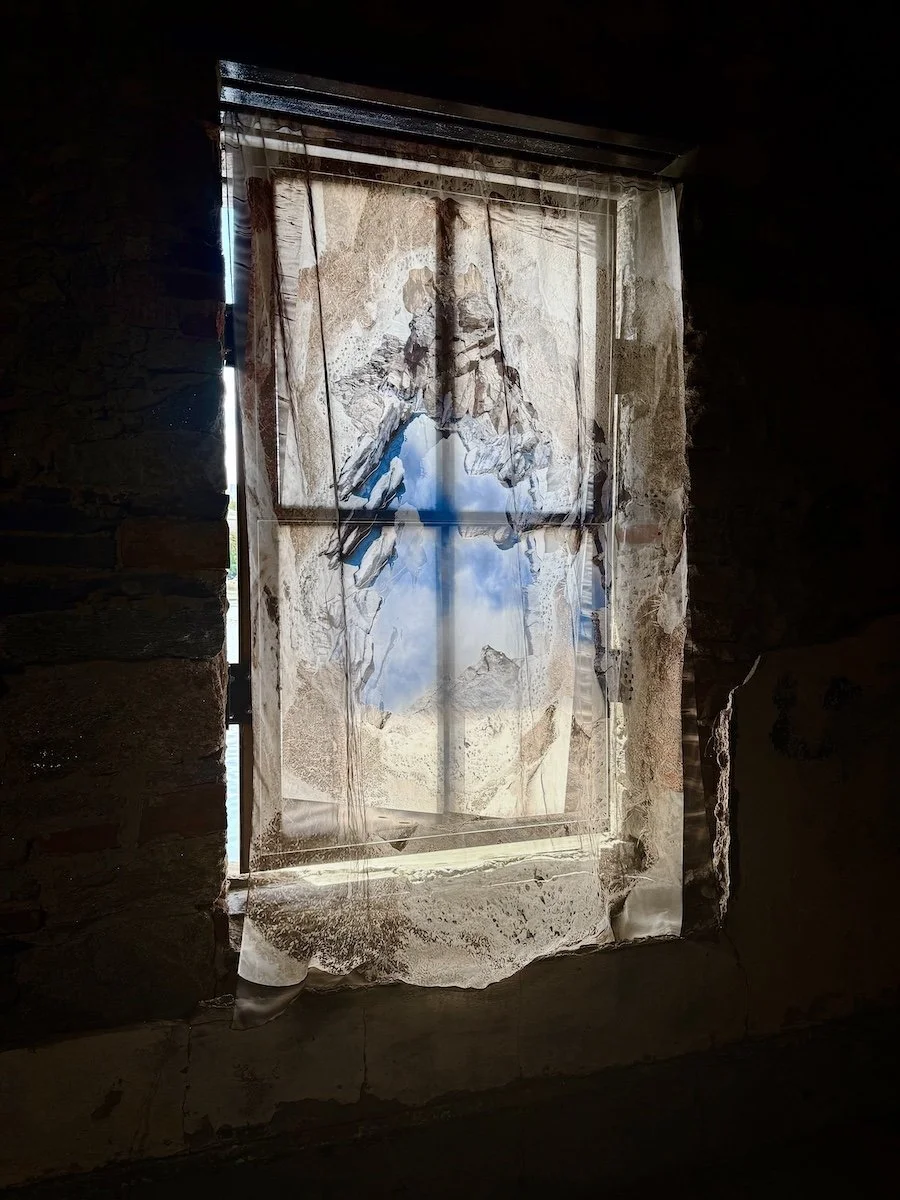
Julianna Foster, Geographical Lore, installation view (Fairmount Water Works), backlit film adhered to window and print on chiffon, approx. 52” x 48”, 2026
ML: How does geological time influence the way you think about the human presence within the landscapes in which you work?
JF: People rarely appear in my recent work, except occasionally as a reference for scale, but their presence is still felt. I think about how these landscapes have formed over immense periods of time, and how quickly human activity can and has changed them. Granite formed over millions of years can be quarried within decades, coastlines shaped over centuries can be compromised within a generation. That contrast makes the human mark feel brief, yet consequential.
This makes me think about Ana Mendieta’s Silueta Series and her use of trace, how the body can be absent but still register within the landscape.(3) Her work makes her presence visible through what she left behind in the natural world. My photographs from Quechee Gorge and the Granite Quarries in Vermont also show this, where human presence often appears indirectly through marks and material intervention.
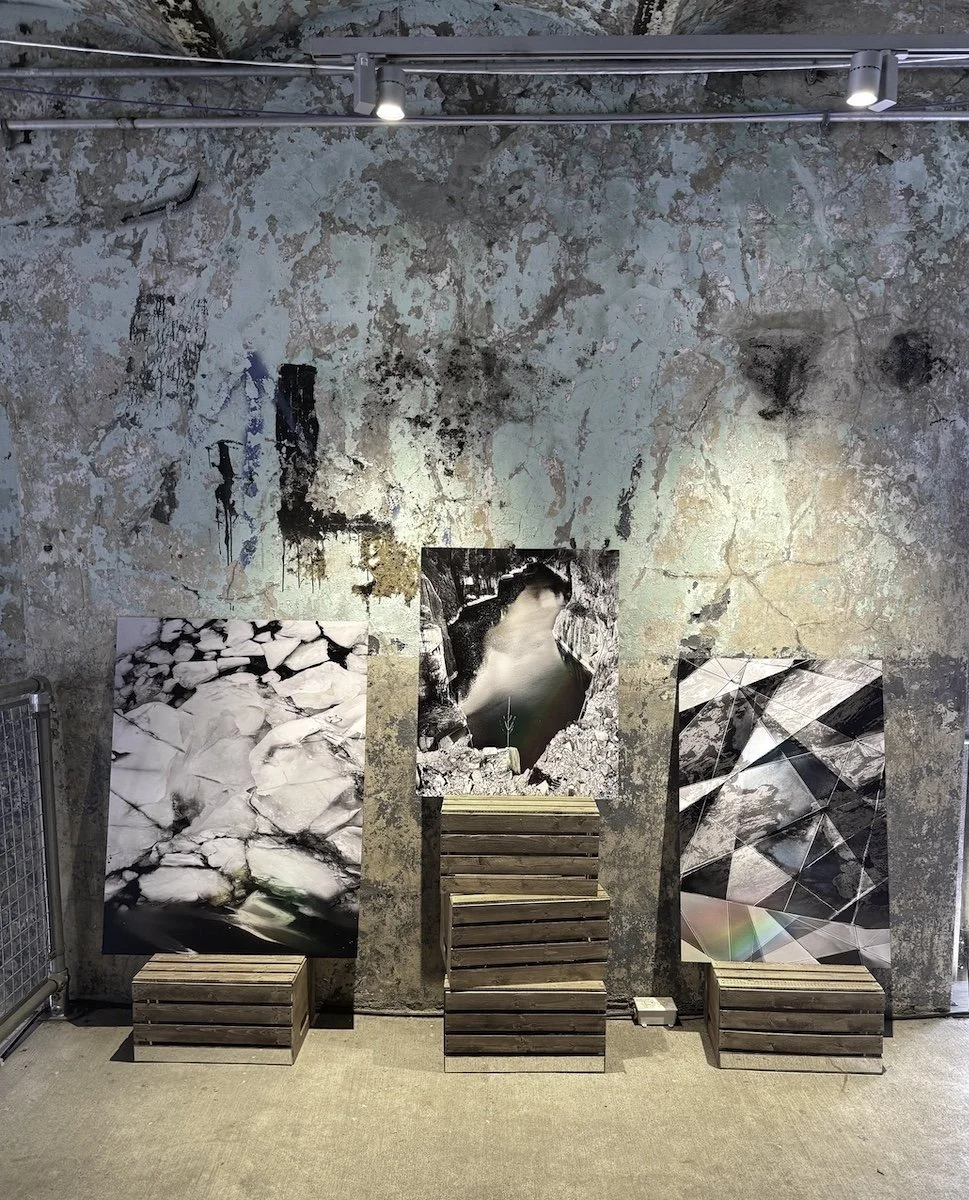
Julianna Foster, Estuary I, II, from the series Geographical Lore, Repository Lake installation view (Fairmount Water Works), digital inkjet prints on aluminum, wood crates, various sizes, 2026
ML: Could fabrication itself be understood as an ecological act in your work, perhaps an acknowledgment that humans are constantly constructing, modifying, extracting from, and reimagining the environments they inhabit?
JF: Yes, I would say so. I’ve photographed in national parks, natural reserves, and protected lands throughout California, Oregon, New Mexico and Colorado, which are also shaped by human decisions through preservation, restoration and boundaries/access. I guess in that sense, protecting a landscape involves constructing a particular relationship to it.
I’m not equating fabrication with conservation. But I am considering how landscapes can be transformed by what we extract, what we choose to protect, and what we restore. Similarly, I treat the photograph as something that can be broken apart and remade. By letting the image itself move through a cycle of loss and renewal. Like ecological processes in landscapes that are continually broken down, transformed, and formed again.
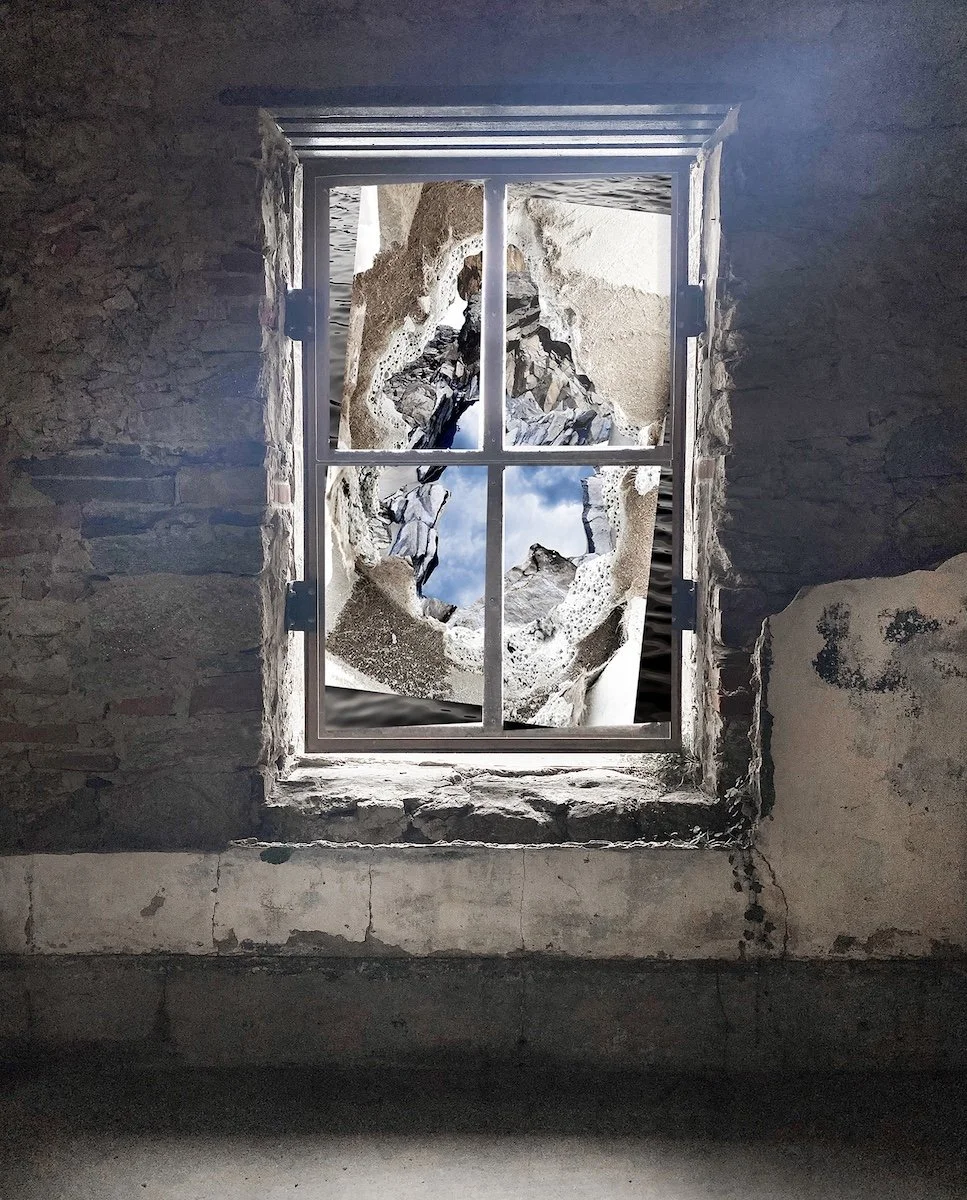
Julianna Foster, Gorge III from the series Geographical Lore, installation view (Fairmount Water Works), backlit film adhered to window, approx. 52” x 48”, 2026
ML: Looking ahead, what role do you hope photographers and other image-makers can play in shaping how we respond to the environmental crisis? Can images do more than bear witness? Can they help change the way we imagine possible futures?
JF: I’ve been following photojournalist Lynsey Addario’s work because she shows how climate change directly affects people and their communities.(4) Her photographs of drought, flooding, and wildfires make these issues feel immediate and personal. What interests me most is how her photographs show that climate change isn’t only about the environment, it affects people’s livelihoods, access to food and water, displacement, and their connection to place. Photographers and journalists make these important issues visible in ways that data alone can’t, building awareness and helping us understand the impact of environmental policies.
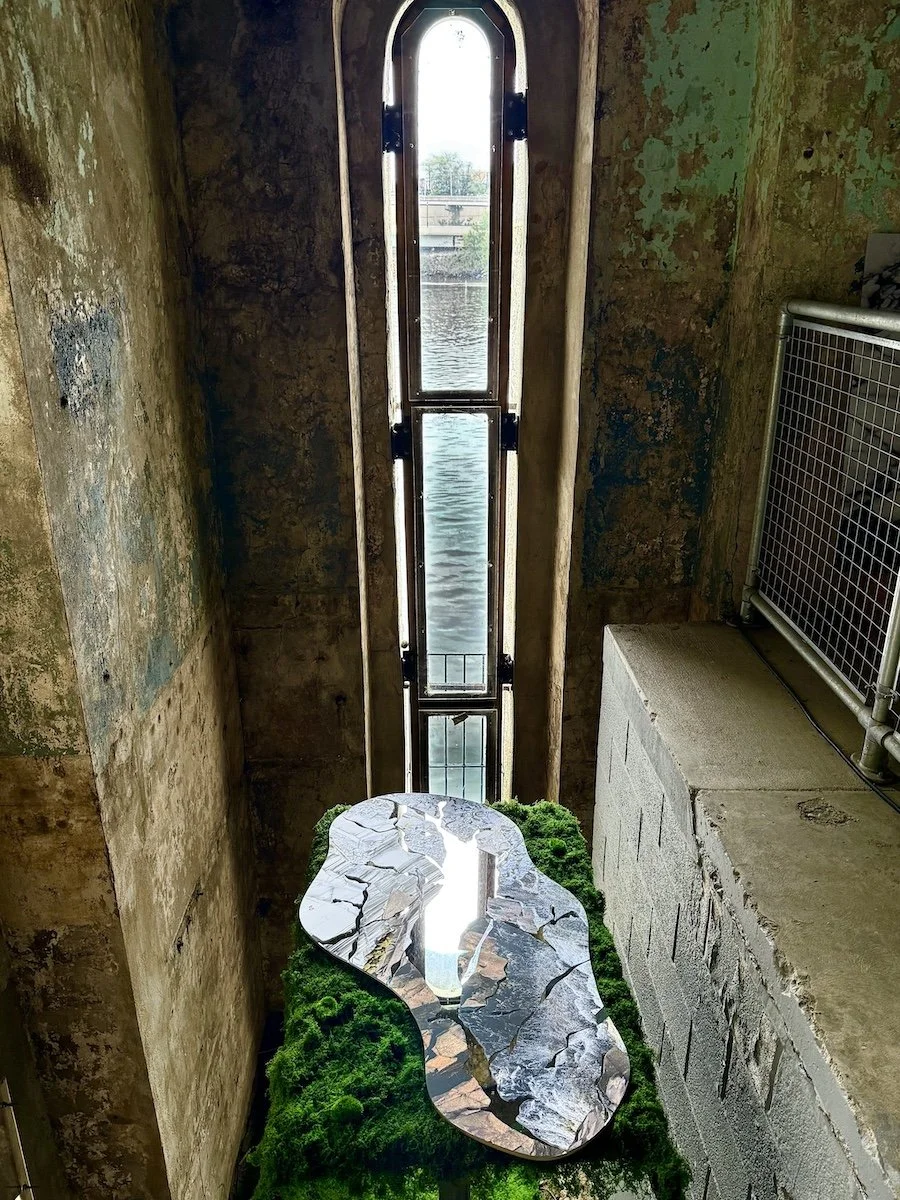
Julianna Foster, River Tributaries from the series Geographical Lore, installation view (Fairmount Water Works), backlit film, mirror, photo vinyl, fabricated moss, 2026
ML: What is holding your attention at this moment? What are you currently working on?
JF: My most recent project included in the exhibit Currents organized by Philadelphia Sculptors, was a site-specific exhibition at the Fairmount Water Works in Philadelphia, where ten artists created work for the building’s underground spaces. My photographic installations grew out of the site itself, the architecture, its proximity to the Schuylkill River, and its history of managing the city’s water.
I wanted to connect the Water Works’ history to current concerns about flooding, shifting shorelines, and our attempts to manage natural systems. In works like Gorge III and River Tributaries II, I printed photographs on backlit film. I adhered them directly to the windows, allowing natural light to illuminate the images while obscuring the view outside. Mirrored surfaces integrated into photo collages reflected the movement of light on the river, bringing the surrounding environment into the installation. The work changed throughout the day as the light on the water changed, making the site an active part of how the installations were seen.
This has opened a new way of thinking/ making by using a site’s history and physical conditions to help the photographs take form/shape, becoming more sculptural and responsive to place. And, maybe most relevant, is the work’s temporality.
Solnit, Rebecca. Savage Dreams: A Journey into the Hidden Wars of the American West. San Francisco: Sierra Club Books, 1994.
Harjo, Joy. “Remember.” In She Had Some Horses. New York: Thunder’s Mouth Press, 1983.
Mendieta, Ana, and Mary Jane Jacob. Ana Mendieta: The “Silueta” Series, 1973–1980. New York: Galerie Lelong, 1991.
Lynsey Addario, https://www.lynseyaddario.com/