

Dawn Roe
Dawn Roe is an artist and educator whose site-responsive work with photography and video explores more-than-human relations and the entanglements of land and water. Drawing on experimental filmmaking and darkroom practices, her work has been exhibited widely throughout the U.S. and internationally, including solo and group exhibitions at the Sault Ste. Marie Museum (Canada) and Lightner Museum (FL), as well as screenings and installations at venues such as Newspace Center for Photography (OR), Screen Space Gallery (Australia), and The Orlando Museum of Art (FL). Roe’s practice has been recognized with honors including the 2021 Critics’ Choice Award from LensCulture and the 2020 Urbanautica Institute Award, and she has been invited to prestigious residencies including the 2023 International Changing Climate Residency at the Santa Fe Art Institute (NM), Villa Barr Art Park (MI), and the H.J. Andrews Experimental Forest (OR). She holds an MFA from Illinois State University and is Professor of Art at Rollins College. She is represented by Tracey Morgan Gallery in Asheville, NC.
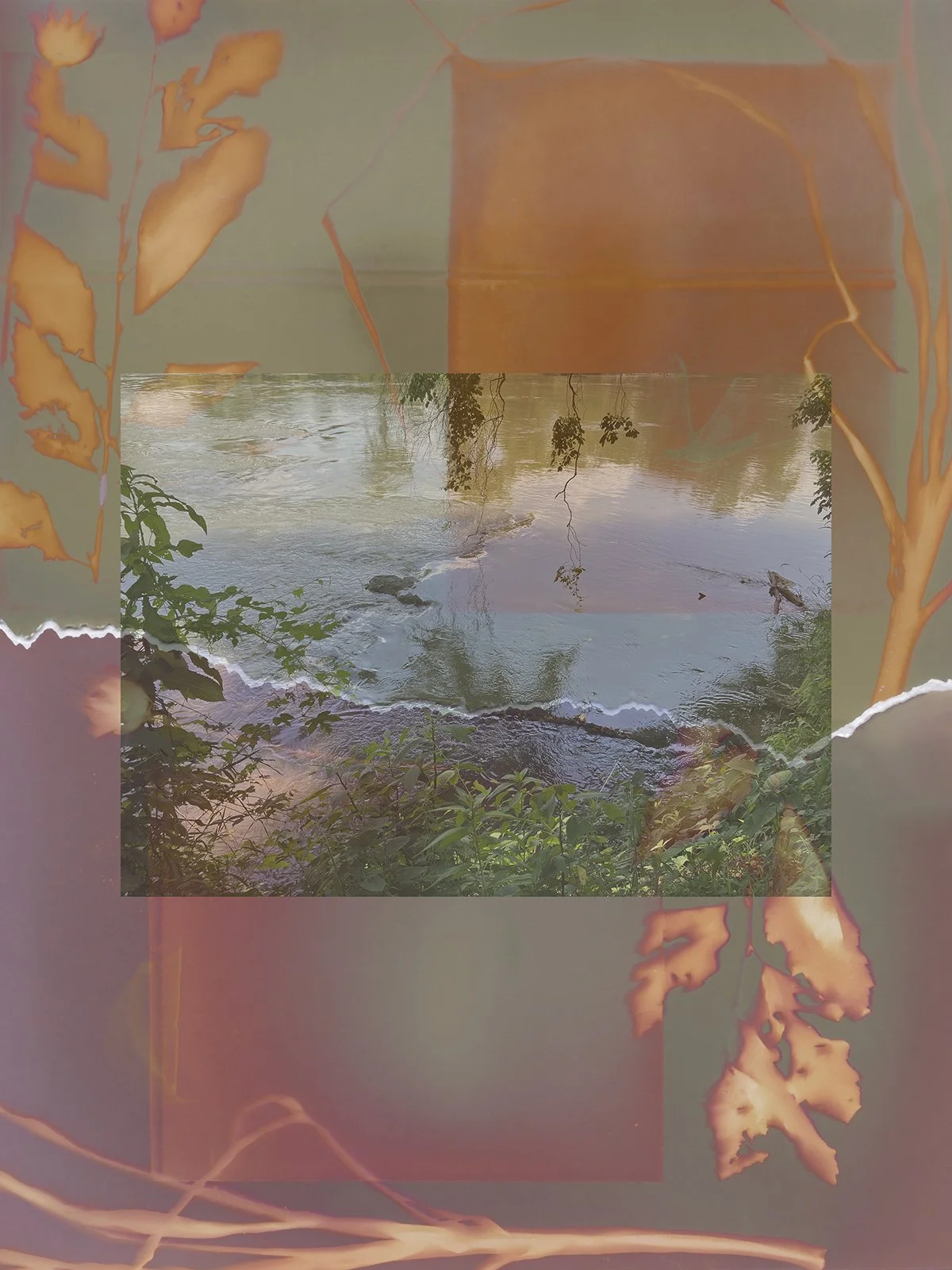
Dawn Roe, torn river; pigment print; 30 in (h) x 40 in; 2025
There are certain souls in this world to whom one feels magnetized without effort or explanation—fellow wanderers moving along parallel currents of thought and care. In my life, they are the ones who carry a reverence for visual culture, a fierce commitment to environmental justice, a devotion to teaching and learning, and a searching, almost sacred curiosity about the living earth. Dawn Roe is one of those rare presences for me.
For years, I followed her work from a quiet distance, attentive to the ways she interprets the landscapes, the histories, and the subtle murmurs between bodies and place. When she graciously agreed to be interviewed for GroundTruth earlier this year, it felt less like a formal invitation and more like the convergence of kindred paths.
What follows is a long, wandering conversation—one that drifts and eddies through photographic materiality, place-based research, hydrofeminism, and the many ways visual art can translate, transcribe, and hold our complex entanglements with the more-than-human world.
ML: Please describe your trajectory as an artist, and how your formal training shaped, or conflicted with, your current creative practice?
DR: I’ve been revisiting a set of early childhood memories lately that have a sort of Proustian quality, of course – bits of sensation flicker up out of nowhere when I glance out a window, or look down at my hands while holding a picture, or something like a picture. These perceptual glimmers sometimes conflict with what I think I know about myself when I actively try to remember these situations I’ve been conjuring, so I can retell them as part of a panel discussion, or an artist talk, or an interview.
This is a meandering answer to what might seem a straightforward introductory question. But, this is the nature of trajectory – it meanders. I tend to situate my development as an artist around my formal training that really didn’t begin until my mid to late 20’s, but it’s probably more likely that I knew very clearly how an image could become a picture when I was just a tiny body sitting on a massive, braided rug surrounded by booklets and albums of family snapshots as I peered out a glass window offering a perfectly framed view of the world as freighters floated along the small stretch of river running behind my grandparent’s home in the small border town currently known as Sault Ste. Marie in what has become the U.S. state of Michigan.
What a perfect amalgamation of conditions to nurture an emerging sense of visual and ecological wonder. There is just something pretty amazing about the way a passing landscape can imprint itself upon/within our minds, perhaps most acutely in our earliest years. I sometimes think about these ships slowly moving across my field of vision the way Proust describes three trees fading from view while gazing out the window of a carriage in the book In Search of Lost Time(1). It’s such a beautiful passage, the ending moments suggest the trees are sort of waving at the narrator in despair, seeming to say “what you fail to learn from us today, you will never know.”
So, this is what I tell myself now – that these early instances shaped me into the artist I am today. I want to believe there is some truth to this, and maybe there is – but these intangible recollections are now filled in with every single thing that has transpired beyond those early moments, including my encounters with the poetic language of Proust, and so many others. This of course includes what would become my formal art education – and these life and classroom experiences HUGELY shaped the way I approach my practice and the decisions I now make as an artist in an intensely and rapidly changing world.
I do want to share that I was super fortunate to have been a student at what was then called the Northwest Film Center in Portland, Oregon where I studied experimental film with remarkable women filmmakers Bushra Azzouz and Enie Vaisburd. My undergraduate degree combined this work with a more traditional BFA program at Marylhurst College just outside of Portland – here I worked with a close knit group of faculty and students in a challenging and supportive program that introduced me to the myriad ways theory and research might inform a developing practice. This was further honed during my graduate work with another influential group of faculty at Illinois State University that helped me loosen up some of the rigidity I had placed upon myself in considering certain forms of documentary practice. Even though all of these programs were interdisciplinary, I was thinking of myself as primarily a photographer, and I guess I maybe held onto a certain idealism around the possibility of some sort of “authentic” documentary image. I always remember fixating on the Dorothea Lange quote – something to the effect of, “I do not meddle, or arrange.” It’s wild to think back on that – I mean, I finished grad school 21 years ago now!
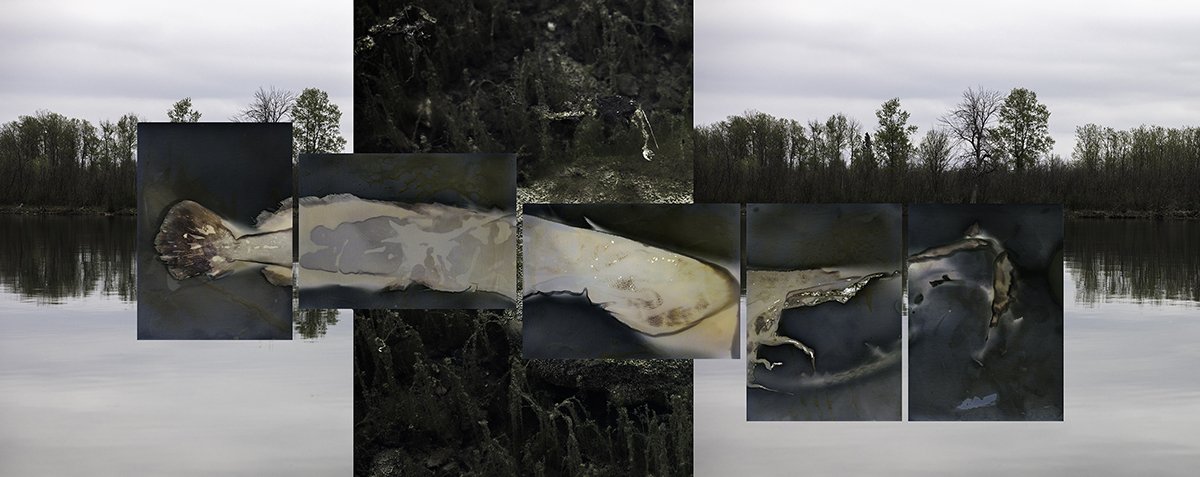
Dawn Roe, the river that connects what were once our grandparent’s homes (for my brother), 2023, 19 x 44”, composite pigment print of scanned UV-exposed gelatin silver prints and digital images
ML: Were there particular moments during your education when your relationship to photography or environmental work fundamentally shifted?
DR: I’m not sure it was during the actual time period of my own education (although, this of course is ongoing) as much as my continual reflections on this as part of my own work as an educator – I’ve just become more and more aware of my responsibility in this role over the years. But, I do want to recognize this ethics of social responsibility was instilled within me by my own teachers – and I want to shout out every single one I’ve learned from over the years. I mean, I’ve just been so lucky in this regard. I was reluctant to include a huge list in my previous response that recognized my Northwest Film Center mentors, but I do embrace a culture of increased acknowledgement and more radical citation practices so what the heck – I’m going to give the big list (trying to recall and include as many of the folks as I can here from undergrad + grad school) – from Marylhurst College (Rich Rollins, Terri Hopkins, Paul Sutinen, Margaret Shirley, Martha Pfandschmidt; Sister Joan Maiers*); from Illinois State University (Rhondal McKinney, Jin Lee, Bill O’Donnell, Scott Rankin, Melissa Johnson, Barry Blinderman, Martin Patrick; Jim Mai; Shona MacDonald, Gary Justis, Melissa Oresky, Claire Lieberman).
*I just want to take a moment to point out the randomness of history and circumstance. Although Marylhurst College had become a co-ed, non-denominational institution by the time of my enrollment in the late 1990’s, it was originally founded by the Sisters of the Holy Names of Jesus and Mary (SNJM) as a Catholic school for educating women. Some of the sisters were still active at the college during my time there and I was incredibly fortunate to learn from Sister Joan Maiers in several writing courses. She continued to surprise me in the years following my graduation by turning up alongside my former art professors when I returned to Portland to show work in local exhibitions or give talks. But I bring this up specifically as there is an interesting sort of happenstance relation between the Sisters of the Holy Names finding themselves in Oregon and my own – we both made our way over from the Great Lakes region under different circumstances. And, though I was unceremoniously kicked out of catechism for misbehavior during middle school and was never confirmed in the Catholic church (and have plenty of misgivings around organized religion), I want to believe the true spirit of care for the earth and all of its life forms is what the Sisters were there for – and there is absolutely a feminist ethos underpinning their work – and, frankly, what seems to me a more pagan form of spirituality, and this perhaps had at least a bit to do with why I found connection and comfort in this space. While thinking about all of this, I did a quick search on Sister Joan and came across this perfectly apt description from a fall 2017 newsletter from the Sisters of the Holy Names – she’s described as “[a]n ardent advocate for social justice, she considers justice and peace illuminated by beauty as one of her lifelong goals.”(2)
So yes, I think these moments of fundamental shifting (in terms of my relationship to photography and the environment) have been slowly occurring quietly underneath the minutia of day-to-day actions, kind of simmering below as I make my way through the world as an observer of sorts – both with a camera as a physical/supplemental device, as well as with the always present camera form embedded within our sighted bodies. But the way that education (hopefully) works on us is to bring that simmer to the surface over time, so one can draw on these bits of knowledge and understanding to think, and to rethink.
In my own teaching, I’m continually reassessing what matters as I myself inevitably guide students to consider photography and the environment in certain ways. I can’t help but think of the often shared Donna Haraway quote in regards to all of this: “It matters what matters we use to think other matters with; it matters what stories we tell to tell other stories with; it matters what knots knot knots, what thoughts think thoughts, what descriptions describe descriptions, what ties tie ties. It matters what stories make worlds, what worlds make stories.”(3)
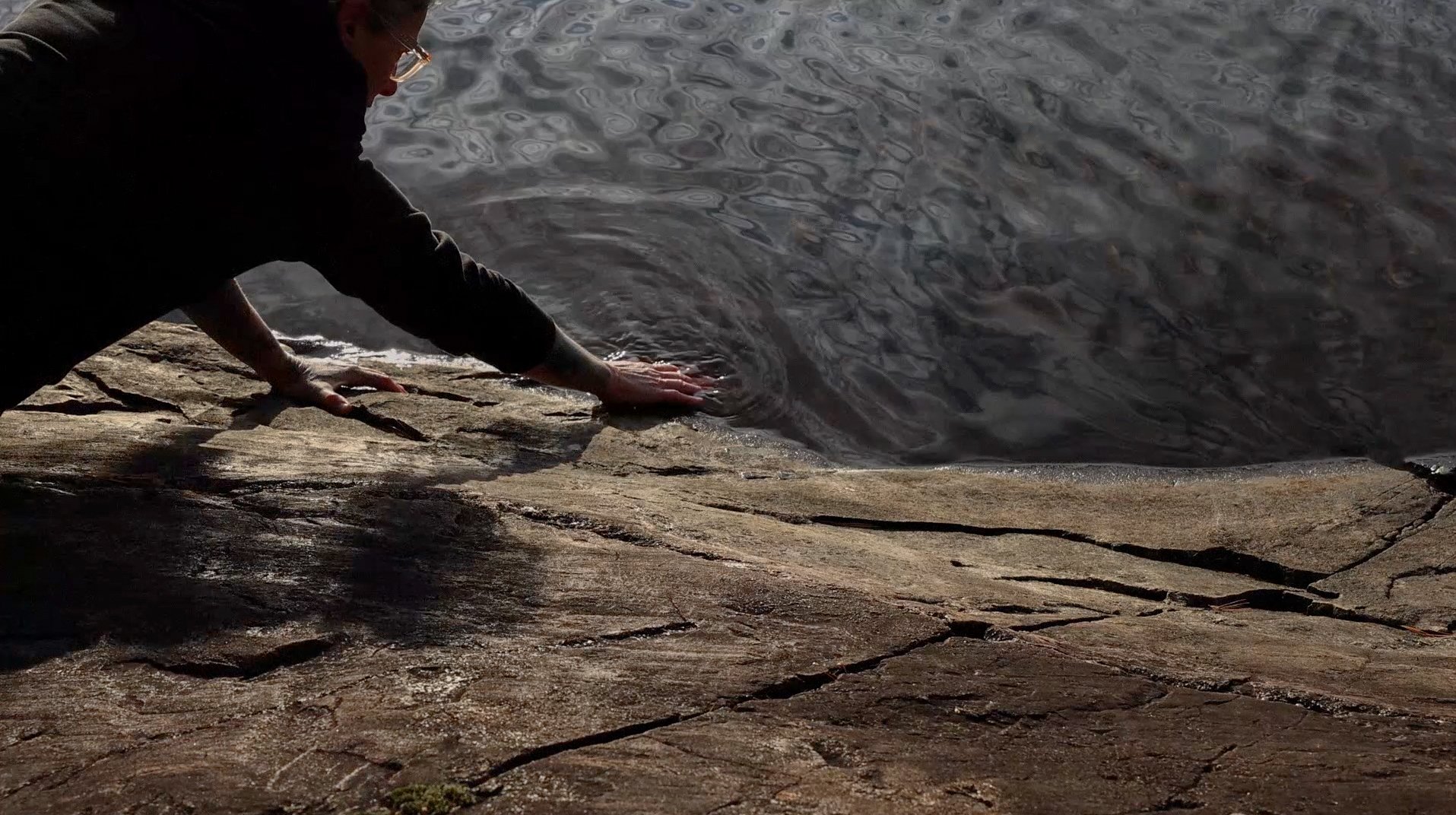
Dawn Roe, DESCENT ≈ An Atlas of Relation (Video Still); Single-channel HD Video; 18 minutes, 16 seconds (silent)
ML: Your work often unfolds through sustained encounters with specific environments. How do you decide when a place asks for your attention and what signals that a relationship with a site has begun?
DR: Oh, wow…such a good one, such a hard one.
It was probably around 2008 or 2009 that my projects began to unfold in what would be considered landscape – most of these initial projects considered natural, forested sites as sort of ambiguous perceptual spaces, rather than specific locations - I was thinking quite a bit about how we are impacted by our perceptions of the natural world when we are within/surrounded by it, and was drawing on literature and philosophical materials that poetically conjure images of landscape in their writing. Travel and learning from other places and people became important to my work as well - a number of my projects have been initiated at artist residencies I was invited to, including a pivotal project in the Australian Goldfields during a residency at LaTrobe University in Victoria in 2011. This was the first project that had me thinking more directly about the specificity of a place and colonial impacts on the land and its inhabitants, which deeply influenced the site-responsive images produced while there.
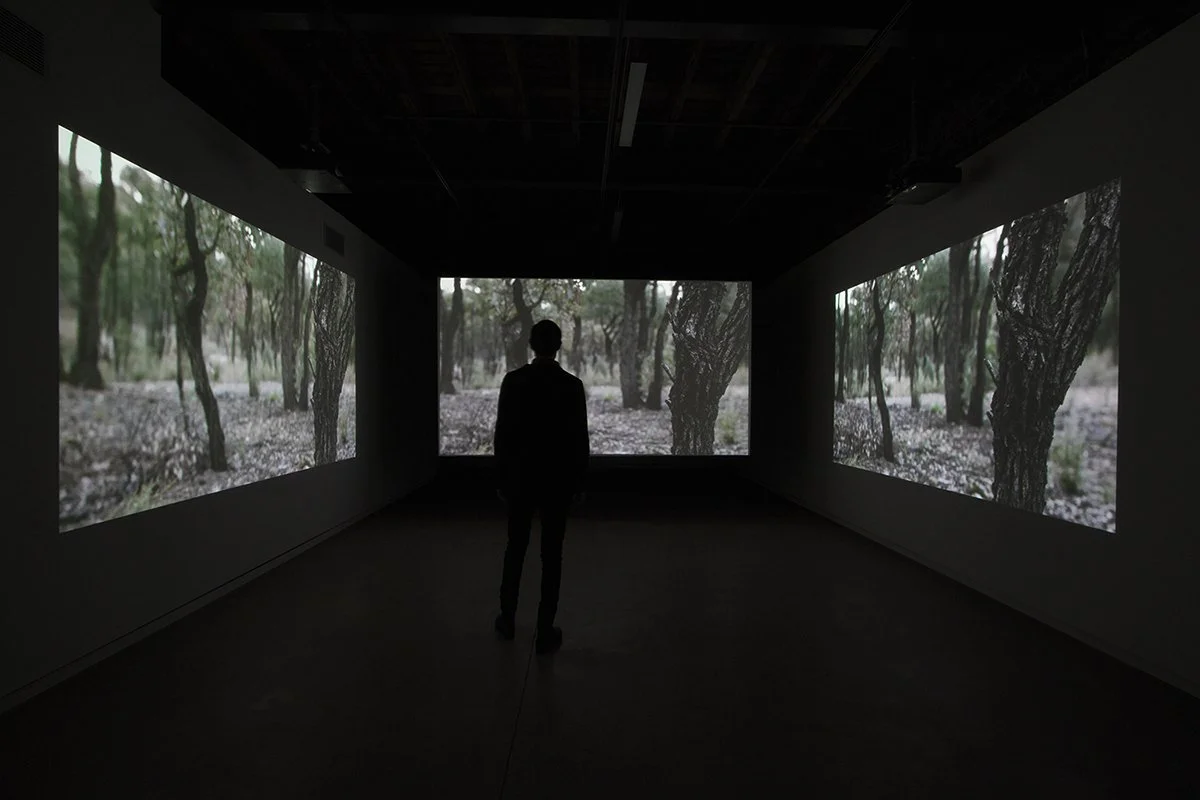
Dawn Roe, Goldfields (Installation View); Screen Space Gallery, Melbourne, VIC, Australia, 2012
A relevant example from several years later might be my project, Conditions for an Unfinished Work of Mourning: Wretched Yew (2018-2020). In this instance, I found myself compelled to spend time with a particular species of tree I first learned of from Virginia Woolf in her novel, The Waves(4) - a book I’ve returned to again and again over the years first recommended to me by my friend and former art history professor, Dr. Melissa Johnson (who writes beautifully about Woolf in her own practice). For a few years before beginning this work, I had been responding to Woolf’s manner of conjuring the natural world in her writing through a series of smaller projects including The Tree Alone, and The Sunshine Bores | The Daylights – the latter specifically referencing (and visually including) distinct lines from The Waves. In my many revisitations to this book, I kept fixating on the mention of the yew tree – one line in particular toward the book’s conclusion is unforgettable, “Let it blaze against the yew trees. One life. There. It is Over. Gone out.”(5)
So, these trees Woolf would have been writing about were taxus baccata, or English yew, mythologically known as a symbol of both death and regeneration. But, my research led me to learn of another species of yew, taxus brevifolia, or Pacific yew, native to the Pacific Northwest - where I also lived for 10 years in the 1990s, and continue to visit regularly and think of as one of my homes. The storied lives of Pacific yew are complex, involving histories of clear cutting followed by overharvesting the tree to obtain the taxol compound found in the bark. Ultimately, I set out to create a set of elegies for these trees that have been both neglected and revered. Over a 3-year period, I returned to spend time with several old growth yew I got to know through this process and I like to think they came to expect to see me. I’m no longer working on this project, but I still visit them when I’m back in this version of home. (A relevant, text-image based reflection on a component of this work can been read/seen on the Two Inadequate Voices project site here: https://twoinadequatevoices.com/Conditions-for-an-Unfinished-Work-of-Mourning)
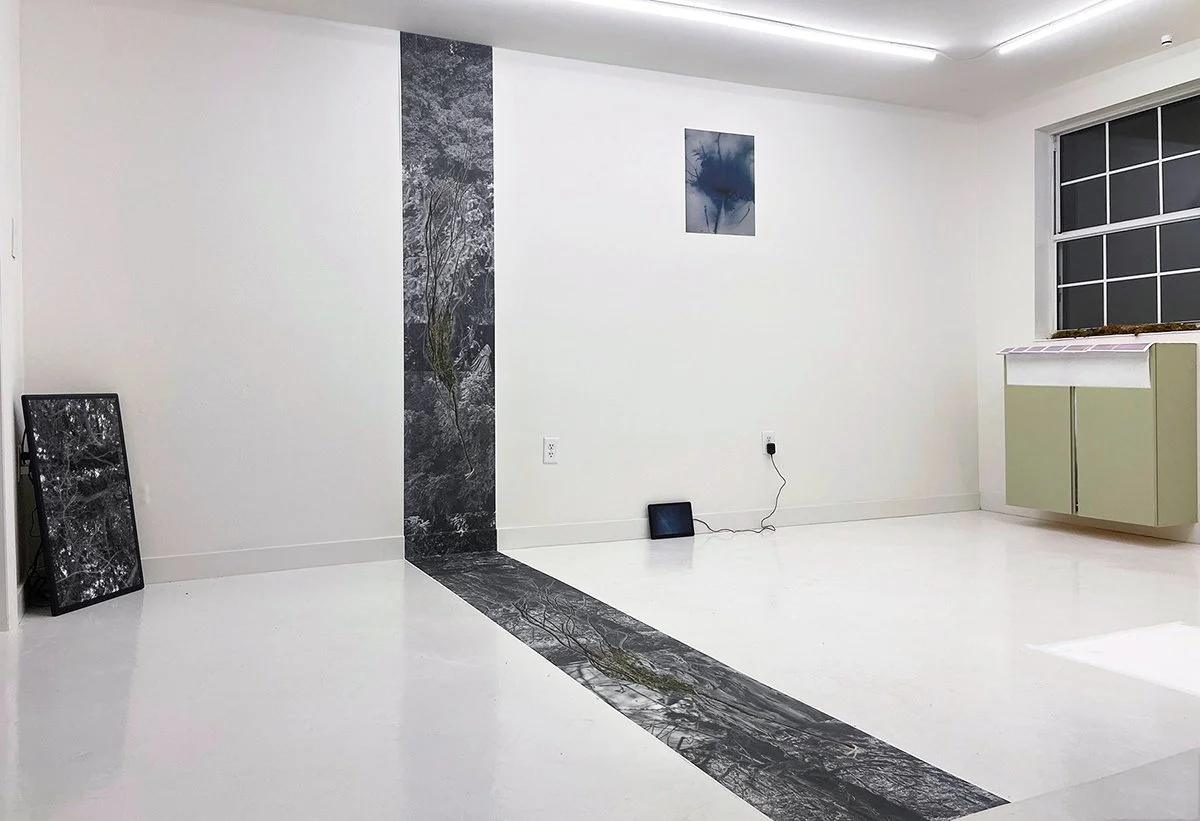
Dawn Roe, Conditions for an Unfinished Work of Mourning: Wretched Yew (Installation View); The Grammar Center, Orlando, FL; 2023
“I can’t ever really know whether a place is asking for my attention, but I want to think I’m showing up with a mindset that is not extractive but generous in terms of the images I may take away and how they will be used and seen.”
Thinking back on these particular engagements with Land* leads me to reflect on the fact that I’ve probably been a bit rude at times by simply inserting myself into a place or situation because of my own interests or curiosities. I can’t ever really know whether a place is asking for my attention, but I want to think I’m showing up with a mindset that is not extractive but generous in terms of the images I may take away and how they will be used and seen. This recognition has very much influenced some of the shifts that have occurred in my approach over the last decade or so. In recent years, I’ve given more deliberate thought to where I find myself – and how/why I’ve made my way there, whether it’s a personal relationship to places I live (or have lived) within, or an opportunity to visit someplace new either by invitation or request.
And, this connects with aspects of an ongoing conversation around ideas of attunement between artists, and researchers AM Kanngiesar and Zoe S. Todd, that I’ll share two brief passages from. Artist and scholar, AM Kanngiesar writes, “I know that my attention brings with it a history that formulates particular kinds of interpretation and representation. Developing attunement means reckoning with this and with being a guest, a trespasser, and a colonizer.”(6) And, researcher and artist Zoe S. Todd acknowledges they have “responsibilities to place and to more than human beings that require I carry myself in a way that is attentive, that is thoughtful, and that is conscious of the impact I have in place.”(7)
“as I continue working within and around traditions of landscape, I make attempts to seek different kinds of permission, find ways to reciprocate, and to give something back. Trying to find ways to be in better relation with place is rightfully slow, ongoing work.”
Following these suggested protocols, as I continue working within and around traditions of landscape, I make attempts to seek different kinds of permission, find ways to reciprocate, and to give something back. Trying to find ways to be in better relation with place is rightfully slow, ongoing work.
*Here, I borrow (with recognition) the particular reference to Land I learned from Max Liboiron’s book, Pollution is Colonialism(8). In footnote 19 on page 6 of the introduction they share that, “Land is a spiritually infused place grounded in interconnected and interdependent relationships, cultural positioning, and is highly contextualized” (300–301). Likewise, when I capitalize Land I am referring to the unique entity that is the combined living spirit of plants, animals, air, water, humans, histories, and events recognized by many Indigenous communities.”
ML: In DESCENT ≈ An Atlas of Relation, fish function as both subjects and conceptual guides. What does attending to fish, across deep time and ecological precarity, make possible?
DR: Wonder, and awe. I find both to be truly life sustaining. A friend asked me not too long ago what has been most surprising about this indefinitely ongoing project, and I told her that I never knew I would fall in love so deeply with the fish, and I’m so glad that I did. Our fish friends have just really seen it all, you know? These transitory beings have been living within and moving throughout the waters that have been their home(s) from time immemorial. And, I’m just endlessly mesmerized by thinking of the fish that swim below the surface of the water, almost always invisibly – some groups managing to stay in their homeplaces, while others meander and return, or find themselves in entirely new territories from one generation to the next.
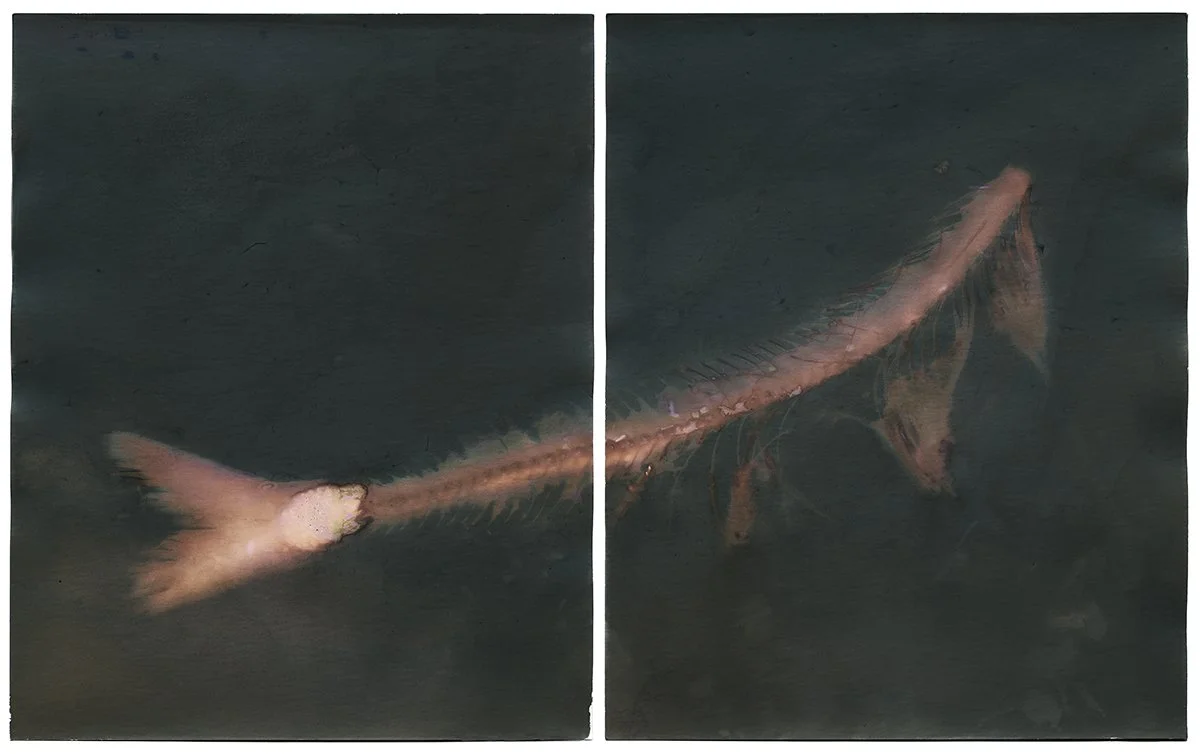
Dawn Roe, with(in) the Bay; adikameg; Coregonus clupeaformis; lake whitefish; pigment print of scanned UV-exposed gelatin silver prints; 19.2 x 29.54”; 2022
I’ve been fortunate to learn with, and from, my best friend from high school, Dr. Heather Dawson, a freshwater fisheries biologist at University of Michigan-Flint, while working on various aspects of DESCENT. She helps me think about Darwinian evolutionary perspectives in a sort of pragmatic way while answering all of my questions about so-called “species management.” It’s kind of great that we both ask one another questions that have us thinking differently, or that we can’t really answer. There is a LOT to consider in terms of how local and global fish populations have been impacted that are too complex to really delve into here – but a mix of truly horrible extractive practices, land theft and subsequent mis-use, and conservation-based “best intentions” have and continue to leave the fish and all the life they support in peril.
In sharing these thoughts, I do want to recognize that some of the imagery I create re-presents the bodies of our fish friends who are no longer in living form. And, these are Beings I came to know through a variety of encounters along the edges of both large and small bodies of water where their bodies came to rest, or may have been acquired naturally and either consumed by myself and my family, or returned to the water.
ML: You describe DESCENT as passage, decline, lineage, and origination. How does this multiplicity of meanings shape the visual and temporal structure of the project?
DR: I love that you reference the visual and temporal together here. This has so much to do with the origin of my approach. There was a merging of thoughts that occurred where I combined some recollections of passages from Rachel Carson’s book, Under the Sea Wind(9), with lines that had stuck in my mind from various writings by philosopher Elizabeth Grosz related to Darwinian concepts of descent read through a feminist framework emphasizing anti-essentialist perspectives of change and transformation. These coalesced somehow – Carson alludes to the oceanic abyss, the visual image associated with an intensely heavy, sinking underwaterness, and Grosz to the temporal with references to the slow slog of geologic time and evolutionary relation (both ecological and ancestral). This line of thinking helps me continually push against hierarchical ideas of the human body as dominant – both as image originator and perceiving subject. As poet and artist Cecilia Vicuña suggests, “no one is exclusively human or twig or animal.”(10)
I specifically hooked into the word DESCENT from Elizabeth Grosz, though. She writes, “Descent, the continuity of life through time, is not the transmission of […] regular, measurable periods of time […] but the generation of endless variation, endless openness to the accidental, the random, the unexpected.”(11) And, I’ve been approaching this through varied attempts at visualizing distinct yet related forms of descent – as passage, downward movement, decline, sinking, legacy, origination. These terms might suggest the act of submerging into depths of water, but also relate to ancestry not only in terms of who we come from, but where we come from - and what role heritage and geography play in our relation to/with place.
“...essentially, I am recording all moments of encounter, placing fish bodies or related aquatic materials on top of basic darkroom paper and letting the sun do its work to create an imprint while simultaneously recording video of this quasi-performative process, inserting and insinuating my own role as a human body within this cycle.”
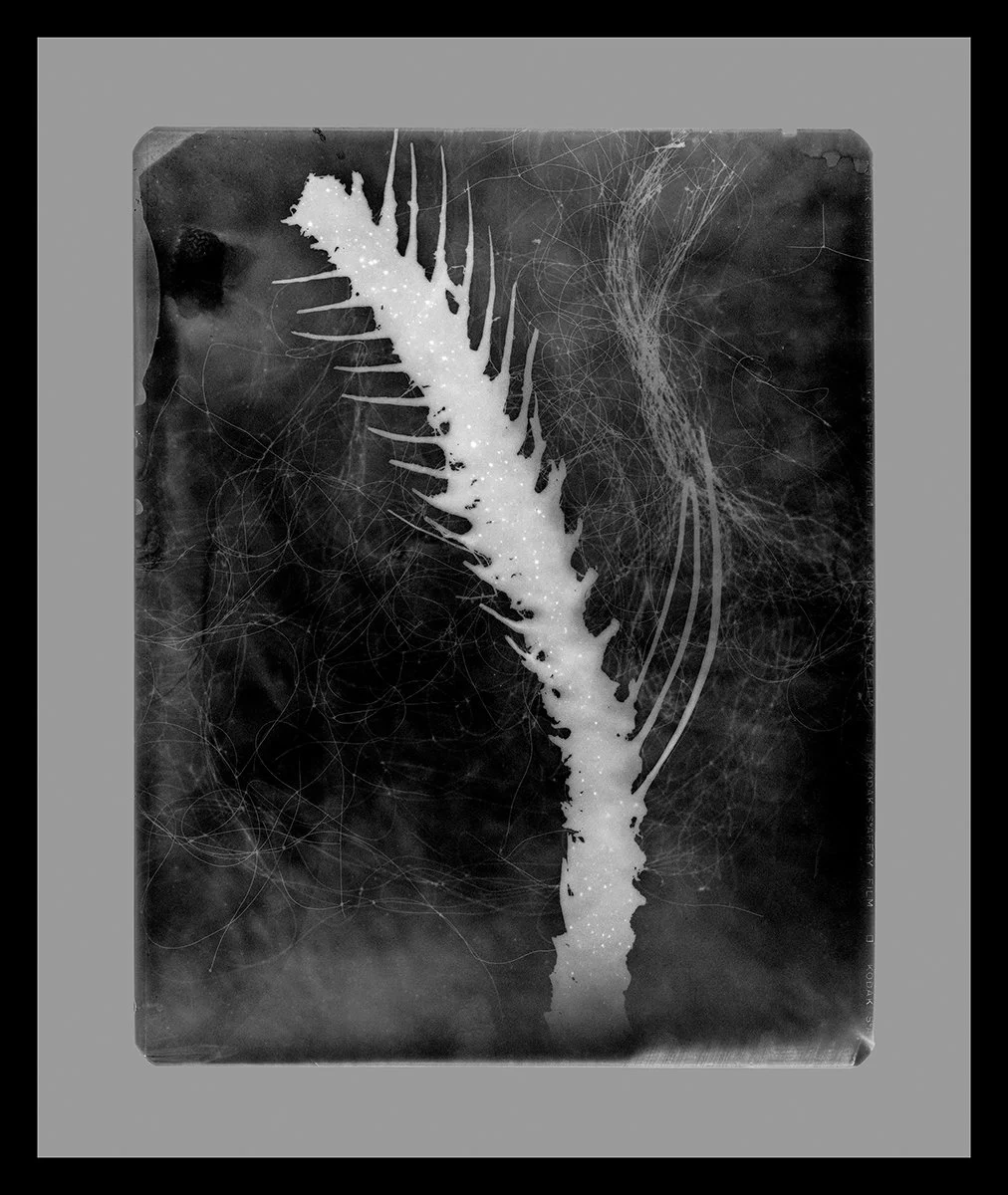
And, of course, we can only relate to place in and through time. So, I try to think about how I can use photosensitive materials and reproduction methods that operate across various timescales. In some works I incorporate multiple, video-captured moments that are interrupted and disjointed by an overlaid image of the same moment in its reproduced contact print version – essentially, I am recording all moments of encounter, placing fish bodies or related aquatic materials on top of basic darkroom paper and letting the sun do its work to create an imprint while simultaneously recording video of this quasi-performative process, inserting and insinuating my own role as a human body within this cycle.
And these analog, contact prints are foundational to this work as they function as frozen traces, or relics, presumed to be stable. Yet, the corresponding video recordings counter this stability by reshaping material into infinitely reproducible experience. So, these paradoxical considerations of time as both forever halted and endlessly cyclical very much inform how I've approached this work so far, and how I intend to continue what I know will be an ongoing process of rethinking my relationship to the Land as a very temporary visitor – one whose actions have impact on present day life forms, and for future descendants in whatever form they may take.
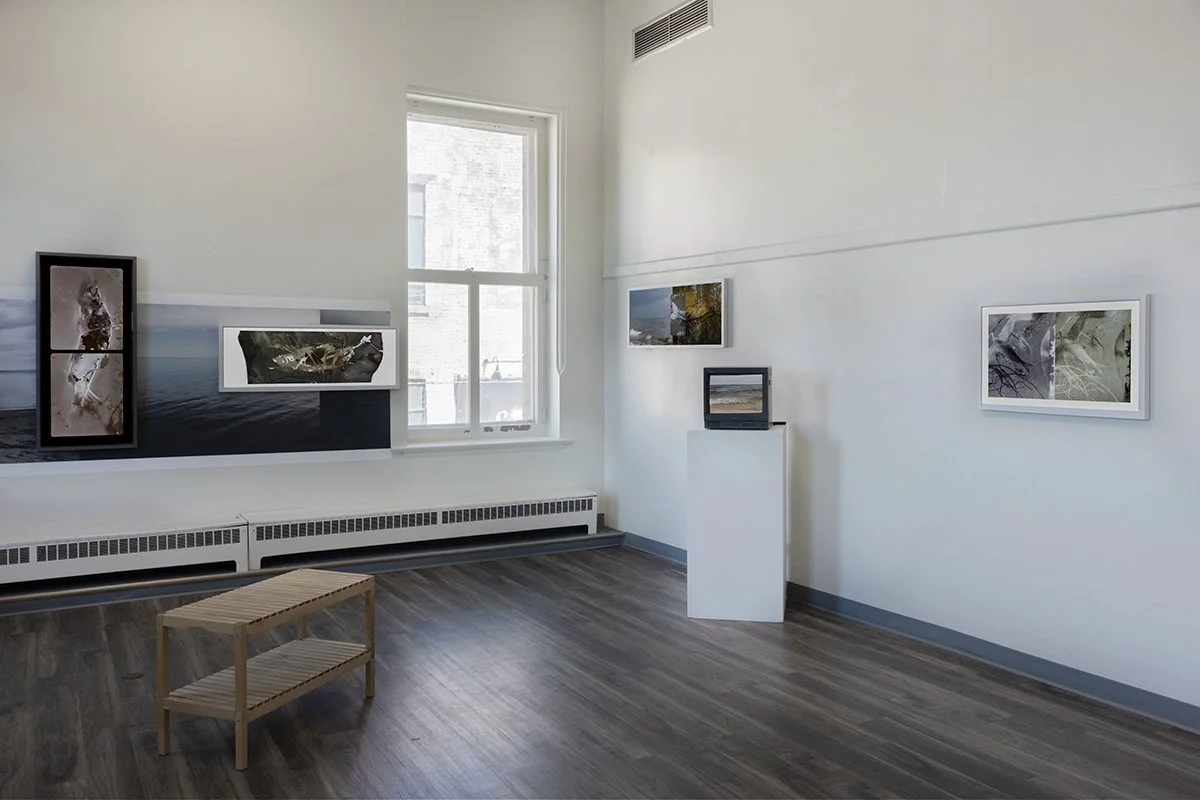
Dawn Roe, DESCENT ≈ An Atlas of Relation (Installation View); Sault Ste. Marie Museum, Sault Ste. Marie, ON, Canada; 2024
ML: Time operates slowly and unevenly in your work, particularly through UV-sensitive and durational printing methods. How do these processes influence your understanding of ecological change and interspecies relations?
DR: Unevenly is such a great way to describe it, particularly as I work very loosely in terms of technique. There are several still and moving images I created for the first installment of the DESCENT series that visualize a tangled mass of gillnet. This material was gifted to me by a fishing crew coming off the water one day. They recovered the netting (sometimes known as derelict fishing gear or the aptly named, ghost net) while out exercising their treaty fishing rights. And, over the past couple of years I’ve had some pretty amazing conversations with both state and tribal freshwater researchers, fisher people, and various community members about industrial impacts and commercial and personal use and misuse of land and water leading to an ongoing and irreversible cycle of “species management.”
“All of this thinking of course requires recognition of how private and public land acquisition and corresponding histories of displacement (have and continue to) physically and culturally re-shape land and water relied upon by a multitude of species, in very different ways.”
These disruptions impact ecosystems over prolonged periods and are often unseen. One of the ways I’m thinking about this is through the use of X-ray film as one of my imaging systems. We tend to associate X-rays with some type of disturbance to a body – in the case of images created with the ghost net, the disturbed body is the massive expanse of Lake Superior and the whitefish within whose populations continue to decline. When I create imprints placing the intricate scales of whitefish in relation to the spider-like, overlapping threads of ghost net as I watch the water slowly move back and forth across the material, I find myself wondering what the whitefish might like to share with us, about their experience in this glacial lake where their families were once too large to be counted. All of this thinking of course requires recognition of how private and public land acquisition and corresponding histories of displacement (have and continue to) physically and culturally re-shape land and water relied upon by a multitude of species, in very different ways.
“Thinking of climate change as climate difference has led me to consider a more embodied position within my own site-responsive approach to working within and upon the land and water - where direct interactions might lead to an awareness that recognizes this kind of difference as subtle shifts over time, where durational printing methods seem not only correct, but vital.”
Of course, all of these habitat disruptions I’ve been alluding to lead to changes which occur within a set of conditions – or a climate, one that is continuously shifting into difference. Thinking of climate change as climate difference has led me to consider a more embodied position within my own site-responsive approach to working within and upon the land and water - where direct interactions might lead to an awareness that recognizes this kind of difference as subtle shifts over time, where durational printing methods seem not only correct, but vital.
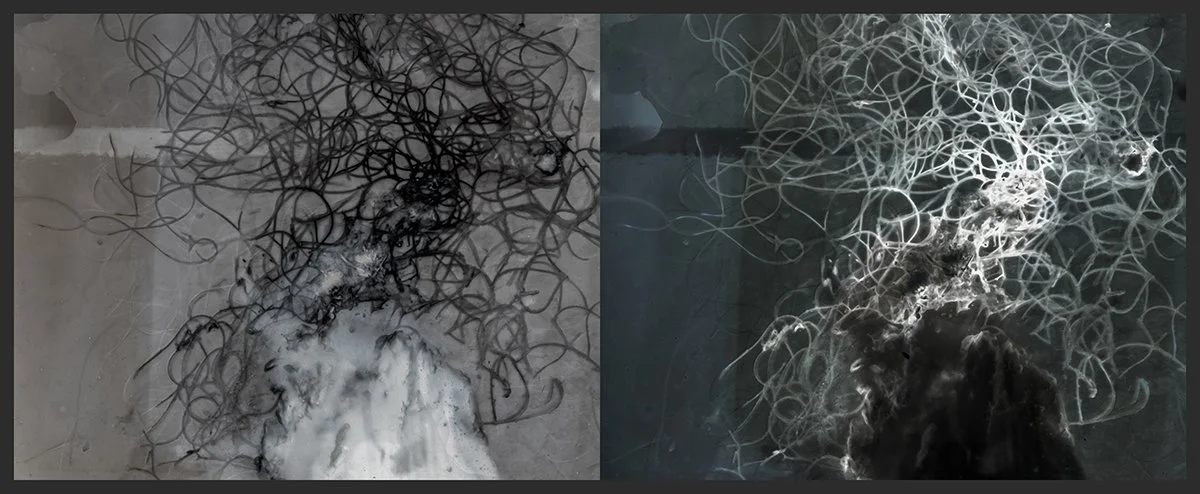
Dawn Roe, ghost net and scales; positive/negative; pigment print of scanned UV-exposed X-ray film; 42 x 16.7”; 2022
ML: Many of your images emerge through repeated observation rather than singular moments. What does repetition allow you to see, feel, or learn that immediacy cannot?
DR: Gosh, I hope the world sees me looking back and caring more deeply – seeing or sensing my return. The images I create become impressions, imprints, residue – all formed in the process of being left behind. I keep trying to think about how I might make some moves to help these multi-species creatures along, so they might show me the images they’d like to make, to leave behind. This takes more than one moment.

Dawn Roe
ML: How do you understand photography as both a recording device and an intervention when working in fragile or disrupted aquatic ecosystems?
DR: Oh it’s so delicate and I feel so many conflicting emotions when I show up with my materials, even when it might just be paper or sheet film. It’s just never not intrusive, you know. And presumptuous. But I hope that what I am recording is done so respectfully and not causing further disruption, and that these images are valuable and in some ways necessary to the archive I’m inevitably always contributing to.
ML: Your practice foregrounds “response-ability” in relation to land and water. How has acknowledging your position as a white woman of settler ancestry reshaped your methods, ethics, and pace of working?
DR: In every single way. I’ve been alluding to these aspects in my above responses, but it all bears repeating and reaffirming. I believe it was from Donna Haraway that I first heard/read the term responsibility broken down into its core components of response, and ability. This is meaningful, and direct. I can remind myself to ask questions about what an ethical response might look like while simultaneously thinking about what I am able to do in/with my position(s) of privilege. Care and reciprocity are so important here. As I’ve alluded to above, a constant rethinking of our (my) positions and perceptions are necessary and I should also add a willingness to be corrected or apologize when making missteps. I know I’ve moved too quickly at times or have been less thoughtful than I could/should have been. Responding more slowly takes continual efforts. I think a lot about socio-economic distinctions, as well, in terms of what I’m able to give back in monetary forms. Though I come from a working class background, I now find myself in the (often uncomfortable) realm of academia – a space where pockets of funding are sometimes available. I include lines in my budgets for stipends I can offer to people or organizations within communities I have opportunities to work within and learn from, which is one of the ways I try to mindfully participate in the redistribution of funds acquired by institutions that have benefitted from exploitation and resource depletion.
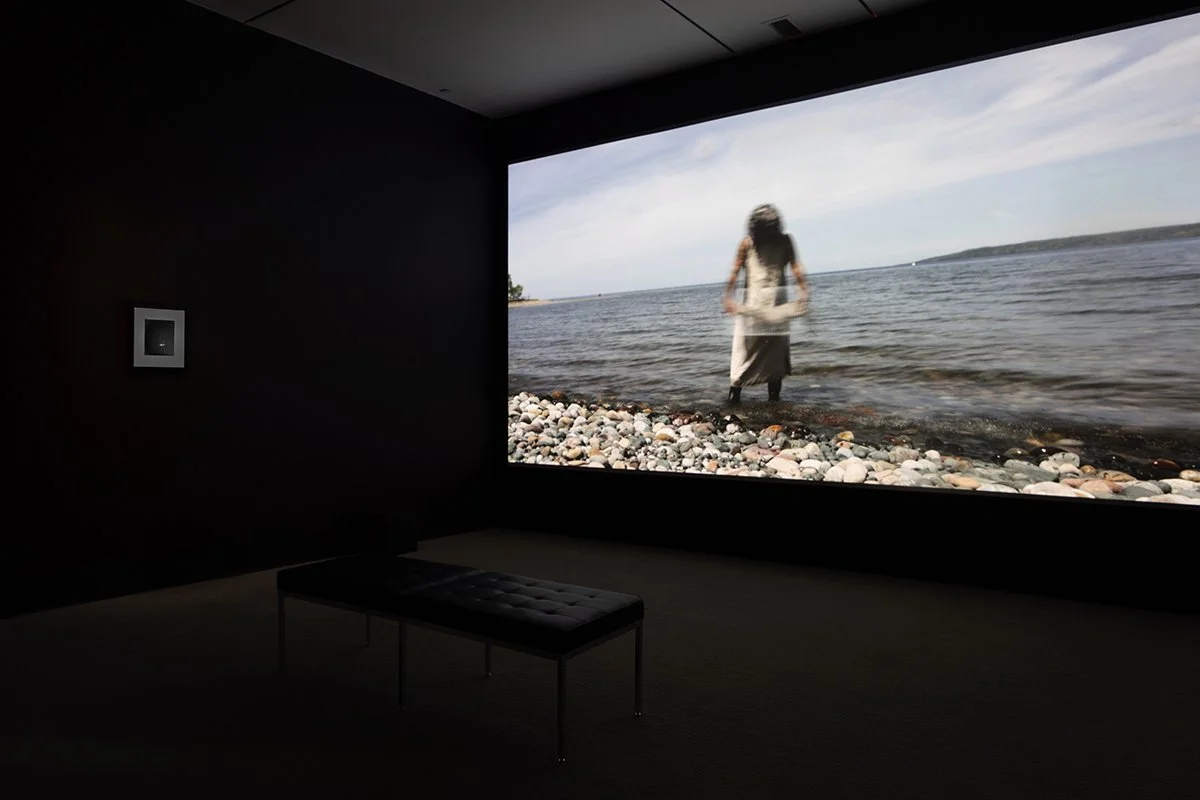
Dawn Roe, The Pulowi Assembly; Theater of Enforcement at Sea, v. 2 (Installation View); Rollins Museum of Art, Winter Park, FL; Single-Channel HD Video with Sound; 12 minutes, 57 seconds, 2025
ML: The Great Lakes region is foundational to your work, particularly the waters surrounding Sault Ste. Marie. How do personal familiarity and historical complexity coexist in your engagement with this place?
DR: It’s kind of hard to articulate, because so much of this coexistence is phenomenological. Something about those waters made an imprint on my mindbody very early on, to be sure. There is another story I’ve been recounting lately as I’ve been speaking and writing about this current/ongoing work that is relevant here. I have these photographs from my baptism I’ve fixated on for years – I’m being placed under water that has been deemed holy, but is most certainly drawn from the St. Marys River just down the road from the church the pictures were taken in – and my godfather is in these images. His name was Maurice “Mo” LeBlanc and I really only ever knew him through these pictures. He was the best friend of my father, who of course is also in the pictures. Both of them are gone now.
One afternoon several years back I was randomly looking into old newspaper archives from our small town looking for any stories about them. One article from 1973 was quite a shock to me – embarrassingly so, as it recounts a history I should have been aware of. The article details – in derogatory language – the most recent arrest of my godfather, a member of the Bay Mills Tribe, who was repeatedly cited for “illegal fishing.” The article glibly makes note of the fact that Mo claimed to be exercising his treaty fishing rights, which of course he was. This is not an uncommon story across the Americas, and there are a number of pretty well known court cases re-establishing treaty hunting and fishing rights – including one that originated with the Bay Mills Tribe involving the years-long battle initiated by “Big Abe” LeBlanc. But, that I was unaware of this profound history in my hometown has been deeply troubling. This is one of the reasons I started thinking with the fish.
ML: Borders, including ecological, political, and maritime, appear as recurring forces in your projects. How do borders complicate ideas of home, stewardship, and shared responsibility in water-based environments?
DR: You’re right, I keep finding myself drawn to the strangeness of these kinds of false edges and lines – demarcations that are entirely fabricated and so, I suppose, can never be felt, by human bodies, water bodies, land bodies – nobody. Certainly not the fish, they’ve been living within and moving throughout the ever changing waters that have been their home for millions of years.
But, our fish friends that live in our own time period swim between more recently drawn borders related to privately “owned” land and water. I had one encounter a few years back with a longnose sucker likely wounded by an eagle laid to rest in a small tributary running through 26,000 acres of private land, now closed off to its original human inhabitants. I was there, though, because I was given special access as an artist alongside a scientist – but members of the local tribes in the community are greeted by security guards at a locked gate. Yet the private club is stewarding the land, and there is a wildlife foundation so all is well, right? It feels very much not right within those fenced in forests. Echoing the question asked to me by Dr. Marty Reinhardt, the recently retired head of the Center for Native American Studies at Northern Michigan University in Marquette, Michigan – how have the tribes been involved [in this stewardship]? On my two separate visits to these lands, I did not receive any sort of answer. I hope this will change.
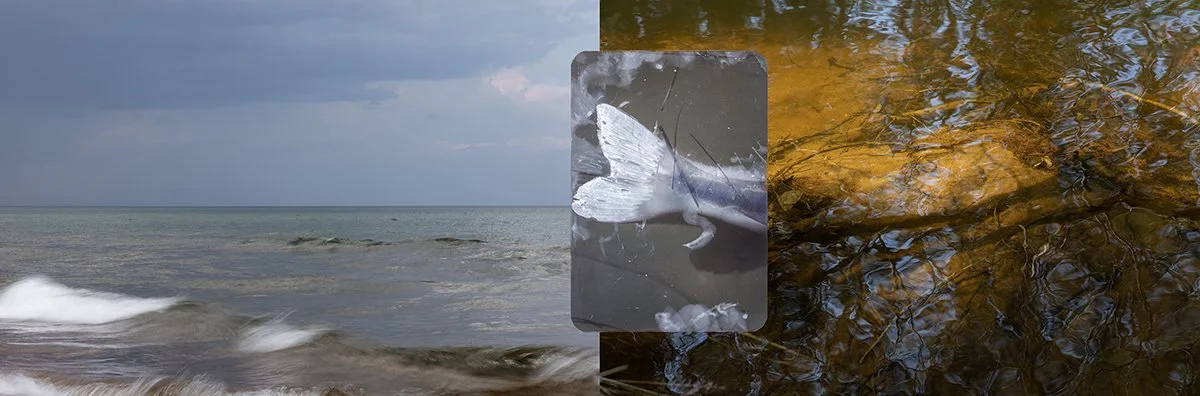
Dawn Roe, recover and return; tailfin of fish sometimes known as bakaan namebin; Catostomus catostomus; longnose sucker; (over waters currently known as lake superior and pine river); composite pigment print of scanned UV-exposed X-ray film and digital images; 14 x 44”; 2022
ML: In Perpetually am I Troubled, you describe bodies and landscapes as “phantom residue.” How does disappearance function visually and conceptually across your still and moving images?
DR: The title in full reads as “perpetually am I troubled, stirred, frozen, or smothered by the noise of your death,” and it comes from a (translated) line in Luce Irigaray’s book, Marine Lover of Friedrich Nietzsche.(12) In some ways, that’s neither here nor there, but all that underlying textual reference is itself a sort of phantom residue if we consider Ursula Le Guin’s suggestion from her Carrier Bag Theory of Fiction essay that, “A book holds words. Words hold things. They bear meanings. A novel is a medicine bundle, holding things in a particular, powerful relation to one another and to us.”(13)
I liken this medicine bundle, in some ways, to the alchemy of photography – bringing the compounds of light and time together with the physical matter of bodies interacting with silver. Analog photography is made of these things – an image can be made with no need for a camera, durational impressions are recorded as ultraviolet light waves move through and around whatever is placed on top of chemically treated paper causing silver atoms to clump together – over time this silver is freed by the light energy, bringing out the image.
And, we can extend these waves and particles to the moving image, as well – this connects with my own emerging engagement with feminist theorist Karen Barad. If these light waves and silver can be thought alongside her notions of intra-activity, we might consider, as she does, how “[spooky] thought experiments made flesh”(14) point us toward the trace residue of intra-actions that remain within the fabric of the world. As she says, “it takes work to make the ghostly entanglements visible.”(15)
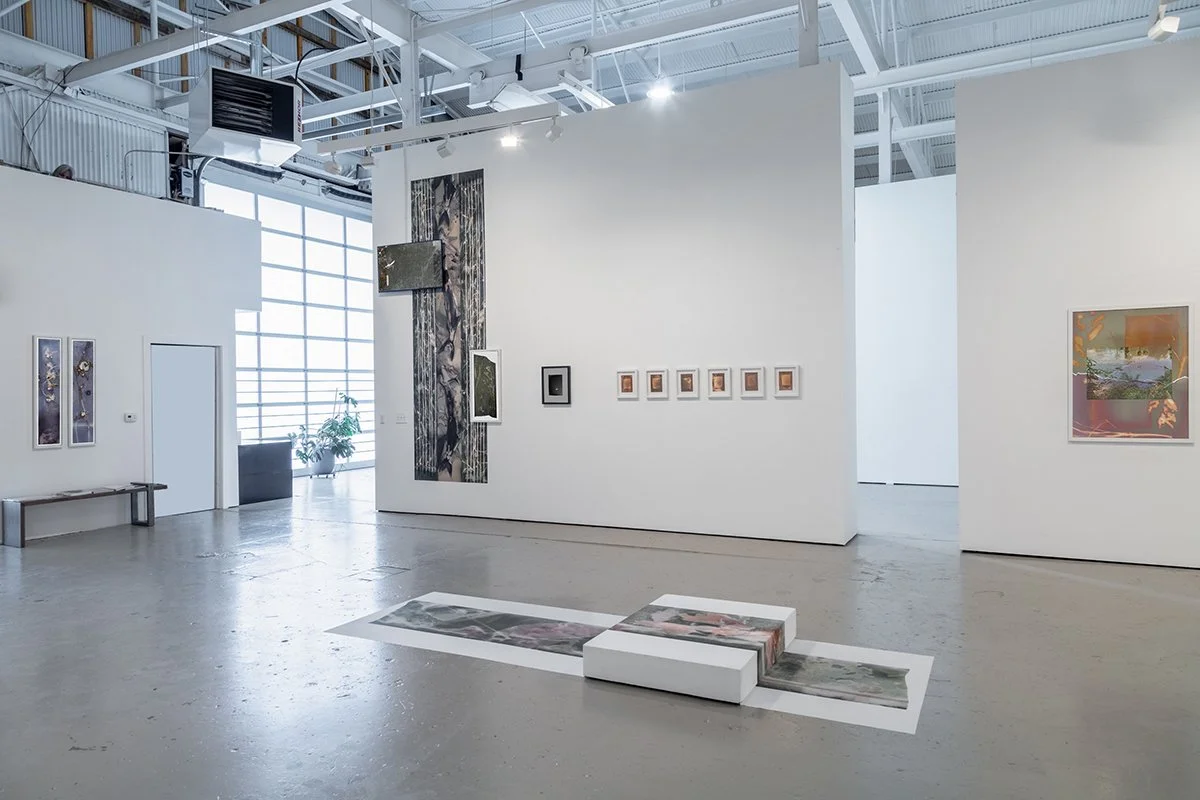
Dawn Roe, Super | Natural (Installation View); Tracey Morgan Gallery, Asheville, NC; 2026
ML: Your installations often place screen-based, cyclical images alongside fixed prints. What kinds of temporal or emotional tensions are you interested in generating through this juxtaposition?
DR: This gets back to embodiment again. There is a physical interaction necessitated by engagement with the moving image when placed in relation to its still counterpart within a shared space. My recent exhibition, Super | Natural, was installed in a way that deliberately pushed at these tensions. As noted above, photography as alchemy is supernatural indeed. And the printed forms hold the time of these encounters in one way. In their framed, stable form they sit frozen (embalmed even, as Roland Barthes might suggest) in direct relation to their moving image counterparts as looped videos that re-present, extend, and repeat these relations – somewhat differently in each of the three videos in this particular exhibition. The first video gestures to a certain kind of choreography, where my performing body becomes part of the record, insinuating my own actions as fabrication. The second video brings material from distant locations together using forms of direct-animation on Super 8mm film overlaid with digitized prints and video recordings, and the third (and most recently completed) corresponds with a camera-less print exposed on the bottom of a creek bed that has been digitized, enlarged, and printed on adhesive vinyl affixed to the floor in the gallery – both the looped video and floor-based print refer to the shallow, underwater spaces where ground and sky are thinly separated.
There is something about noticing both stillness and movement that is inherently jarring. Feminist film theorist Laura Mulvey describes the image of life in the cinematic/moving image as necessarily haunted by deception – [where] the presence of the past is also the presence of the body resurrected, [triggering] questions that still seem imponderable: the nature of time, the fragility of [life] and the boundary between life and death.”(16)
ML: Conditions for an Unfinished Work of Mourning engages histories of exile, displacement, and death through landscape and early photographic processes. How do you approach sites where human trauma is embedded in the land itself?
DR: As you can imagine, this occupies my thinking each time I situate or re-situate myself in familiar or new spaces. Human trauma is very likely embedded everywhere in often unannounced or never known forms. The first installment of this two part series was initiated on the Spain/France border in 2017. Here, I was very delicately negotiating a set of sites where the traumas were very present, with every step and every glance – these mountains hold centuries of conflict but also the very recent past involving still living families, and a history with stories that were not my own to tell. I was extremely mindful of this while spending time in these locations and was looking to these landscapes and surrounding natural materials as metaphoric markers of time, loss and history, with a more pointed emphasis upon linking these aspects with the political and ecological predicaments within the U.S. and globally that had dramatically shifted during this time period of 2017.
I approached these sites as a respectful observer, open to phenomenological occurrence, maybe a sort of enchantment even – standing along the trails of the Pyrenees mountains overlooking the Mediterranean Sea, potentially having a strikingly similar visual experience to those who used these trails leading through the Spanish city of Portbou as paths of exile. This particular border was a major crossing point during the Spanish Civil War and WWII, as well as the site of philosopher and cultural theorist Walter Benjamin’s suicide following an unsuccessful attempt at fleeing Nazi persecution in 1940.
The primary title of this series, Conditions for an Unfinished Work of Mourning, is drawn from a line in an Ariella Azoulay essay(17) from 2001 in which she poses questions about the visual work of death in the age of mechanical reproduction – the essay is of course a direct allusion to Walter Benjamin’s timeless essay, The Work of Art in the Age of Mechanical Reproduction(18) (or, Technological Reproducibility, depending on which translation you prefer). In Azoulay’s essay, she devotes special attention to Benjamin’s insights about the representation of loss and death in modern visual culture. She connects the space of the museum with the medium of photography as modes of looking and seeing, and suggests that they “share a similar motivation: to help the apparition of the lost image, but that they ultimately produce the conditions for an unfinished work of mourning.”(19) Exhibitions of this work took the form of various installations of related elements – which I thought of as attempts at producing my own conditions for the histories and spaces I was drawing upon.
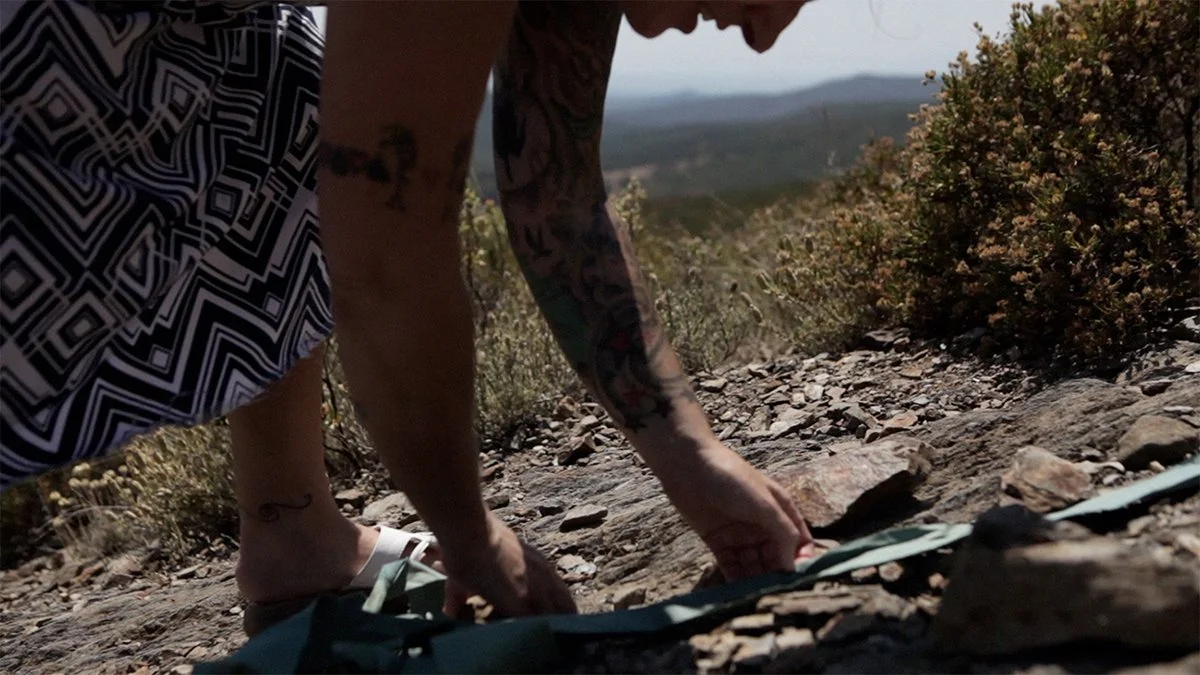
Dawn Roe, Conditions for an Unfinished Work of Mourning: Beauty as an Appeal to Join the Majority of Those Who are Dead (Video Still); Single-channel HD Video; 9 minutes, 47 seconds (silent)
I also chose to very deliberately include my own female-presenting body in the moving image components of this work as a deliberate nod to the contributions of women within the overlapping narratives I was connecting with while working on location, and one of several ways I chose to reinscribe the role of women in these histories. Among these women were resistance leader Lisa Fittko who led numerous refugees across the Pyrenees during WWII – including Walter Benjamin in 1940 – and Anna Atkins*, an early practitioner of the cyanotype process and the producer of the first ever book illustrated solely by photographs.
*Quick note to acknowledge the need for a nuanced understanding of Anna Atkins as detailed by artist Marie Smith in the text accompanying Smith’s project, Extraction: In Conversation with Anna Atkins.(20) Smith tells us that, “Anna Atkins is recognized as the first woman photographer to create a book of photographic illustrations, making her a notable figure in both art and history. She was married to John Pelly Atkins, a man whose family benefited financially from slave ownership in Jamaica. Atkin’s family received compensation that was paid to the Atkins family alongside other former slave traders at the expense of the UK taxpayer that was paid off in 2015. This aspect of her background provides context of how she was able to finance her artistic practice.”
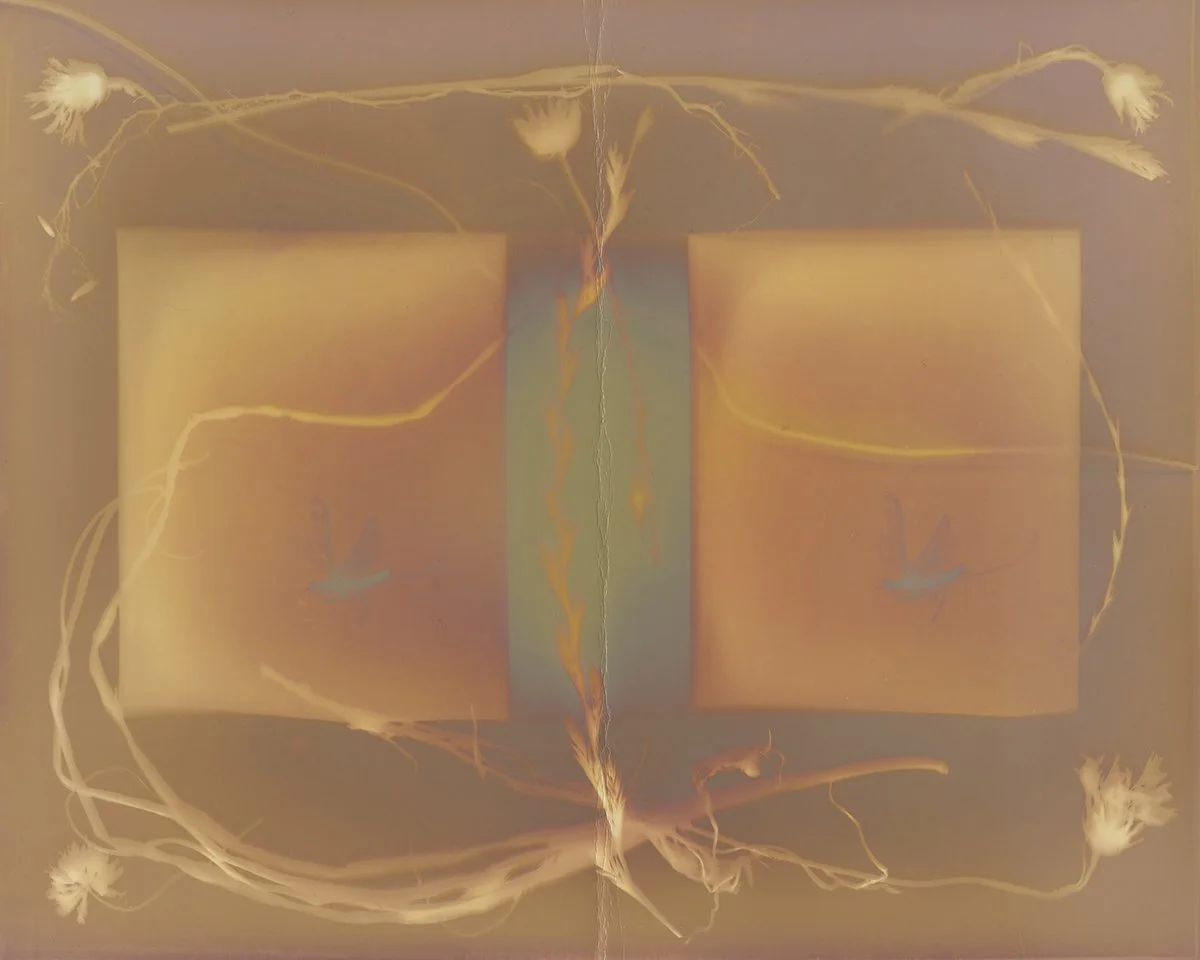
Dawn Roe
ML: Cyanotypes and camera-less techniques play an important role in your recent work. What do these historical processes offer you when thinking about aura, presence, and absence today?
DR: I have this sort of ongoing internal battle with myself about photography, and what led me to first begin incorporating camera-less techniques had to do with feeling as though I had exhausted every viable approach to documenting, recording, or responding to landscape in particular – with a camera. For years, I had been thinking deeply about re-presentation and breaking it down to its fundamental meaning – to present, again (and again, and again, and again). I thought a lot about how breaking down the image to its constituent parts might influence a viewer’s response – as a way of highlighting the fragmentary and incomplete nature of perception – so I was very much moving away from traditional, photographic conventions that kind of expect a series of distinct, single images. I started creating diptychs and triptychs quite a bit as well as sort of slicing up and reassembling portions of similar spaces as digital composites, also using the ground glass of the view camera as another visual reference to sight, and orientation.
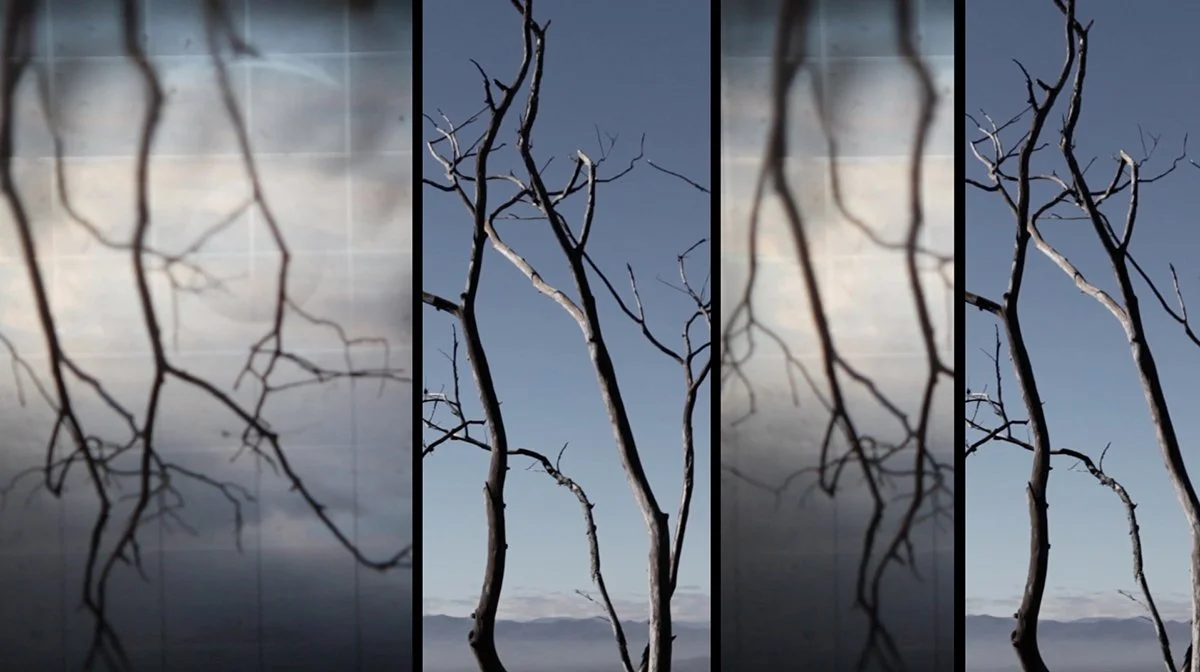
Dawn Roe, The Sunshine Bores | The Daylights (Video Still); Single-channel HD Video; 5 minutes, 38 seconds (with audio contributions by Rachel Blumberg); 2017
I was thinking a lot about how cameras see as influenced by both human perspective and perception, through a lens, and then trying to consider how the world might reveal itself more directly – through physical imprints. This led me to incorporate the cyanotype process as a means of recording imprints of duration, often resulting in abstractions rather than a re-semblance of any particular thing. The work in Spain was where I first recognized how valuable camera-less methods were for stripping the photograph down to its ontological essence – which is the aura that’s both created and held by light and time. So simple and beautiful.
The way most of us might think of the term aura is as a sort of metaphysical presence that emanates from an object, or a person. Many of us also think of aura as described in Walter Benjamin’s various writings on the concept – he describes aura as a marker of authenticity or authority; as an historical index of the past; and as a “strange weave of space and time, the unique appearance or semblance of a distance, no matter how close it may be.”(21) Those of us who work with reproducible, lens-based media are never far removed from Benjamin – which I suppose is appropriate if we consider that, like photography, one of the understandings of aura suggests a sort of lingering presence, or historical significance.
And, it was thinking about the relationship to time and history within this particular landscape that led me to subtitle the first volume of the Conditions for an Unfinished Work of Mourning project, Beauty as an Appeal to Join the Majority of Those Who Are Dead. This comes from a translated line from a somewhat obscure footnote in one of Benjamin’s 1939 essays referenced in Miriam Hansen’s 2008 article, ”Benjamin’s Aura.”(22) In this instance, Benjamin describes being moved by beauty on the basis of its historical existence as - an appeal to join the majority of those who are dead. So, really thinking of beauty in relation to the impossibility of ever truly knowing the past as it once was, and the futility of attempting to grasp that which perpetually disappears.
“Though I come from and still to some extent work from within a documentary tradition, I am skeptical of this type of representation, and what we presume it reveals.”
I’d also like to emphasize that my choice to combine camera-less processes that produce unique prints with reproducible digital media (in both still and moving forms) has been very deliberate, and was at least partially intended to challenge prevailing notions that - at times – irrationally value one-of-a-kind objects as particularly precious as, in theory, everything is reproducible. In terms of these aspects of media and material, it’s important to acknowledge the photo-based foundation of all of my projects. Though I come from and still to some extent work from within a documentary tradition, I am skeptical of this type of representation, and what we presume it reveals.
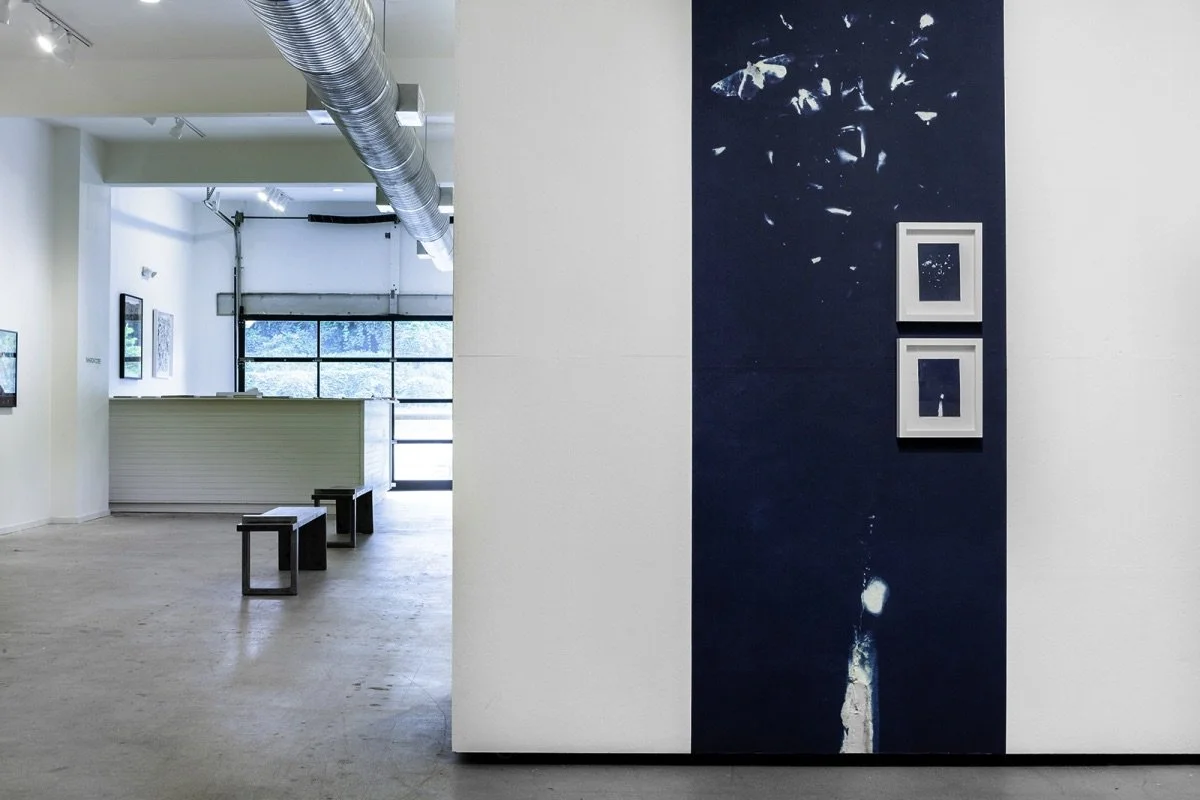
Dawn Roe, Conditions for an Unfinished Work of Mourning: Beauty as an Appeal to Join the Majority of Those Who are Dead (Installation View); Tracey Morgan Gallery, Asheville, NC; 2020
ML: How do you think about collaboration—not only with other humans - but with plants, animals, water, and weather as active participants in your work?
DR: I was just chatting about this with someone as I’ve recently kind of rethought how I use this term, or whether what I get up to in my work is actually collaboration. A couple of years ago, I contributed an entry for an audio guide accompanying a museum exhibition related to environmental justice. In that recording, I described my work as being informed through multi-disciplinary perspectives which, in turn, have shaped my ethical response to our globally shifting climate. I described my process as taking the form of a kind of wandering, looking, and thinking followed by moments of pause where I attempt to hold and record seemingly inconsequential moments of encounter – a kind of collaboration with the world.
“As a visual artist, I’m working to remain committed to my response-abilities as an image-maker in a time of climate crisis by creating imagery that asks us to re-consider how we engage with our environment while seeking permissions (in whatever form that may take) and following (or learning) appropriate protocols when visiting and working within and upon land and water.”
But I’m not sure that’s true, as collaboration suggests willingness and reciprocity. This is where my colonial mindset rears its head again. I feel it’s presumptuous for me to assume a level of collaboration that’s unacknowledged. This might sound silly, but it’s something I’m pondering a lot lately. Certainly these more-than-human Beings are active participants, though, so I try to be as mindful as I can when including their image(s) in my work. As a visual artist, I’m working to remain committed to my response-abilities as an image-maker in a time of climate crisis by creating imagery that asks us to re-consider how we engage with our environment while seeking permissions (in whatever form that may take) and following (or learning) appropriate protocols when visiting and working within and upon land and water.
ML: Beyond visual artists, what writers, theorists, or thinkers have played a formative role in shaping your approach to place, time, and interspecies relations?
DR: SO MANY! I’m just rolling off a quick top of my head type list as a sort of exercise so I’ll certainly be leaving some out, but… Virginia Woolf, Wendy O. Williams, Leanne Betasamosake Simpson, Maya Deren, Yoko Ono, Donna Haraway, Hildegard von Bingen, Motörhead, Andrei Tarkovsky, Sam Cooke, Astrida Neimanis, Bette Davis, Mary Oliver, Adrienne Rich, Cecilia Vicuña, Maurice Merleau-Ponty, Henri Bergson, Claudia Rankine, Stevie Nicks, Anna Tsing, bell hooks, Diamanda Galas, Marcel Proust, Patti Smith, Octavia Butler, Ursula Le Guin, Joan Didion, Robin Wall Kimmerer… and, more recently, Karen Barad, Eduardo Kohn, and Max Liboiron.
Do ALL of these references relate specifically to place, time, and interspecies relations? Though it may not seem so at first glance, I can’t say they do not - this is the heart of embeddedness, no? There are energies and insights I gain from reading or listening (or both) to all of the folks on this list, and they build off one another in my mind - sometimes keeping me in check and reminding me to do better work, which is very necessary.
Dawn Roe
ML: What role do archives, both ecological and photographic, play in your thinking about legacy, transgenerational relations, and the future reception of your work?
DR: I guess the biggest role, so it would seem. I’m continually realizing this as it keeps becoming more and more clear that our role on this planet, at this time, is to be a collective of archivists. This isn’t terribly new, of course, but the rapidity with which image making, producing, and collecting technology is advancing in our lifetime right alongside the speed with which our climate is shifting into drastic difference perhaps necessitate a more deliberate, consistent, and maybe more experimental or less conventional form of archiving. It’s not unusual to learn of people, places, and communities that have been left out of archives, or to come across materials that offer limited pictures (for lack of a better term). That’s part of why I’m being so thorough (or perhaps tangential) in my responses here – I want to think of this as archiving a particular moment in my own thinking about my work as one among many respondents to the world, this world, right now.
Related to this, I can share a tiny bit about an ongoing series of workshops I lead whenever and wherever I can called Marking Time With(in) the Water, a participatory exercise I designed to promote collective engagement with varied bodies of water and related shoreline spaces. I lead community members through a basic, camera-less process while emphasizing the durational nature of the method in relation to the deep time embedded within land and water continually re-shaped by disturbances, both observable and invisible. I’ve been archiving the images created in these workshops in the hopes we might begin to assemble a collection of prints visualizing our interconnected watersheds and the many living beings supported within and throughout as integral members of both local and global communities in perpetual states of transition. I’m increasingly announcing this as a hydrofeminist* action, in recognition of the influence of this concept/movement on the project.
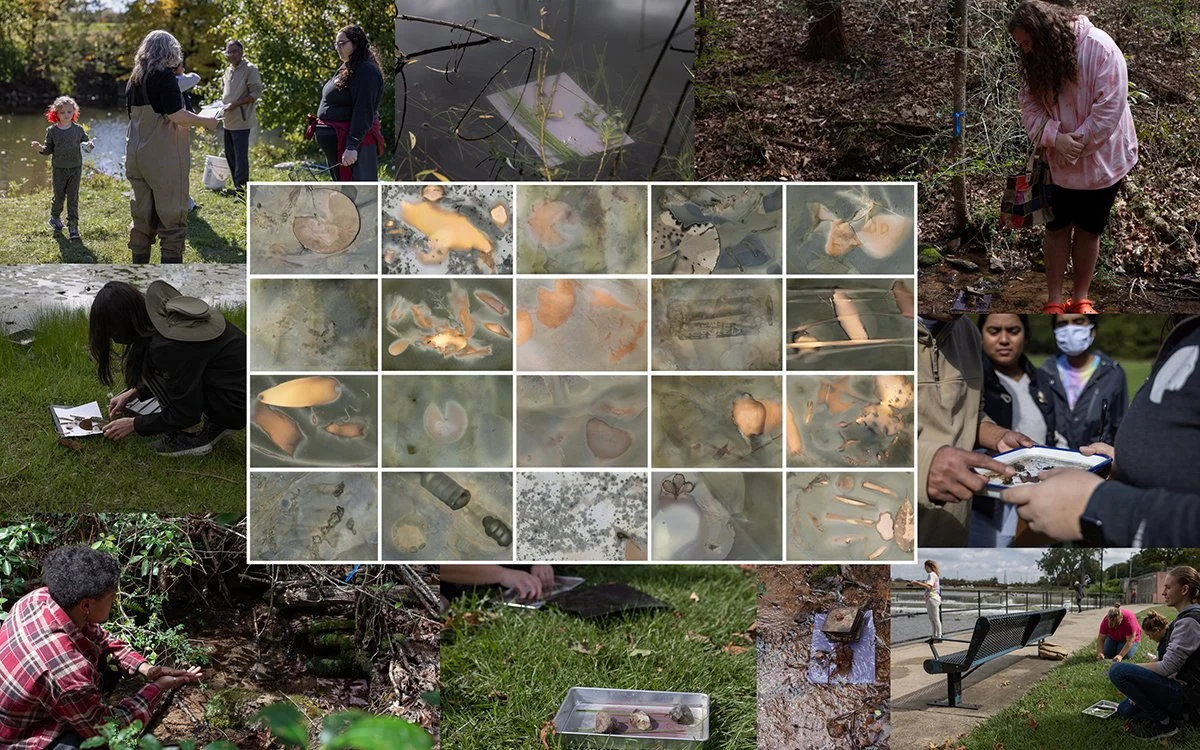
Dawn Roe, Marking Time With(in) the River (digital composite image from ongoing series of participatory workshops)
ML: Looking ahead, what questions or uncertainties continue to rouse you, and how do they propel your ongoing engagement with photography, place, and environmental change?
DR: For me, there is a constant unease surrounding the frenetic energies I mention above propelling the rapid changes we are contending with that pushes against slowness and the mindful time needed for careful deliberation and observation. Material and cultural things now seem to occur, unfold, and impact our lives within a single generation that in the not so distant past would have only been known through passed down stories. This makes me think of one of my favorite lines from Virginia Woolf’s book, The Waves, where she writes, “I hate all details of the individual life. But I am fixed here to listen. An immense pressure is on me. I cannot move without dislodging the weight of centuries.”(23) These lines were written (or at least published) in 1931. Can you imagine the pressure Woolf would be feeling now? This kind of attentiveness to bodily agency and personal responsibility alongside considerations of stillness and temporality give me a certain kind of permission to be okay with, and to value, long and extended engagements with people and place, with no expectation of any sort of immediate return. I’m trying to get better at this. The contemporary art world expects a kind of continual output, and working within an academic context accentuates these expectations. I’m committed to giving my ongoing relationships with place and the many lives within all the time they need.
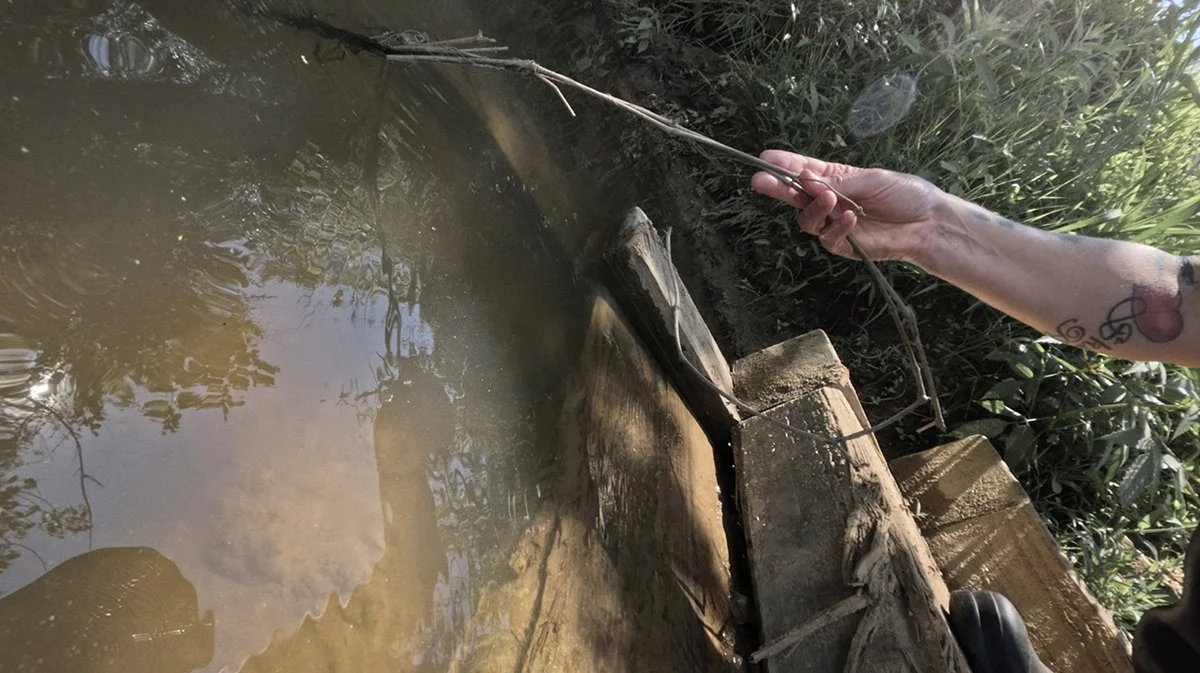
Dawn Roe, for the small waters (video still); single-channel HD video loop (silent); 3 minutes, 29 seconds (silent)
ML: Is there anything else you would like to share?
DR: Yes, I again want to share how special this invitation to be one of the contributors to the GroundTruth archive is. And I want to be absolutely certain I convey the immense gratitude I feel toward the Land and all of its amazing Beings I’ve had occasion to spend time with and learn from while creating images, and to name my own privilege as a white woman from settler ancestry occupying Native Land as an uninvited guest while doing my best to be a respectful co-inhabitant and friend.
I also want to grapple with one final thing here, and I’m not sure whether I can eloquently articulate the tensions I’m feeling around this but want to at least make an attempt. I couldn’t help but think about some of my trans, and nonbinary friends and fellow arts and culture contributors as I was considering the role of this archive, as well as a few who are male-identifying. As a feminist, I recognize the contributions of women STILL continue to be undervalued and often unseen and unheard in our hetero-patriarchal culture. And, I fully understand why archives like this continue to be necessary.
As a white, woman-identifying feminist I also think a lot about the intersectional feminist frameworks necessary to promote equal justice for all underrepresented voices and bodies – both human and more-than-human – and what my role is in supporting and promoting ongoing forms of intersectionality. And, I wonder how our shared practices of care-based engagement with land, environment, and community might continue to grow.
As a closing thought, I want to include an extended excerpt from the entry on hydrofeminism by Astrida Neimanis from the 2023 book, More Posthuman Glossary(24), edited by Rosi Braidotti.
“[F]or hydrofeminism care as and for waters is never “only” environmental. Any calls for sustainable futures must consider how issues of pollution, extinction and meteorological change are also questions of social injustice and infrastructures of inequality. Environmental catastrophe must be understood as a symptom—the proper trickle-down—of deformed human relations that flow across the planet.
We are all bodies of water, but as watery, we are not all the same. And, if we are all bodies of water, then are we all, in some way, already at sea?
untether
In the English language, “to be at sea” is an idiom to suggest discombobulation or confusion. To lose one’s bearings. To be alive as bodies of water, in these catastrophic times, might also be to feel tetherless, and at sea.
As a transfer point of queer time, hydrofeminism is also a praxis of speculation—not only for the futures, but for the many presents that we are already imagining otherwise. For hydrofeminism, then, tetherless can be another way of saying: get free.
step up speak out
say no let go lift up
step back.”
Marcel Proust, In Search of Lost Time, trans. C. K. Scott Moncrieff and Terence Kilmartin, rev. D. J. Enright (New York: Modern Library, 1992).
Sisters of the Holy Names of Jesus and Mary. Fall 2017 Partners in Ministry. 2017. “Sister Joan Maiers,” p. 13.
Haraway, Donna J. Staying with the Trouble: Making Kin in the Chthulucene. (Durham, NC: Duke University Press, 2016).
Virginia Woolf, The Waves (New York: Harcourt, Brace & Company, 1931).
Ibid.
A. M. Kanngieser, Geopolitics of Listening (Durham, NC: Duke University Press, 2017).
Zoe Todd, “Fish, Kin and Hope: Tending to Water Violations in amiskwaciwâskahikan and Treaty Six Territory,” Afterall: A Journal of Art, Context and Inquiry 43, no. 1 (2017).
Max Liboiron, Pollution Is Colonialism (Durham, NC: Duke University Press, 2021).
Rachel Carson, Under the Sea Wind (New York: Simon & Schuster, 1941).
Cecilia Vicuña, interview by Tin House (Between the Covers), https://tinhouse.com/transcript/between-the-covers-cecilia-vicuna/
Elizabeth Grosz, Becoming Undone: Darwinian Reflections on Life, Politics, and Art (Durham, NC: Duke University Press, 2011).
Luce Irigaray, Marine Lover of Friedrich Nietzsche, trans. Gillian C. Gill (New York: Columbia University Press, 1991).
Ursula K. Le Guin, The Carrier Bag Theory of Fiction (Ignota Books, 2020).
Karen Barad, Meeting the Universe Halfway: Quantum Physics and the Entanglement of Matter and Meaning (Durham, NC: Duke University Press, 2007).
Ibid.
Laura Mulvey, Death 24× a Second: Stillness and the Moving Image (London: Reaktion Books, 2006).
Ariella Azoulay, Death’s Showcase: The Power of Image in Contemporary Democracy (Cambridge, MA: MIT Press, 2001).
Walter Benjamin, “The Work of Art in the Age of Mechanical Reproduction,” in Illuminations, ed. Hannah Arendt, trans. Harry Zohn (New York: Schocken Books, 1969)
Azoulay, Death’s Showcase: The Power of Image in Contemporary Democracy, pg.4.
Marie Smith, Extraction: In Conversation with Anna Atkins (visual art project and bespoke photobook, Horniman Museum and Gardens Digital Residency, London, 2023).
Walter Benjamin, “The Work of Art in the Age of Mechanical Reproduction,” pg. 218.
Miriam Bratu Hansen, “Benjamin’s Aura,” Critical Inquiry 34, no. 2 (Winter 2008): 336–75, https://doi.org/10.1086/529060.
Virginia Woolf, The Waves
Astrida Neimanis, “Hydrofeminism,” in More Posthuman Glossary: Theory in the New Humanities, ed. Rosi Braidotti, Emily Jones, and Goda Klumbytė (London: Bloomsbury Academic, 2023).