
Meghan Kirkwood
Meghan Kirkwood is an Associate Professor and chair of undergraduate Visual Arts at Washington University in St. Louis. She earned a B.F.A. from Rhode Island School of Design in Photography before completing her M.F.A. in Studio Art at Tulane University and PhD at the University of Florida. Here work has been exhibited internationally in solo and group shows at venues including Blue Sky Gallery (Portland, OR), Filter Space (Chicago, IL), Bangkok Art and Culture Center (Thailand), ArtSpace Durban (South Africa), and Plains Art Museum (Fargo, ND). Her photographs are held in several private and public collections, including the RISD Museum of Art, the Museum of Contemporary Photography in Chicago, Lewis and Clark University, University of Idaho, Minot State University, North Dakota Museum of Art, and the University of Florida Genetics Institute. Her work has been featured in publications such as Places, Lenscratch, Oxford American, New Landscape Photography, and Landscape Stories. In Fall 2026, Kirkwood will become the Director of the College of Art and the Graduate School of Art at Washington University in St. Louis.
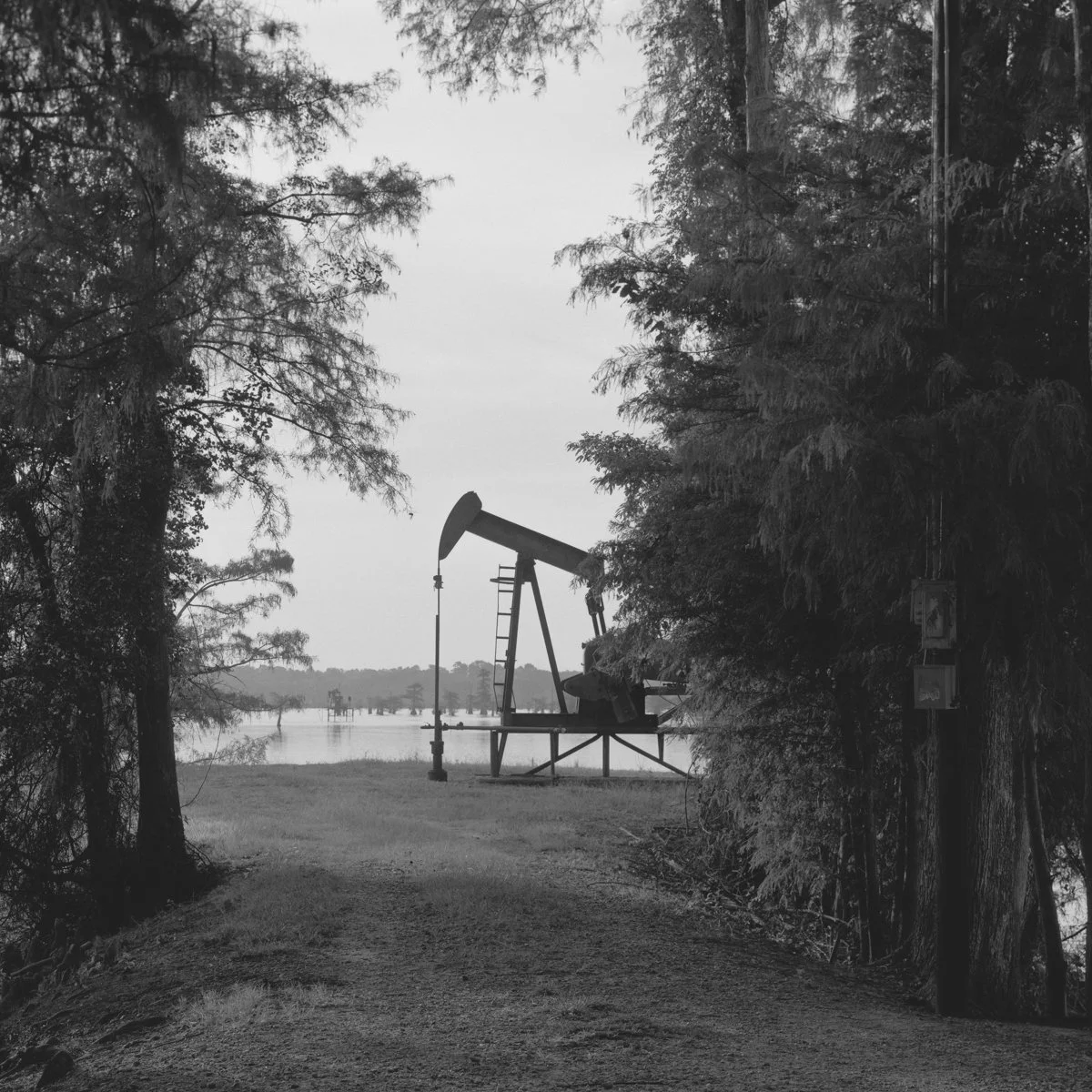
Meghan Kirkwood, “Untitled,” from the series Orphan Wells, 2024, (original) 7.5”x6,” archival inkjet print from 4x5 negative scan
In this conversation for the GroundTruth Institute archive, director Margaret LeJeune speaks with photographer and researcher Meghan Kirkwood, whose creative practice examines land use, infrastructure, and shifting values around the natural environment. Focusing on her projects Orphan Wells and Production Landscape, the discussion considers how photographic practice can render visible the often-overlooked sites where energy, labor, and environmental consequence converge.
Margaret LeJeune: What first drew you to landscape photography as a way to think through environmental issues and land use?
Meghan Kirkwood: My interest in landscape photography as a way to think through environmental issues and land use first grew in two places.
First, as a graduate student in post-Katrina New Orleans I was interested in ways photography could portray land—and specifically wetlands—as an active subject. What makes wetlands unique and valuable to places like coastal Louisiana occurs primarily below the surface and cannot easily be pictured, or at least through traditional landscape photography. I wanted to—and believed one could—create work that could show the dynamism of these environments and in doing so, advocate for viewers to see them as more than flat expanses.
Second, through my work researching contemporary South African landscape photographers I grew to appreciate how landscape photography could foreground the ubiquity of environmental issues and the ways they intersect with social concerns and mirror histories of decline. So many of the artists that I have had the privilege to speak with and whose work I’ve studied are challenging themselves to make landscape photography that can do more than show a place, and their work exemplifies ways landscape photography can function as a discursive medium
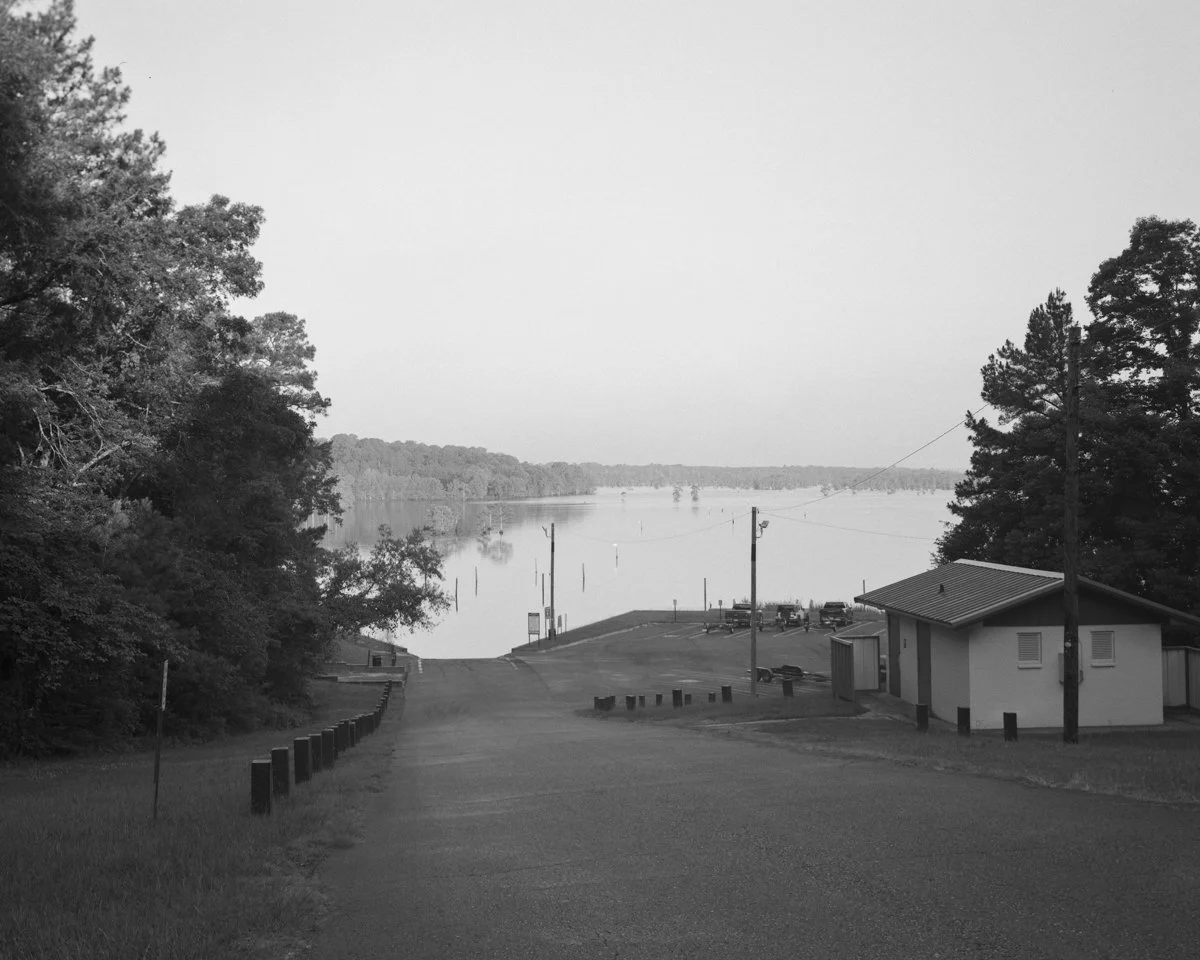
Meghan Kirkwood, “Untitled,” from the series Orphan Wells, 2025, 7.5”x6,” archival inkjet print from 4x5 negative scan
ML: How do you define “place-based research” within your photographic practice, and what distinguishes it from simply working in a location over time?
MK: For me, place-based research means considering a set of questions about land and land-use and using place-specific data—in the form of landscape photographs—to think through them.
In my work I ask questions about how people live with infrastructure, how oil and gas development interfaces with communities, how people draw social and economic identity from the industry, and how landscapes absorb this kind of activity differently.
Presently, I consider these questions in relation to northwest Louisiana, but in a few years it may be a new location. For me, place-based research means the questions come first and the locations offer a real way to think through them, which feels distinct from working in one place over a period of time and letting the focus of the series emerge or shift from the images themselves.
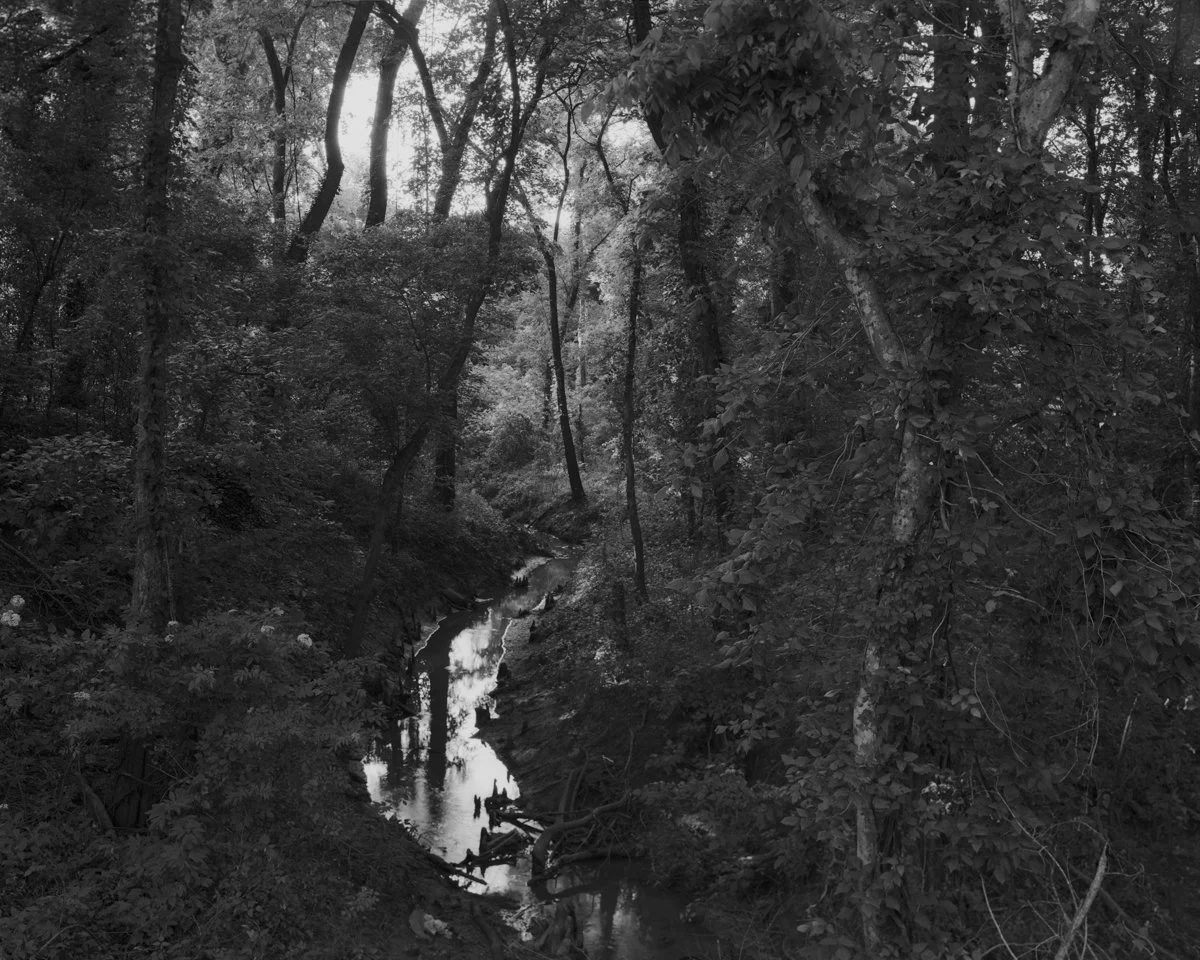
Meghan Kirkwood, “Untitled,” from the series Orphan Wells, 2025, 7.5”x6,” archival inkjet print from 4x5 negative scan
ML: How has your identity and experience as a woman shaped your access to, movement through, or reception within the industrial and rural landscapes you photograph?
MK: I think my identity as a woman has been an asset while working in northwest Louisiana. For two of the years I’ve photographed there I was also pregnant, so I’ll add that I think being a pregnant woman has helped me access places I might not have otherwise.
The people I meet in Caddo Parish are overwhelmingly kind, but seeing anyone walking around the woods, near oil wells, carrying a tripod and 4x5 camera can understandably invite questions, if not suspicion. But, because of my age and gender (and perhaps the spectacle of a pregnant woman on the side of the road) I think most people encounter me with curiosity and give me the benefit of the doubt. Most are eager to ask questions about my work rather than react negatively or assume I’m doing something illegal. Race obviously has an impact as well.
There is also a real sense in which my gender encourages people I meet in industrial and rural landscapes to perceive me as a caring, active listener who is genuinely interested to learn from them and their experience moving, working, and living in these spaces. It happens to be true, but I think that being female and a mother helps me convey my feelings of care in a way that is more perceptible than if I was I male.
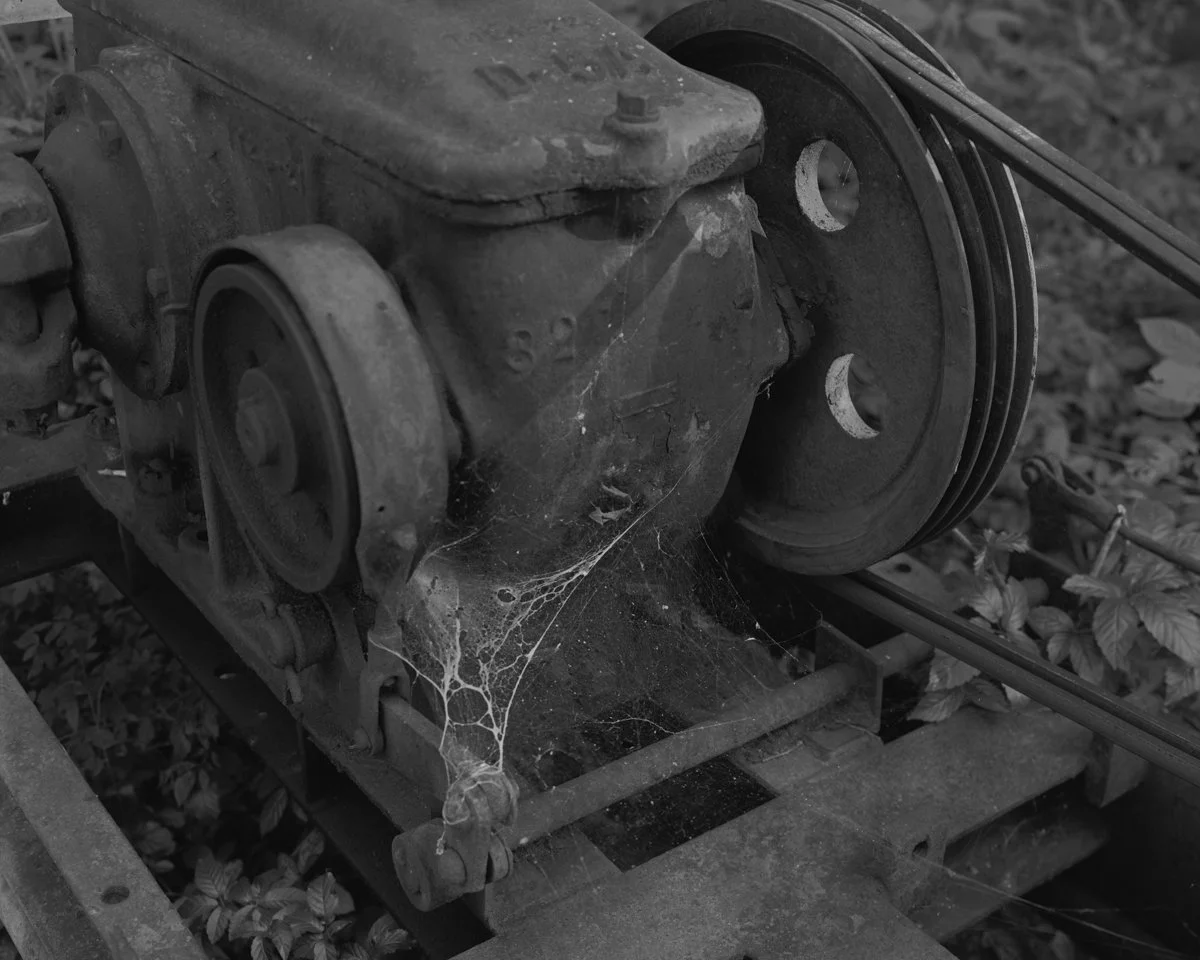
Meghan Kirkwood, “Untitled,” from the series Orphan Wells, 2025, 7.5”x6,” archival inkjet print from 4x5 negative scan
ML: What led you to focus specifically on orphan oil and gas wells, and how did you begin researching a problem that is largely invisible or subterranean?
MK: I first learned about orphan wells and their ubiquity across the United States from a landscape architect colleague. He told me about their numbers in North Dakota and from there I started researching the issue in other states, and ultimately, in Louisiana.
There were a number of things that led me to develop a body of work about the issue. First, the sheer numbers of abandoned wells across the US is staggering—and where you find them. Some of the highest densities of orphaned wells are in places one may not associate with oil: West Virginia, Kentucky, Illinois. Second, the number of ways uncapped wells can pollute air and groundwater are truly frightening. And, in turn, the benefits of capping them are significant; addressing the issue of orphaned oil wells in the US could meaningfully affect the effects of climate change in a way other more logistically or socially challenging efforts (e.g. getting people to fly or drive less) cannot. Third, at the time I started this project there was broad bipartisan support at the federal level to fund states to plug orphaned wells. No one, regardless of political affiliation wants an uncapped well in their yard, potentially polluting their water or air and politicians seemed ready to work together on the issue.
As far as researching the issue through my images, I first began by locating the wells in Caddo Parish—where Oil City, Louisiana is located—from available data and photographing them, almost as a kind of topology. I wanted to figure out what an “orphaned” well looked like compared with a regular well. This got predictably boring after a while and the series grew into a much more complex look at the Parish landscapes and how communities there interface with decades worth of infrastructure impacts.
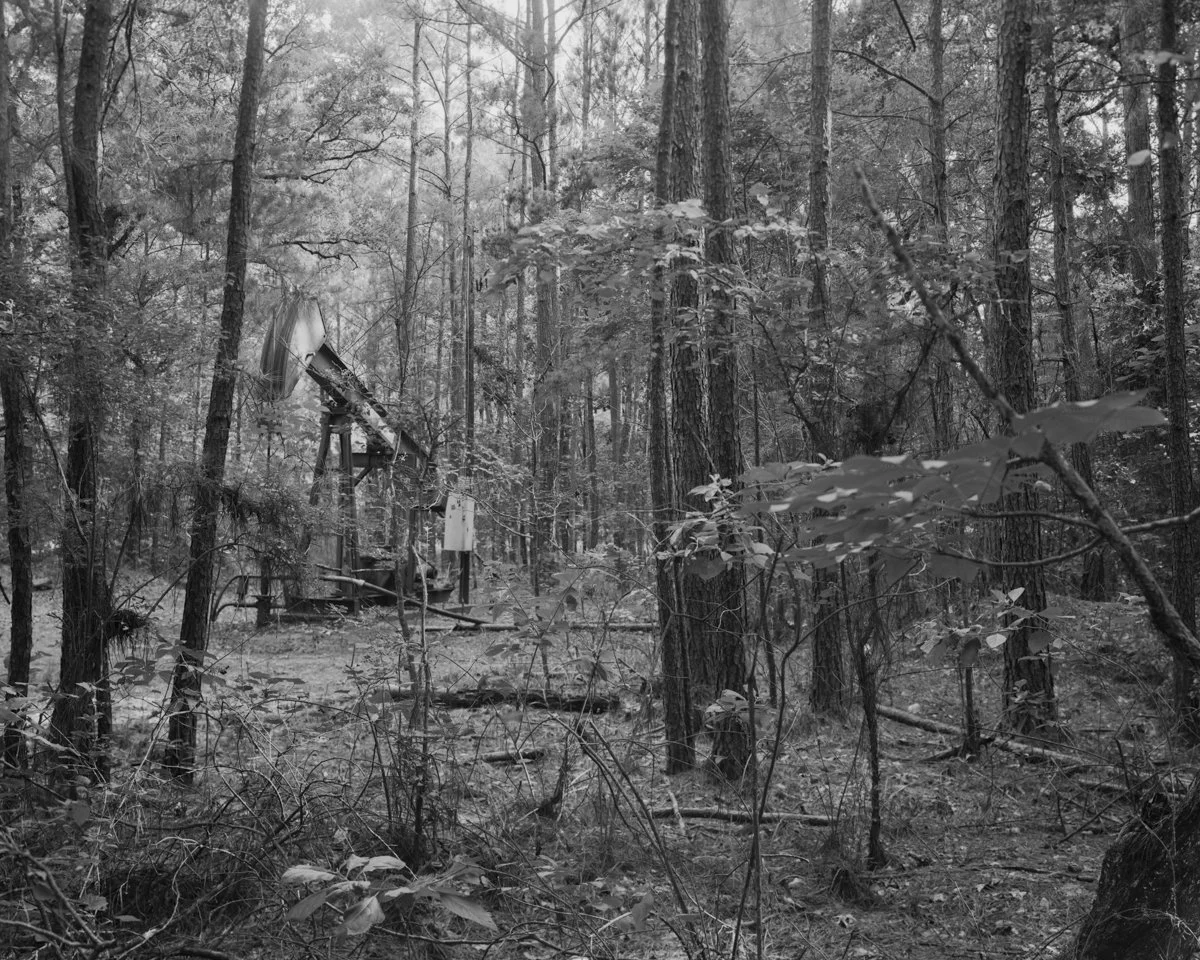
Meghan Kirkwood, “Untitled,” from the series Orphan Wells, 2025, 7.5”x6,” archival inkjet print from 4x5 negative scan
ML: In Orphan Wells, many of the sites appear visually quiet or even pastoral. How do you think about photographing environmental harm that does not announce itself dramatically?
MK: I think a lot about how to present environmental harm in my work. In Orphan Wells I don’t want to overwhelm the viewer with representations of environmental damage or visible harm. My goal isn’t to shock them into outrage or awe at all that’s occurred over decades of natural resource extraction activity. Instead, I want my viewers to be lured into looking, and challenged to ask questions about what they are seeing. I want them to consider how oil and gas development and abandonment can become normalized or interlaced with a place where real people live, people who don’t feel like they are living in a wasteland or damaged area.
Also, when I am in Louisiana photographing I feel a tension between the environmental harm I know to be occurring and the quiet, pervasive beauty of the landscapes in the Parish. Caddo Parish is a striking place made up of acres and acres of forest, creeks, cypress groves, and two large lakes. With this in mind, I want my viewers to bring empathy to their reading of place and a kind of quiet looking, one that is at odds with the way people consume visual representations of environmental damage. And because, intellectually, I struggle with how to process harm as an undercurrent to beauty, or attraction for a place that is also dangerous, and I want my photographs to in some way share this tension.
I also don’t think it is entirely necessary to foreground the harm to convey its centrality in the series. I often recall Martha Rossler’s 1974-5 work, The Bowery(1) in two inadequate descriptive systems, and her decision to not include stolen images of drunk people in the series because “what could you learn from them that you don’t already know?” I feel similarly about showing dramatic pictures of environmental harm in my series. To some extent the image that the viewer has in their mind of the impacts of oil and gas development is the case in Caddo Parish and the viewer doesn’t need me to overemphasize it or confirm their biases. Instead, I strive to immerse my viewer in the place itself, make them aware of the harm, but not let it take over the series.
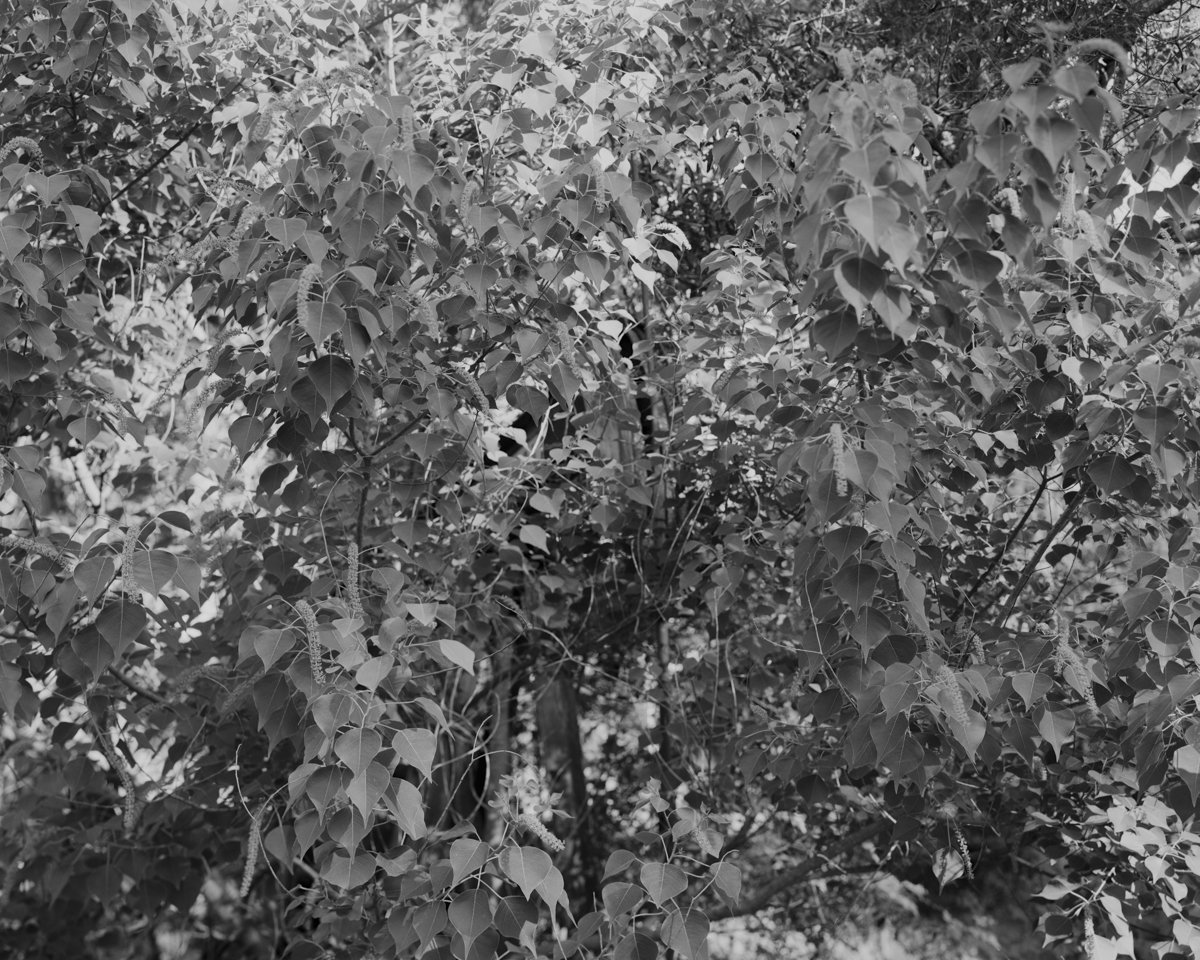
Meghan Kirkwood, “Untitled,” from the series Orphan Wells, 2025, 7.5”x6,” archival inkjet print from 4x5 negative scan
ML: How did working in communities around Oil City, Louisiana, shape your understanding of the social and economic dimensions of orphan wells?
MK: It’s sort of embarrassing to say this but working in the communities in and around Caddo Parish reminded me that people lived there. I started this project intently focusing on the wells themselves and what, specifically, an “orphaned” well looked like and I was not photographing much in the communities or landscapes in the Parish. But, the longer I worked on the project the more people I met and the more time I spent actually seeing people live their lives in the area. I could see how oil and gas development fit into local identities and supported livelihoods in the Parish. I could also see the many people who didn’t seem to engage with the industry at all, and those whose properties were right in the middle of it. I could see that orphaned wells showed up in the middle of town and in woods miles from the nearest neighborhood.
I also spent a lot more time photographing areas with no visible oil activity at all, or at least not visible activity, and that time gave me important context for the project and made it much more interesting (for me and viewers of the work). Overall, working in the area of Oil City for an extended period of time showed me that orphan wells are not isolated phenomena: they are everywhere in places like Caddo Parish, hidden in plain sight, and don’t have the disruptive presence one might assume when looking at a map of their numbers and density.
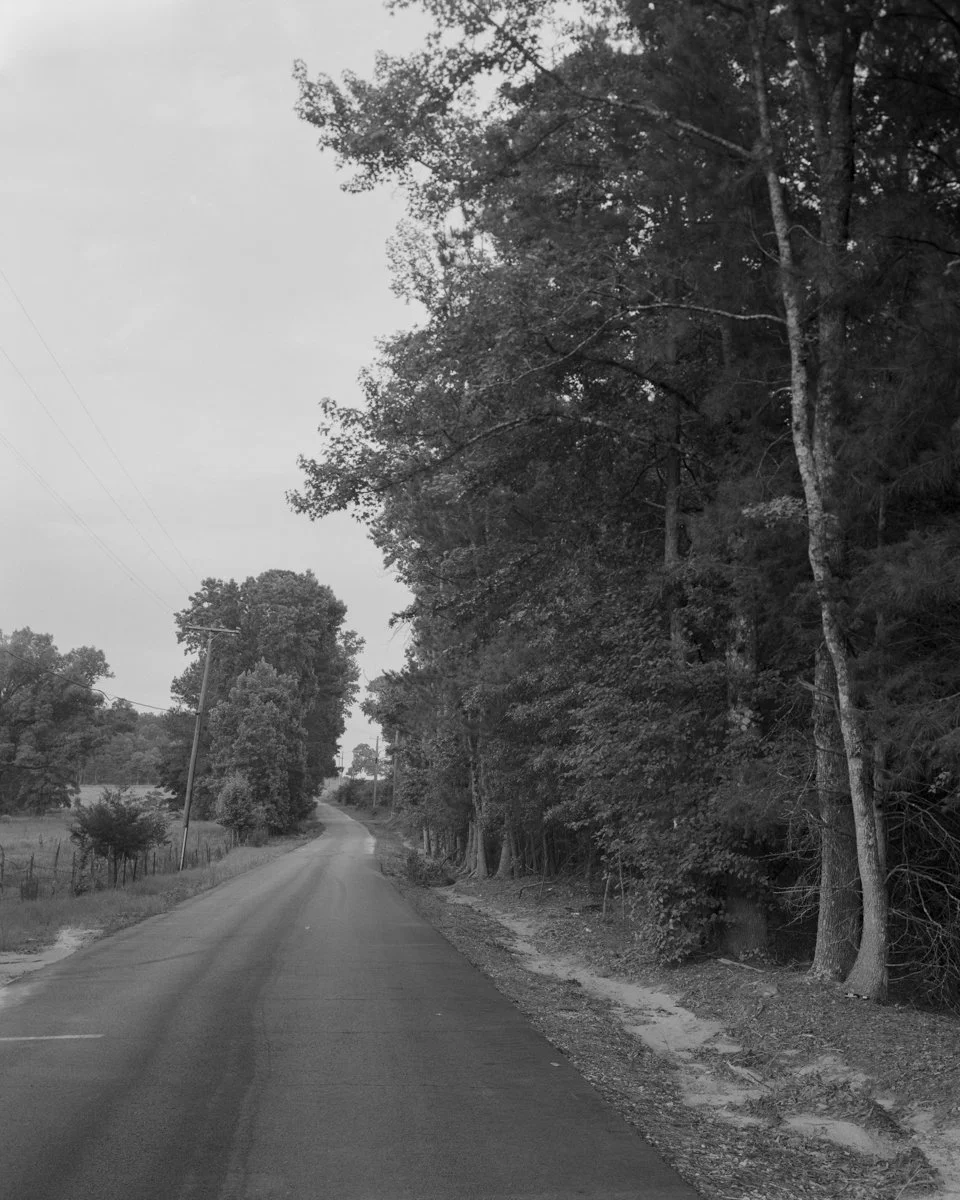
Meghan Kirkwood, “Untitled,” from the series Orphan Wells, 2025, 6”x7.5” archival inkjet print from 4x5 negative scan
ML: Can you speak about the idea of “slow burn” environmental damage in this project, and how photography can make long-term or deferred consequences perceptible?
MK: Orphan Wells considers the long aftermath of oil and gas development in Caddo Parish and the slow violence that has resulted from decades of extraction. In some of my photographs, such as the photographs of orphaned wells in forests, I can make direct reference to the lingering consequence of a past action. In others, I don’t reference the industry or its markers at all, but those images build off of a quiet, perhaps ominous tone to the others. As a series the photographs then create a context wherein the oil photographs inform the reading of the non-oil works, and weigh them differently than they would otherwise read to a viewer.
For me, I think this type of strategy—establishing a context or tone for a set of photographs through a considered sequence—is one way that photography can make perceptible the long-term consequences of environmental damage. Doing so allows the photographer to create a type of afterimage or background noise that a viewer can’t help but bring to everything they see after it. This reinforces the idea that environmental harm doesn’t impact places in isolation. Everything is linked to some degree, and though to different degrees, harm ripples outward.
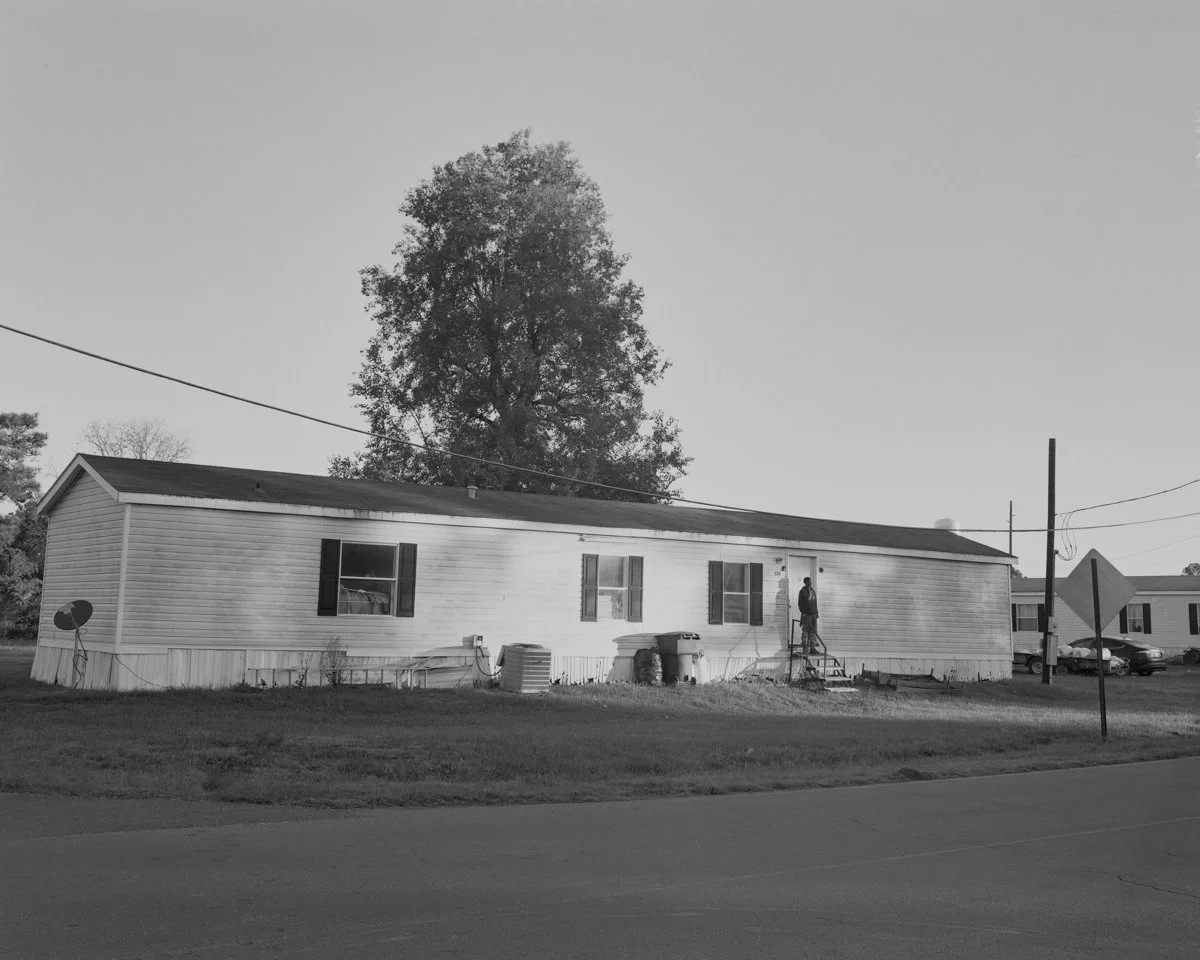
Meghan Kirkwood, “Untitled,” from the series Orphan Wells, 2024, 7.5”x6,” archival inkjet print from 4x5 negative scan
ML: What ethical considerations guided your decisions about photographing wells located in residential areas, backyards, or community greenspaces?
MK: I try to be respectful of how I photograph wells in inhabited areas. It’s important for me to show how closely they abut homes, libraries, common spaces in some parts of the Parish, but practically I don’t need many photographs to convey that point and so it’s not something I photograph that often. In the series as a whole I don’t show many people and I make a point to not show homes or places that might confirm a stereotype that many people may have about the rural South. No one needs to see a sad shot of a Dollar General near a Walmart to know that incomes in this part of Louisiana aren’t high, or look at yards with junk or trash to feel empowered to judge or otherwise dismiss people that live in this area. I think a lot about ways to photograph the towns in the Parish that are fair and representative, without being easy or sensational.
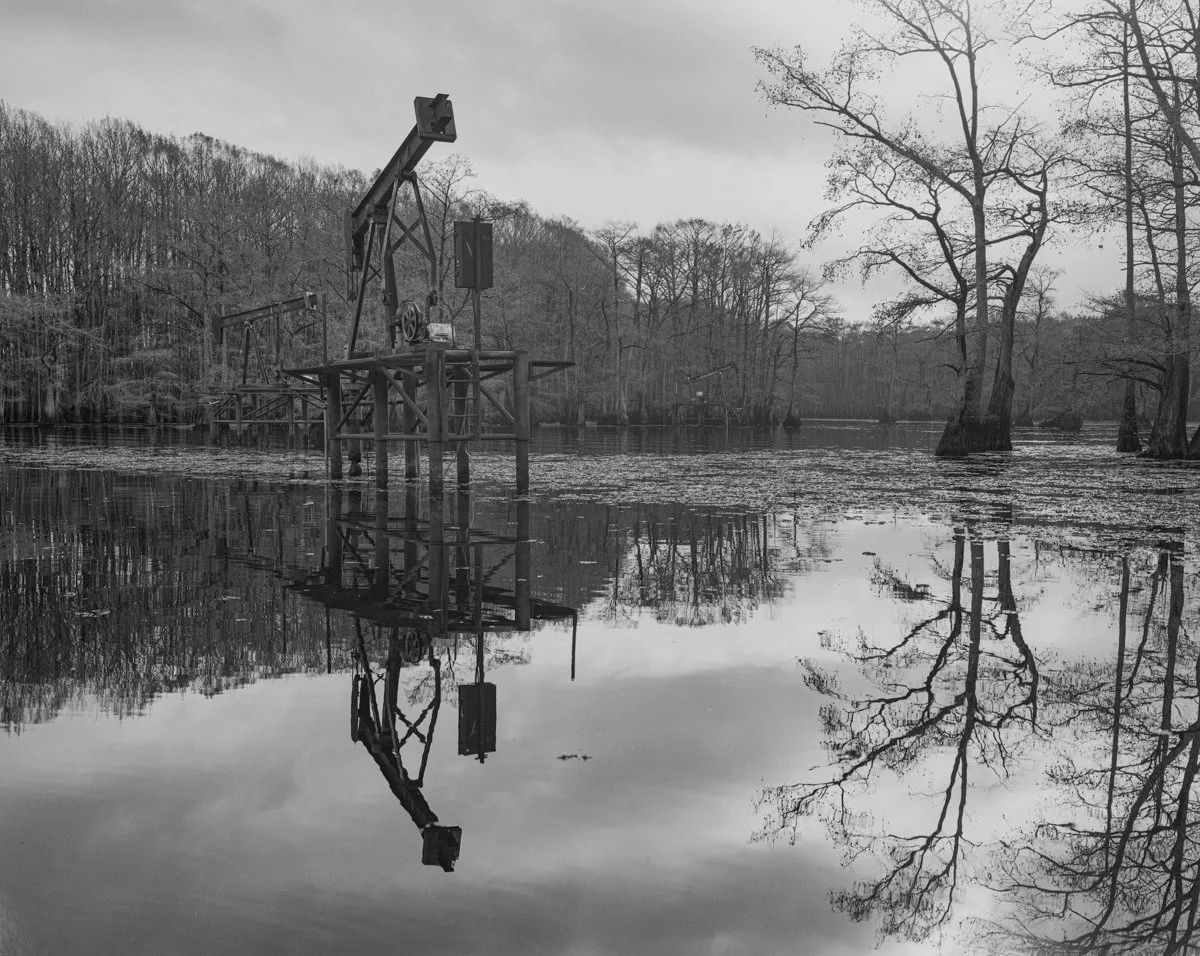
Meghan Kirkwood, “Untitled,” from the series Orphan Wells, 2025, 7.5”x6,” archival inkjet print from 4x5 negative scan
ML: How do you balance the aesthetic traditions of landscape photography with the urgency of environmental crisis in this series?
MK: I think about this tension a lot. Maybe it is a product of getting older but I no longer feel the drive I once did to photograph in the visual language of crisis or foreground crisis in my writings about my images. I want my viewers to know about the problem of orphan wells and I want them to see what decades of abandoning oil infrastructure looks like. But, first, I want them to see a place and imagine themselves moving through it. I want my viewers to see the landscapes of a Parish— which has one of the highest densities of orphan wells—and care that this particular place is impacted. And for me, in this series, the care has to come first before the concern. I don’t take it as a given that anyone cares about a corner of Louisiana far from any major metropolitan city with minimal population. But once people find a reason to care, a respect for the beauty of the location, I think that the need and urgency to think about the issue of orphan wells comes naturally, and perhaps more effectively than if I made the series all about the wells themselves.
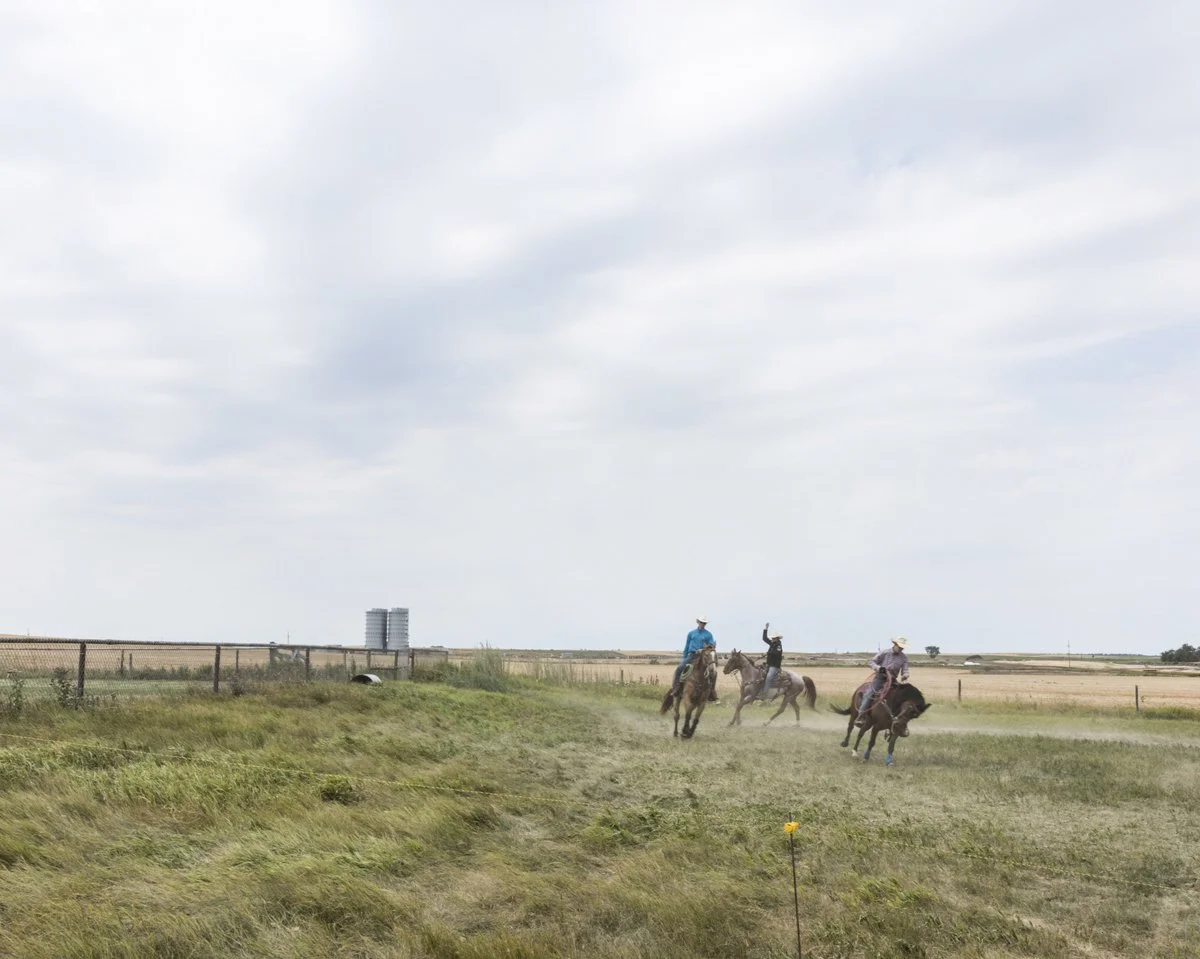
Meghan Kirkwood, “Rodeo,” 2016, 16”x20,” Archival Inkjet Print
ML: What did you learn by following the path of the Dakota Access Pipeline across multiple states?
MK: I learned that it was worth the effort to look. I’m originally from New Hampshire and we don’t really have massive infrastructure projects impacting our state, apart from highways and powerlines, etc. First reading about the Dakota Access project I just didn’t have any sense of the scale or true enormity of a 1200-mile pipeline or how different the landscapes it crossed would be. Like many, I had never been to the rural areas the pipeline travels through and assumed they were much the same.
And, with respect to my own practice, I learned to make room for my own questions in the process of creating the project. When I started the work in 2016 I didn’t know what I would find, or whether it would be interesting. I did not have much of a reason for doing the project beyond wanting to know for myself what happened to a landscape when something so big was put into the ground. I gave myself space to grow in the series at the same time as I acknowledged many gaps in my own knowledge. And in this sense the Dakota Access work feels really personal to me even though it doesn’t really present that way as a series.
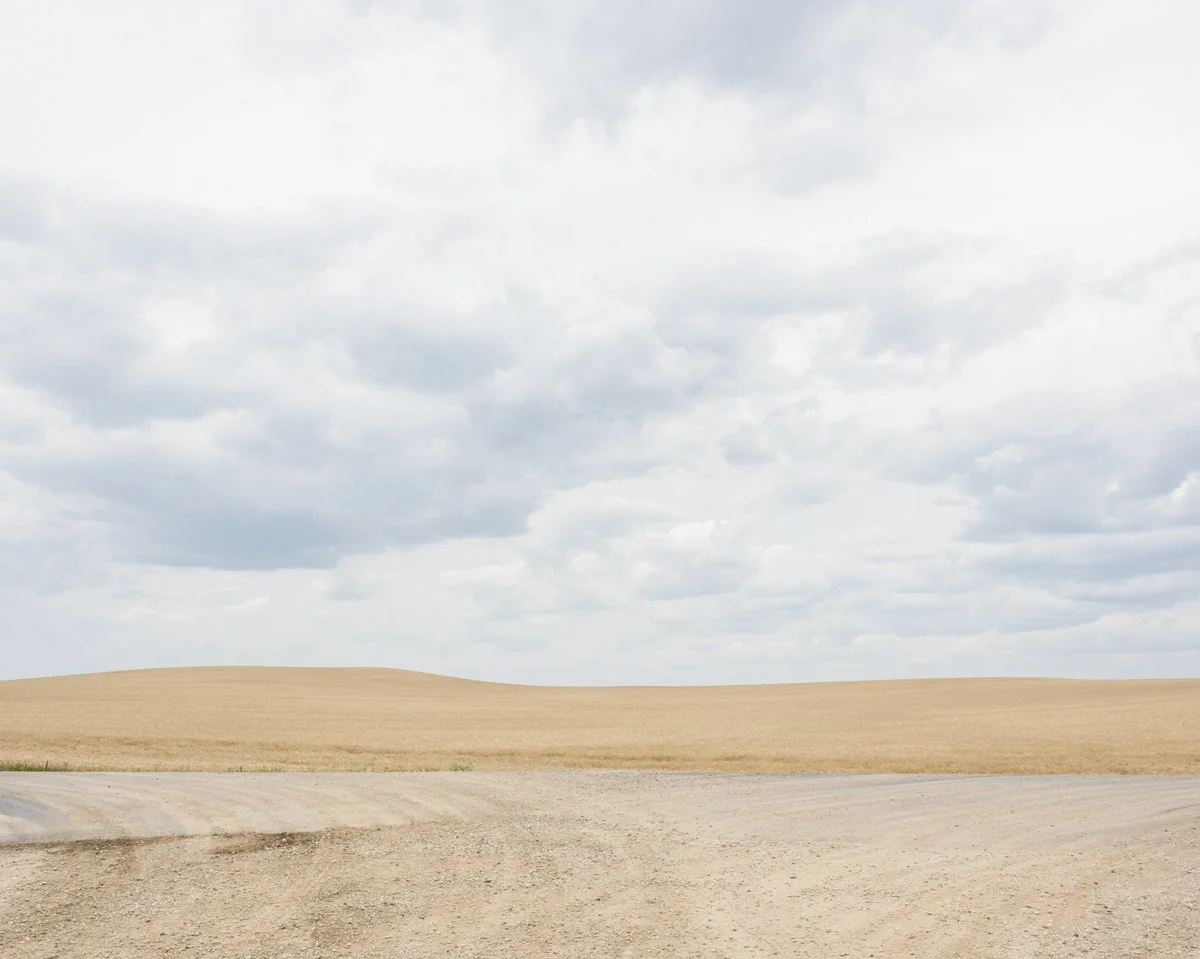
Meghan Kirkwood, “Dirt Intersection,” 2017, 16”x20,” Archival Inkjet Print
ML: How does the concept of landscape as a “synthetic” or man-made system, as described by J.B. Jackson, inform your work?
MK: This is a great question. For me, conceiving of landscapes as synthetic and constructions in and of themselves allows me to lean more into formal play in my photographs. I feel—in some ways—more able to perceive landscape images as parts with their own narrative structures in addition to the meaning they build as a whole.
In Orphan Wells I play a lot with conceptions of the natural vs the non-natural, such as the ways oil is both a natural substance and something that transforms into a manufactured, “less” natural thing through the process of man-made interventions and inventions. Because my series is in black and white I can also play with the ways things like pipes and hoses mimic branches or roots, the way dark water echoes the thicker blacks of leaked oil. Engaging in this play lets me challenge the notion that oil and gas development breaks up a “natural” landscape even as I emphasize the ways in which it never truly visually syncs with or becomes reabsorbed in the landscape.
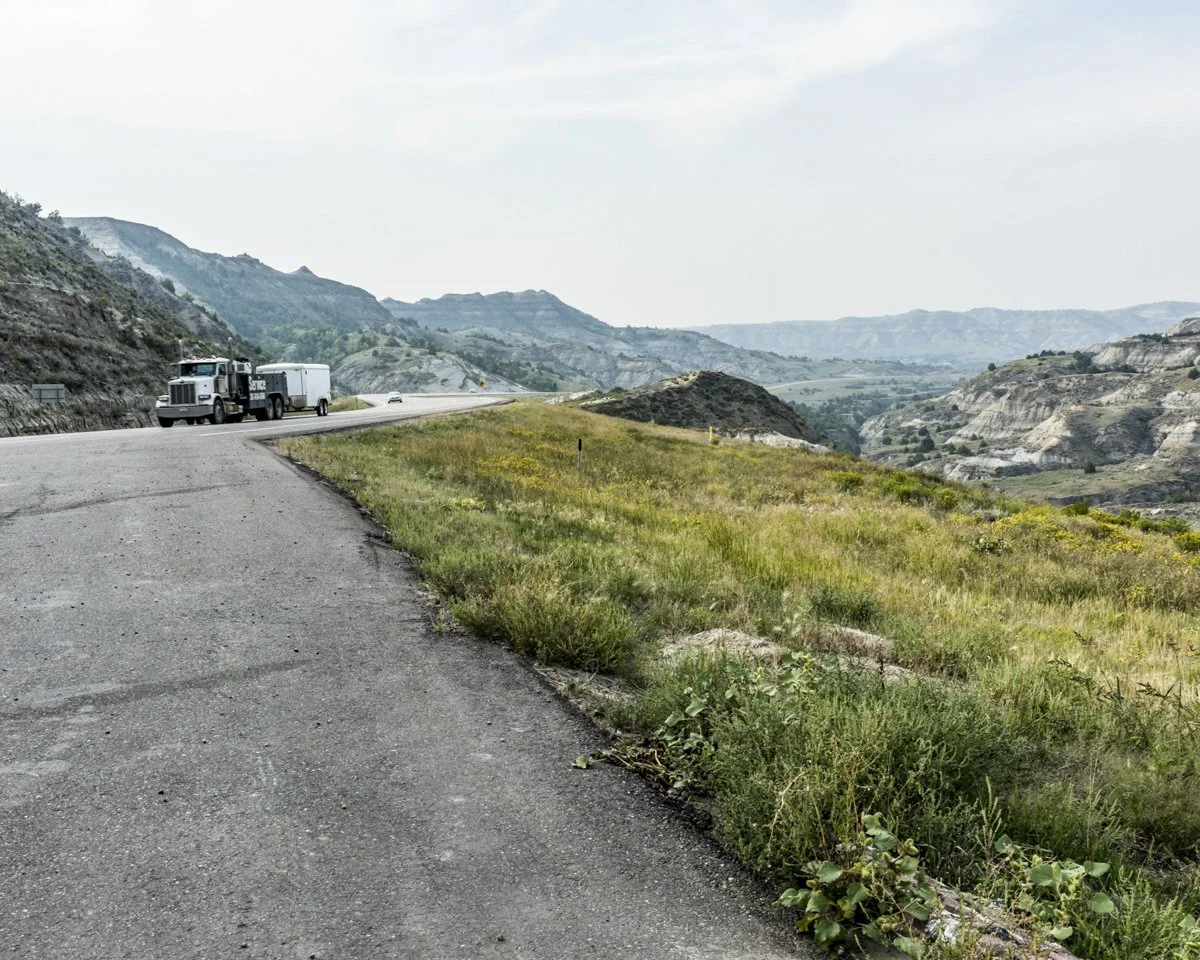
Meghan Kirkwood, “Truck over the Little Missouri,” 2017, 16”x20,” Archival Inkjet Print
ML: What visual strategies did you develop to convey scale, both of the pipeline network itself and of the cumulative changes it produces, in everyday environments?
MK: A key part of the Dakota Access work was aerial imaging. I used drones to photograph portions of the pipeline path about five years after construction. In these images you can see a shadow of a thick line on the ground, almost as though there was a huge diagonal cloud moving down the landscape. It feels strange and disconcerting to see such a clear visual trace, if you will, of something that from the ground doesn’t appear disrupted.
For me, combining the aerial photographs with ground-level views offered a way to stress that impacts from infrastructure are both on-going and not immediately clear. With landscape photography I can’t talk about what’s happening in the air or the soil as a result of the construction, but with something like aerial imaging I can introduce the idea that there is a difference in the land as a result of the activity, a lingering aftermath if you will, that is visible from the right view. And knowing that impacts from pipeline construction remain can impact how the viewer sees the other photographs in the series.
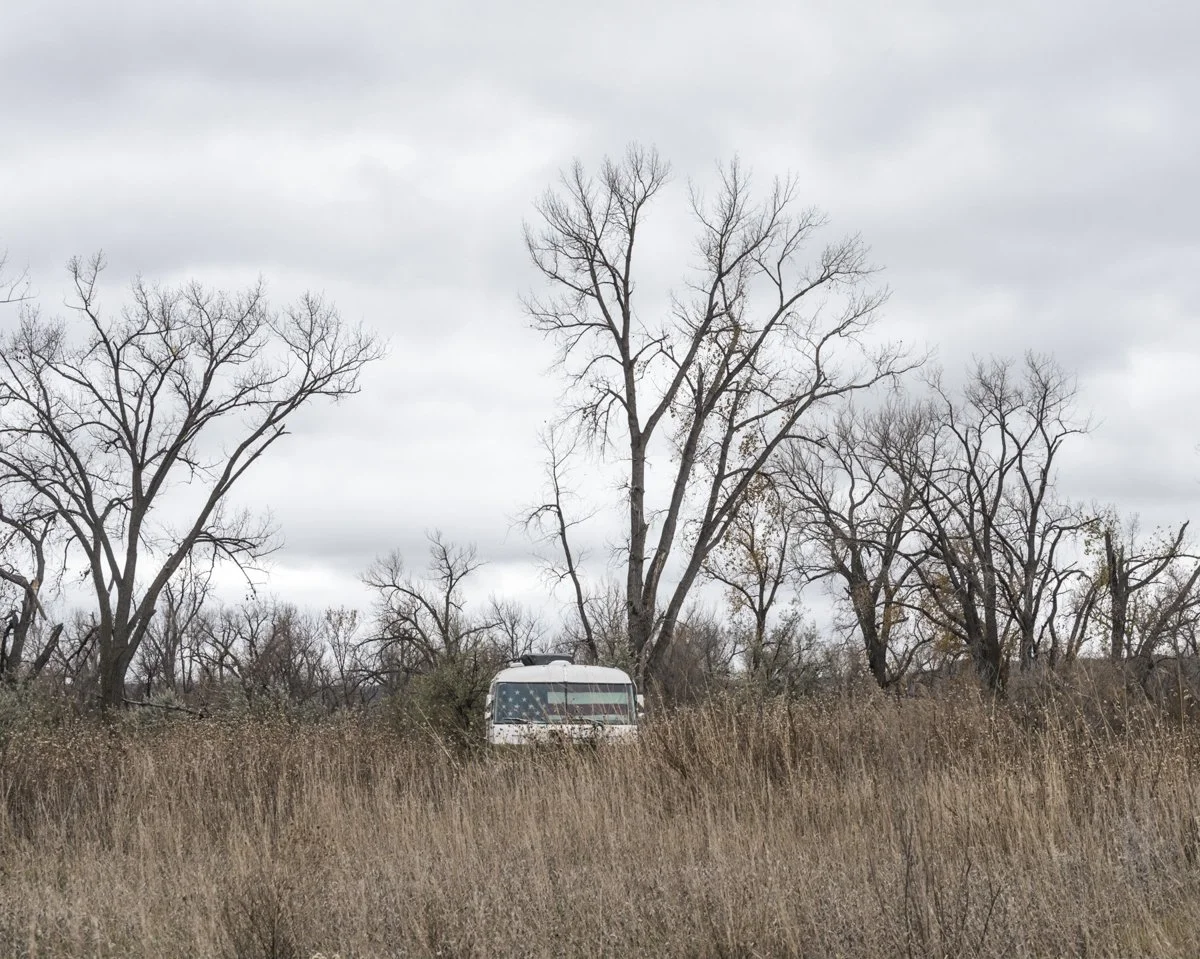
Meghan Kirkwood, “Van Camp,” 2017, 16”x20,” Archival Inkjet Print
ML: How does time, including return visits, seasonal shifts, or multi-year observation shape your understanding of transformation in your work?
MK: Working on a project over time, through many visits at different intervals over years helps me bring some patience to my work. It can feel overwhelming to tell a story about oil in a place as big as Caddo Parish. And because I don’t really photograph Shreveport proper, I’m not even attempting to be comprehensive and it still feels like a daunting task. Nonetheless, my time in any given trip is limited and that can lead to rushed shooting and a pressure to make enough work to build a series. But as the series has grown I’ve felt less pressure to make work that can create narrative pillars for the series and given myself more space to focus on whatever is interesting at the time, even if it means only photographing in a small part of the Parish or leaning into a particular idea or time of day. Returning year-after-year, in different seasons, also allows for me to attend to small-scale transformations in the landscape that I might otherwise not observe over a shorter interval.
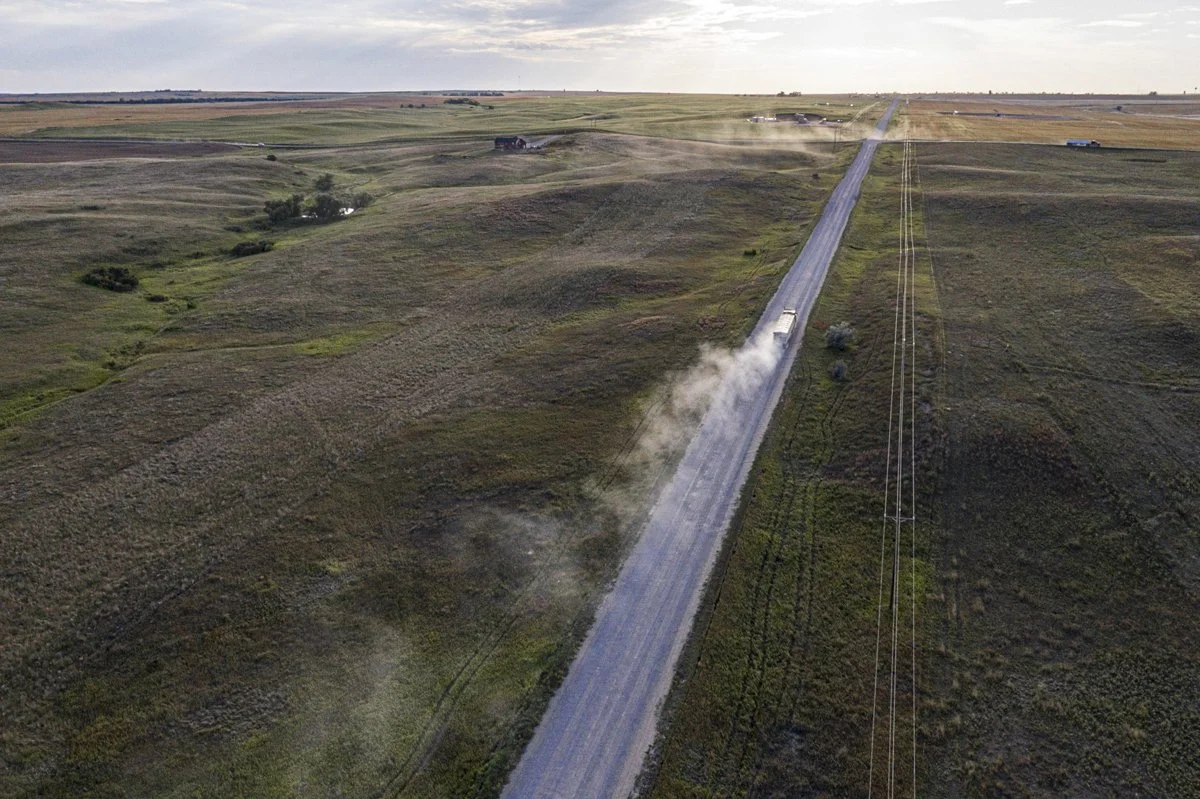
Meghan Kirkwood, “Untitled, Pipeline Scar,” 2019, 12”x16,” Archival Inkjet Print
ML: How does your background in art history and visual culture influence the way you read, construct, and contextualize landscape photographs?
MK: My background in art history has been hugely important in forming how I photograph land and think about landscape photography generally. My art historical research looks at how South African photographers use landscape photography as a way to process and promote dialog about space, belonging, access, and identity post-apartheid. Landscape photography is hugely complex and wonderfully dynamic in South Africa and I’ve been incredibly inspired by artists working there and the ways they’ve used the genre to tackle intersections of social and environmental challenge and conflict. At the risk of oversimplifying, I think that South Africans are always considering the history of a space they photograph in a way that is different from Americans, keeping aware of what the space they’re photographing has been witness to over generations. It’s a very considered approach to the genre that I admire. And of course, my art historical work has also been greatly important for exposing me to the work of non-Western artists I’m not sure I would have known otherwise.
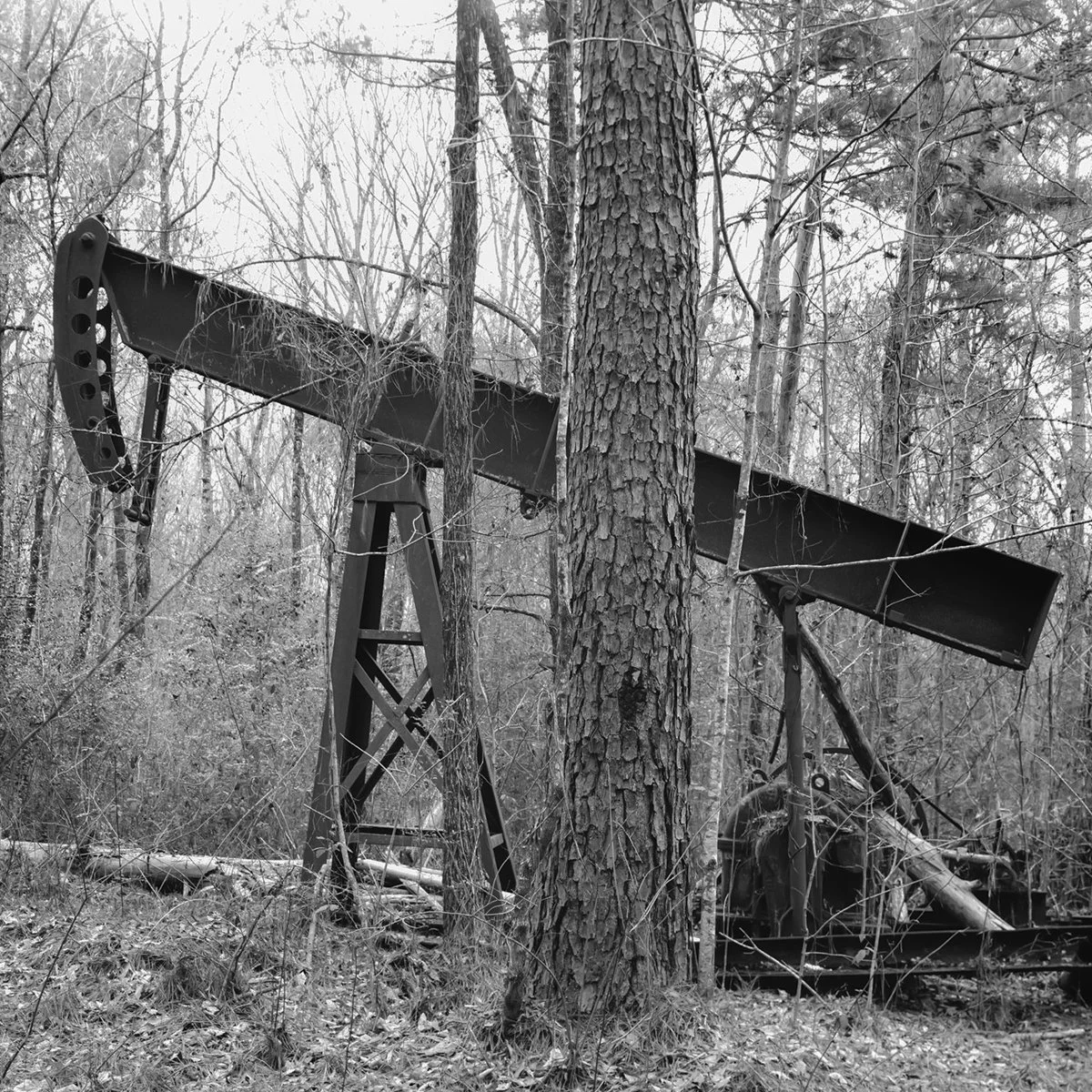
Meghan Kirkwood, “Untitled,” from the series Orphan Wells, 2024, (original) 7.5”x6,” archival inkjet print from 4x5 negative scan
ML: How do you see your photographic work functioning within broader public conversations about infrastructure, climate change, and environmental justice?
MK: I aspire for my work to give context to the lived experience of people and places living in the aftermath of infrastructure growth and decline. I hope that my photographs can break down misconceptions of places impacted by infrastructure development. And, in doing so, promote learning and care for both impacted communities and environments, as well as awareness of environmental issues such as orphan wells. Looking at my series, I want my viewers to visualize the slow creep of natural resource extraction, and empathize with a life where industry becomes part of what you see and know, and to think through what it means to confront the problems associated with it.
Oil and gas development in northwest Louisiana is so pervasive and so big that distilling down actions to address solvable problems—like orphan wells—can feel daunting or even futile. From the outside the need for action—in various forms—seems clear and obvious, but in that part of the world, where one orphan well may not look different from a working rig, and where oil is truly everywhere, both positively supporting and negatively impacting the community, it’s not always clear if something is off or needs attention.
In this sense I want my work to help people orient themselves to a place and what it means to be moving through it before planning for action. It’s very easy to fall into a way of treating the land and communities impacted by climate change, oil and gas development as victims—and in many cases they certainly are—but that mentality can be limiting and often a barrier to affecting real change.
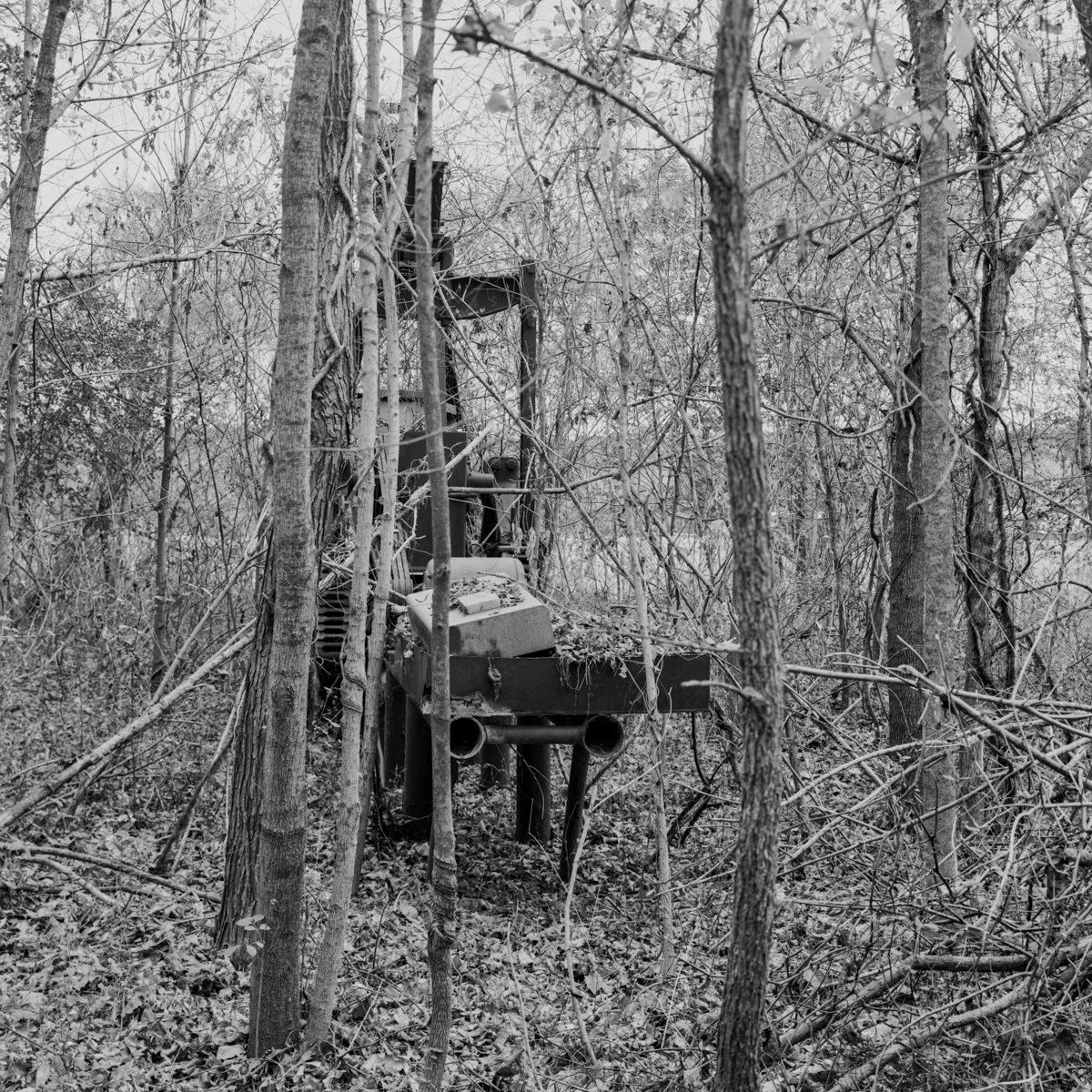
Meghan Kirkwood, “Untitled,” from the series Orphan Wells, 2025, (original) 7.5”x6,” archival inkjet print from 4x5 negative scan
ML: Has motherhood altered your sense of responsibility as an artist working with environmental themes?
MK: This is an interesting question. I think motherhood has made me care more about everything in my life and made me a more empathetic person. My own concerns feel trivial compared with my hopes for my family and kids. I remember someone telling me that there is something very freeing about having kids and no longer having to care so much about yourself, and I have found that to be true.
But, I care very much that my kids are able to experience a life on a planet that has not been completely wrecked by previous generations. I worry that what I perceive to be a general callousness to the realities of climate change in the US will make their lives and the lives of so many others challenging and very different from the way we live today. And recent efforts to limit climate regulatory power only make these worries feel more real and potent.
Because of these concerns I feel a responsibility to promote a path to engaging with environmental issues that could result in meaningful behavioral and regulatory change. I worry that caring about the real danger of climate change is becoming coded in a way that makes it easy for people to dismiss care for environmental health as a political, rather than human concern. As a result I feel an urgency to both meet people where they are at and acknowledge a very real situation through my work, and I think that has intensified in motherhood.
ML: As an educator and department chair, how do you encourage students to engage critically with pressing contemporary issues?
MK: As an educator and to some extent as a department chair I encourage visual arts students to use their work to explore something that they care about. Emphasizing that the care comes first gives me an opportunity to share a wide variety of work that foregrounds contemporary issues, be it environmental concerns, marginalized perspectives and identities, or even just whatever weird thing an artist loves.
Because of my own background and research areas I’m able to share a lot of work related to landscape and the built environment. With this work in front of them I’m able to talk through ways artists introduce and explore topics with varying degrees of emphasis, and how artists can create space for a viewer to think and ask questions. I encourage students to embrace the questions they have about a topic—even as they may have strong feelings—and create space for their own learning in a series.
In my classes we also talk about what makes an artist's exploration different from editorial work. We discuss why and where some artists' series may be an extension of their activism and others where an artist may want to invite more subjective readings, even as they embrace the importance of a concern.
ML: Looking back across your projects, what do you hope viewers and researchers will learn about the long-term cultural and environmental consequences of resource extraction in the United States?
MK: I hope viewers who see my work will see different views of a similar theme: the incremental and varied ways natural resource extraction transforms a place. I want them to appreciate the very real impacts oil and gas development has on local and regional environments, communities, and identities, while also acknowledging the beauty and value of places where this type of development occurs.
I want viewers to see that oil and gas extraction creates an on-going relationship to a place wherein one party or the other may rise or subside in dominance—be it visual, economical, or physical—but that the engagement never dissolves. And in a nation that will not stop using fossil fuels, I want the work that I do to help people ask what the tradeoffs are in these exchanges, are they worth the cost, what can we live with, what can we absorb, and what is too much.
Importantly, I want my work to promote this type of reflection outside of the context of a crisis, such as a massive disaster, oil spill or large-scale public health impact. I want us to think about these questions while looking at a landscape quietly, without the simplicity of drama. I want us to see an oil landscape and acknowledge that there will never again be a before, only a very mediated form of after, and think about what that means.
ML: Looking ahead, how do you imagine your work evolving as climate change continues to reshape both the physical landscapes you inhabit and the conceptual frameworks of photography itself?
MK: This is a great question. As an artist, I’m very interested in ways that post-documentary or lyrical documentary practices will impact environmental photography and photography that engages with environmental concerns.
In environmental photography artists consider a real issue of concern that has a discernable history, a timeline, and a set of actors. On the face of it, telling the story of an environmental harm would seem to need to lean towards objective representations and succinct narratives. In post-documentary modes of working, artists steer clear of explanation and closure, and actively allow meanings to be unresolved and shaped by subjectivity. This type of work motivates a different, perhaps more critical means of viewer engagement, one that may also lend itself to environmental photography.
In sum, I’m thinking a lot about what adopting strategies of post-documentary practice—modes of image-making, sequencing, exhibition and distriubution—could mean for artists whose work focuses on environmental concerns. I think there is opportunity here, and maybe a way to meet people in the strange moment we are in. I could see how adopting post-documentary strategies could help confront the unique challenges of climate change as a subject, and in series that could be different and impactful.
ML: What projects or ideas are occupying your attention at the moment? What feels urgent or most important?
MK: Right now I am thinking a lot about empathy and understanding and what it means to foster both in daily interactions as well as my work. I feel as a society we are increasingly channeled into a way of interacting with others that foregrounds our feelings and reactions first, and minimizes open-mindedness, or a willingness to ask questions of and connect with those that feel or act differently than we do. Because of the way we make and consume photography and photographic series I think photographers have a unique role in emphasizing a way of learning about and seeing others that is grounded in empathy and understanding. That way of working feels critically important right now, and I am excited by all the ways photographers are sharing and promoting connection and challenging biases.
On a less heavy note, currently my attention is mostly occupied by all things trains (my son is all about trains), train books, beads (my daughter is very into perler beads) peppa pig, white mountain search and rescue, and Sally Mann’s most recent book. Also, some attention is always devoted to an embarrassingly large consumption of mystery and thriller audiobooks (happy to share recommendations if anyone has a long car ride ahead and needs a good one!).
ML: Is there anything else you would like to share?
MK: I’m grateful for the opportunity to share my work and thoughts about my work with this platform. It is hugely exciting to think about the ways this forum can bring artists together who share similar concerns, and how it can help advocate for work that is environmentally-oriented. Reading the profiles of other artists is inspiring and feels like a reminder to have hope at a time when so much feels so fraught for those who care about the environment.
Rosler, Martha. The Bowery in Two Inadequate Descriptive Systems. 1974–75. Forty-five gelatin silver prints of text and image mounted on twenty-four backing boards. Whitney Museum of American Art, New York.