
Jessica Hays
Jessica Hays is a conceptual photographer and interdisciplinary artist working between Montana and Chicago. Rooted in the American West, her practice traces the emotional imprint of landscape, exploring mental health, trauma, environmental precarity, and loneliness through deeply personal, yet often universal, experiences. Working across pigment printing, handmade artist books, video, and historic photographic processes, Hays considers how place shapes the psyche.
Her work has been exhibited internationally, published in magazines and textbooks, and collected in public and private collections across the United States and Canada. She has lectured on mental health and alternative photographic processes at conferences, classrooms, and community forums. Hays holds an MFA in Photography from Columbia College Chicago and dual BAs in Film & Photography and Environmental Studies from Montana State University. She was recently named a Critical Mass Finalist and shortlisted for the BarTur Photo Award. Her ongoing series, The Sun Sets Midafternoon, was recently published as a monograph with Fall Line Press.
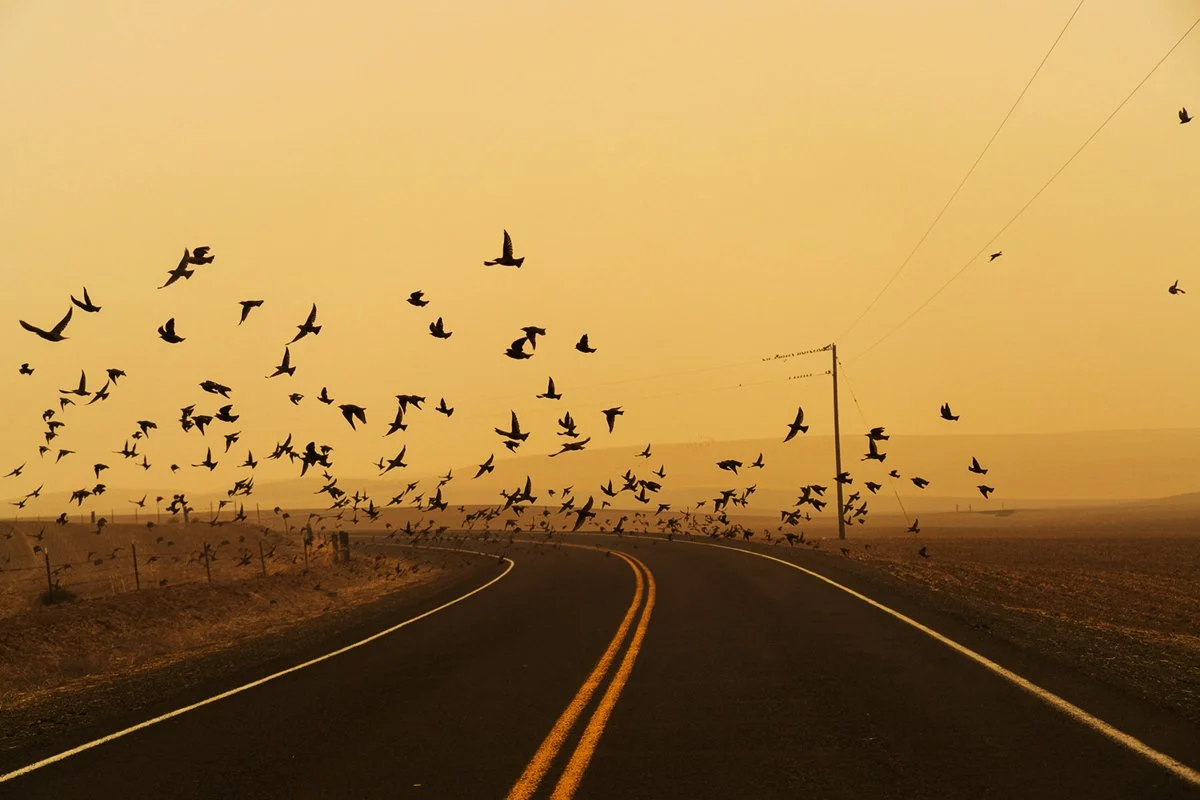
Jessica Hays, Murmuration, 2020, 40” x 60” archival pigment print
In this conversation for the GroundTruth Institute archive, director Margaret LeJeune speaks with conceptual photographer and interdisciplinary artist Jessica Hays about landscape, memory, and the emotional terrain of place. Together, they discuss photography as a form of ecological and personal inquiry, and the ways place-based practice can deepen our understanding of both the land and ourselves.
Margaret LeJeune: Your work is often grounded in lived experience with specific landscapes. How has growing up and working in the American West shaped the way you understand place as both an ecological and emotional space?
Jessica Hays: These landscapes really feel like home to me in so many ways. Even as I have moved around the country more recently, I have spent vast amounts of time in western landscapes on road trips and outside my back door. I think growing up so close to them gave me an appreciation for place that I didn’t fully understand until I was older and moved away on my own for the first time. That sense of belonging I felt in these places—and conversely did not feel elsewhere—continues to shape my relationship with place and how I express that in my work in so many ways. I think pairing that with studying ecology and the environment in my undergraduate career helped me to understand and examine how we both shape and are shaped by our surrounding environments. That’s always a topic I’m looking at and investigating.
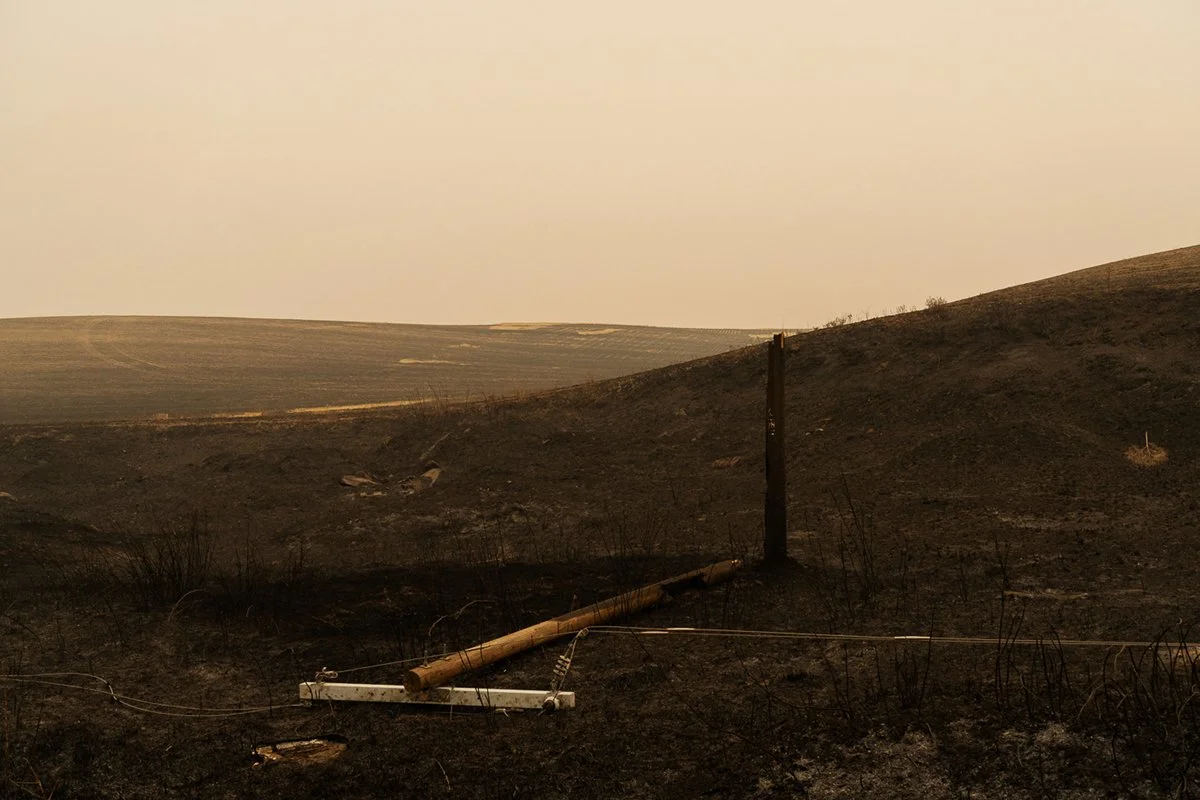
Jessica Hays, Downed Line, 2021, 40” x 60” archival pigment print
ML: In The Sun Sets Midafternoon, you engage with the concept of solastalgia. When did you first encounter this term, and how did it help you articulate your own experience of wildfire and environmental loss?
JH: I first read about solastalgia in 2020 in an article Glenn Abrecht wrote for a psychology magazine, and quickly did some deeper research, finding his NIH paper from 2005. At this point, I had watched my own community live through an out-of-season wildfire, and been on several other fires in Oregon and Washington. I saw everyone racing to do whatever they could, and also the emotional fallout of the aftermath. I knew what I was seeing and experiencing, and I felt a heavy kind of grief for these places, but I had a hard time describing it to others. I think finding that term, which Albrecht coined, created a framework not only for me to understand what I was seeing and experiencing, but to connect with others who had similar experiences. Solastalgia describes emotional and existential distress caused by negative environmental change, and is often felt by people who live closely connected to the land. The rest of the fall of 2020 and following fire seasons, I talked to a lot of people from all walks of life about this feeling of missing home while you are still there, and found it to be such a foundational way to understand how climate change driven disasters affect us psychologically.
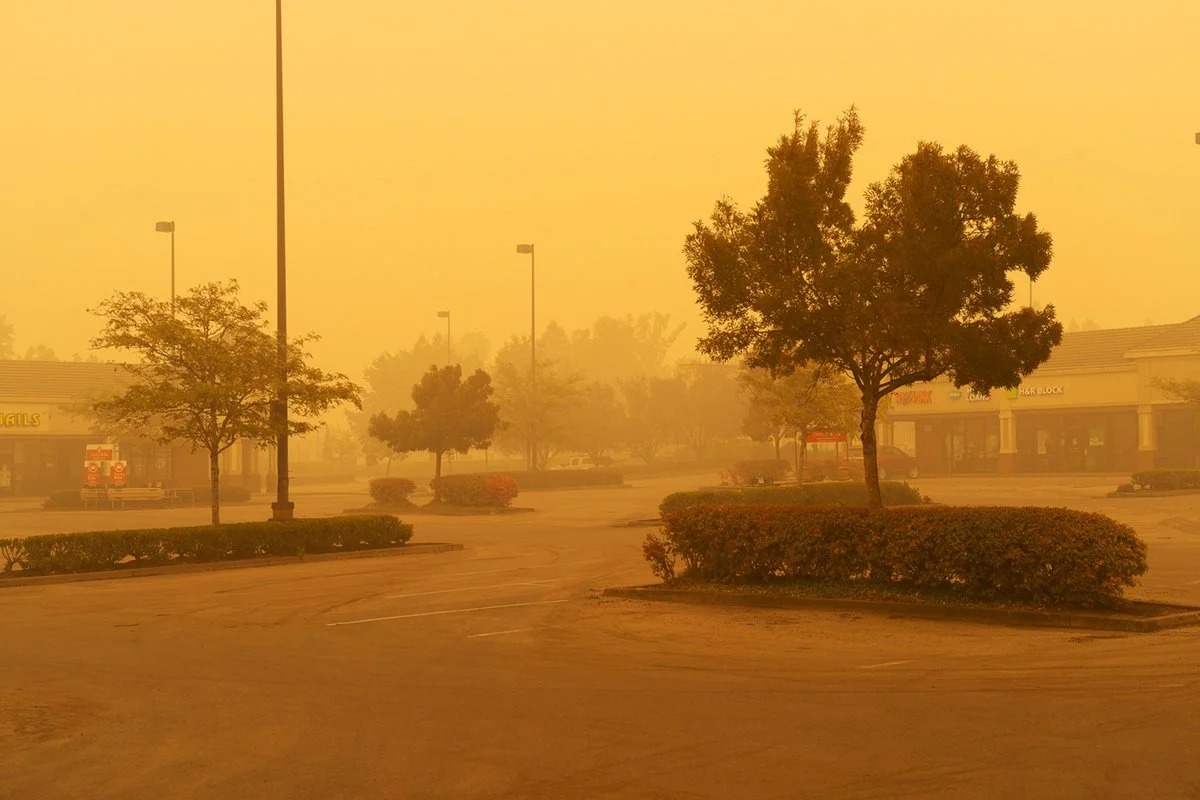
Jessica Hays, Safeway, 2020, 40” x 60” archival pigment print
ML: You describe wildfire as an “all-consuming” experience that crowds out vision. How does this sensory overwhelm translate into your photographic and moving-image strategies?
JH: This is such a great question, and one I consider most when I’m thinking about how these photographs will live in the world. Very early on, I imagined this project as a book, and as I was working on the first handmade copy, I thought about the individual and more personal experience a book offers. Using full bleed images gives the image space to essentially run off the page, and for the viewer to consider it as more expansive than the single frame can hold. Similarly, in exhibitions, I utilize mural-scaled installations combining mural prints, framed photographs, and text. These draw the viewer in close to the large images, allowing the murals to fully encompass ones field of view. I think about how moving through that space could give a glimpse of moving through the burn perimeter of a wildfire, the reference time and flashback with overlapping images. With this work, I am focused on inviting the viewer to imagine their own feet in the dirt and ash looking out at these landscapes, whether shrouded in smoke, burning, or burned.
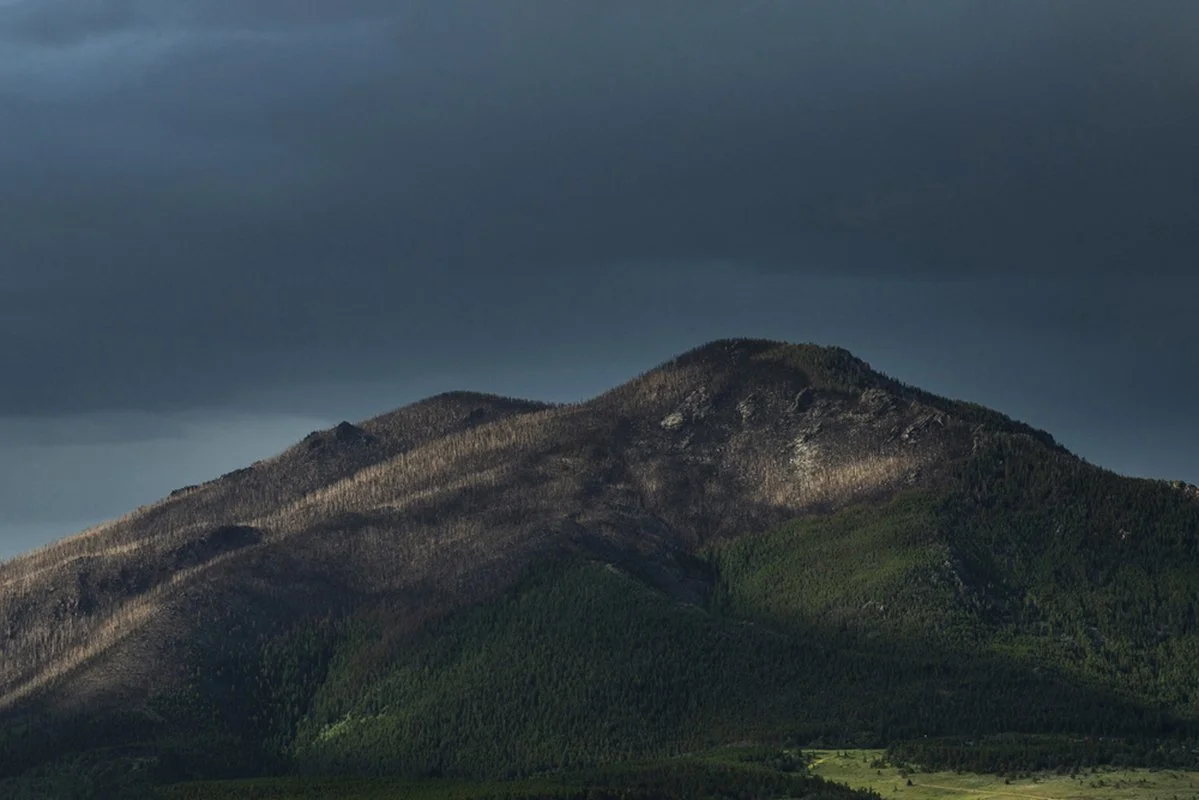
Jessica Hays, Burn Scar, 2024, 40” x 60” archival pigment print
ML: Much of The Sun Sets Midafternoon addresses collective trauma experienced through waiting, data, and uncertainty. How do digital interfaces such maps, alerts, databases factor into your understanding of contemporary environmental experience?
JH: So much of our general experience of life, not just the environment is mediated by screens and digital interfaces. I use these tools in my work often, either for research, or as part of the finished work itself like in Horizon Line and with the end papers for The Sun Sets Midafternoon. But that being said, I am visually much more interested in what it looks like—what it feels like—to actually experience these environmental phenomenon. Which relates back to your question about the ‘all-consumingness’ of a fire and my interests in scale. I invite the viewer to image themselves there through installation, text, image; I ask the reader to consider their own relationship to land through making a book so large it requires you to take a step to turn the page; I give glimpses of maps and data to contextualize the scale of land we are seeing. Data and maps are important to making the work, but the work lives best in a physical space. We can’t get these kind of experiences through a digital interface.

Jessica Hays, Solar, 2020, 40” x 60” archival pigment print
ML: Your projects often weave together personal narrative with research-based text. What role does writing play in your practice?
JH: Writing moves in and out of visibility in my practice. I am always writing about my work or what I am thinking or reading, and in some cases that writing becomes integral to the work itself instead of only the making of the work. It was like that in The Sun Sets Midafternoon. I would hike around burn areas with my camera and a journal, my goal typically being to photograph, but several times I became sort of overcome with emotions and grief, and so I would sit down amongst the ash and char and write in order to process, to record, and find a way to understand the sort of compulsion I felt to make these photographs. Most of the text in the book is ripped from those journal pages (albeit edited of course!) The writing for Blue has been much more complex and longer running, working with many different forms and methods that I am experimenting with, and that body of work is still very much in progress so I am still in the process of discovering how all the text will work out in the end. It’s an exciting process to engage in! In other bodies of work, the writing I did was more for my own thinking, as I way to understand, organize, process things. I have stacks of journals with all the writing I do piled up on a bookshelf.
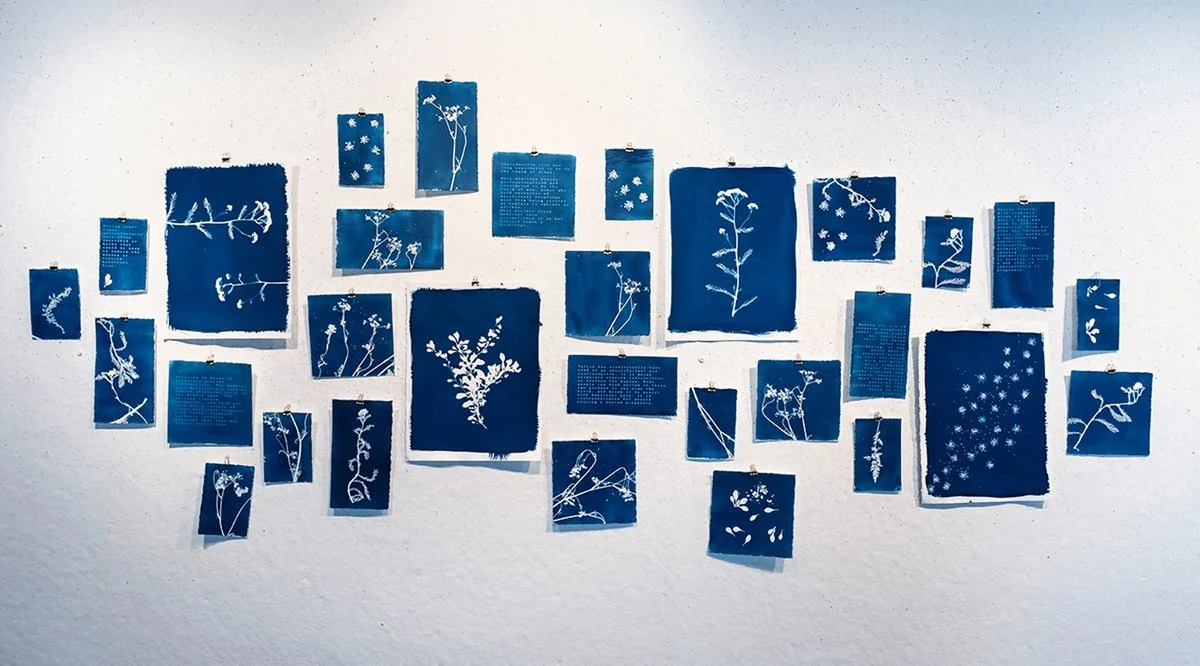
Jessica Hays, The First Photobook Was Blue (installation view), 2024, cyanotype prints, various dimensions
ML: The First Photobook Was Blue engages deeply with photographic history, particularly Anna Atkins. What drew you to Atkins as both a scientific and artistic figure?
JH: Anna Atkins is someone I love to talk about when I’m teaching photo history. She wasn’t in the history I learned, but she is certainly in the history I teach. Women who have gone against the grain in the past, especially to contribute works of art or science, have always intrigued me, and I feel a kinship with Atkins, as her work combining art and science mirrors my own interests. I was reading more about her, and things clicked into place when I learned that she never had any children. The First Photobook Was Blue is all about ones right to choose motherhood or non-motherhood as a path. As a young person, I grew up in a fairly conservative environment that tacitly placed much of my value in that of marital and motherly relationships, and neither of those things were particularly important to me, especially the idea of birthing and raising children. Finding this early example of a woman who chose scientific inquiry, chose a medium that combined aesthetics and technology, and did so while not raising children felt like peering into an earlier version the kind of life I imagined for myself, especially since in my younger life had so few examples of this to see.
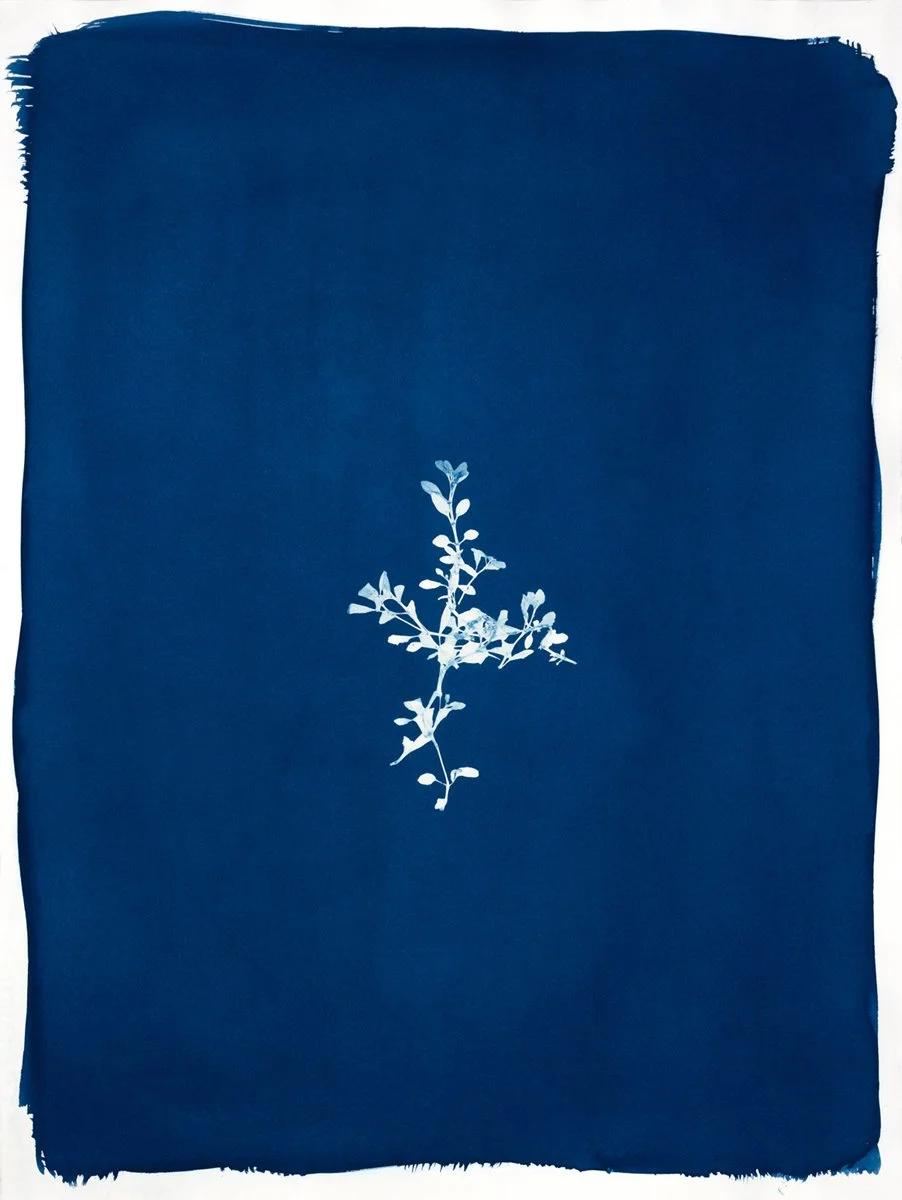
Jessica Hays, Pennyroyal, 2025, 22” x 30” cyanotype print
ML: Cyanotype is central to The First Photobook Was Blue. How does working with a historical process influence your thinking about time, lineage, and women’s knowledge systems?
JH: Cyanotype is such an interesting process, as it is one of the earliest processes, and is now experiencing a bit of a renaissance that seems to be driven by a majority of female practitioners. I have worked with a variety of historic processes over the years, waiting for the concept that is going to be strengthened by the process. In reference to The First Photobook Was Blue, I wanted to work with the processes Atkins had worked with, as a way of paying homage to her. I mentioned above that I feel a kind of kinship with her, and working in the same process she did is important to the work. Her knowledge building was overlooked for so long, and that parallels the way women healers’ contributions to medicine were dismissed as witchcraft when medicine became ‘professionalized’ and thus the responsibility of men. There is an ongoing cycle that shows up even today where our society overlooks and actively diminishes women’s contributions outside of very narrow fields. I also thought the aesthetic qualities of the prints create tension with the overtly political message. They are photographs that are a bit sneaky in way, being so beautiful and so political at the same time. This relates to how I think about the ways women have moved for years, in the edges and the margins, behind the scenes, but in their own strong communities.
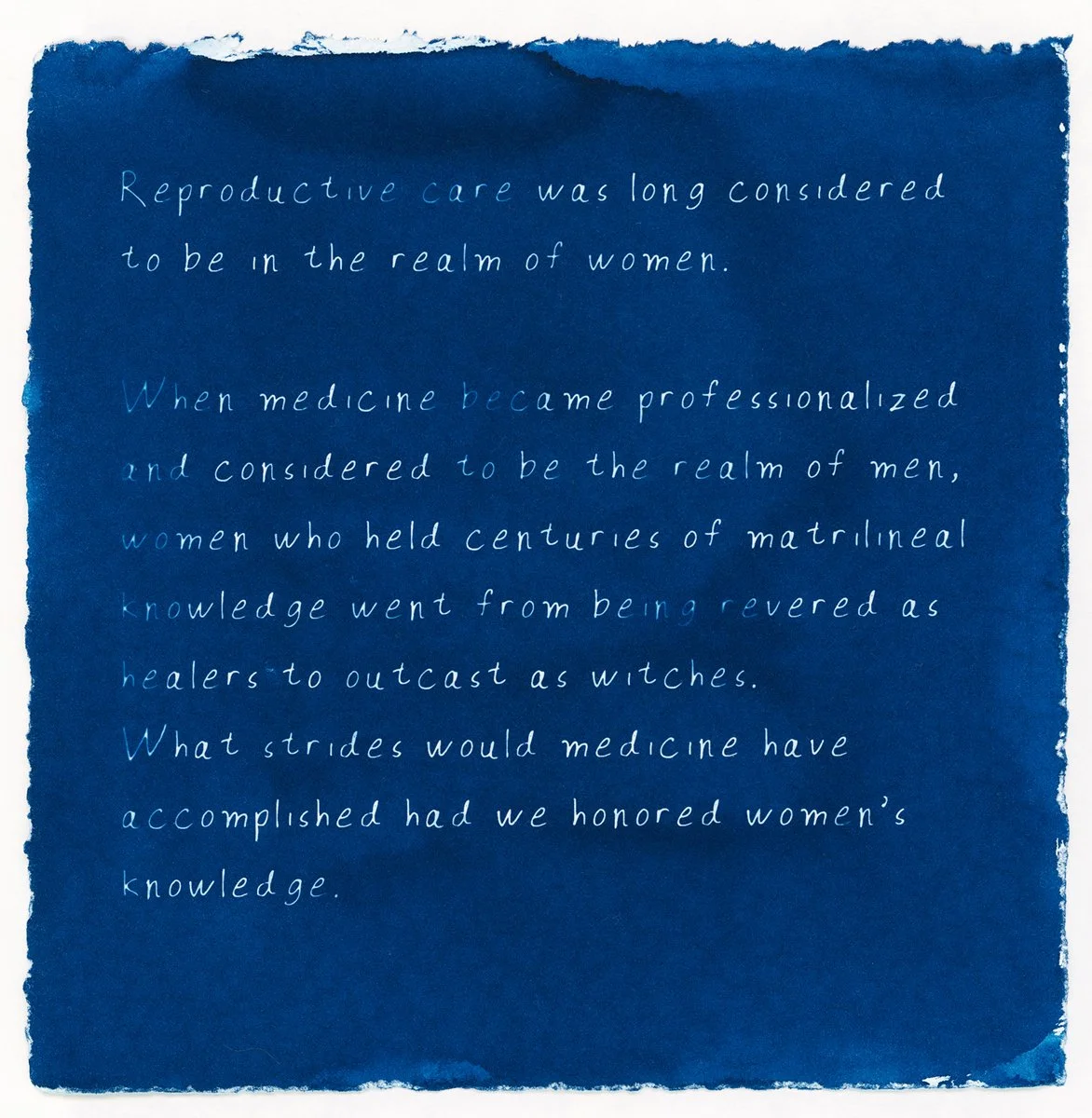
Jessica Hays, Women’s Realm, 2024 9” x 9”, cyanotype print
ML: Plant medicines and reproductive care are forms of place-based ecological knowledge. How do you approach photographing plants not just as subjects, but as carriers of cultural and political meaning?
JH: I think about humanity and nature (or human nature and non-human nature) as being originally in harmony with each other. Plants (and other environmental factors) have provided so much of what humans needed, and in that provided cultural structure, ceremony, nourishment, medicine, shelter, and so on. I think about them as inherently cultural and political just as I think of art as inherently political, even in works that are less overtly so.
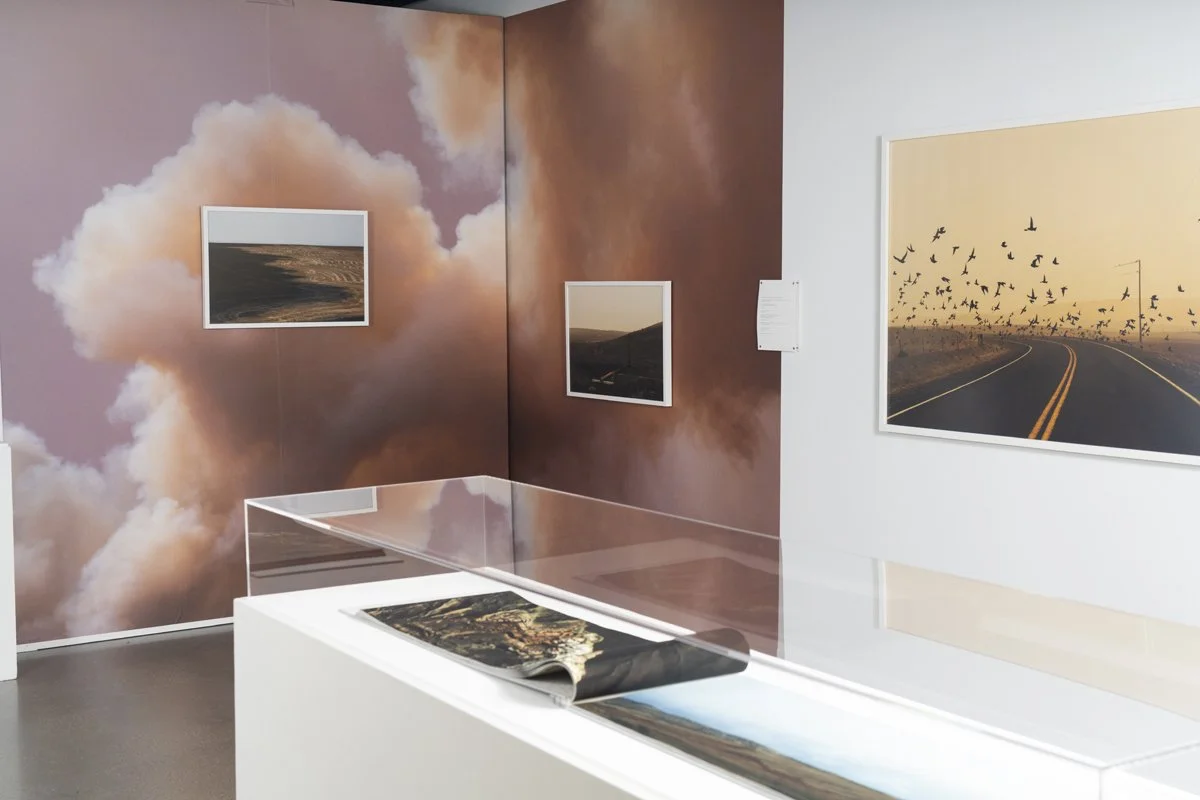
Installation at the Center Galleries (Chicago, IL), 2023, featuring The Sun Sets Midafternoon and Horizon Line, archival pigment prints, text, mural prints, and handmade artist book
ML: Across your projects, you blur distinctions between individual and collective experience. Why is that boundary important for you to complicate?
JH: There is that old adage that the more personal something is, or the more specific, the more relatable it will be. I have always thought that is an interesting dichotomy. The idea that most universal experiences will be explicit or definitive, and that is what will make them relatable. We tend to think we are these islands of thought, but we have some many things in common with each other, similar forces shaping our lives. Specificity, and individuality is what makes things universal, and that tension is what I am interested in.
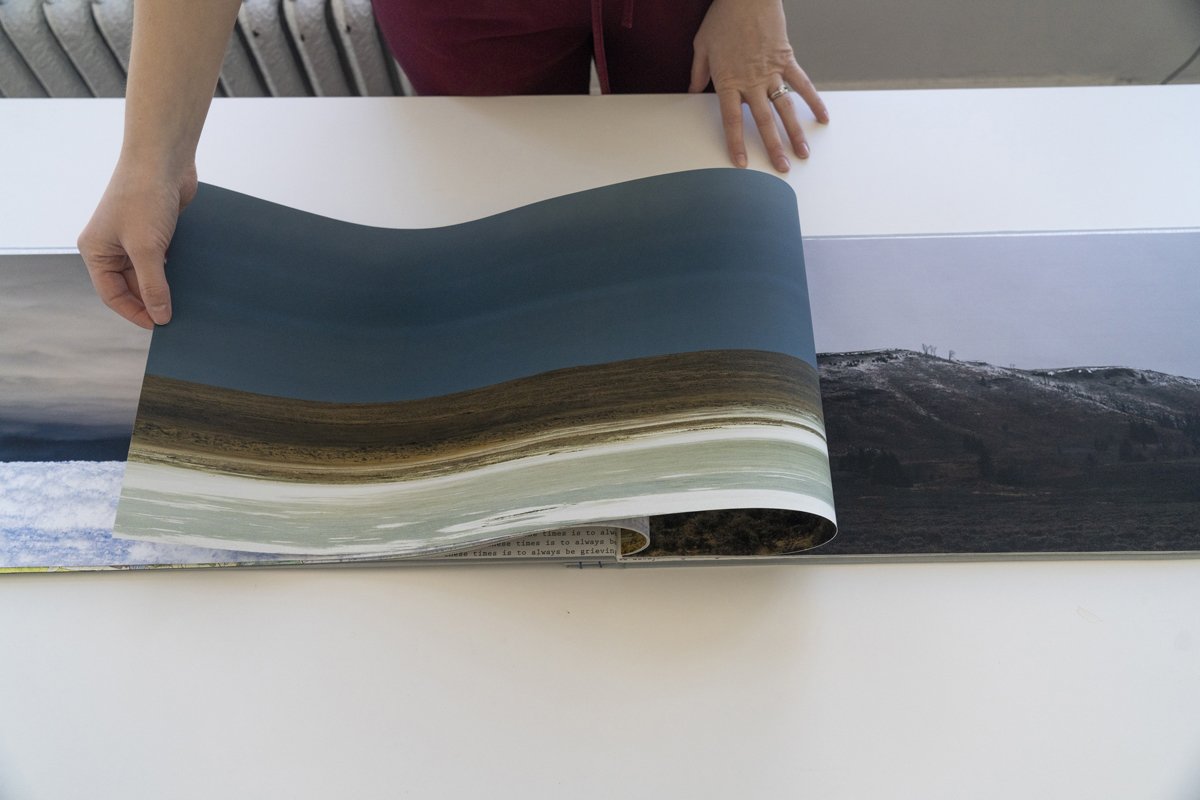
Jessica Hays, Horizon Line, 2023, handmade hardcover artist book, 12” x 60” open, 24 pages, hand bound noble stab binding
ML: Your work Horizon Line engages scale and embodiment through a monumentally sized artist book. What does physical interaction with the work offer that a wall-mounted photograph does not?
JH: With Horizon Line, I wanted to viewer to have to move their body in order to view the work, and I wanted the experience to also feel intimate and personal—which mirrors how I understand a relationship with land. So that scale requires the viewer to take a step just to turn a page. Even a more casual viewer is probably enticed to turn a page in a way that they might not be with a photograph on a wall. I also think the direct engagement of the viewer’s hands turning to page to see more is important. It mirrors how we have to move across the landscape to understand it, and the use of our bodies to do so is the way to know that place more intimately.
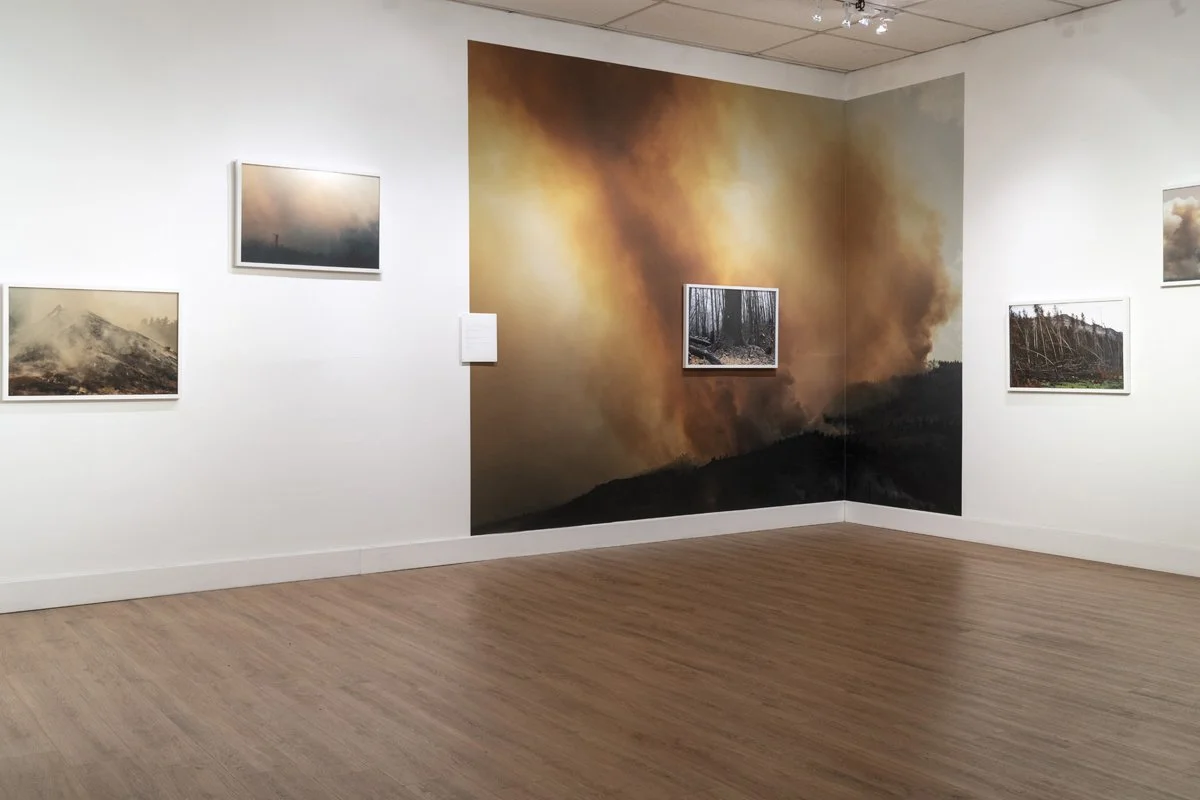
Installation at Aurora PhotoCenter, 2024, featuring Jessica Hays’ The Sun Sets Midafternoon, archival pigment prints, text, mural prints
ML: The project considers land as simultaneously vast and subdivided. How do you conceptualize that dichotomy?
JH: These is the greatest myth of the west, that it was unpopulated when settlers arrived, and that today it is vast open space with nothing in it. No matter the ownership status or management strategy, these places are filled with flora and fauna, crawling with living things, mineral things, growing things, decaying things. And, space that can feel empty of human intervention is often managed land, or land subdivided by use and owernship, creating literal checkerboards of how we occupy, use, and manage lands.
ML: Your practice spans pigment printing, handmade books, video, and alternative processes. How do you decide which medium best serves a particular ecological or emotional inquiry?
JH: I think of myself as a bit of a multihyphenate, and my practice is perhaps the strongest evidence of this. I love to learn and try new methods and mediums, sometimes with a project in mind and sometimes just because I want to learn it. I think this background where I have multiple options and skills in my back pocket makes room for my practice to be expansive and iterative. Sometimes it feels very intuitive when working on an idea and finding how it should live, other times it is more difficult and I try a few things out before finding what works. Usually I just start working on it, and the form needed to elevate the work, whether it be a book or a gum print, starts to reveal itself as I am going. The work tells me what it needs to be, and I just try to listen.
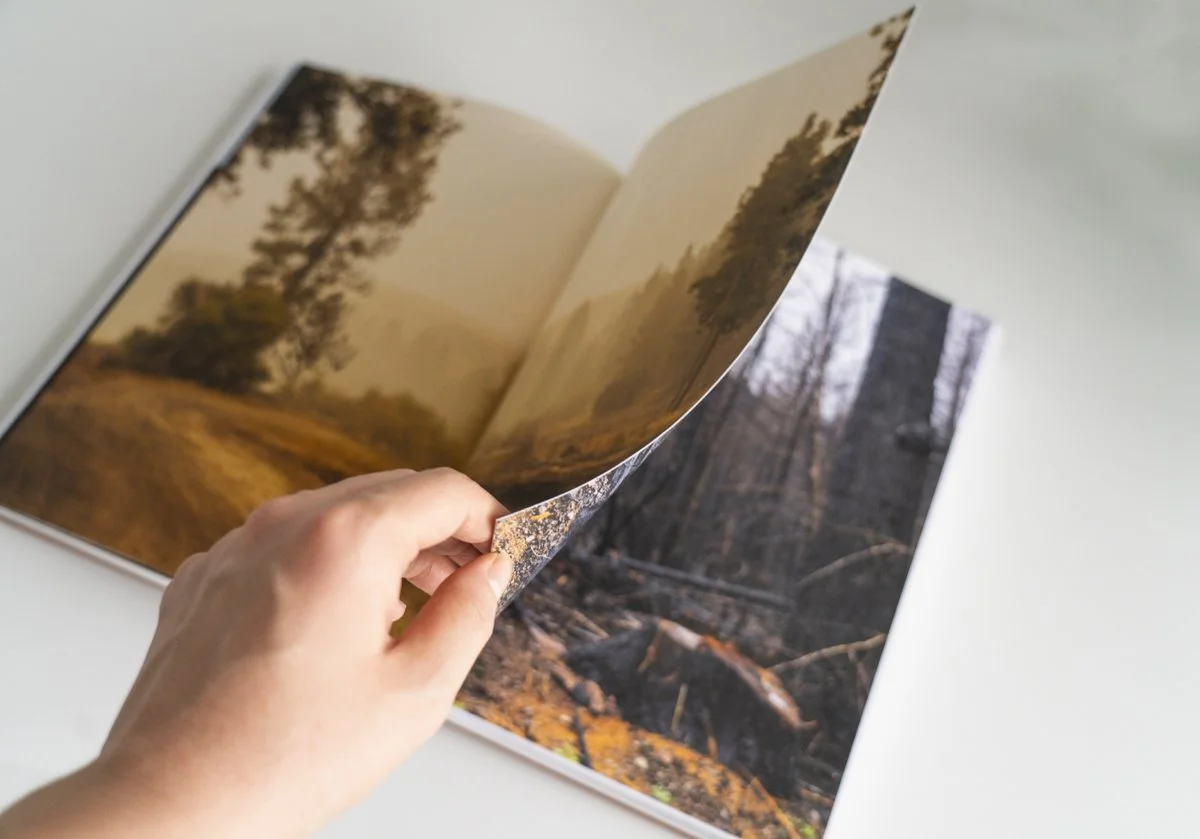
The Sun Sets Midafternoon published by Fall Line Press, 2026, 85 full color images with essays from Jessica Hays, Tim Carpenter, and Stephen Pyne
ML: With a background in both environmental studies and photography, how do scientific frameworks inform or conflict with your artistic practice?
JH: Research and a general awareness of science and psychology really informs my practice. I’m the type of person who reads scientific and psychology journals in my spare time, and sometimes things float up to the top and serve as a spark for what I am working on. And if not, I’m still quite happy to have read an interesting article about this or that. I don’t find it ever in conflict, but I do remember while I was in college and working on these two very different degrees, and pairing one of them with a similarly distant minor, that it was hard to describe why I was doing so much in disparate fields. I love to learn and know about things, and so these backgrounds have always been together, even if I had a harder time defining it when I was studying. I think about inspiration as a nebulous thing—sometimes I know what I saw or read that got an idea simmering in my mind, and sometimes it’s just something in the air, in everything I’ve been looking at and reading and noticing, rather than a single moment. Having the background in science makes those nebulous inspirations more accessible for me. It also meant that I spent time reading and parsing fairly technical environmental writing as a young artist, and that’s a skill I still use in my work and life.
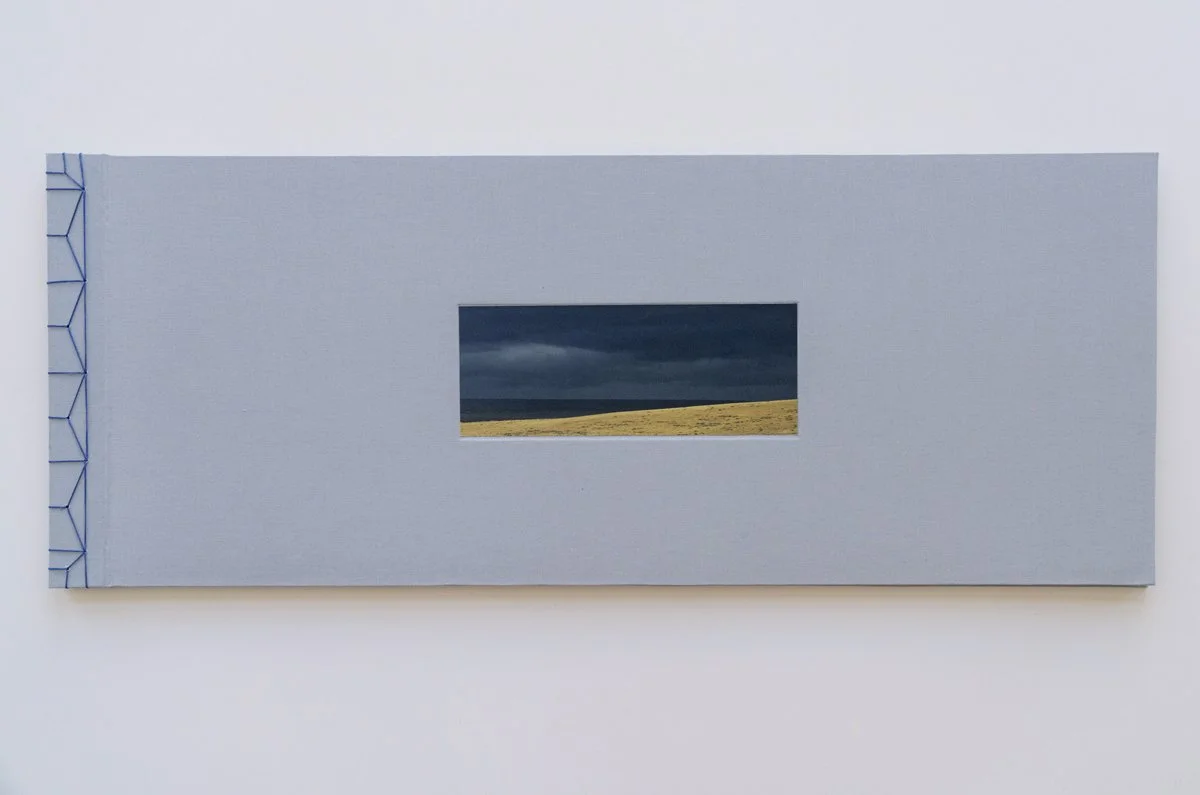
Jessica Hays, Horizon Line, 2023, handmade hardcover artist book, 12” x 60” open, 24 pages, hand bound noble stab binding
ML: Montana and Chicago represent very different relationships to land and environment. How does moving between these places affect your sense of belonging and your artistic focus?
JH: Living between two places has been a pivotal chapter in my artistic sensibility. Most importantly, I think it has allowed me to more clearly understand my viewers, and how the perceptions of work can change based on locale and audience. I have very different conversations at receptions and signings in Montana, where I might find myself speaking to long-time fire lookouts and fish biologists more often than other artists, than I do in Chicago or other places. Both are so valuable to me, and being comfortable in very different places has made it easier to connect with different audiences, and understand how my work can move in the world.
ML: Many of your projects call for slowness, attention, and care. How do you hope viewers physically and emotionally engage with your work in an era of accelerating climate crises?
JH: Our world is accelerating, not just in terms of climate crises, but in terms of how much we consume, produce, expect, see. I think the only way forward is to slow down in order to actually engage and understand what we see and experience. I hope that my work provides and invitation to do that, to spend time with one series of images, with an idea of land, or an idea of grieving a place, or celebrating it—and to sit with that idea for longer than the few seconds we spend per idea in many other formats.
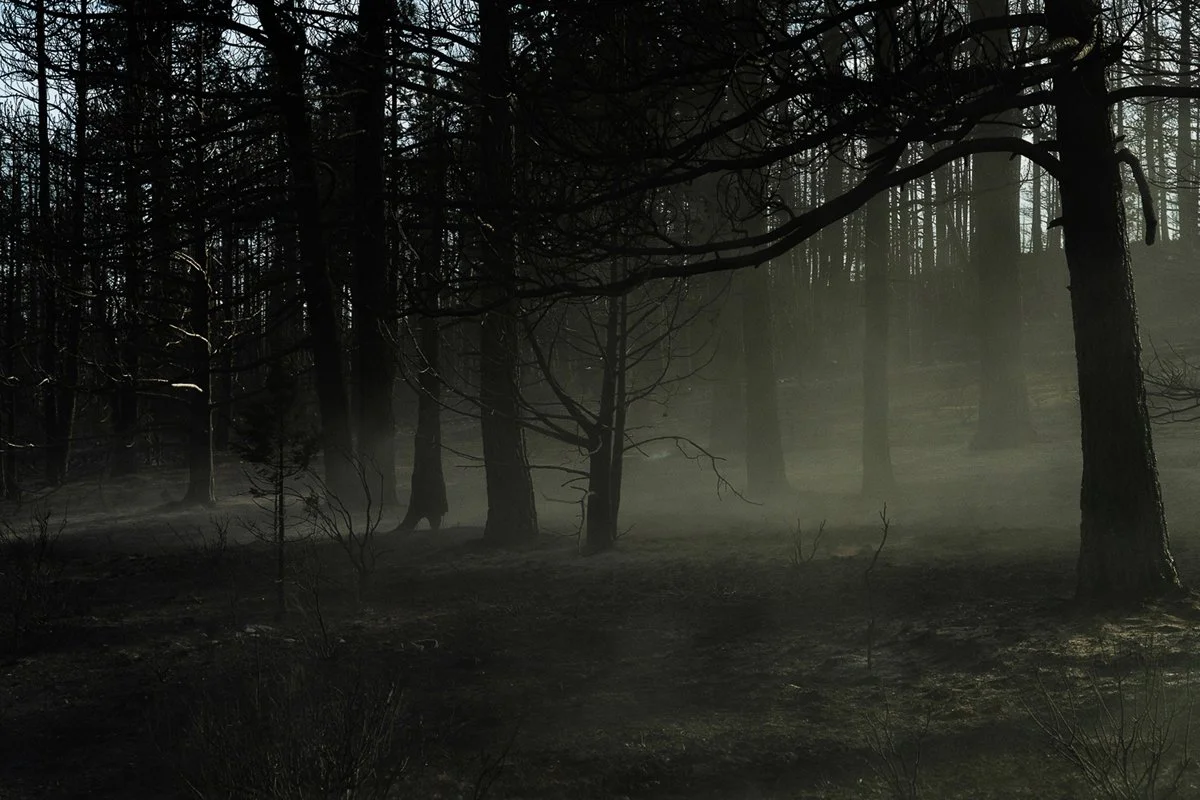
Jessica Hays, Linger, 2023, 40” x 60” archival pigment print
ML: What projects or ideas are occupying your attention at the moment? What feels urgent or most important?
JH: I’m still spending a lot of time working on Blue, and writing about that work and the things it makes me think about. It also feels very urgent to me to spend time on work that focuses on the joy and solace found in the landscape. I’ve been traveling throughout the mountain west lately for another project that brings me out into the woods and the mountains when they are not on fire, and that has been refreshing and necessary to pair with all the work I do on climate grief and time I spend speaking about it. Things feel out of hand and kind of terrifying a lot of the time, and I think it is important to make sure I am also recognizing the beauty, the connection, the solace, the joy I find in these places. I wouldn’t feel the grief if I didn’t have the love for them, and I want to spend time reveling in the magic of these landscapes when I can.
ML: Is there anything else you would like to share?
JH: My first monograph, The Sun Sets Midafternoon(1), is out now and I’m having events throughout the country in support of it. There are current and upcoming exhibitions at Texas Tech University, Griffin Museum of Photography, Goat Farm Art Center, and Holter Museum of Art. I’ll be signing books and giving talks with many of these exhibitions, so if one is in your neighborhood I hope to see you there!
Jessica Hays. The Sun Sets Midafternoon. Atlanta: Fall Line Press, 2025.