
H. Jennings Sheffield
H. Jennings Sheffield was born in Richmond, Virginia and is a contemporary artist working across lens-based media, video, and sound. She received her BFA in Photography and Digital Media from Atlanta College of Art and her MFA in Photography and New Media from University of Texas at San Antonio. Sheffield’s interdisciplinary practice investigates the porous terrain between memory, identity, and temporality, examining how personal narratives intersect with collective histories. Running parallel to this inquiry is an environmentally engaged body of work rooted in landscape and ecological transformation. Her projects, particularly Going Away from Here, engage sites threatened by climate change and environmental loss through embodied encounters with the land itself. These works function as meditations on disappearance and duration, situating ecological precarity within broader questions of time, memory, and human presence.
Sheffield is Professor of Art at Baylor University. Her work has been exhibited extensively both nationally and internationally and is held in the permanent collections of the Museum of Fine Arts, Houston, Bainbridge Island Museum of Art, and Capital One, as well as in the special collections of William & Mary, University of Virginia, University of North Texas, Virginia Commonwealth University, and Baylor University.
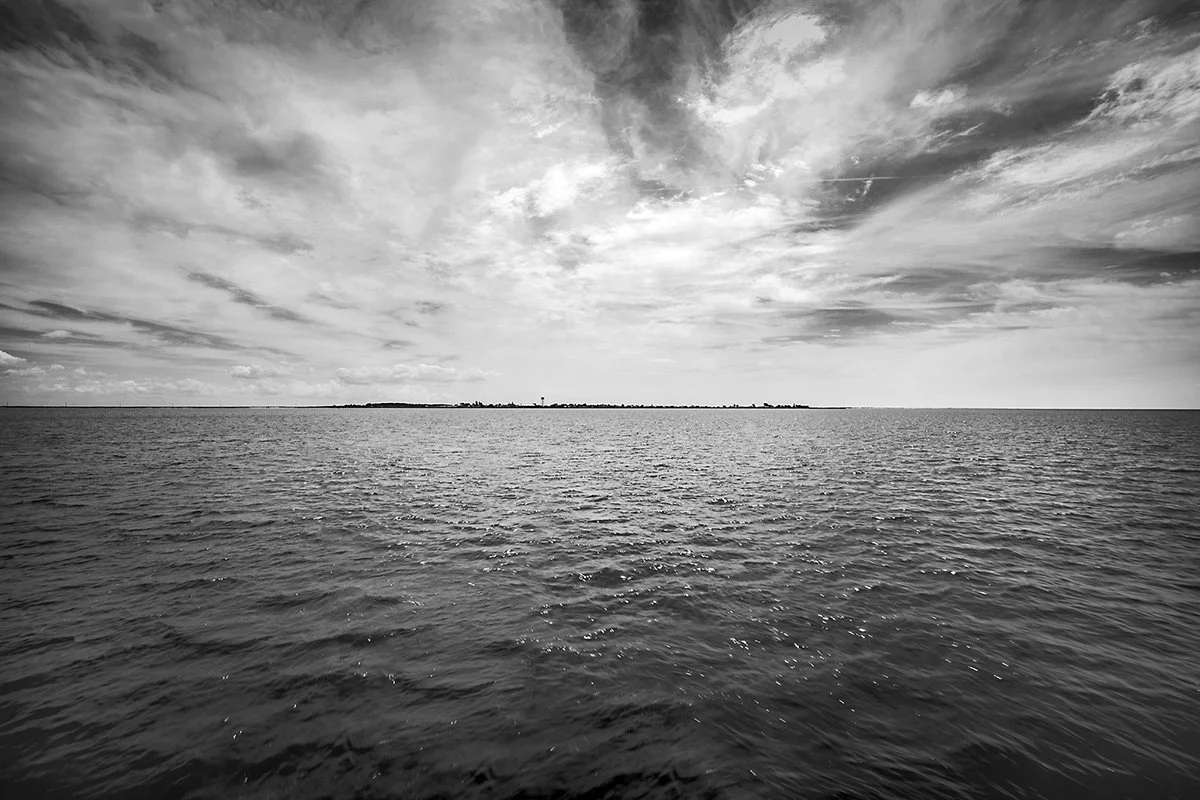
H. Jennings Sheffield, Upon Approach, 2022, 31 ½” x 25 ½", Archival Pigment Print
Margaret LeJeune: In our conversation for the GroundTruth archive, H. Jennings Sheffield reflects on the intersections of memory, landscape, and ecological change within her interdisciplinary practice. We discuss how Sheffield constructs visual and sensory environments that examine how time alters both personal histories and physical terrains. Her work moves fluidly between intimate narrative and environmental observation, tracing the fragile thresholds where identity, memory, and place converge. Through discussions of process, materiality, and the evolving role of the image in an era of environmental uncertainty, Sheffield offers insight into an artistic practice deeply attuned to impermanence, transformation, and the poetics of disappearance.
ML: Thank you for joining me today. Let’s being by talking about your acute and sensitive observations of land loss and environmental change. In your series’ Going Away from Here and Kalapana Gardens you focus on communities living with environmental inevitability. What initially drew you to these places?
HJS: My initial engagement with both places emerged through circumstance rather than intention. Yet once encountered, I was drawn to them as sites where home and impermanence converge, where loss is lived.
With Kalapana Gardens, I was in Hawaiʻi on a business trip with my husband, whose work focuses on education in at-risk communities. He was asked to take a side trip to the Big Island to visit a place with no running water and no electricity, where children nonetheless continued to attend school. As soon as I heard about it, I grabbed my camera and tagged along.
Up until the early 1980s, Kalapana had been a thriving fishing village in Hawaiʻi’s Puna District. Lava flows from Kīlauea gradually destroyed the town, and over time more than 180 structures were lost. By 2010, lava threatened the Kalapana Gardens subdivision, which at that point contained approximately thirty-five structures. Many residents, some self-identifying as “lavatics” or “fringers,” continued living there despite having no access to electricity or running water. At the time, the lava continued to flow behind them and would glow in the night sky as a constant reminder. Even for those who wanted to leave, relocation was often constrained by economics and circumstance. When I arrived, much of the community lay buried beneath roughly thirty feet of lava. I walked the landscape, responding with my camera to what remained. I stayed through sunset. The place felt otherworldly, like being on Mars, simultaneously erased and present, beautiful and unsettling.
Tangier Island came to me differently, but just as quietly. I am from the Chesapeake region, and over the years the island had become a focal point in conversations about sea-level rise and climate change. Tangier is low-lying and small, losing an estimated seven to nine acres of land each year due to erosion and rising water. What compelled me, however, was not only the environmental crisis, but the way daily life continued alongside it, how routine, memory, and belonging persisted even as the ground itself receded.
As a child, I had been fascinated by the crabbers from Tangier Island. They spoke a baroque old English dialect, and I would see them while fishing with my father on the Chesapeake Bay, distinct even before they spoke because of their deadrise boats. Years later, while visiting my parents, I watched Mayor James “Ooker” Eskridge appear on a televised climate town hall with Al Gore, questioning climate change. Shortly after, it was broadcast that he had received a phone call from Donald Trump, who reassured him that the island had existed for hundreds of years and would remain for hundreds more. I knew that was not true. No plan or rescue was waiting. The island’s erosion was slow, measurable, and unrelenting.
That is how I arrived at these places. Kalapana Gardens emerged out of a natural curiosity and a need to see for myself. Tangier Island was also driven by curiosity, but it was shaped by skepticism. I knew that what we were being told publicly did not align with lived reality, and I felt compelled to go photograph it. In both projects, I was not seeking spectacle or catastrophe. I was more interested in looking, seeing, and being present, in understanding what was happening, capturing it, and responding to it with my camera. That was something I felt I needed to do.
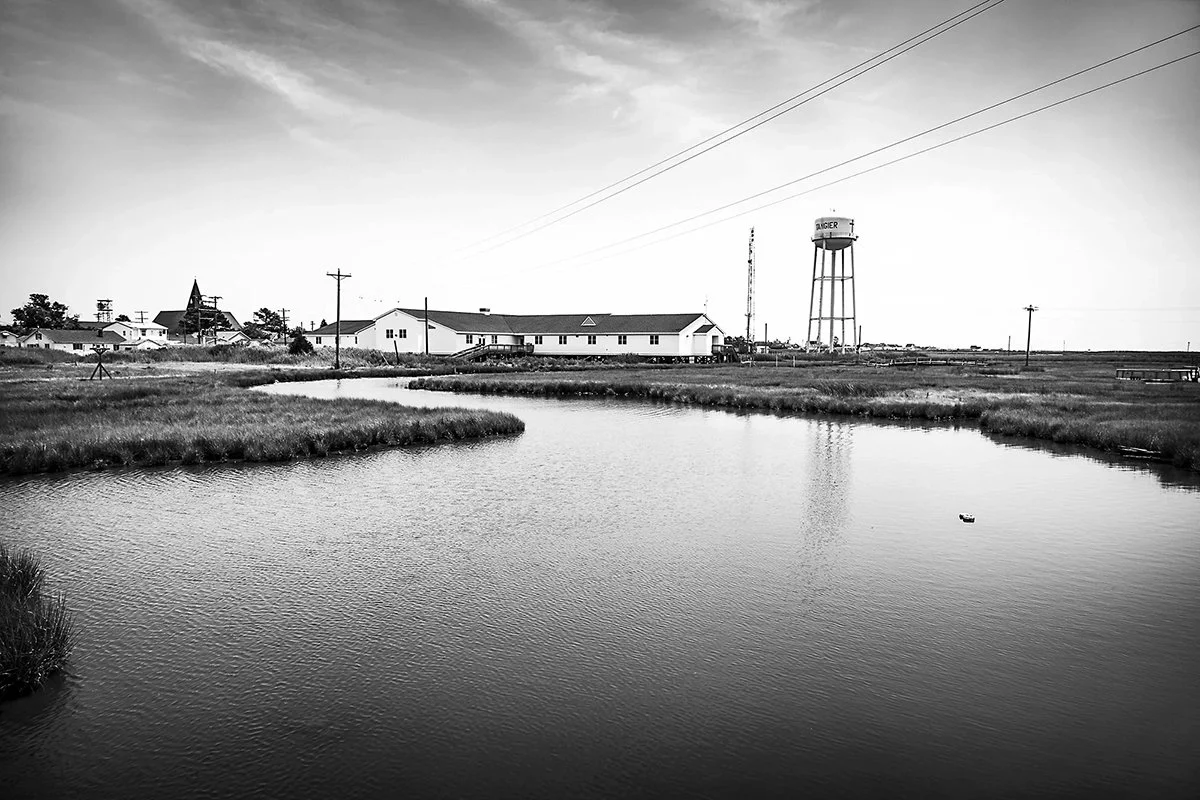
H. Jennings Sheffield, Tangier Combined School, 2022, 31 ½” x 25 ½", Archival Pigment Print
ML: You spent six years photographing Tangier Island. How did working over such an extended period shape your relationship to the island and its residents?
HJS: Spending six years working on Tangier allowed my relationship with the place and the pace of the work to grow and change. Over time, I felt a greater responsibility toward the people who live there. Tangier is small and low-lying, and when you arrive by boat you feel how precarious it is. It’s barely visible in the Bay, marked in the distance by the water tower with a crab on one side and a cross on the other. That physical vulnerability is matched by a cultural one, and the land loss is happening fast.
Working over the years changed the work tremendously. Trust had time to build, and the complexities had time to reveal themselves. The project moved away from simply documenting what was happening and toward growing in scale and medium, while also allowing space to form a deeper relationship with the island. Most of the time, I was simply responding to what I was seeing—paying attention, photographing what was in front of me, and letting that guide the work. I became less interested in making a single statement image and more interested in building a portrait of the community—its labor, faith, humor, and daily life—while the shoreline continued to change.
At first, I thought the importance was about documenting the island itself and connecting it to my childhood intrigue. But the longer I stayed, the more that focus shifted toward the people. So much of the conversation around Tangier is framed through climate change and politics, but what stayed with me was the community. They depend on each other in very real ways. When storms roll in and they’re cut off, they share food and take care of each other. It really functions like one large family. That kind of care doesn’t exist everywhere, and it’s shaped by the conditions they’re living in—by isolation, environmental pressure, and generations of labor tied to the water. Within all of that, there’s also beauty. A generosity. A strength. None of that was visible to me on the first day. The layers revealed themselves over time.
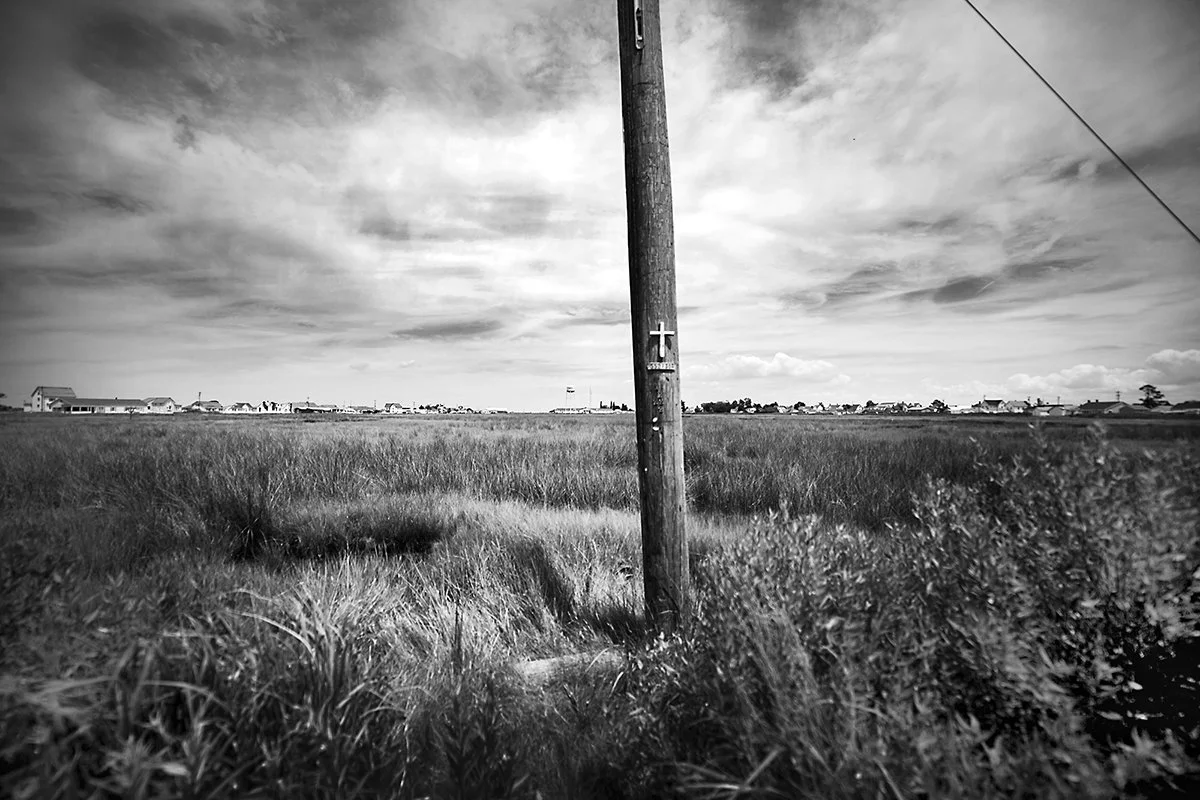
H. Jennings Sheffield, Line of Communication, 2022, 31 ½” x 25 ½", Archival Pigment Print
ML: Tangier Island is often discussed in political and media narratives about climate change. How did you navigate making photographs that resist sensationalism while still communicating urgency?
HJS: Sensationalism often relies on distance and spectacle. With Tangier, I wanted the opposite. I wanted time on the island and quiet observation. I paid attention to the small details and the larger narrative. Hand-painted signs. Posted notices. Lived experience. I spent time listening, returning, and letting relationships shape what I photographed. The urgency is there, but it lives in their everyday.
It was also important to me to show how deeply tied the community is to the landscape, and that’s not something you can understand quickly. It reveals itself over time, through the images and the narrative they build. As an artist, my responsibility was to honor that complexity, to acknowledge environmental precarity without turning people into symbols or victims. I believe urgency doesn’t need to be loud. In this work, it shows up in what’s quietly slipping away, and in the understanding that by the time something becomes visually catastrophic, it has often already been lost.
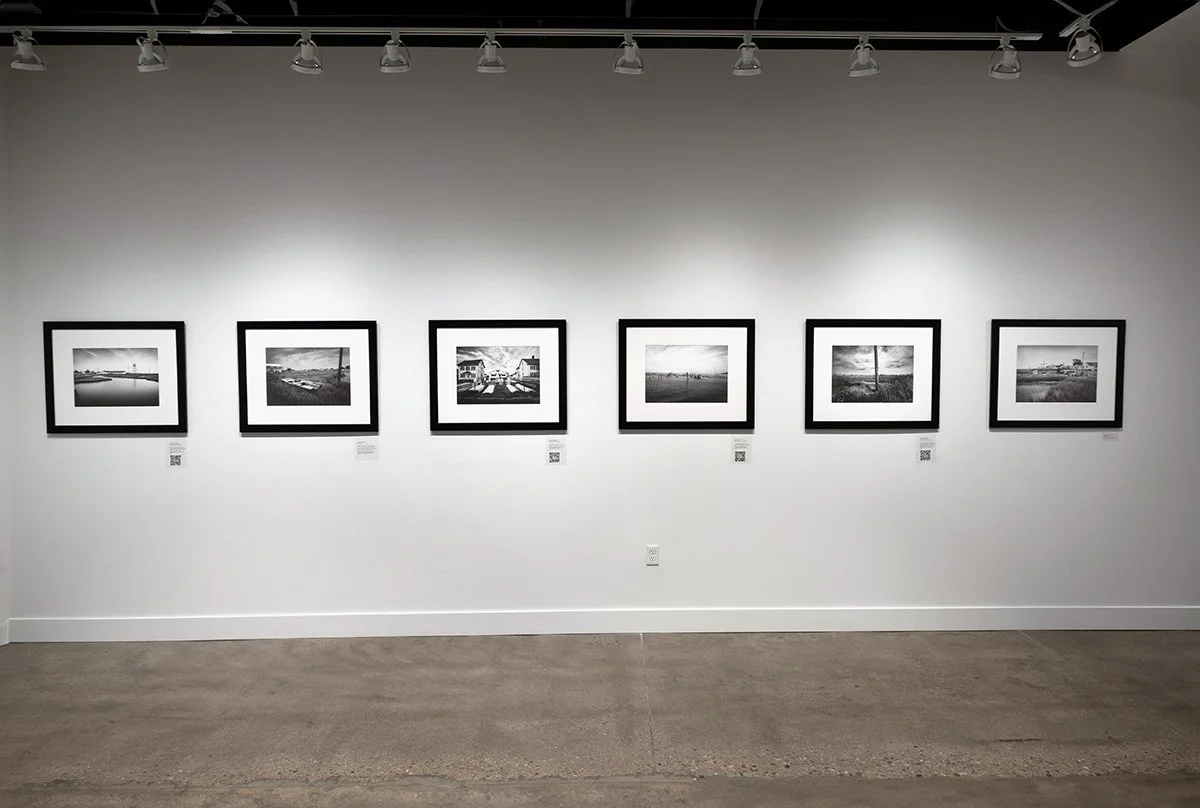
H. Jennings Sheffield, B&W prints and QR Codes of Going Away from Here installed at Colorado Photographic Arts Center
ML: In Going Away from Here, you pair images with QR codes linking to audio interviews. What led you to incorporate sound and oral histories into a photographic project?
HJS: I initially approached Going Away from Here with the intention of photographing Tangier Island as objectively as possible, without imposing an agenda or reacting too quickly or emotionally to what I was seeing. When I began the project, I didn’t yet know what the work would become. I only knew that the island held significance for me from childhood.
As the photographs began to come together, it became clear that something essential was missing. The residents’ voices. Their cadence, dialect, and ways of speaking are such a vital part of Tangier’s identity. Incorporating interviews and oral histories through QR codes allowed the project to remain grounded in photography while adding another layer of understanding. In the exhibition, the audio recordings work collaboratively with the images. They sit alongside the images, offering another way of knowing the place. Sound brings intimacy, presence, and time, mirroring how memory and loss operate on the island. Some recordings provide context specific to life on Tangier, while others feature residents responding to what is shown in the images through their lived experience.
Ultimately, this decision came from a sense of responsibility. The work could not speak about Tangier without also making space for Tangier to speak for itself. The photographs offer a visual framework, but the voices anchor the project in lived experience, ensuring the story is not only seen, but heard.
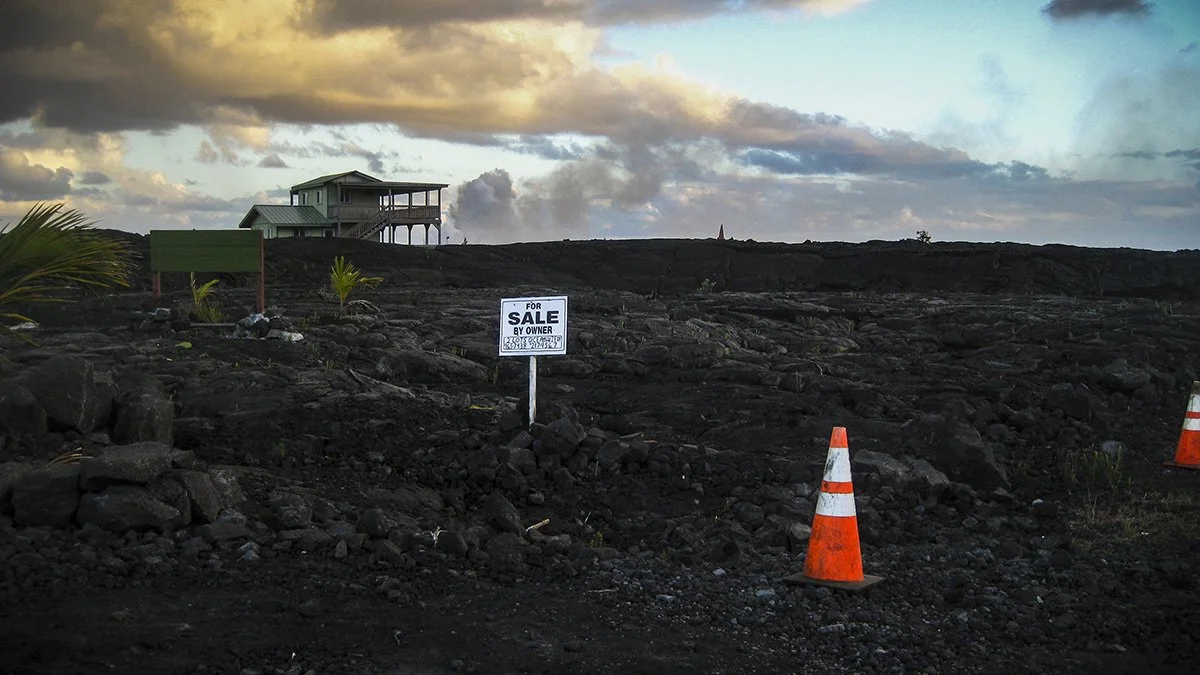
H. Jennings Sheffield, Kalapana Gardens I, 2014, 24” x 20”, Archival Pigment Print
ML: Both Going Away from Here and Kalapana Gardens address the loss of land in very different geographic and cultural contexts, the Chesapeake Bay and Hawai‘i. What similarities did you notice between these communities despite their distance?
HJS: Despite the vast geographic and cultural distance between the Chesapeake Bay and Hawai‘i, I was struck by the shared resourcefulness and resilience of both communities—and, most powerfully, by the strength of collective care. In both places, access to resources is limited and often unpredictable, which fundamentally shapes how people relate to one another. Survival and continuity depend less on individual self-sufficiency and more on trust, cooperation, and deeply ingrained systems of mutual support. Community is not an abstract value; it is a daily practice.
“What connects these communities is not just their exposure to environmental loss but how that loss reinforces interdependence. In places where the land is unstable and resources are limited, the community becomes the most reliable infrastructure—and the most enduring form of resilience.”
This was especially evident on Tangier Island, where families stretch back generations and shared history becomes a form of knowledge. People know who to rely on, who has particular skills, and how to mobilize when resources are scarce. When winter storms cut off access to the mainland and boats can’t run to Maryland for groceries or supplies, the community responds collectively—food, labor, and care are pooled, and individual needs are absorbed into a shared reserve. Dependence is not seen as weakness but their strength.
What connects these communities is not just their exposure to environmental loss but how that loss reinforces interdependence. In places where the land is unstable and resources are limited, the community becomes the most reliable infrastructure—and the most enduring form of resilience.
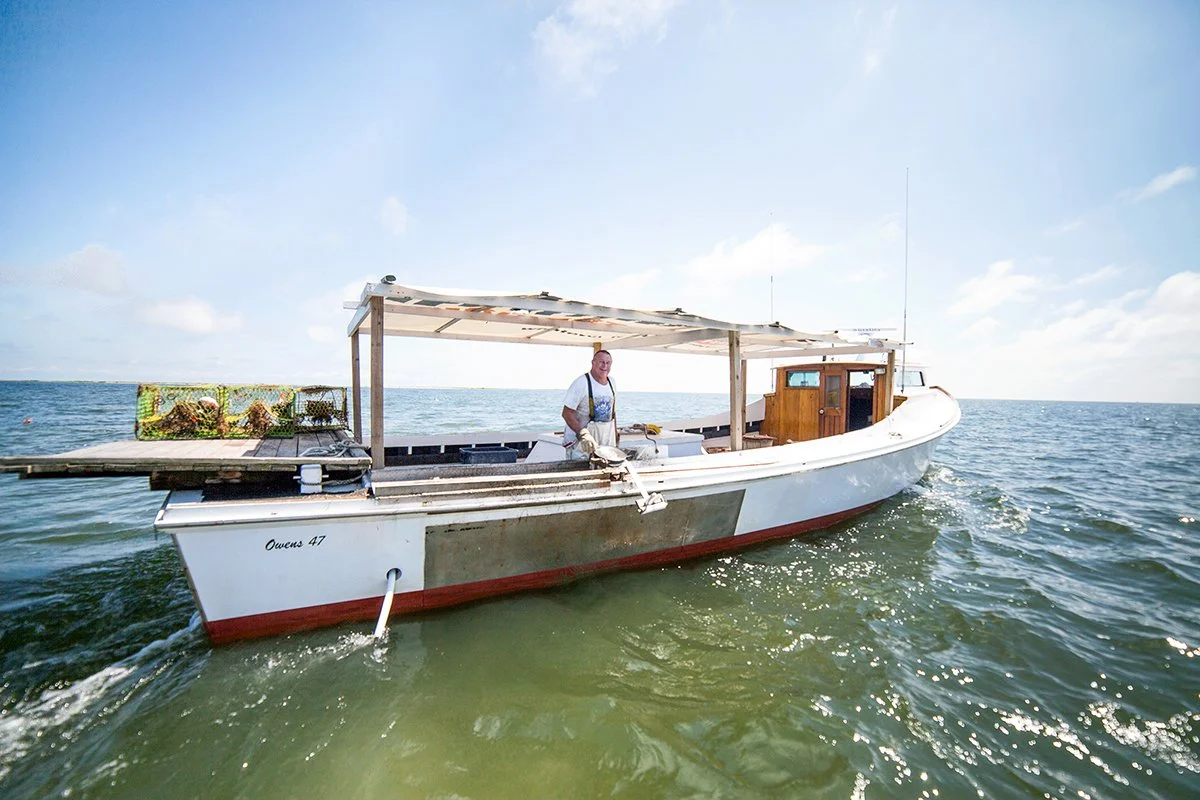
H. Jennings Sheffield, Searching for Peelers, 2022, 31 ½” x 25 ½", Archival Pigment Print
ML: Many of the people you photographed are unable to leave, whether due to financial constraints or cultural ties. How do you ethically represent communities that are often portrayed as “stuck”?
“My responsibility as an artist isn’t to sensationalize precarity, but to convey dignity, agency, and lived complexity. The photographs aren’t meant to speak for the community, but to share their presence and stories, and to show what’s at stake when a place disappears not just homes and infrastructure, but social systems, traditions, and collective memory.”
JHS: That’s an important and difficult question, and one I was very aware of throughout my time on Tangier Island, especially given the time and space I had to really engage with the community. I was careful not to frame residents as “stuck” or as passive victims of climate change, because that’s not how they see themselves. For many, staying is a choice, rooted in hope and in a belief that their circumstances can still be addressed. I wanted to represent them as knowledgeable, resilient, and deeply rooted people whose decisions are tied to economic, cultural, and generational connections to place.
For Tangier’s residents, the island isn’t just land. It’s livelihood, history, faith, and kinship. The island has been continuously inhabited for more than three hundred years and leaving would mean losing a culture as distinct as its dialect, one sustained for centuries through crabbing, shared labor, and mutual reliance, and losing a community they have known for generations.
My responsibility as an artist isn’t to sensationalize precarity, but to convey dignity, agency, and lived complexity. The photographs aren’t meant to speak for the community, but to share their presence and stories, and to show what’s at stake when a place disappears not just homes and infrastructure, but social systems, traditions, and collective memory.
ML: Your work frequently addresses what is lost when a place disappears, not just land, but language, ritual, and memory. How do you attempt to photograph something as intangible as culture?
“I don’t think of culture as something you can photograph directly. For me, it reveals itself through the repetitions and rhythms of daily life, and sometimes, it can even be reflected in what is not there. Culture lives in how people move through space, how they work, gather, speak, and take care of one another.”
HJS: I don’t think of culture as something you can photograph directly. For me, it reveals itself through the repetitions and rhythms of daily life, and sometimes, it can even be reflected in what is not there. Culture lives in how people move through space, how they work, gather, speak, and take care of one another. My photographs hopefully capture the culture by paying attention to small, often overlooked moments that quietly exist. Several times while I was photographing on the island, someone would come up to me and ask me why I was photographing that, or what I was photographing, because to them it was so ordinary, so given. That ordinariness is important. When you live inside a culture, it often disappears into routine. It’s not something you stop to notice because it’s simply how life works. Photography can hold that tension between what feels invisible in daily life and what is quietly at risk of being lost.
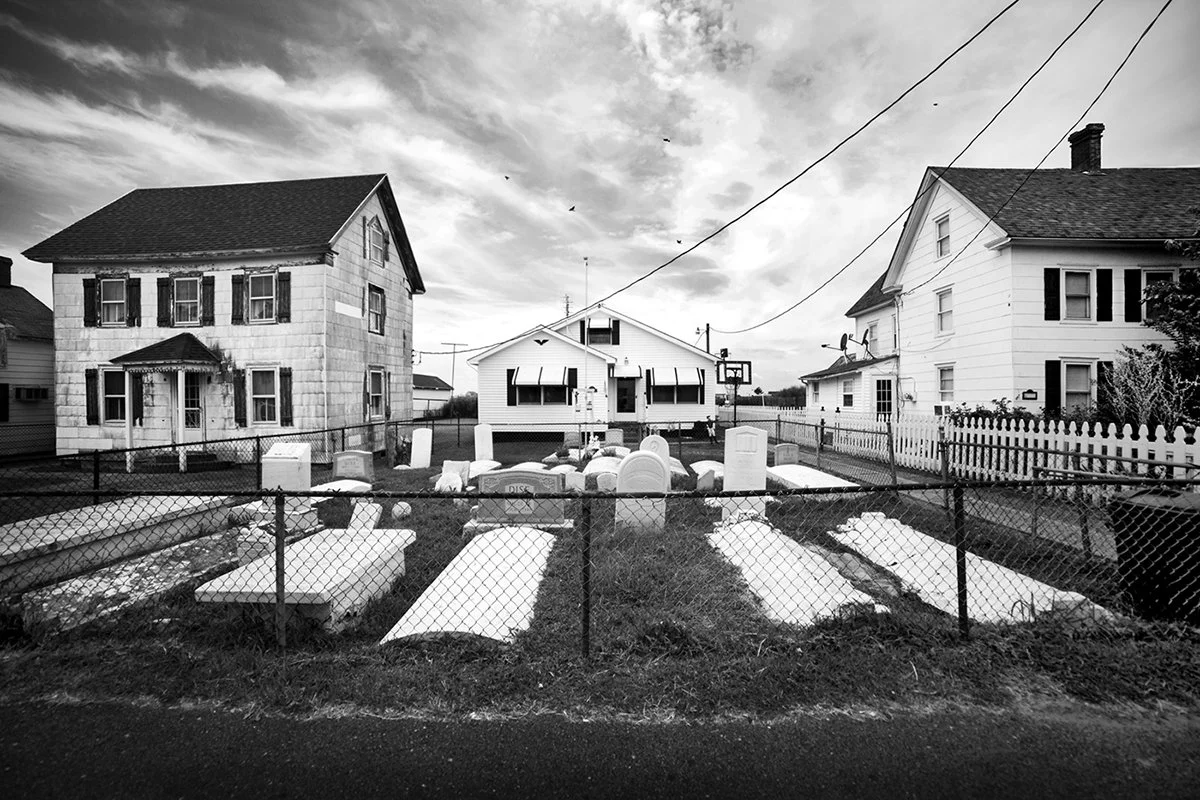
H. Jennings Sheffield, Keeping Loved Ones Close, 2022, 31 ½” x 25 ½", Archival Pigment Print
ML: The cemeteries on Tangier Island are overcrowded, with graves placed in front yards. How did photographing spaces of death and remembrance affect you personally?
HJS: Photographing the cemeteries on Tangier Island affected me more deeply than I expected. At first, I was drawn to them, partly because I couldn’t imagine having graves in my own front yard. From my perspective, death is something we tend to separate or keep at a distance, so seeing it woven so directly into everyday domestic space was unsettling.
Over time, I realized that reaction was shaped by my own cultural assumptions. The graves aren’t necessarily those of immediate family members, and their placement isn’t seen as strange or morbid by residents. It’s simply what has always been done. Limited land made the practice necessary, but it also normalized a closeness to death that feels very different from how many of us experience it.
That realization shifted how I photographed these spaces. Instead of treating them as symbols of loss or crisis, I began to see them as markers of a community that lives alongside its past rather than separating from it.
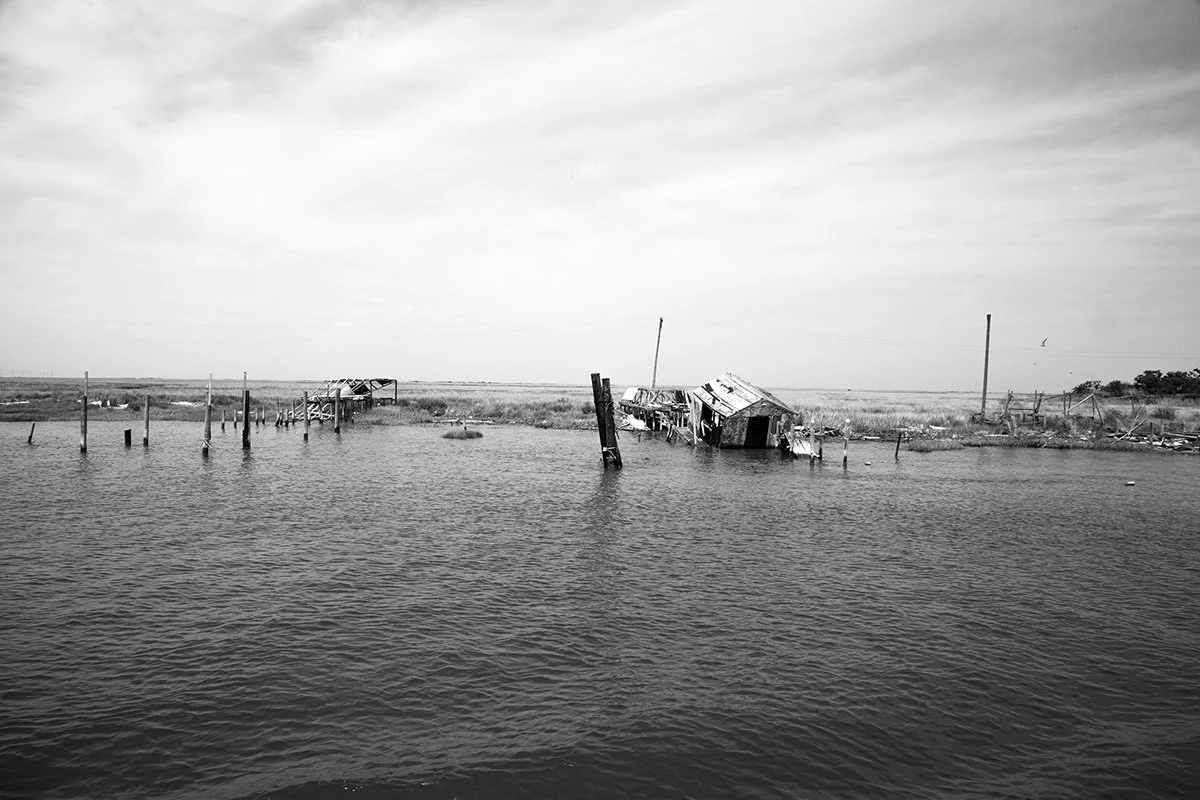
H. Jennings Sheffield, After Isabel, 2022, 31 ½” x 25 ½", Archival Pigment Print
ML: How does being an educator influence the work you create? Do your concerns about climate-related issues influence your teaching?
HJS: My role as an educator influences my work every day. My students continually shape how I think—through our conversations, the questions they raise, the content they’re engaging with, and the techniques they’re testing. That exchange feels reciprocal: they inform my work, and I inform theirs. At the same time, I’m very intentional about not positioning my practice as a model they should emulate. I want students to feel free to pursue what is theirs to hold—conceptually, materially, and ethically—without feeling tethered to my own concerns or methodologies.
Climate-related issues do surface frequently in my teaching, largely because they are already at the forefront of my students’ lives. I’ve had several students working directly with environmental themes. One recent BFA exhibition focused on water systems in Louisiana and received significant recognition. During that process, we had ongoing conversations about approach and responsibility—discussing, for example, how my project Going Away from Here centers community voices through oral histories and QR-linked narratives, while her work relied more heavily on data analysis and visualization. Those conversations became a way to think critically about authorship, representation, and the ethics of translating climate realities into visual form.
More broadly, I emphasize the increasingly collaborative nature of contemporary art, particularly its intersections with the sciences. I encourage students to work across disciplines and across campus, and I often see this most clearly in projects that engage data visualization, environmental research, or scientific methodologies. In parallel, I’ve been developing a white paper with our Dean of Libraries and a faculty member in Environmental Sciences, proposing future collaborative frameworks at Baylor. I hope that this work models for students how scientific data and lived experience can be brought into dialogue—how climate realities can be understood not only through information, but through visual, sensory, and human-centered forms of communication.
In this way, teaching and making are deeply intertwined for me: both are about listening, collaboration, and finding ways to translate complex ideas into forms that invite understanding rather than prescribe meaning.
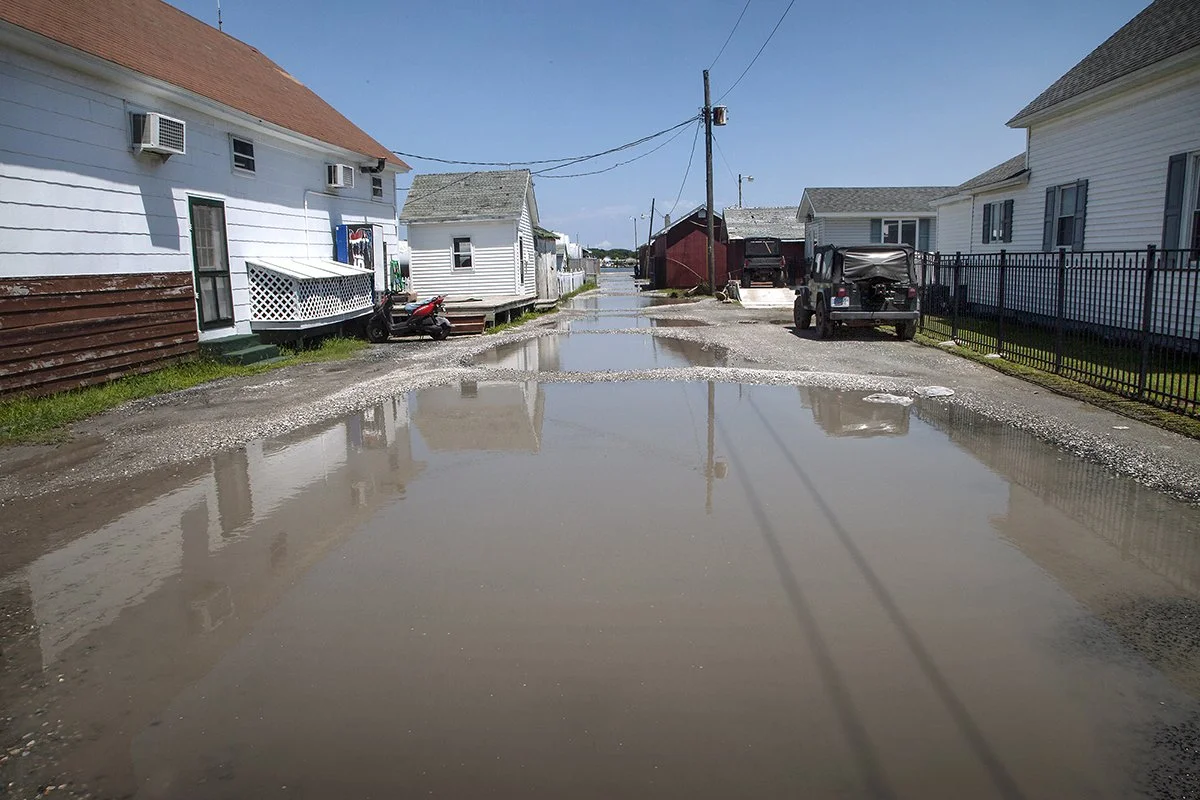
H. Jennings Sheffield, High Tide, 2022, 31 ½” x 25 ½", Archival Pigment Print
ML: Your work seems to raise the question: who and what is worth saving? Do you see your role as a photographer as asking questions, advocating, or bearing witness?
“I want the work to create space for reflection—to encourage viewers to consider where they believe value resides and how those beliefs shape the choices we’re already making about what, and who, we are willing to protect.”
HJS: The question of who and what is worth saving is central to this work, and it’s one I’m really directing toward the viewer. Tangier Island exists in many layers at once. It is often described as one of America’s first climate refugee communities, yet there is no clear plan or guaranteed support for when relocation becomes unavoidable. At the time I was working there, fewer than 500 people lived on the island. That reality raises difficult but necessary questions about how we define value—value of culture, of history, of home, and of community.
What continues to surprise me is how many people say they didn’t know this was happening. And yet, in other spaces, the future is already being acknowledged. Real estate is being sold miles offshore as “future waterfront,” with the understanding that climate change will reshape the coastline. Financially, those conversations are happening. Culturally and humanly, they often are not—because loss does not offer the same kind of return.
I don’t see my role as purely advocacy or detached documentation. I think of it as bearing witness and asking careful questions. How do we decide what is worth saving? Who gets to make those decisions? Are resources directed only toward places with larger populations, or do smaller communities hold equal value, even when saving them is complex or costly?
I’m not trying to offer answers or frame this as a political argument. Instead, I want the work to create space for reflection—to encourage viewers to consider where they believe value resides and how those beliefs shape the choices we’re already making about what, and who, we are willing to protect.
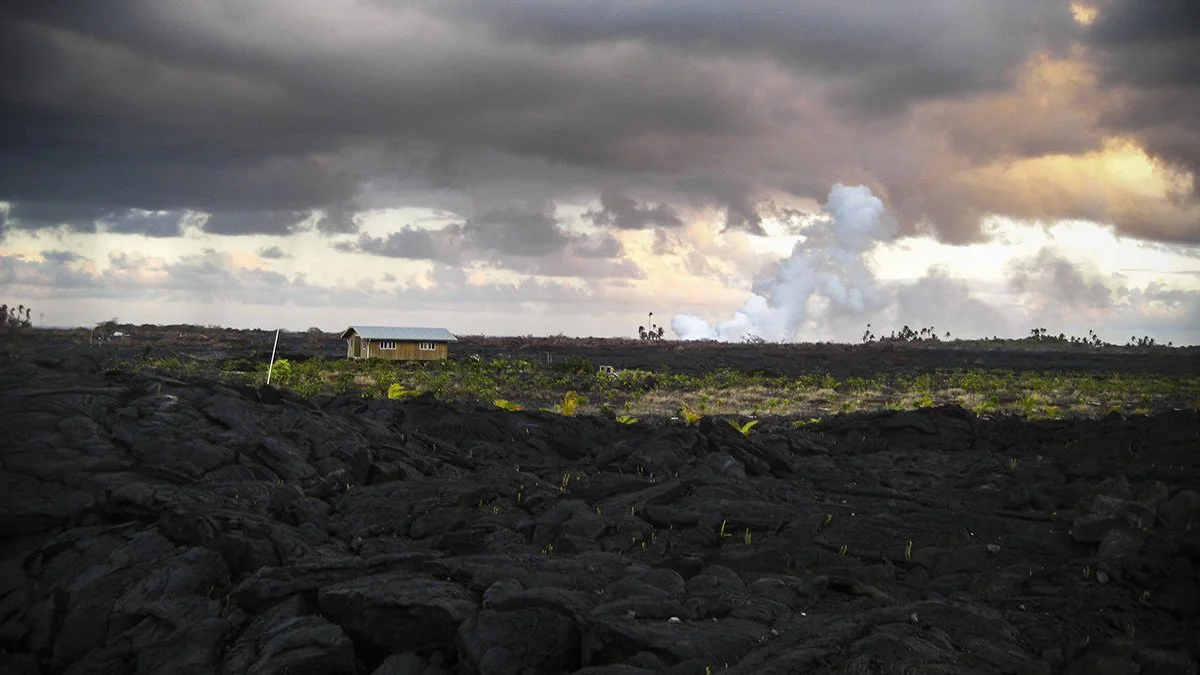
H. Jennings Sheffield, Kalapana Gardens III, 2014, 24” x 20”, Archival Pigment Print
ML: How do you think fine art photography can contribute to conversations about climate change differently than journalism or scientific research?
HJS: I think fine art photography occupies a space where data, perspective, education, and intention can coexist. Scientific research is essential, but it is largely data-driven, and emotion is intentionally removed in order to maintain objectivity. That distance serves an important purpose, but it can also create a gap between information and lived experience.
“Fine art photography has the ability to slow the viewer down and create an emotional entry point, allowing people to connect with climate change not just as an abstract problem, but as something that affects real places and communities.”
I’ve presented my work to environmental science departments at several universities, and what often becomes clear in those settings is that students know the facts—they understand the data—but they haven’t always considered the lives, stories, and cultural worlds that exist behind those numbers. Fine art photography has the ability to slow the viewer down and create an emotional entry point, allowing people to connect with climate change not just as an abstract problem, but as something that affects real places and communities.
Journalistic documentation, on the other hand, is often focused on recording and time-stamping events as they unfold. That work is critically important, but it is also shaped by what is included and sometimes what is left out. Fine art photography can make those omissions visible or intentionally leave space for what cannot be easily shown—memory, absence, uncertainty, and loss.
In that way, fine art photography doesn’t replace scientific research or journalism but complements them. It provides a different kind of understanding—one that invites reflection, empathy, and sustained engagement, rather than simply delivering information.
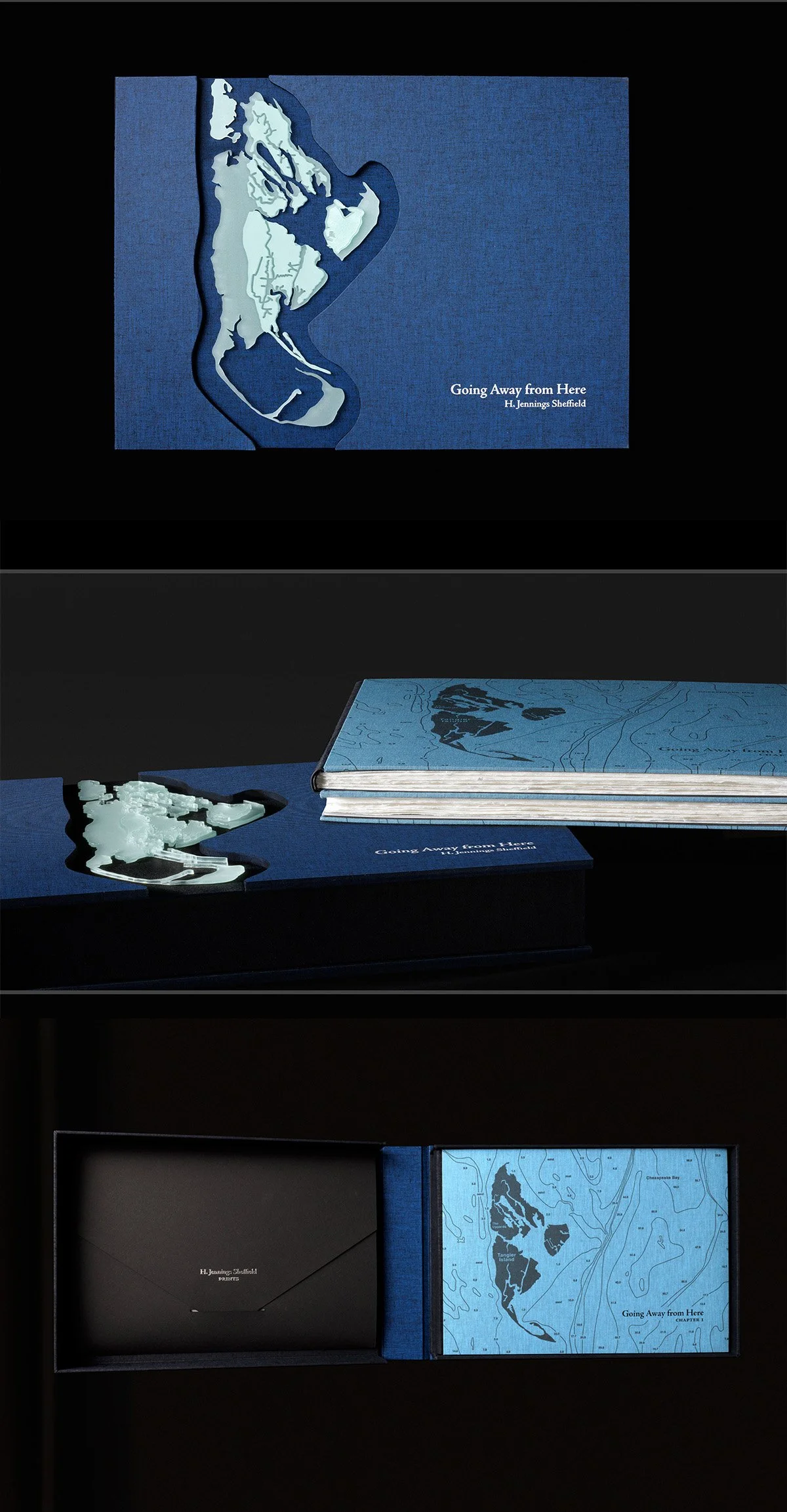
H. Jennings Sheffield, Going Away from Here Fine Artist Book, 2022, limited-edition Dos-à-Dos book
ML: What responsibilities do you feel toward the communities you photograph once a project is finished and enters galleries, books, or academic spaces?
HJS: I do believe there’s a responsibility once a project leaves the community and enters galleries, books, or academic spaces. For me, that responsibility is about shared responsibility. It doesn’t have to result in a single outcome, but there should always be a sense that something is being returned.
With Tangier Island, I approached the project with several intentions in mind. I wanted the work to exist as an exhibition, with QR codes allowing the voices and stories of residents to remain present alongside the images. I also wanted it to live as a fine art book that could enter university and museum special collections, allowing the project to move into broader academic conversations across the sciences, humanities, and environmental studies. Ultimately, my hope has been to develop a more accessible publication, ideally through a university press, in the form of a coffee table book that could reach a wider audience.
From the beginning, it has been important to me that a portion of the proceeds from that broader publication be directed back to Tangier Island and its residents. I’ve been able to realize the first two goals, and the larger publication remains something I’m continuing to work toward.
In the meantime, I’ve focused on what I can give now. When the project was completed, I sent between fifty and sixty large-format archival pigment prints back to the island to be distributed to the individuals and places I photographed. Early on, I saw a post from a resident who recognized their home in a gallery image and shared how meaningful it was to see it represented that way. That moment stayed with me and reinforced the importance of returning images to the community.
There were quieter moments as well. During COVID, I learned that one of the island’s oldest watermen had passed away, and I sent photographs of him tending to his crab floats, or “fishing up,” to his family for his memorial. In moments like that, the responsibility becomes very clear. It’s about honoring trust, presence, and shared time.
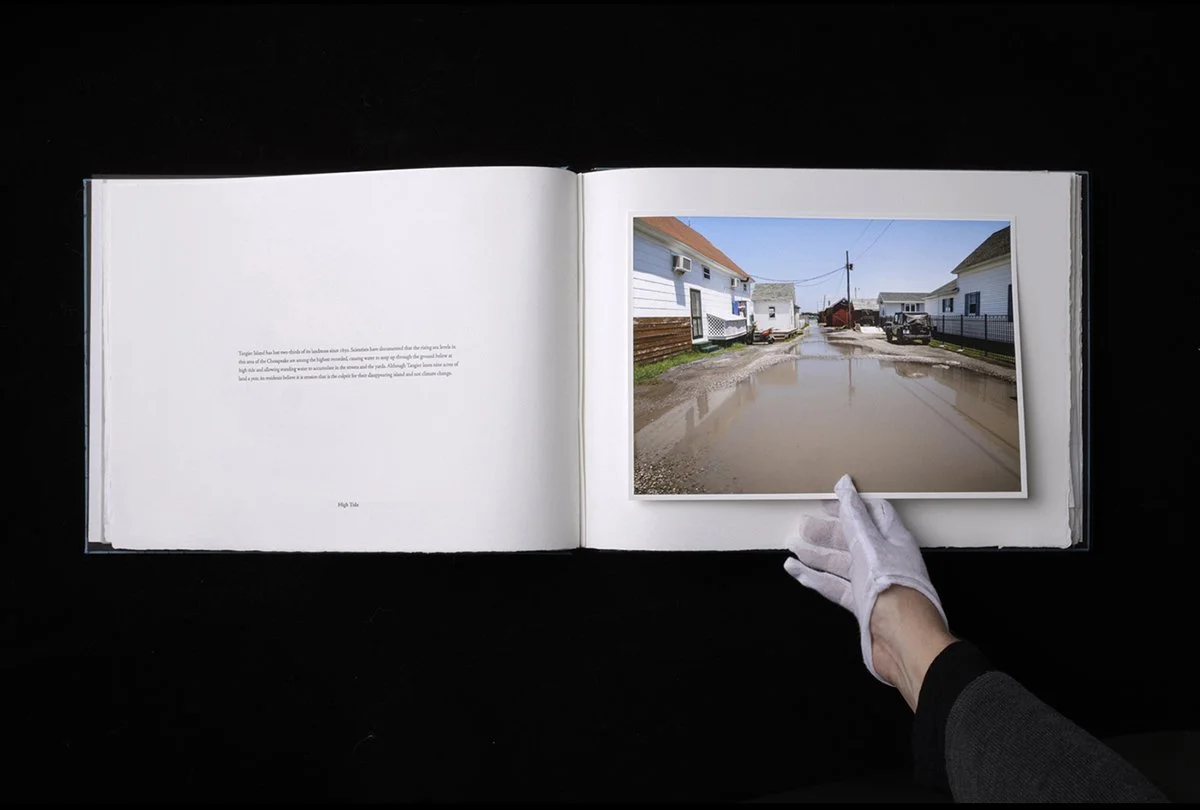
H. Jennings Sheffield, Chapter 2 from Going Away from Here Fine Artist Book, 2022
ML: How do you hope viewers will engage with your images beyond generating awareness?
HJS: Beyond awareness, I hope the work encourages curiosity and deeper questioning. I want viewers to be interested enough to ask practical, sometimes uncomfortable questions. Why hasn’t a different seawall been built? Why do people remain in places without reliable infrastructure? Why haven’t certain solutions been implemented? Ideally, that curiosity leads people to dig a little deeper and realize that these situations are often not simply matters of choice, but the result of long-standing limitations, policy decisions, and uneven access to resources.
From there, I hope viewers continue learning about these communities in ways that move beyond surface-level assumptions. When people take the time to seek out information on their own, it opens the door to more informed and nuanced conversations.
Ultimately, I want the images to help shift thinking from reactive to intentional. Climate change is already happening, and delaying these conversations only narrows our options. Engaging thoughtfully now allows for more proactive planning and more careful decision-making, rather than responses driven by urgency or emotion in the middle of a crisis.
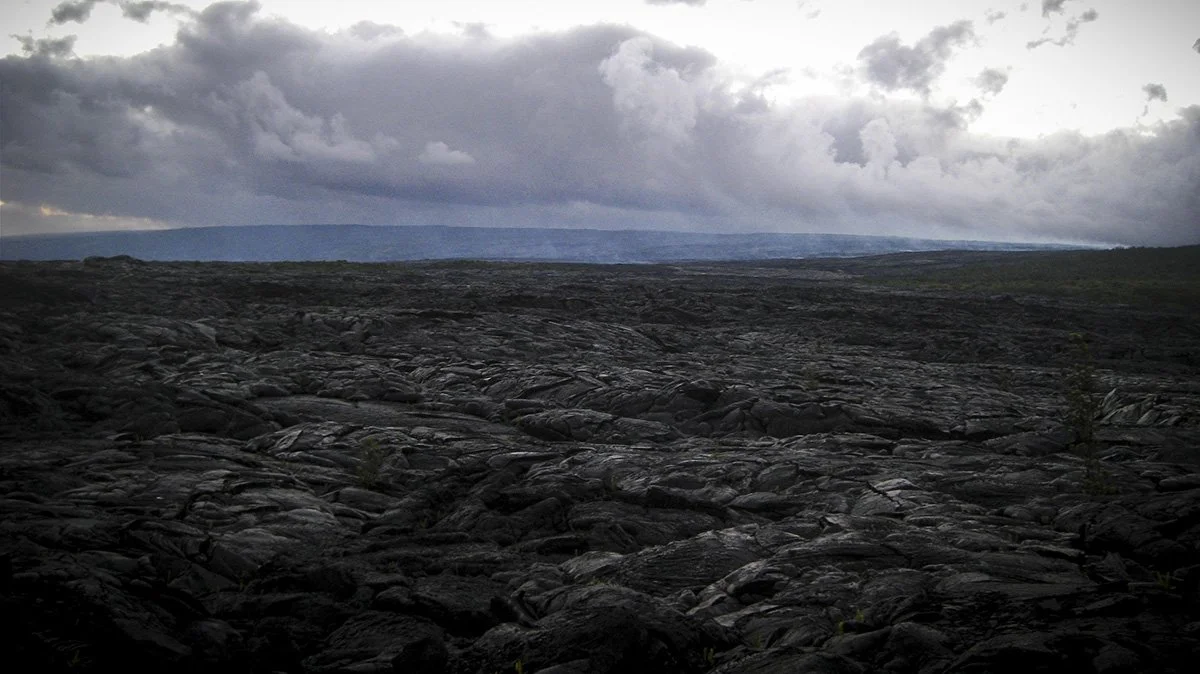
H. Jennings Sheffield, Kalapana Gardens II, 2014, 24” x 20”, Archival Pigment Print
ML: Both Tangier Island and Kalapana Gardens are warnings of what may happen to many coastal and vulnerable communities worldwide. How do you situate your work within a global climate narrative while staying rooted in the local?
HJS: It’s funny, I don’t think about the work as part of a global conversation while I’m making it, even though it clearly is one. My entry point is always local and lived. I’m responding to specific places and communities I’ve spent time with. But when you step back, the connections become clear. These places are shaped by the same larger forces.
“ I keep the work rooted in the local because that’s where climate change becomes real, where it affects homes, culture, and daily life. Taken together, these local stories point to a global truth: across geographies, communities are facing parallel questions about water, loss, and how to move forward in a changing climate.”
I’ve lived in very different regions climatically, and that’s shaped how I understand this. Growing up on the East Coast, water is something that advances. Sea levels rise, shorelines erode, and communities like Tangier Island lose land year after year. In Texas, where I live now, the geography feels very different. Central Texas can seem far removed from coastal threat, yet just a few hours away, Houston sits at or below sea level and faces increasing flood risk from stronger storms and rising waters. These realities exist side by side.
I became more aware of this broader framework while participating in Rising and Falling(1) exhibition at the Colorado Photographic Arts Center, curated by Samantha Johnson. The exhibition looked at water from multiple perspectives—too much water on the East and West Coasts, and not enough in the West. In Colorado and across the Colorado River Basin, prolonged drought, reduced snowpack, and over-allocation have led to critically low reservoirs, threatening agriculture, power generation, and entire communities. While the conditions are opposite, the consequences are remarkably similar: displacement, loss of livelihood, and uncertainty about the future.
I’ve seen this echoed internationally as well. In places like Venice, rising sea levels and more frequent flooding have made climate change an everyday reality. Historic infrastructure and cultural heritage are increasingly at risk, raising the same questions I see elsewhere: what do we protect, what do we adapt, and what do we ultimately have to let go?
So while Tangier Island and Kalapana Gardens are deeply specific places, they’re also part of a much larger pattern. I keep the work rooted in the local because that’s where climate change becomes real, where it affects homes, culture, and daily life. Taken together, these local stories point to a global truth: across geographies, communities are facing parallel questions about water, loss, and how to move forward in a changing climate.
ML: What are you currently working on? Where is your energy focused at the moment?
Right now, my thoughts and work are centered on a new project, She/Me/US. She/Me/US grows out of my personal experience of trying to sustain a relationship with a loved one as memory begins to change. The work sits in that fragile space between presence and absence, asking how we stay connected when names slip away, stories fall apart, and time no longer moves in a straight line. While the project is deeply intimate, it’s also something many people recognize. Even as recall fades, what often remains is connection, recognition, and love.
The work brings together cyanotypes, photo-based tapestries, a silk photo column, and medical imagery as a way of building new visual languages for understanding memory loss and its impact on identity and relationships. Cyanotype sits at the center of the project. Its deep blue tones, spectral quality, and ties to early scientific processes feel like a natural metaphor for memory itself, where permanence and dissolution exist at the same time. Some images remain sharp, while others blur or fragment, mirroring how memory can be uneven, holding tightly to the distant past while letting go of the present.
Other elements extend that idea of collapse and continuity. A tall column of cyanotypes printed on jacquard silk brings together two generations in a single vertical image, folding time so that childhood and adulthood exist at once. The woven tapestries, on the other hand, physically unravel over time. Older sections remain intact, while newer ones loosen and fray, leaving gaps where recent memories can no longer hold. Threads that fall away gather below, quiet accumulations of what has slipped out of reach.
I also include medical scans and sensory diagrams in the work to ground it in the biological reality of memory loss. By layering these clinical images with personal symbols, the work holds science and lived experience in the same space. It becomes a way of acknowledging that memory loss is both measurable and deeply human.
In many ways, this project connects back to my earlier climate work. While She/Me/US isn’t about environmental change, it shares the same attention to fleeting moments, disappearance, and what remains as something slowly recedes. Whether I’m looking at eroding land or eroding memory, I’m drawn to that in-between space where loss is unfolding, but life, connection, and meaning persist.
I’m also profoundly thankful for the support of my university, which has consistently encouraged this kind of sustained, interdisciplinary research. Having the time, resources, and institutional trust to pursue work that is both deeply personal and publicly engaged is not something I take lightly. This support makes it possible for the work to unfold thoughtfully, and for the questions at its core to be explored with care.
Rising and Falling. Exhibition at the Colorado Photographic Arts Center, Denver, Colorado, 2023.