
Millee Tibbs
Millee Tibbs’ work derives from her interest in photography’s ubiquity and the tension between its truth-value and inherent manipulation of reality. Tibbs is Professor of Photography at Wayne State University. She holds an MFA in Photography from the Rhode Island School of Design. She is the recipient of two MacDowell fellowships, as well as multiple national and international artist residency awards. Her work has been published by the Humble Arts Foundation, the New York Times, and the Aperture Foundation, and is held in several permanent collections, including the Portland Art Museum, the George Eastman Museum, the Chrysler Museum, and the Detroit Institute of Arts.
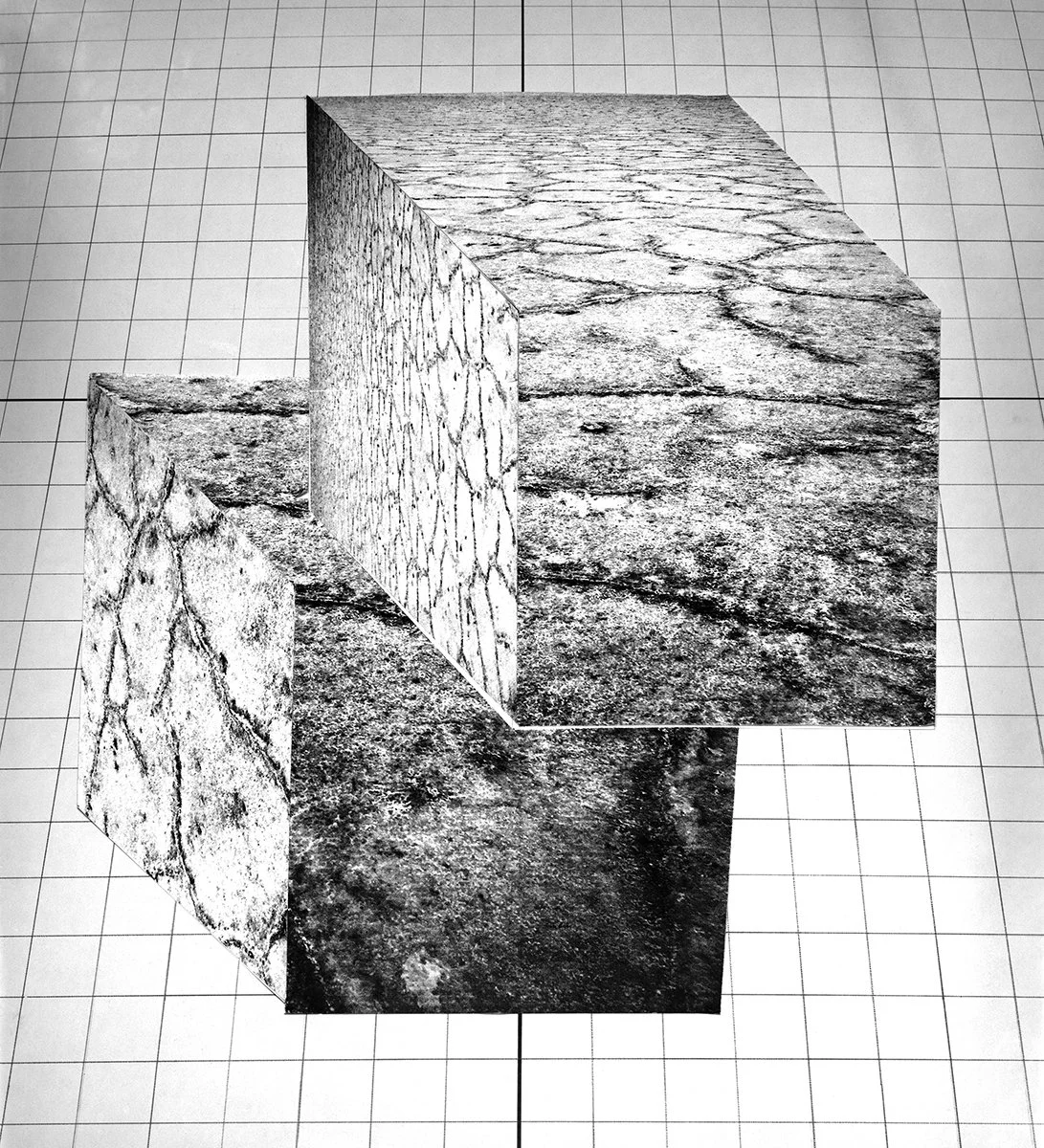
Millee Tibbs, Alchemical Translations (Bonneville Salt Flats #1), 2024, 40×50”, digital print
I have had the pleasure of working with Millee Tibbs on several curatorial projects over the last decade including The Inland Experience at Bellarmine University and Mountains and Valleys at Bradley University. More recently we served together on the Board of Directors for the Society for Photographic Education. Tibbs is a brilliant thinker and image-maker whose practice has been an inspiration to her students and colleagues for almost twenty years. In February 2026 I had the opportunity to catch up with Millee about her work, influences, and the layers of meaning within her imagery.
ML: Would you please share some of the influences that have shaped your creative practice and how those influences show up in your work?
MT: In one of the graduate seminars I taught, I asked my students make a family tree of artistic influences. I will share mine with you:
My art grandfather is Hippolyte Bayard. His “Portrait as a Drowned Man” encompasses the ethos of photographic theory. He deals with photography’s relationship to death. He pairs text and image and points to how photography is a sneaky lie. He uses humor. He uses self-portraiture, like maybe makes the very first self-portrait…? And if not THE first, certainly one of the first.
My art mother is Sophie Calle. The circularity of her conceptual games never ceases to amaze and intrigue me.
My art father is Sol LeWitt. I am particularly drawn to and influenced by his generative system drawings.
My art sisters are Penelope Umbrico, Lisa Oppenheim, and Letha Wilson. They are my contemporary influences. These artists that have inspired me and challenged me on different points on my journey.
And my crazy uncle (that person unrelated to art practice directly, but still hugely influential) is the composer Erik Satie. He was a conceptual artist before there was conceptual art. His piece “Vexations” seems so far before its time that I think he must have time traveled.
ML: Can you describe a moment in the field that changed how you think about your relationship to the natural world?
“This simple epiphany, that how we look at something is taught to us by how it has been represented previously, made me consider how the history of landscape representation informs our ideas of landscape, and by proxy, place. ”
MT: My work took a dramatic turn after an artist residency in New Mexico. At the time, I had been working in self-portraiture. I liked how the power dynamic of photography is leveled when one is both author and subject of an image. I had been exploring the codes and conventions of photography with a focus on vernacular images. At this residency, I made some work, but mostly I hiked in the mountains surrounding Santa Fe. And because this made me feel guilty (I wasn’t making art in the studio) I took my camera along. I found myself taking the most saccharine photos of landscape, like I was remaking every calendar or screensaver I had ever seen. And I had this realization that this is how I was trained to see the landscape – absent of humans, “beautiful,” framed from a highpoint so that the land extends into the horizon…. This simple epiphany, that how we look at something is taught to us by how it has been represented previously, made me consider how the history of landscape representation informs our ideas of landscape, and by proxy, place.
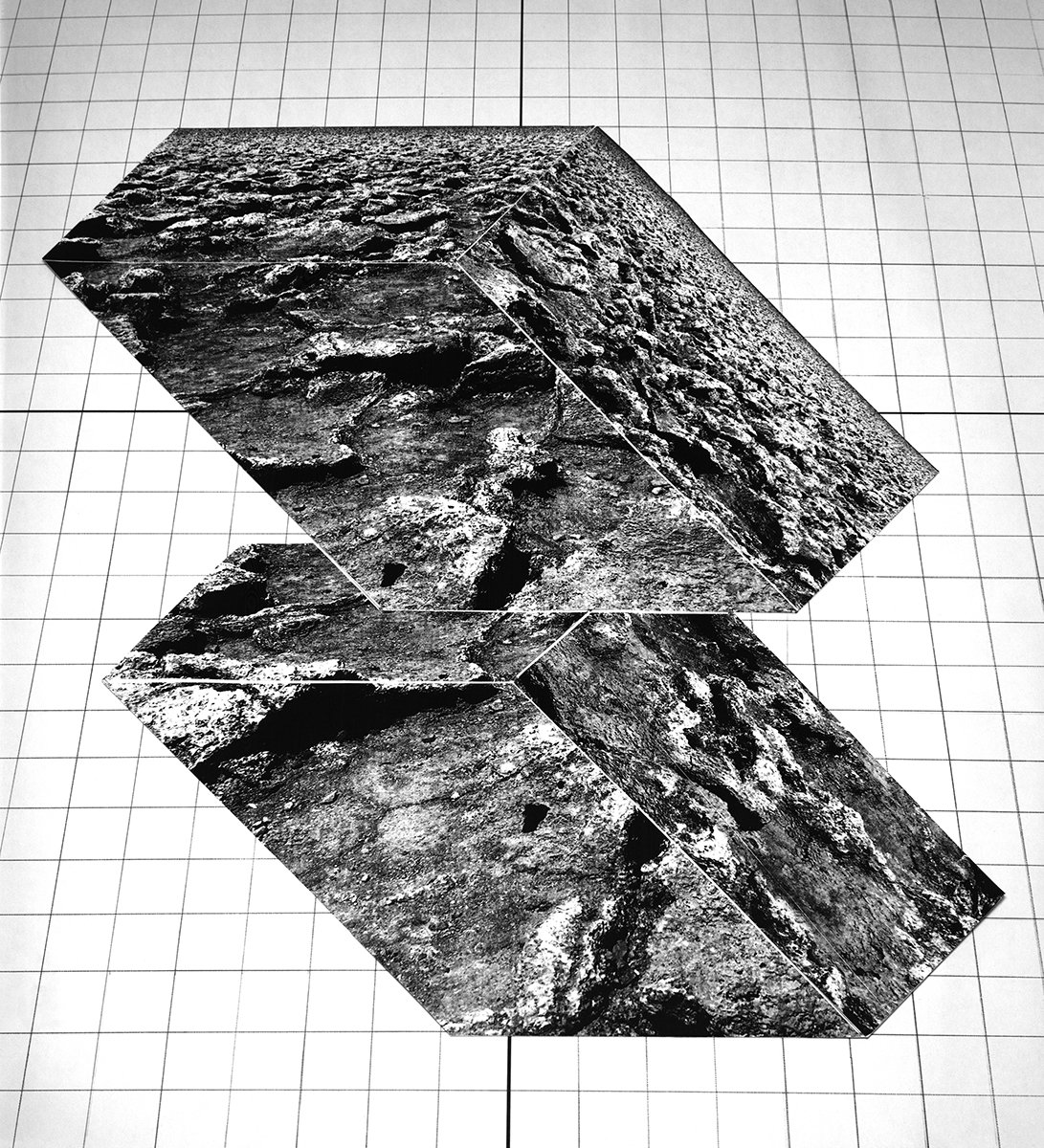
Millee Tibbs, Alchemical Translations (Death Valley), 2024, 40×50”, digital print
Of course, this is not new territory, many other artists and scholars have explored these ideas, but it was the path that led me into the work I make now. It also helped me to realize that, while I like to spend time in the studio, I find joy traveling and experiencing the world around me, especially the natural world. So, perhaps this moment in the field didn’t change the way I thought about the natural world so much as the natural world made me change the way I think about making.
ML: You received your MFA from Rhode Island School of Design (RISD) and your undergraduate degree from Vassar College. Would you talk about how your education has influenced your career trajectory and creative practice?
“Every language holds a world, and there are so many languages, so many worlds inside our world. ”
MT: Some aspects of my education have been pathways, and other aspects have been seeds that were surreptitiously planted and sprouted years later. In high school and college, I studied Spanish language and Hispanic cultures. This pathway led me to Spain for my Junior Year Abroad and to the Hispanic Caribbean after graduation. I lived in the Dominican Republic for nearly seven years. This afforded me the opportunity to experience a different paradigm - to understand that the world is many things beyond what we are accustomed to through our upbringing. Every language holds a world, and there are so many languages, so many worlds inside our world. This has expanded the way I think and make on so many levels.
In grad school at RISD, I worked with many prominent landscape photographers (Steve Smith, Joe Deal, Deborah Bright), but I had NO interest in making landscape imagery during my studies there. It’s almost comical. But being adjacent to those thinkers and makers planted seeds that took root over time, they just needed to grow through my own framework and development, and on my own terms.
ML: I’ve heard you speak about photography as both an index of reality and a subjective construction. How do you navigate or intentionally destabilize that tension in your working process?
MT: This is my favorite thing about photography – its paradox. What is photographed has to have been in front of the lens, but how it is imaged is a complete construction. One of the reasons I am so drawn to the analog process is because of that indexical directness. Light bounces off the subject and imprints the light-sensitive film emulsion. It leaves its trace, which is made visible through chemical processing. I use that same light and chemical processing in the printing of the image to draw attention to my presence as the image maker. All photographers manipulate their image in some way, even if it is the simple act of choosing the “correct” exposure or deciding how to frame and when to capture the image. In my work, I want to draw those decisions to the surface. Basic gestures like dodging and burning (selectively lightening or darkening parts of the photographic print) take on an aesthetic role that contain and redirect the image they overlay. The interplay of these two illusionistic systems create a third image that is both indexically true and overtly manipulated.
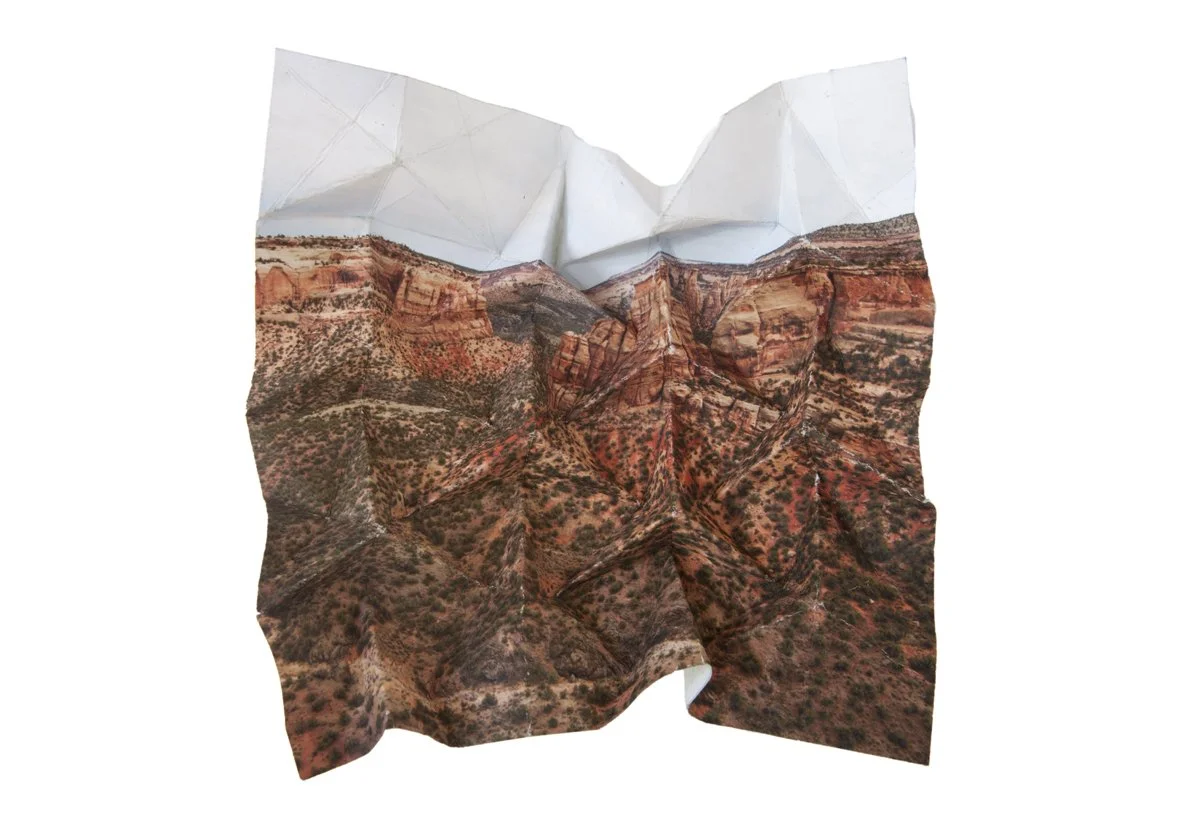
Millee Tibbs, Mountains + Valleys (Colorado National Monument #1), 2013, 17.75 x 25.75” archival digital print
ML: Many of your works reintroduce the hand of the artist into the photographic image through cutting, folding, and darkroom manipulation. What does this physical intervention allow you to say that a straight photograph cannot?
MT: These interventions allow me to reframe the conversation around landscape representation. Since the imagery that I use is often familiar or iconic, the “straight” reading can be quite predetermined. By bringing the dialogue back to the surface, the space between object and illusion, I hope to redirect the conversation back to ideas of mediation and subjectivity.
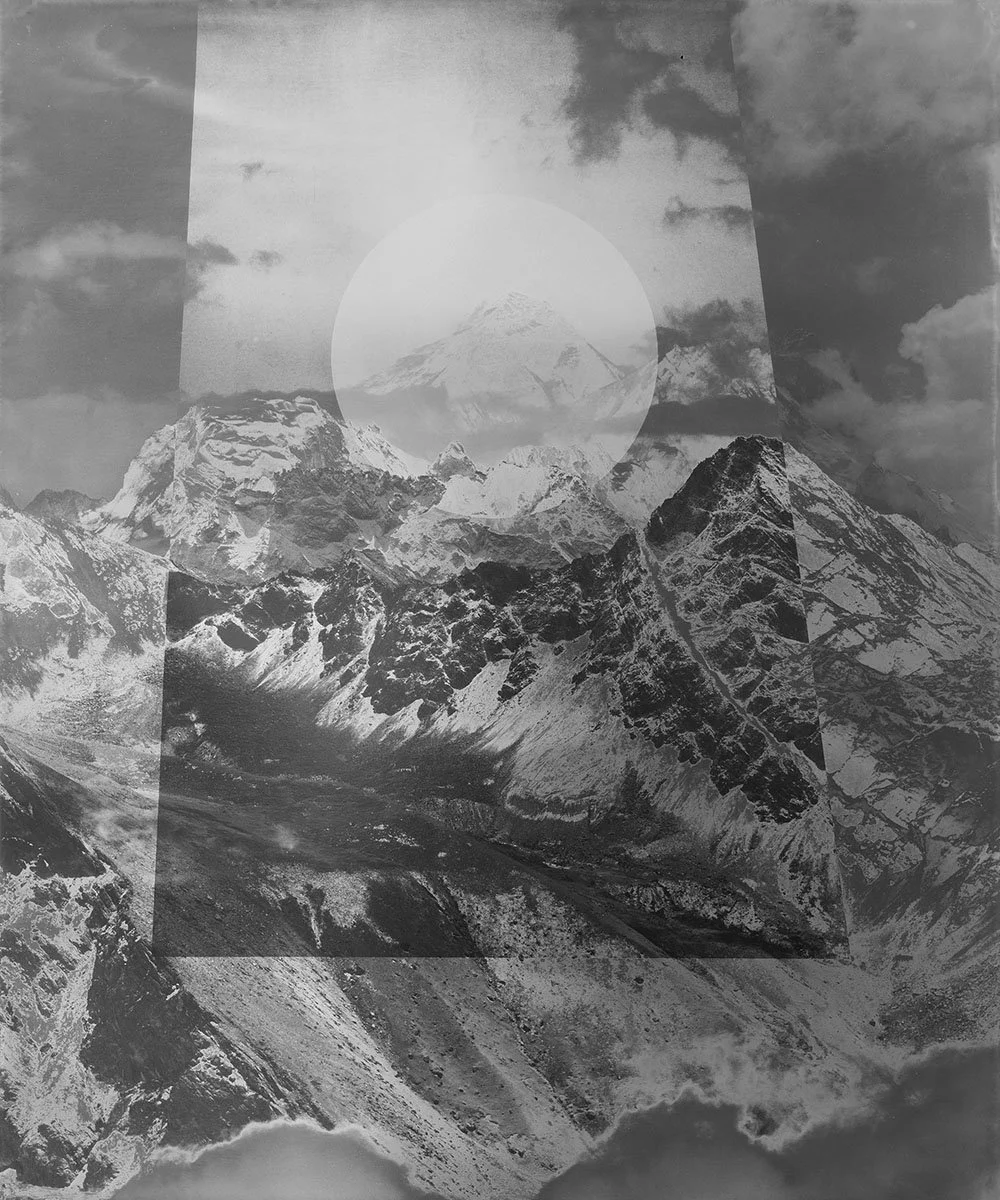
Millee Tibbs, Approach, 2019, 20 × 24”, silver gelatin print
On a less theoretical level, these gestures allow me to express and elaborate upon my subjective experiences of physically, psychologically, and emotionally encountering these places. For example, my experience in the Himalaya was extraordinary. My encounter with those mountains felt sacred and I wanted to create some veil that both shielded my experience from the directness of the photographic image and allowed for a more interpretive engagement—one that invites viewers to sense the awe, mystery, and reverence I felt, rather than simply observe the landscape as a static record. So, I used masking and darkroom solarization techniques to obscure certain details, introducing ambiguity and layers of meaning that mirror the complexity of my internal response to the landscape.
ML: What does this layered act of mediation reveal about photography’s claim to realism?
MT: Photography, folding, and rephotographing the landscape both challenges photography’s claim to realism and reinforces it. The end product of that practice is an image that holds two illusionistic systems simultaneously: the original “vista” and the image of the photo object. Both are equally “real” and both are equally manipulated.
ML: How do you want viewers to sit with that contradiction?
“I want to promote visual literacy: learning to read the codes and conventions of an image, question the agenda or position of the image maker, and know that there is always a bias in every image ever made, because the way that we experience the world, and by proxy the way we see it, is a very, very subjective experience. ”
MT: I hope that people can sit in the complexity of that statement and understand how images work on us. The realness of photography – the way it presents the world the way we see it – is photography’s most powerful tool, but it is also dangerous because it can normalize inequity, can present partial truths as objective reality, and can perpetuate stereotypes. If we can understand that images can do that, and challenge those that do, then we can use photography for what it does when it’s at its best: give agency, give representation, witness and empower. Ultimately, I want to promote visual literacy: learning to read the codes and conventions of an image, question the agenda or position of the image maker, and know that there is always a bias in every image ever made, because the way that we experience the world, and by proxy the way we see it, is a very, very subjective experience.
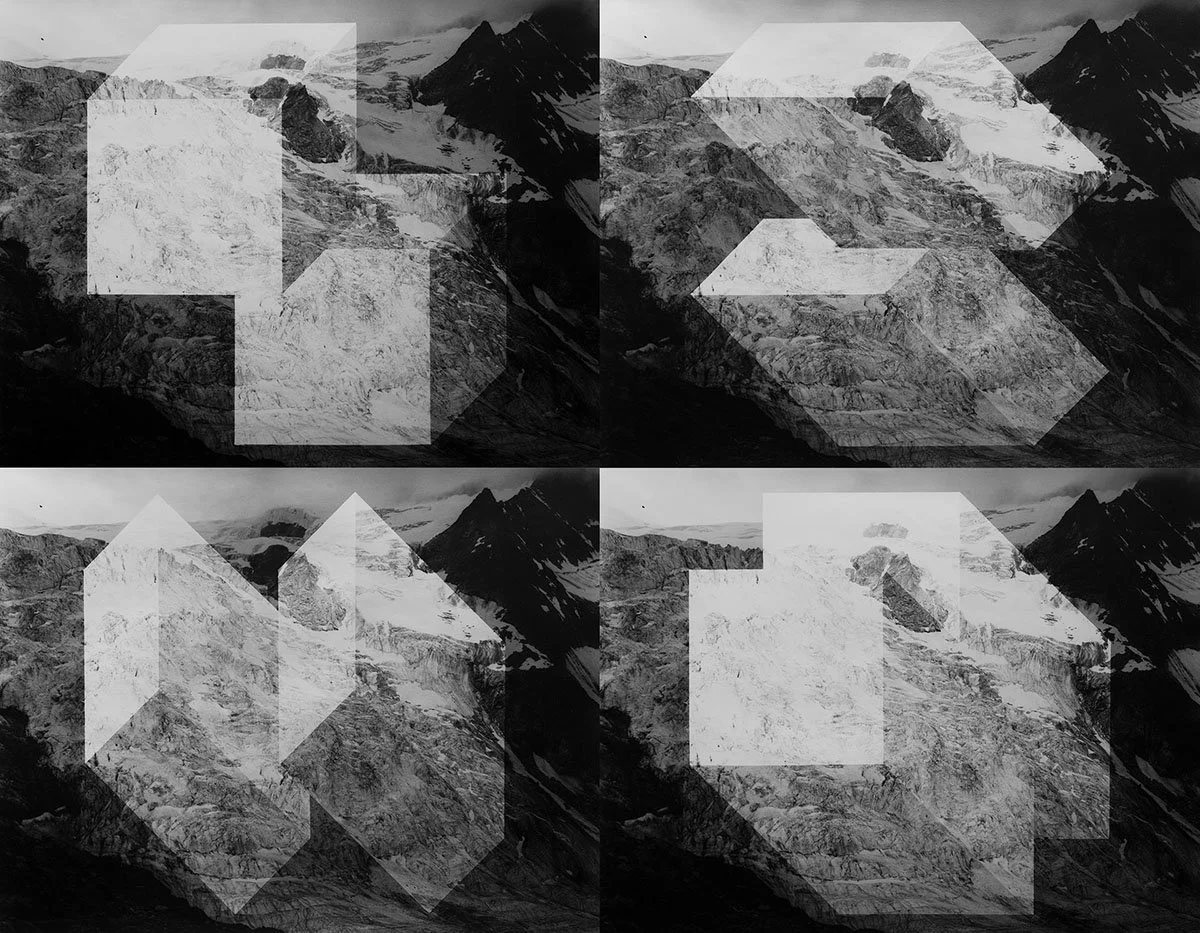
Millee Tibbs, Tesseract / Glacier de Cheilon: Composite - The Null Hypothesis, 2016, 11×14 each, silver gelatin print
ML: In project statement for the series Mount Analogue, you discuss the “paradoxical relationship between photography, which can only represent what is in front of the camera’s lens, and the ineffable nature of the sublime experience.” In this work you use a single negative and multiple darkroom exposures to create abstract geometries. How does this process mirror the mind’s attempt to comprehend the sublime?
“My images attempt to hold the paradox of photographing the unphotographable: capturing a subject so immense it defies measurement and quantification, using a medium—photography—that is inherently indexical, mimetic, and data-driven. ”
MT: The sublime is such an interesting concept, defined in multiple ways. In my work, I am drawn to the sublime as something beyond measure—an experience that evokes awe and wonder. In Mount Analogue, I use the mountain as a surrogate for that feeling. During the Romantic era, which coincided with the rise of landscape as a genre, the vastness and immeasurability of mountains made them iconic subjects of the sublime. Yet, we have long since measured, mapped, and summited all the mountains, often at great peril and loss. Contemporary humans possess a deep drive to understand through quantification—an empirical model that, interestingly, preceded the Romantic period by about a century.
My images attempt to hold the paradox of photographing the unphotographable: capturing a subject so immense it defies measurement and quantification, using a medium—photography—that is inherently indexical, mimetic, and data-driven. My interventions impose our tendency toward abstraction—ordering and simplification—onto landscape imagery that gestures toward the Romantic impossibility of truly experiencing the sublime. I employ perceptual abstractions: images that exist in two dimensions but are impossible in three, emphasizing that our perceptions are always incomplete, always in flux. At the same time, I use the logic of the medium itself—light and chemistry—to disrupt the stasis of the analytical photograph.
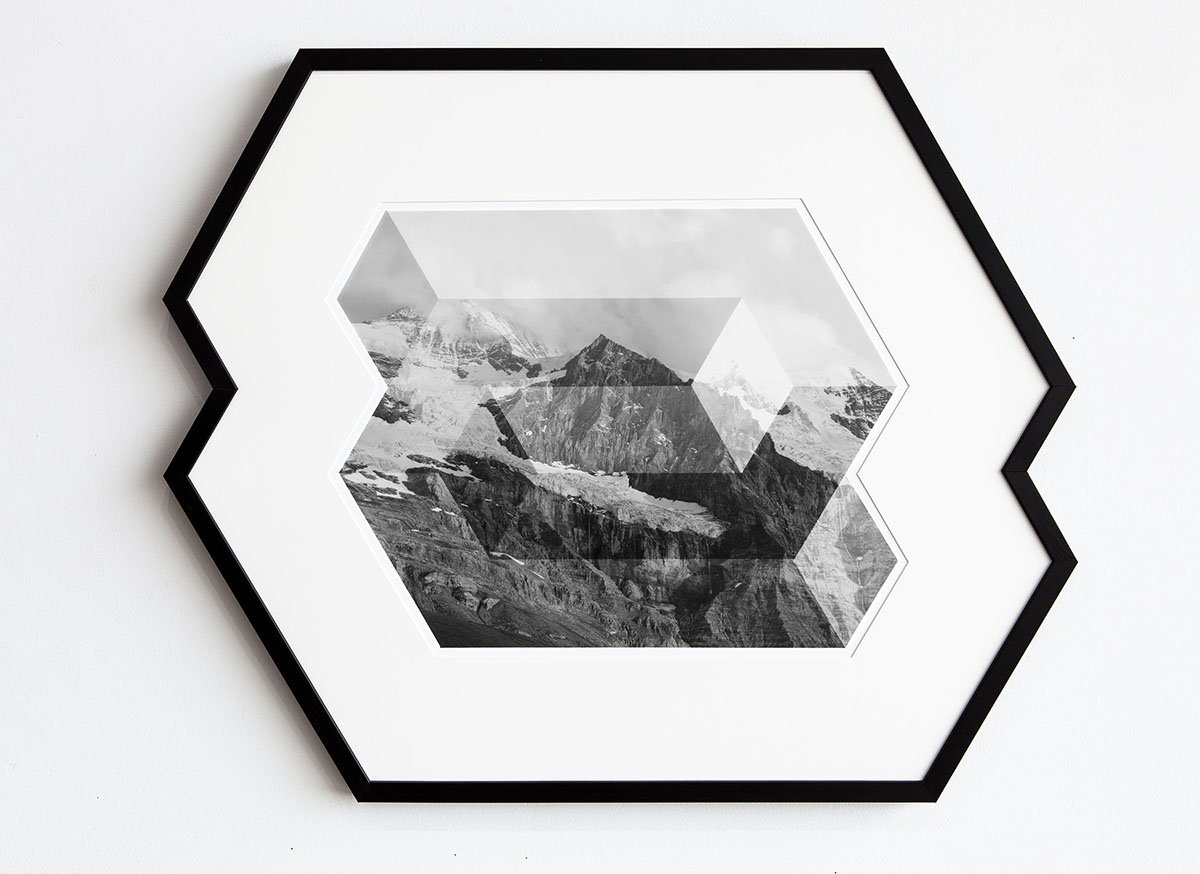
Millee Tibbs, Vertical Metropolis, 2018, 30×24”, silver gelatin print
ML: How do you reconcile the romantic legacy of landscape imagery with contemporary realities of climate change, land degradation, and human intervention?
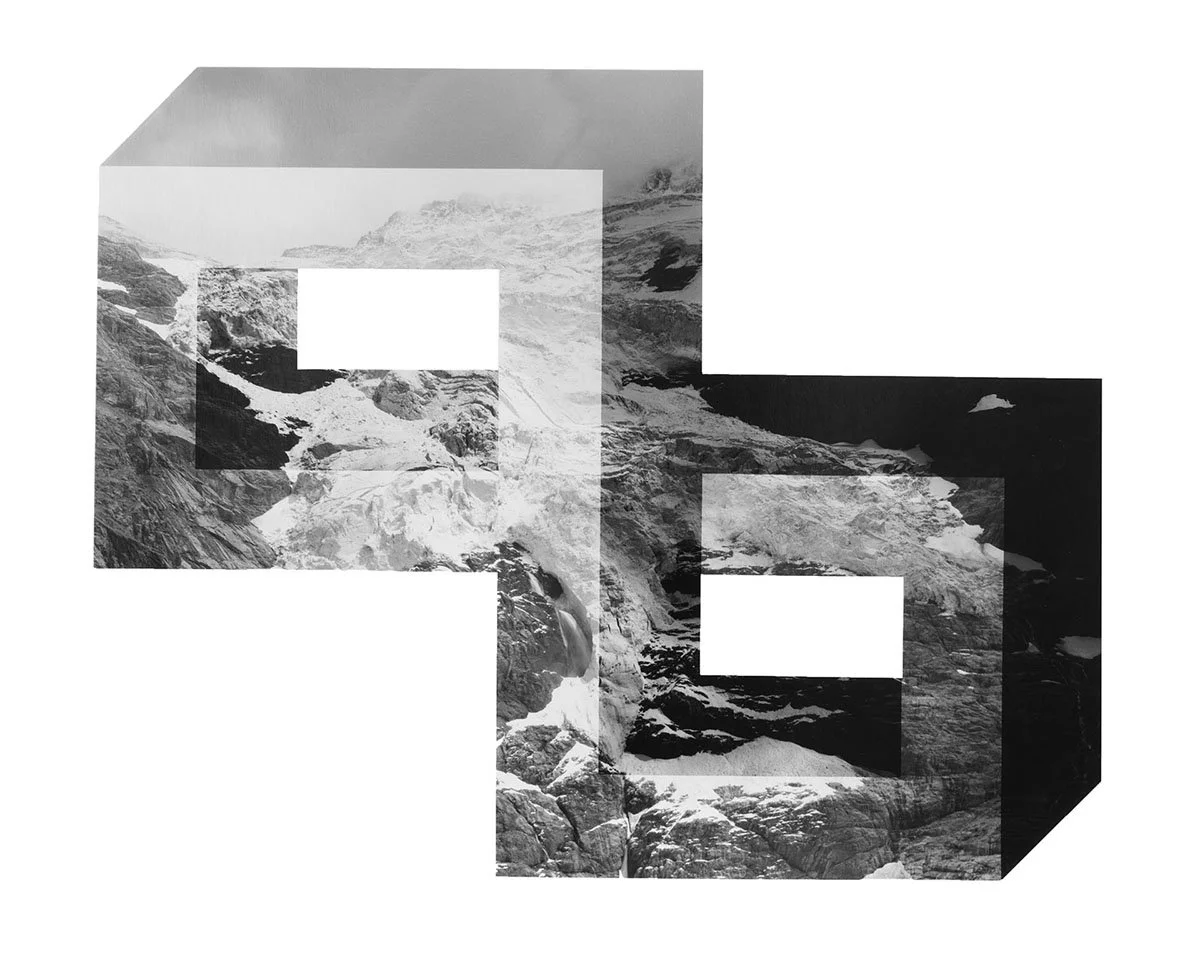
Millee Tibbs, Grand Tournalin, 2017, 20 × 24”, silver gelatin print
MT: Oh, I don’t think I reconcile this or even try to… but I am interested in how the Romantic legacy taught us to view and use land. Ironically, the Romantics were making landscape imagery in response to industrialization and the loss of wilderness. Somewhere along the line, though, I feel like the overly sentimental approach undermined its activist roots, and once it got bound up with Manifest Destiny it became much more problematic. Ever since, Expansionism lives inside the most seemingly benign landscape images like a little trojan horse, perhaps this is the legacy of the Romantics you refer to?
Today we are living the result of industrialism, capitalism, and consumerism. The great wildernesses that were set aside in the American National Parks system somehow manage to feel like a simulacral experience - mediated scenic routes that string together vista points – and now even those are in peril of being sold off. It’s depressing and demoralizing… So maybe the question is, how do we learn from the failures of the Romantic legacy moving forward?
ML: Does your use of darkroom techniques and material processes carry ecological or ethical implications for you, especially in contrast to digital image production?
MT: This is a very interesting question. It is challenging to be a maker in this moment of environmental crisis. So much waste is involved in any process. It is well known that certain darkroom processes are highly toxic, others less toxic but hardly environmentally friendly. But the nice thing about analog photography is that the waste or the toxicity is apparent and can be mediated. Silver can be recycled, and if you work in partnership with an institution, hazardous waste can discarded appropriately. There is momentum towards more ecologically sustainable practices (i.e. The Sustainable Darkroom and photo festivals like Experimental Barcelona) that support alternative analog models.
Digital photography, while seemingly more benign, actually scares me more because there are more unknowns. There is less oversight over where the e-waste goes, less knowledge about where the minerals for LED screens or lithium batteries comes from, and less awareness of energy consumption in general.
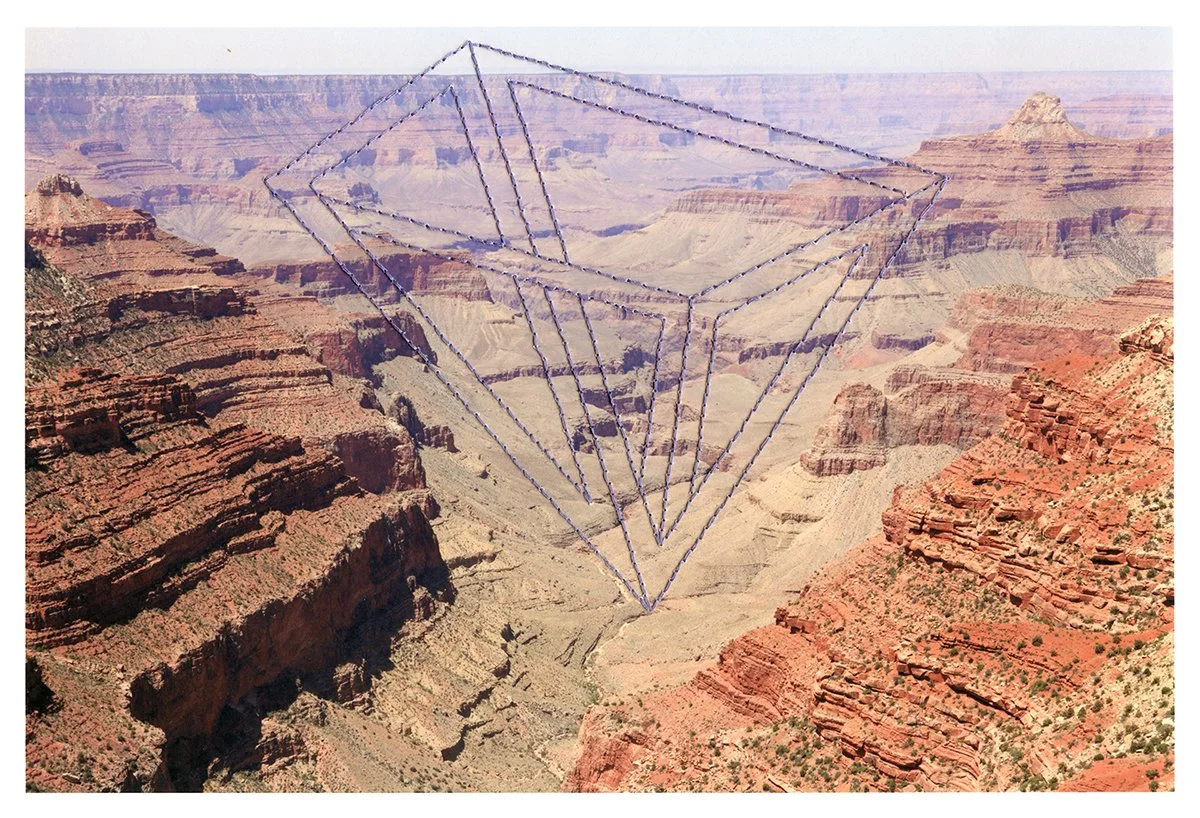
Millee Tibbs, Impossible Objects (Grand Canyon), 2014, 7.5 x 11”, archival digital print and thread
In the end, both processes have the potential to be ecologically damaging, and each artist must confront that issue mindfully and in accordance with their values. The great thing about analog photography is that it is so freaking expensive that it already creates waste mindfulness…lol. Sigh.
ML: The American West is often framed through highly mediated and politicized imagery. How does being there physically affect your understanding of those representations and how does it manifest in your work?
“When I fold and re-photograph these landscapes, I am thinking about their conceptual malleability, and how our ideas about them change through our perceptions of them.”
MT: Oh, there were so many! The American West is ripe with symbolic meaning and myths. I became very interested in the idea of the West as the future of America during the 19th century. During the period of expansionism after Civil War, the West was depicted as the future, the antithesis of the East, which was more European and therefor more aligned with the past. The West was a place to start fresh. Prospectors ran towards the gold rush. Settlers ran to the prairies. There was the notion that the land was a tabula rasa, a place to reinvent oneself. And this was probably true for the white settlers, not so much for the indigenous peoples that were being displaced. But once the railroad finally connected East and West, and the West was accessible, its symbolic value quickly shifted to an idealized past version of itself. (Edward Curtis’ photographs of native Americans in the West is a clear example of this. He created idealized and nostalgic images to document the disappearance of a people as they were disappearing.) Symbolically, the West never had a present.
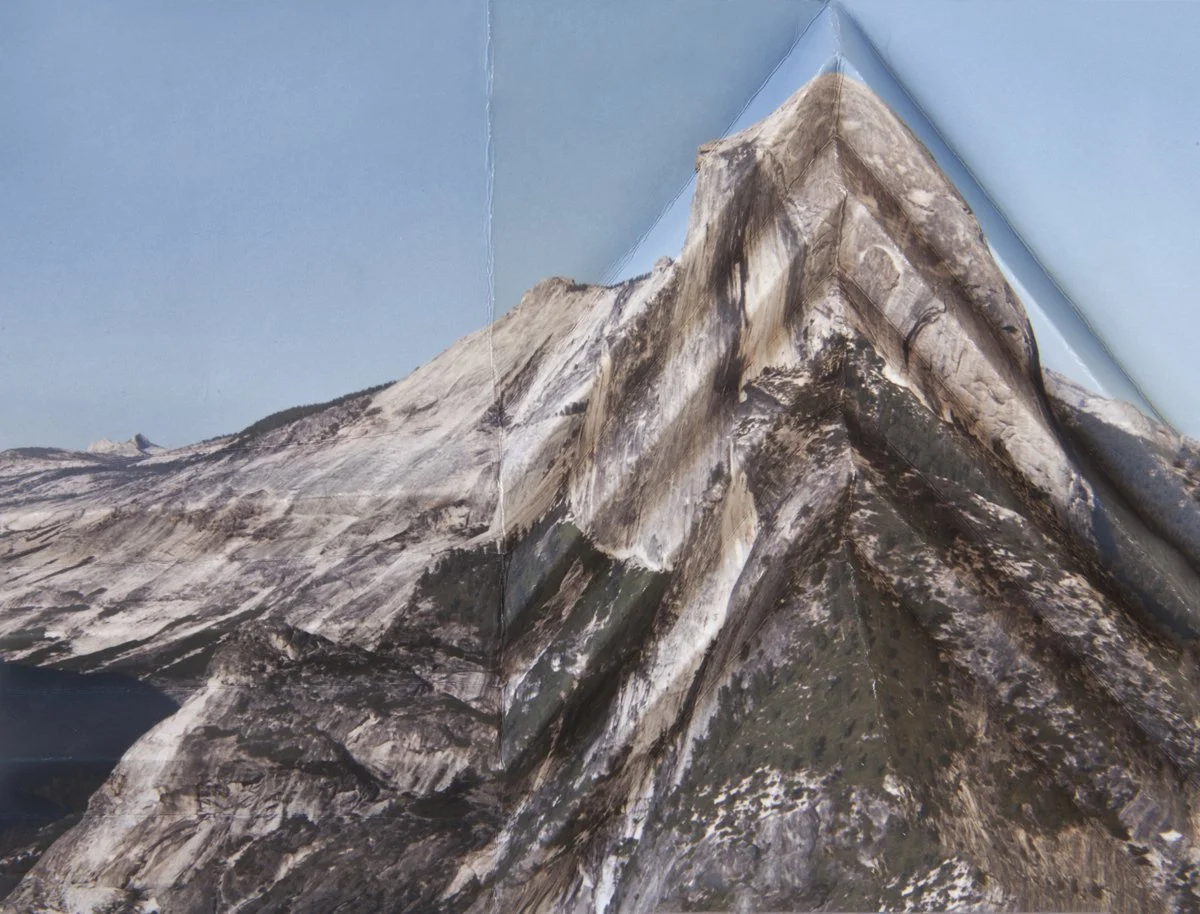
Millee Tibbs, Mountains + Valleys (Yosemite National Park #4), 2013, 20 x 26.25”, archival digital print
Another myth, beautifully intertwined with the previous one, is the West as a backdrop for the rugged individual and Western masculinity. Once again, this narrative applies only to the white settlers who didn’t understand the landscape and struggled within it. Those who had inhabited the land for millennia possessed a deep knowledge of how not only to survive, but to thrive there. Yet, because the terrain and vistas were so unfamiliar compared to the European and East Coast landscapes the settlers knew, they deemed the West alien and uninhabitable. Those who dared to enter—and survived—were celebrated as heroes. The tradition of landscape photography is, of course, closely tied to this hyper-masculine mythos; it is (was...? I hope...) a highly gendered genre. By incorporating stereotypically feminine traditions like stitching or quilting patterns, I aim to undermine this convention and reintroduce the female body—mine, specifically—into the conversation.
ML: In interrupting the fantasy of an untouched vista, what conversations are you hoping to open about land use, ownership, environmental stewardship, something else?
MT: Landscape is a space that is often gendered. We use words like “virgin,” “barren,” and “raped” to describe land that is untouched, unusable, or exploited. These descriptors suggest a purity or emptiness that never truly existed. In reality, every environment is layered with stories, interventions, and the traces of those who have come before.
“ By foregrounding my own presence and process, I aim to challenge the illusion of objectivity and neutrality in landscape imagery, and to acknowledge the layered histories—personal, cultural, and ecological—that shape our understanding of place.”
Every landscape bears the imprint of those who have encountered it—whether through physical intervention, cultural interpretation, or the act of representation itself. Even the act of looking, framing, and photographing is a form of interaction and alteration. By foregrounding my own presence and process, I aim to challenge the illusion of objectivity and neutrality in landscape imagery, and to acknowledge the layered histories—personal, cultural, and ecological—that shape our understanding of place. In this way, my work seeks to make visible the entanglement between body, land, and image, and to question whose stories and perspectives are inscribed onto the landscape.
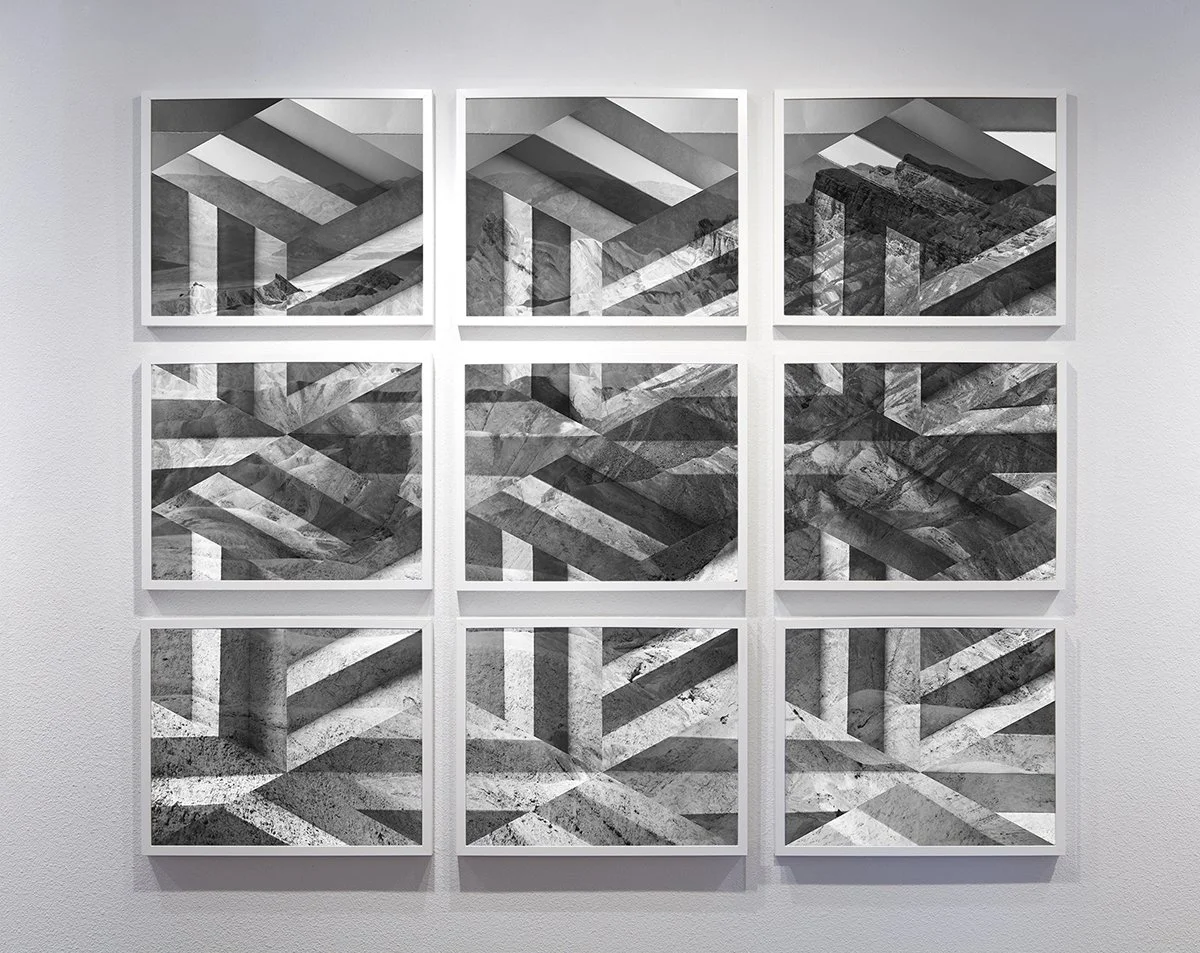
Millee Tibbs, Mountains + Valleys (Death Valley), 2014, 19.75 x 27.5” each, archival digital prints
ML: The geometric impositions of your work suggest systems of order imposed onto natural space. Are these forms referencing specific histories such as surveying, mapping, or modernist abstraction, or are they intentionally ambiguous?
MT: Yes, in part, the geometries reference the triangulation of mapping and surveying, and there are very overt references to the perceptual abstractions of Op Art in the Mount Analogue series. More generally, though, the geometries present an abstraction that overlays the organic landforms. To me, this reflects the way humans create conceptual order by simplifying and abstracting our experiences. I am interested in the resonance, harmony, and discord that emerge between these two systems of representation.
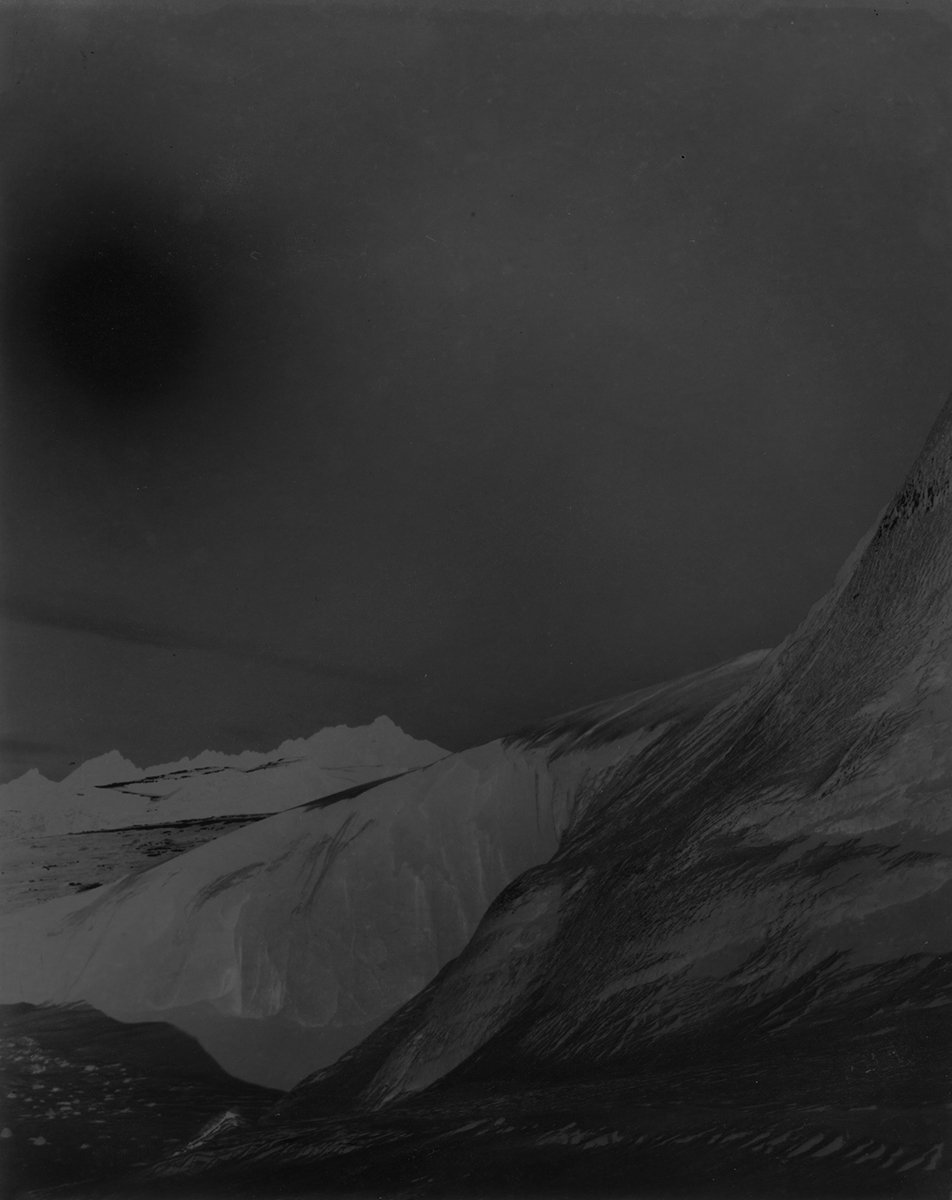
Millee Tibbs, Black Ice #1, 2025, 8 × 10”, digital print
ML: What projects or ideas are occupying your attention at the moment? What feels most important in your work right now?
MT: Well, I just finished (almost finished…) building a sauna—does that count? This past year has brought a lot of heartbreak, so I’m trying to tend to myself physically (hence the sauna) and emotionally (also the sauna). I sense that this heartbreak will find its place in my upcoming work, especially in the Arctic imagery. There is so much loss and longing associated with that landscape. I wasn’t there long enough to truly witness how it is changing over time, but much of what I’ve heard from those who know it deeply echoes this sentiment.
The two bodies of work from the Arctic currently in progress are Black Ice and Sublimation. Both address the fragility, permeability, and continual transformation of the polar environment. Black Ice uses darkroom solarization to create tonal inversions in the print. Sublimation will be video documentation of the degradation of in-camera lumen prints I make using an 8x10 camera during my residency. Addressing change, and accepting that it is the only constant, feels relevant to both my work and life right now.