

Allison Grant (she/her) is an artist, writer, and curator based in Tuscaloosa, Alabama. Her work has been widely exhibited and is held in numerous public and private collections, including Bainbridge Island Museum of Art, Birmingham Museum of Art, High Museum of Art, and DePaul Art Museum. She was named to the Silver Eye Center for Photography’s 2022 Silver List and has received several notable awards and fellowships, including the Atlanta Photography Group’s 2020 Portfolio Purchase Award and the 2019 Developed Work Fellowship from the Midwest Center for Photography. Her editorial photography has appeared in The New York Times and The Wall Street Journal. Grant is currently an Associate Professor of Photography at The University of Alabama.
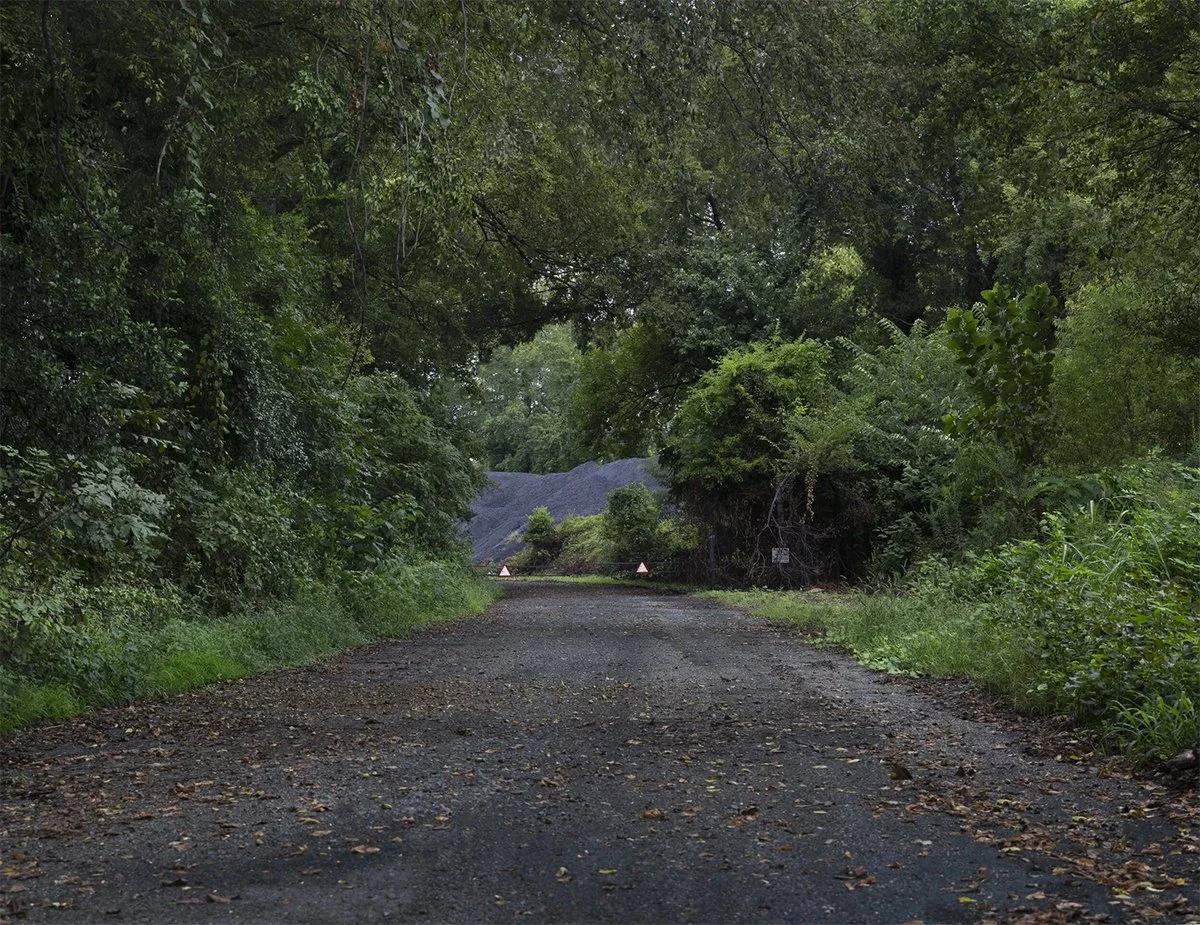
Allison Grant, Petroleum Coke Storage Near the School, 2019, 48 x 36”, archival inkjet print
In March 2025, at the SPE Annual Conference in Reno, Nevada, I attended a session titled Adapting Our Work to a Changing Climate, featuring presentations by Dana Fritz, Terri Warpinski, Beth Johnston, and Allison Grant. Among these, Grant’s project Within the Bittersweet resonated deeply with me. Her photographic exploration of raising children amid climate chaos and environmental contamination offered a tender yet unflinching lens on parental care in an era of uncertainty. I found myself taking copious notes as she spoke, compelled by both the urgency of the work and the sensitivity of its approach. This interview grew out of that moment and my curiosity to better understand Within the Bittersweet and the creative practice from which it emerged.
ML: Thank you for taking your time to speak with me about your work and creative practice. Your series Within the Bittersweet is rooted in the landscape surrounding your home in Tuscaloosa, Alabama. How has long-term intimacy with this place shaped both your visual language and your environmental awareness?
AG: I moved to Tuscaloosa nine years ago and living here has changed the way I see the world. There is this constant push and pull. Tuscaloosa has some of the most politically progressive people I’ve met living among people on the complete opposite side of the spectrum. There are lush wild spaces, but they exist alongside pockets of heavy industry and pollution that are the result of the state’s lax environmental laws. Being here has brought complex social and political issues to my doorstep and made me contend with the nuances of living in a place where the dominant politics don’t always align with my personal beliefs or my sense of what community care should look like. Disagreement and unease are just a more intimate part of life here than in other places I’ve lived.
At the same time, the natural surroundings are awe inspiring, and the bonds I’ve formed with friends and collaborators are deeper than anywhere else I’ve been. There are great artists, activists, scholars, and creatives and we’re sort of on our own, away from the “center” of the art world. Watching people fight to protect their community, imagine better futures, and share stories about this place is so powerful, especially because most people have chosen to do this work in a place where community is what motivates them, rather than an art career or status. All of the challenges in Alabama are difficult, but they make working here feel more critical and purposeful.
There is a similar sense of fraught complexity that I feel when I think about ecology as climate change accelerates. I have this beautiful life in a world that blooms and changes with the seasons, and a family that is healthy and thriving. But beyond that present, the problem of climate change and the possibility of illness in my state from toxic exposure are problems that are hard to live with. Tuscaloosa offers a lot of opportunities for intersecting with these big geopolitical and social problems from a local and firsthand point of view.
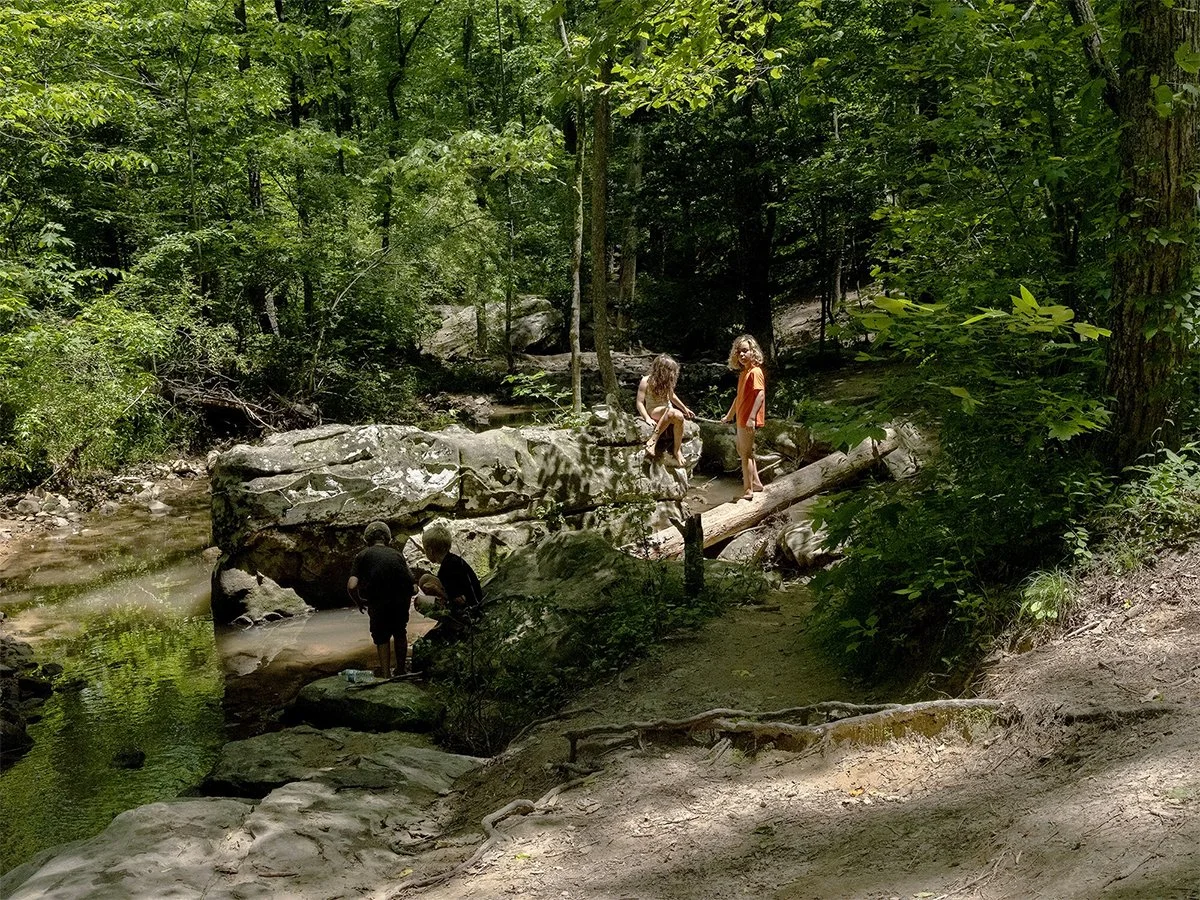
Allison Grant, Isa and the Creek Boys, 2021, 48 x 36”, archival inkjet print
The landscape here has shaped the visual language in my photographs in important ways, too. The vegetation is so thick that many images don’t have a horizon line. You’re surrounded, visually, by plant life. Even though most of my pictures are taken outdoors, they often end up with a feeling of enclosure and intimacy. Sometimes, I use that to create a sense of closeness between a human subject and the landscape, but in other images that same feeling of intimacy makes the presence of toxicity feel close by. For example, in Petroleum Coke Storage Near the School there is a pile of petcoke, a byproduct of oil refinement, that I think feels both distant and near because it is so surrounded by greenery. That tension is really important in the work. And the light in this region is spectacular and functions almost like another presence. It adds drama and intensity, and the photographs would be fundamentally different if they were made somewhere else.
ML: Your work often holds beauty and toxicity in the same frame. How do you approach photographing landscapes that are both emotionally beloved and environmentally compromised?
AG: I think of my work as exploring a complicated kind of beauty. The splendor, aggression, and complexity of Alabama’s landscape, along with the shifts coming with climate change, are a lot to hold in mind and organize your life around, especially while raising kids who will have to navigate whatever the world becomes. I try to make work that holds many ideas in proximity to one another. I use the same visual language to photograph the things I love and the things I wish were different because those things coexist in my life. I hope the outcome has many emotional resonances that reflect how living in our time is something more complicated than simple categories like beauty or repulsion.
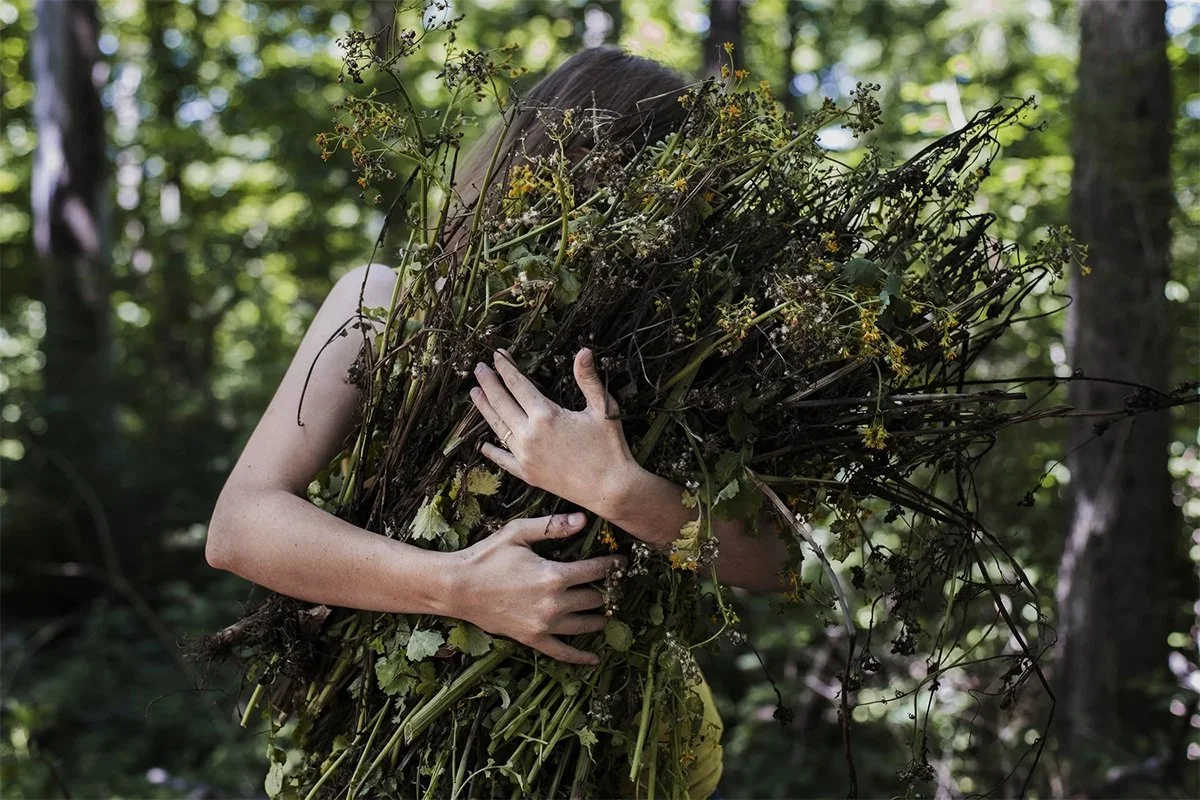
Allison Grant, Holding Half-dead Flowers, 2019, 30 x 22.5”, archival pigment print
ML: Motherhood is central to Within the Bittersweet. How has raising children altered your sense of responsibility as an artist working with environmental themes?
AG: There is a book of poetry that I love called The Long Devotion: Poets Writing Motherhood. In the introduction, the book’s editors draw on poet Sasha West’s writing to describe motherhood as, “taking the body into a different type of knowing.”(1) That description and the way it is rooted in a material and embodied type of understanding, is the best way I’ve found to express how raising children has altered my sense of time, space, and emerging environmental harms.
Within the Bittersweet is, at its core, a project about love. It is about coming to love another person more than myself and more intensely than I ever thought possible. These feelings sit right beside an understanding that their generation will face a future filled with challenges that humankind is only beginning to imagine. To me, the “different type of knowing” I have found shapes the kind of care I want to put into my family and my artwork, and to extend outward beyond them. Parenthood has sharpened my sense of responsibility to nurture a future where my children and the generations that follow can survive and lead meaningful lives.
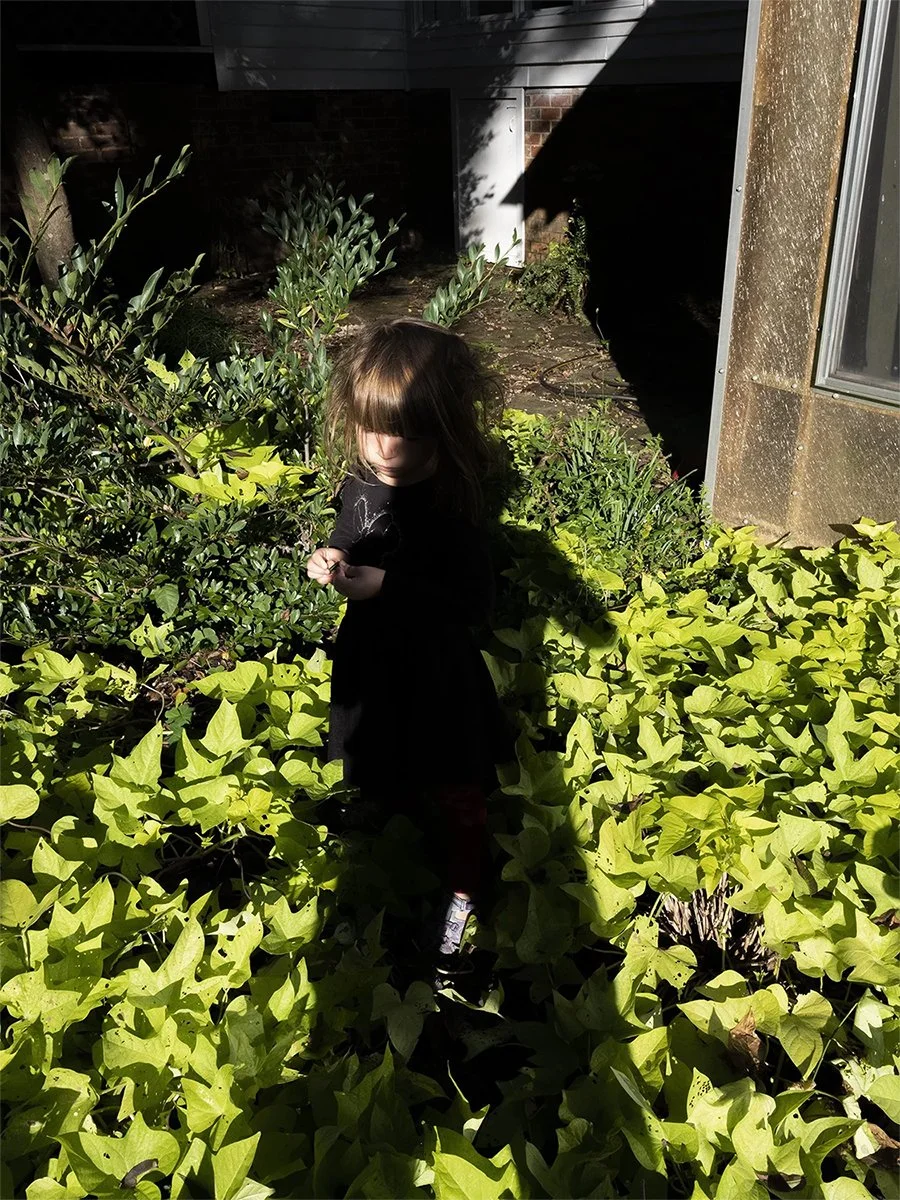
Allison Grant, Mother Shadow, 2021, 22.5 x 30”, archival inkjet print
ML: How do your daughters’ presence, both literal and symbolic, function within the photographs? Do you see the work as a form of testimony or archive for them?
AG: Initially, I did think of the work as a sort of visual journal or love letter to my adult children that would mark my experiences of parenthood as climate change escalates. I wanted them to know how I felt about this issue in relationship to their lives. But over time and as the work has become more public, my thinking has changed. My daughters aren’t old enough to fully understand how identity, politics, and environmentalism show up in the work, nor are their thoughts on those topics fully formed. I don’t know what they will think about climate change when they are adults. And, they may come to realize that their gender differs from the one they currently inhabit. These are just some of the ways they could change and feel that the work misrepresents their thoughts or identity.
So, it is important to me to state that this project is autobiographical and, first and foremost, about me, while still acknowledging the profound ways my daughters have shaped it. Any time a photographer works with another person, they are collaborating with that subject to create a visual image. My daughters’ gestures and experimentation are so important to the work, and they often come up with ideas or scenarios that inform what we make together.
“I believe parenthood is an extraordinarily meaningful experience, one that generates specific forms of knowledge and ways of understanding the world that deserve representation in contemporary art. ”
I want my daughters to live self-determined lives without my artwork taking any possibilities for that away from them. At the same time, I do not want to silence my own perspective in an effort to protect my children. I believe parenthood is an extraordinarily meaningful experience, one that generates specific forms of knowledge and ways of understanding the world that deserve representation in contemporary art. One way I’ve tried to balance these concerns is to place myself visibly in the work, emphasizing my presence as the photographer and author. The image Mother Shadow, where my shadow falls over my daughter and mostly obscures her, is one example of this attempt to foreground my authorial presence.
Throughout the work, the way I use authorship moves. I carry my camera as I live my life, capturing spontaneous moments one day and staging images the next. The work shifts between documentation and imaginative autobiography, reflecting how my inner and outer worlds are intertwined. Parenthood is such a multifaceted experience that I think photography has a unique capacity to explore in this way.
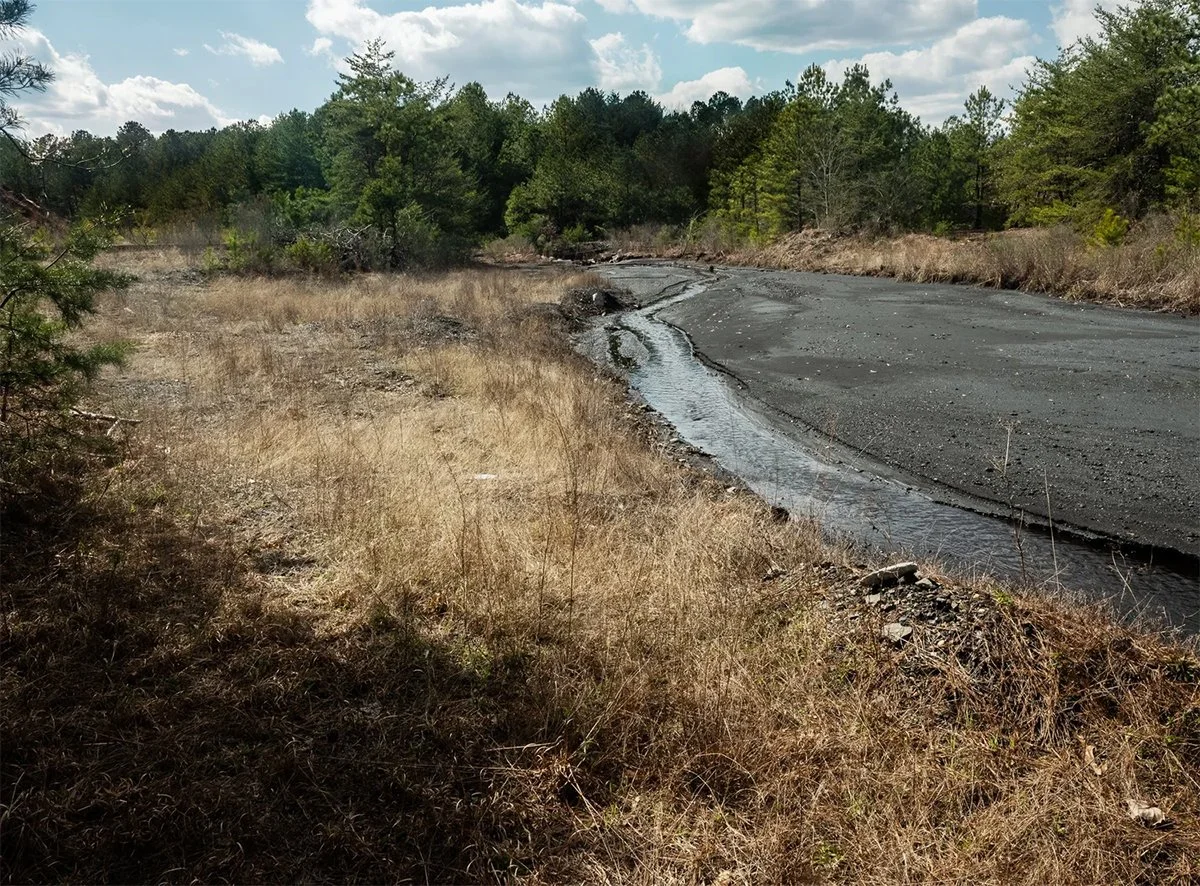
Allison Grant, Runoff Near Mines, 2019, 48 x 36”, archival pigment print
ML: Tuscaloosa is depicted as a place where dense vegetation and industry coexist. How do regional histories of labor, extraction, and the South inform your understanding of environmental harm?
AG: I did not grow up in the South, and my understanding has changed a lot since I moved here nine years ago. Many parts of the state’s economy are built on extractive industries. In Tuscaloosa, the Black Warrior River runs through one of the richest coal fields in the country before connecting to the Gulf of Mexico. Unsurprisingly, coal has played a central role in economic development here, along with iron ore, which is also found in large deposits in the region.
I’ve spent a lot of time photographing local mining operations for Within the Bittersweet, and through that work I met historian Kristina Mullenix, whose family has deep ties to coal mining in Tuscaloosa. Two years ago, we began collaborating on a photography and oral history project focused on the lived experiences of miners and their families.(2) Perspectives within mining communities vary, but concerns about community survival, financial stability, and access to healthcare are consistent. Many of these communities, rightly in my opinion, believe that no one is going to protect their jobs, livelihoods, or towns, and that corporations will extract value from both the land and the bodies that occupy it without making people whole unless they band together.
“Coal miners and other industry employees are often dismissed or blamed, particularly in the South, but these judgments overlook the broader mechanics of late capitalism, which demand ever-increasing energy intensity to sustain growth. ”
My own family history parallels these stories. My parents are from West Virginia, and many of my relatives, past and present, have worked in coal or related industries. Last summer, I traveled through West Virginia with my parents to photograph family members and mining communities.
I see this becoming a new series. I am interested to see if I can make a project that brings together my perspective as an academic and knowledge worker, and as a descendant of miners, with the experiences of people who still work in the industry. I want to consider how narratives of progress, growth, and upward mobility obscure the environmental impacts, people, and places that provide the energy and material resources that have been so intrinsic to prosperity.
I also want to explore self-determination, community solidarity, and the forms of worker power that intersect with coal mining. Coal miners and other industry employees are often dismissed or blamed, particularly in the South, but these judgments overlook the broader mechanics of late capitalism, which demand ever-increasing energy intensity to sustain growth. That demand does not come from the people who physically labor to pull resources out of the earth, though many do fight to keep their jobs and livelihoods. I am interested in a broader distribution of responsibility. The South is often positioned as the origin of a problem whose causes and benefits spread far beyond the region, even as environmental harm is felt most acutely at a local level. That’s something I’ve thought about as I’ve made Within the Bittersweet, but a project can only hold so much, so I think this new work will explore those histories more directly.
ML: In your earlier project, Unsoiled, you didn’t photograph lived landscapes, but rather you were constructing scenes in the studio. Can you talk about that work and your use of fabricated environments?
AG: I made the photos in Unsoiled between 2008 and 2014 while I was living in Chicago. I moved to the city to attend graduate school at Columbia College, and at first, I struggled to make work in an urban environment. I couldn’t figure out what to do with the modern glass-and-steel architecture. I would go to the city’s parks and green spaces and make images that felt like they were in rural or wild places. I think I was searching for a visual language that was reminiscent of the parts of Ohio where I grew up.
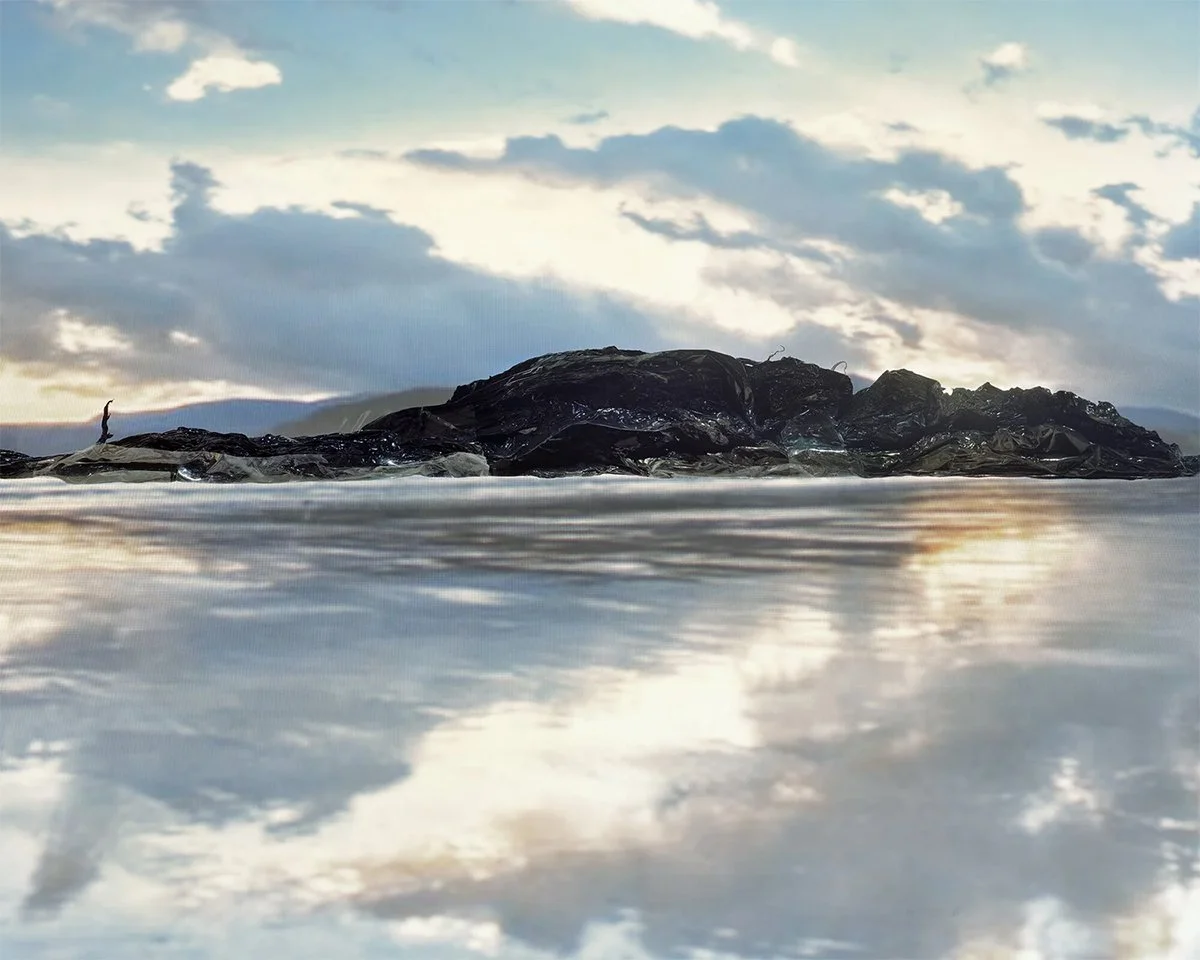
View from Wiki, facing south, 2013, 40 x 30”, archival inkjet print
Those early images ended up looking like bad versions of the kind of photos you’d find in a cheap nature calendar. They seemed idyllic and distant from the urban grit and slick buildings that were just outside of the frame, and I felt curious about the way they were a little deceptive.
I started studying the conventions of nature photography that repeat in our visual culture—the ones that I’d inadvertently copied—and that led me to consider how the genre of nature photography itself perpetuates certain fictions. Nature photography is a sort of shorthand for what “nature” looks like: lush fields, distant mountains, or sunlight filtering through forests. These scenes have a certain visual mystique and they look untouched and “unsoiled” by humans. They can be understood as an opposite to places that humans inhabit. You are either standing in nature or you’re not.
To me, that type of thinking sets up a false binary. Climate and environmental scientists study the earth’s systems, and those fields have made it clear that human life, like all life, is folded into and dependent on the natural systems that surround it.
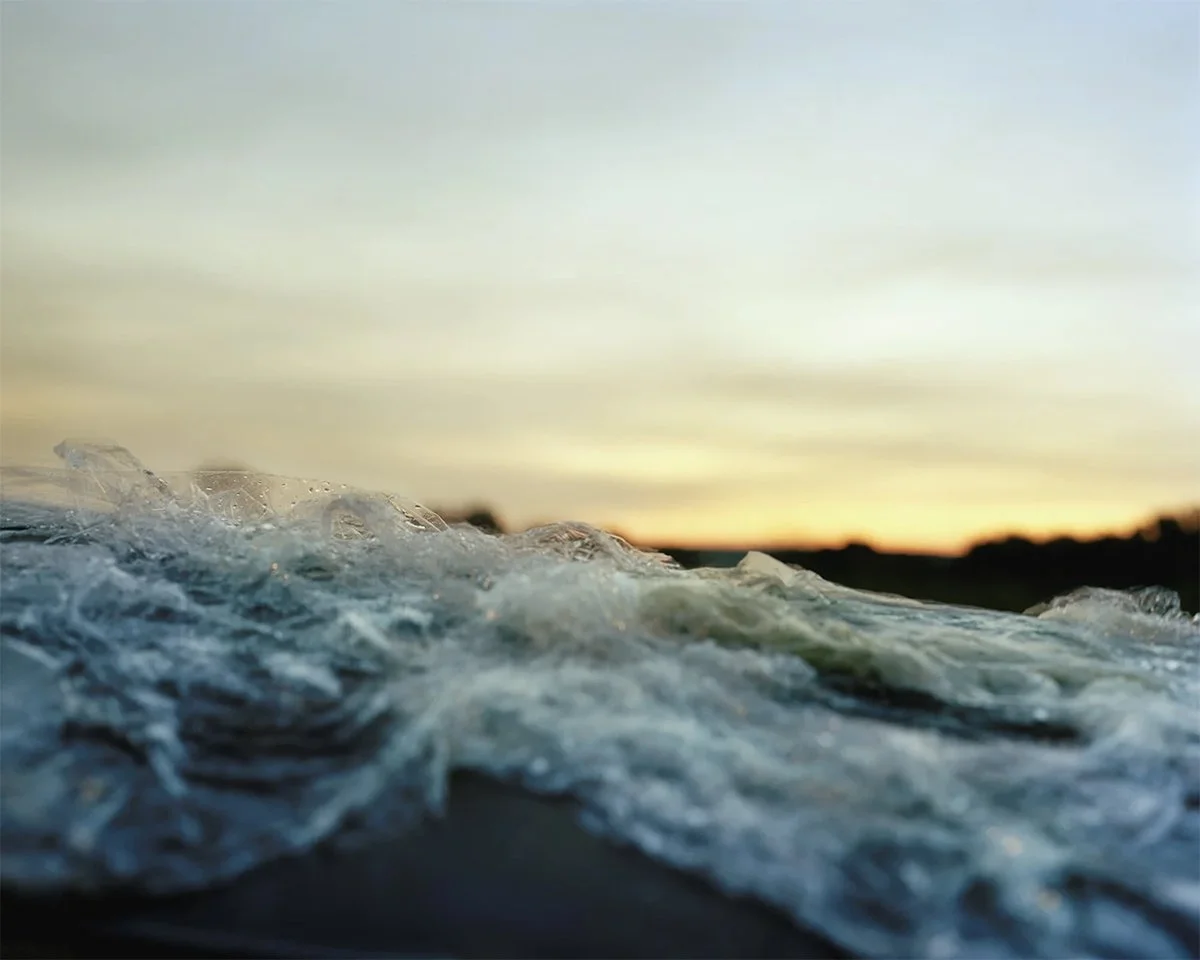
Allison Grant, Ocean Sunset, 2009, 40 x 30”, archival inkjet print
The photographs in Unsoiled are, in this sense, about other photographs. I construct the images as a way of considering how the idea of nature is constructed through mass media as something apart from human culture, rather than as a lived and entangled reality.
ML: Plastics and synthetic materials play a central role in Unsoiled. How do these materials function both formally and symbolically within the work?
AG: That’s right, the images in Unsoiled are illusions that look like idyllic landscapes, but they are actually constructed in miniature from plastic. The kinds of plastic most of us encounter in daily life are, at a molecular level, altered by humans and would not exist without human processes. They are the sort of materials that seem out of place in pristine nature. But plastics flow through nearly every aspect of contemporary life and are often used just once and discarded. They, of course, don’t disappear. They enter the environment and can take over 500 years to decompose. We now live on a planet where the mass of plastic outweighs the mass of all living wildlife. It’s astonishing.(3)
“I use illusion because I want viewers to be able to return to that original impression and continue to inhabit a sense of depth and space even after recognizing the artifice.”
When you look at my images initially, in a gallery from a distance, you might think you are looking at a photograph of an actual landscape and not a constructed one. I use illusion because I want viewers to be able to return to that original impression and continue to inhabit a sense of depth and space even after recognizing the artifice. I try to create set-ups that don’t feel like dioramas. My goal is for the plastic to feel like a small, single-use item that is familiar and an expansive landscape at the same time. I want to draw a connection between massive environmental problems and the everyday items we often take for granted.
Ocean Sunset, for example, looks like a churning ocean, but it’s made from a piece of cellophane. To me, the photograph shifts from feeling alluring to evoking a sense of suffocation as the illusion flips. There is a massive plastic patch in the Pacific Ocean that is twice the size of Texas and when I made that image I was thinking specifically about how learning about the patch changed the way I think about what an ocean contains.
ML: How does working with appropriated images from mass media complicate ideas of authorship, authenticity, and environmental truth in your practice?
AG: I began collecting images from mass media not long after I started Unsoiled to help inspire my work. I started to wonder what would happen if I included those source images in my setups. At the time, I worked long hours in an office in a basement with no natural light. One of the first images I appropriated was from a screensaver on my work computer that showed scenes of the outdoors to me when I was most sunlight deprived. One day, I put some plastic on top of the screen and took a photo. The results were so exciting. When you photograph a screen, there is a grid that is ordinarily barely visible, but it becomes obvious in the image. That interrupted a simple read. I found other strategies for nodding at the ways images degrade when they are rephotographed. This allowed me to challenge the authenticity of images that present nature using specific photographic conventions that can feel objective or neutral. I think it’s an interesting way to emphasize how these images enter our lives through layers of mediation and while they may have some relationship to the real, they also perpetuate fictions.
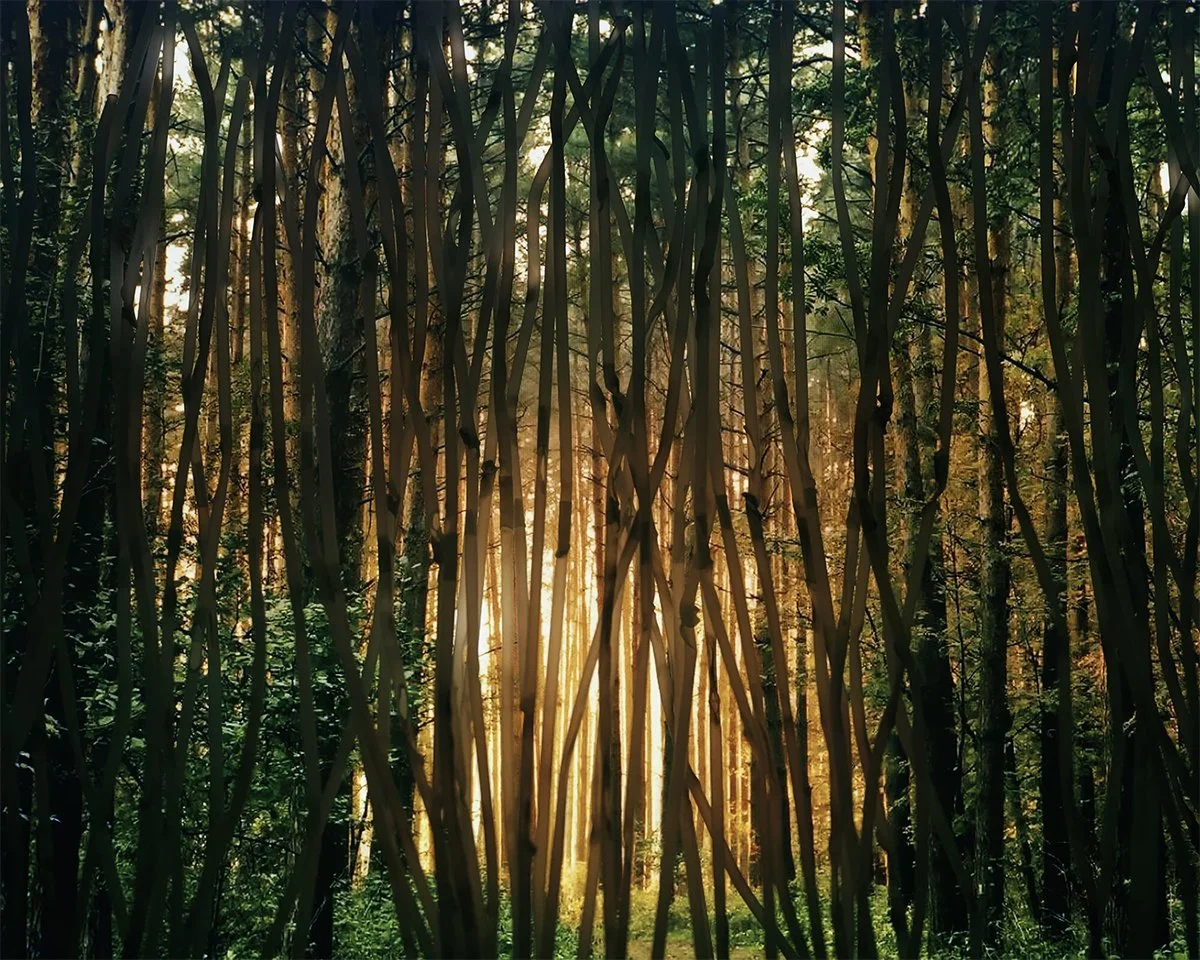
Allison Grant, Macintosh Forest, 2009, 40 x 30”, archival inkjet print
ML: You challenge the tradition of “pristine” landscape photography in Unsoiled. What responsibilities do you think photographers have in confronting the myth of untouched nature?
AG: Pushing against the idea that authentic nature is “out there,” worth protecting only when it is tranquil, and separate from human life feels more important now than ever. Climate change is altering ecology in shocking ways. And AI is sucking up more and more fossil energy while also distorting the way people understand their place in the material world. We are ecological beings who depend on resources for our survival. To me, it feels incredibly urgent that our integration within these systems is acknowledged and taken seriously in our storytelling, policymaking, economic decisions, and art. We can no longer afford to imagine the world through fantasies that ignore the planetary boundaries we are quickly approaching.
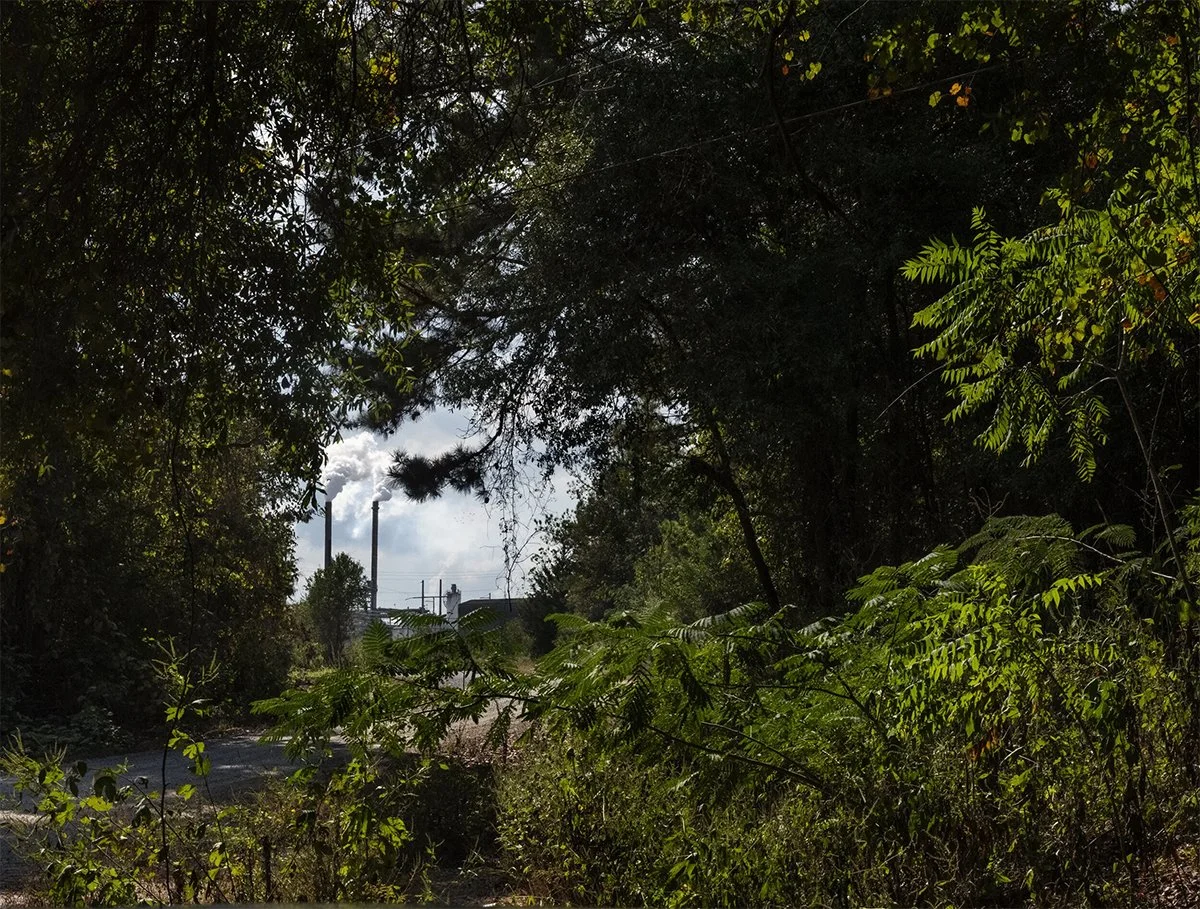
Allison Grant, Papermill Stacks, 2019, 48 x 36”, archival inkjet print
ML: Your photographs suggest that environmental contamination is not only external but embodied. How do you think about the body, especially the maternal body, as a site of environmental exposure?
AG: I am glad you brought this up. Microplastics are now being found in hearts, brains, and testicles, and they cross the placenta during gestation. Chemicals and environmental toxins are the same. One of the paper mill plants that I photographed for Within the Bittersweet was sued by the EPA for releasing dangerous amounts of a pollutant called dioxin into a neighboring community. It’s a carcinogen that is especially harmful to developing fetuses because it can cross the placenta and cause birth defects.
Lucy Jones addresses this eloquently in the book Matrescence: On Pregnancy, Childbirth and Motherhood(4), describing babies as born “prepolluted.” What is in our environment literally becomes us. There is a passage in that book where Jones talks so powefully about the body being of the environment. Writing about her pregnancy, she says:
“I was carrying the future inside me. I would learn that I was also carrying the eggs already within my baby’s womb that could go on to partly form my potential grandchildren; my future grandchildren were in some way inside me, just as part of me spent time in the womb of my grandmother. I was carrying inside me a pool of amniotic fluid which was once rivers, lakes, and rain. I was carrying a third more blood which was once soil, and stars, and lichen. The baby was formed of the atoms of the earth, of the past and the future. Every atom in her body existed when the earth formed four and a half billion years ago. She will live for many years, I hope. When I have returned to the ground, she will live on the earth when I am gone. Time bends.”
Jones is describing pregnancy as an ecological phenomenon that carries the genetic heritage of ancestors across time along with the material components of the planet. Though she doesn’t name it here, that increasingly includes toxins and synthetic plastics to which our exposure is not optional and precedes consent.
My photograph As My Mother, So I shows me nursing my daughter in the woods where I grew up as a child. My mom is behind me in that picture, and she has her arm wrapped around mine. I think of the three generations of women in the photo as symbolic of an ancestral past that extends backward beyond the doubling of our arms and also forward to potential future generations. Sometimes I show this piece next to images of toxic industry as a way of considering the body’s connection to the ecology, land, and time, drawing on a sense of knowing similar to what Jones outlined.
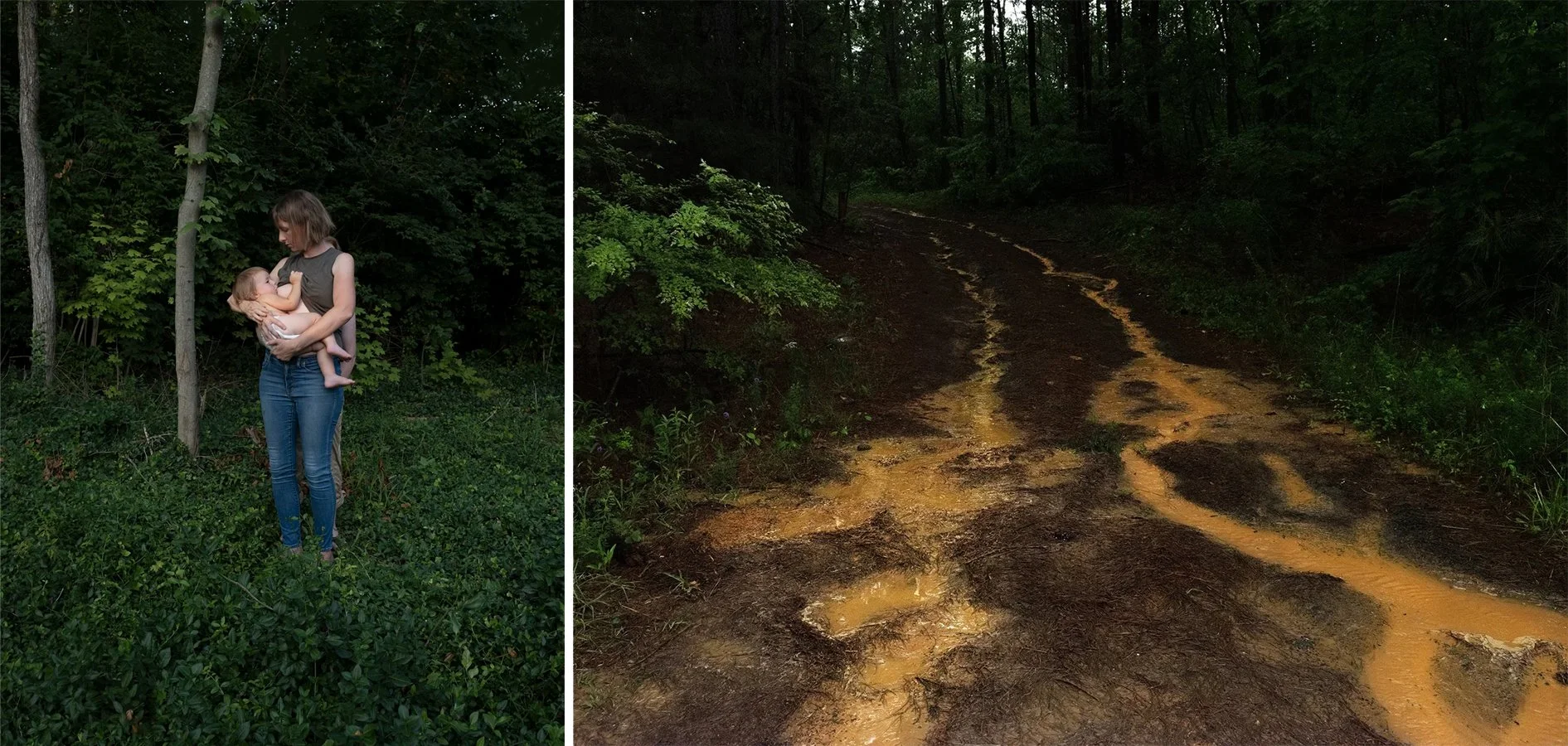
Allison Grant, As My Mother, So I, 2019, archival inkjet print, 30 x 40” (L), Water Streaming Down a Mine Access Road, 2024, 48 x 36”, archival inkjet print (R)
ML: How do you hope viewers emotionally engage with your work—through grief, love, urgency, discomfort, or something else?
AG: I certainly hope those are some of the ways people engage with the work. Most of my work is not prescriptive in terms of solutions to environmental problems. It’s reflective of some of the nuanced emotions and experiences I’ve had in relationship to 21st century environmental concerns, and I hope those resonate with others and offer space to process the ways life is shifting in our time.
When I give public talks about Within the Bittersweet, I’ve had people weep because the emotional weight of the work intersects with their lived experiences. I’ve also had people tell me that the work is not resonant at all. I’m not sure any artwork can inspire emotions universally to all people, but my work is not for everyone. I think it strikes a chord for people who have shared similar experiences of love and connection that allow them to empathize with the gravity of the situation future generations will face and the ways many of us are not individually powerful enough to curb that threat.
ML: What projects or ideas are occupying your attention at the moment? What feels urgent or most important?
AG: Last year, I started a new project called Holding Together that deals with attacks on reproductive freedom in the Deep South. I was talking with a photographer friend of mine, Pete Halupka, about invasive plants, and he mentioned that Queen Anne’s Lace has some pretty magical properties. It has been used as a form of herbal birth control, but it’s a little bit toxic, so it’s not a great option. We started talking about other medicinal herbs that induce abortion, and I knew before the conversation was over that I was going to make a project about it. Even though 54% of Alabamians support abortion in most or all cases, it’s illegal in the state from conception and there are, in practice, essentially no exceptions.
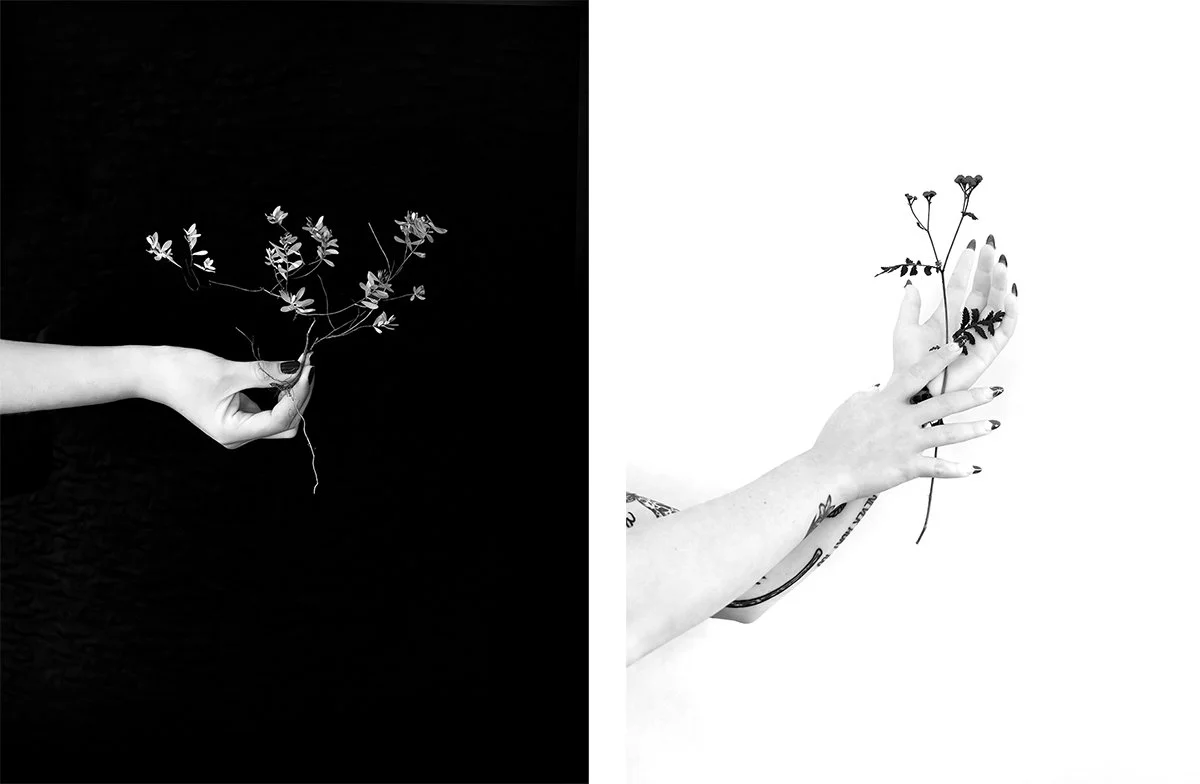
Allison Grant, Elvira Holding Saint John’s Cross, 2025, 12 x 15”, archival inkjet print (L), Grace Holding Tansy, 2025, 12 x 15”, archival inkjet print (R)
I started photographing women and people with uteruses holding different botanicals historically used in reproductive care, including cotton, pennyroyal, cohosh, tansy, and dogfennel. I wanted to honor the long history of people trying to figure out a way to achieve reproductive freedom. We are so lucky to be living in a time when we have so many tools, but they’ve been politicized and withheld in tremendously cruel ways.
I work closely with the people I photograph, and together we’re pushing back against the political control that’s come to shape life in the Deep South. The folk remedies in the project are imperfect, and many of the plants are actually dangerous. We’re very clear that we don’t want to live in a world where those become our only option. When our hands come together in the images, they stand in for a shared community of voices and support.
It is important to me that the people I work with aren’t fully identifiable. Some have asked to stay anonymous because they are worried about consequences from relatives, friends, or workplaces. I have photographed immigrants and migrants in the US who fear repercussions from ICE for speaking out about their beliefs or needs. At the same time, tattoos, jewelry, and other markings of identity help make the photographs individuated and play an important role in the project's aim of bringing multiple voices together. Using hands is, for me, a way of exploring an expansive idea of what portraiture is. I want the work to communicate the strength, resilience, and solidarity of people living in the south through expressions of unity and resolve that include those unable to fully use their voices. The project also includes the hands of partners, friends, and health care providers as a way of acknowledging the role of allies in facilitating access.
Emily Pérez and Nancy Reddy, The Long Devotion: Poets Writing Motherhood, ed. Emily Pérez and Nancy Reddy (Athens: University of Georgia Press, 2022).
To learn more about Grant’s project with historian Kristina Mullenix , see Tributaries Journal, Vol. 18 (2024), pp. 16–47. https://static1.squarespace.com/static/5ee78543230a62660be75859/t/67509a5b984cb36fcc64a22a/1733335651343/AFA-2024-Tributaries-issue-18-WEB.pdf
Emily Elhacham, Liad BenUri, Jonathan Grozovski, Yinon M. BarOn, and Ron Milo. “Global humanmade mass exceeds all living biomass.” Nature (2020). https://doi.org/10.1038/s41586-020-3010-5
Lucy Jones, Matrescence: On Pregnancy, Childbirth and Motherhood, (New York: Pantheon Books, 2024).