

Adriene Hughes
Adriene Hughes is a San Diego based fine art photographer with an MFA from The School of the Museum of Fine Arts, Boston, and Tufts University. She is a multimedia artist whose current body of work is based within the genre of grand landscape and the effects of global warming on the environment through the use of infrared technology, photography, and video installation. Her work is included in the collections of the Museum of Photographic Arts in San Diego, CA; The Gardner Collection, Boston, MA; California Museum of Photography, UC Riverside, Riverside, CA; and many private collections. She is represented by Black Box Gallery in London, UK
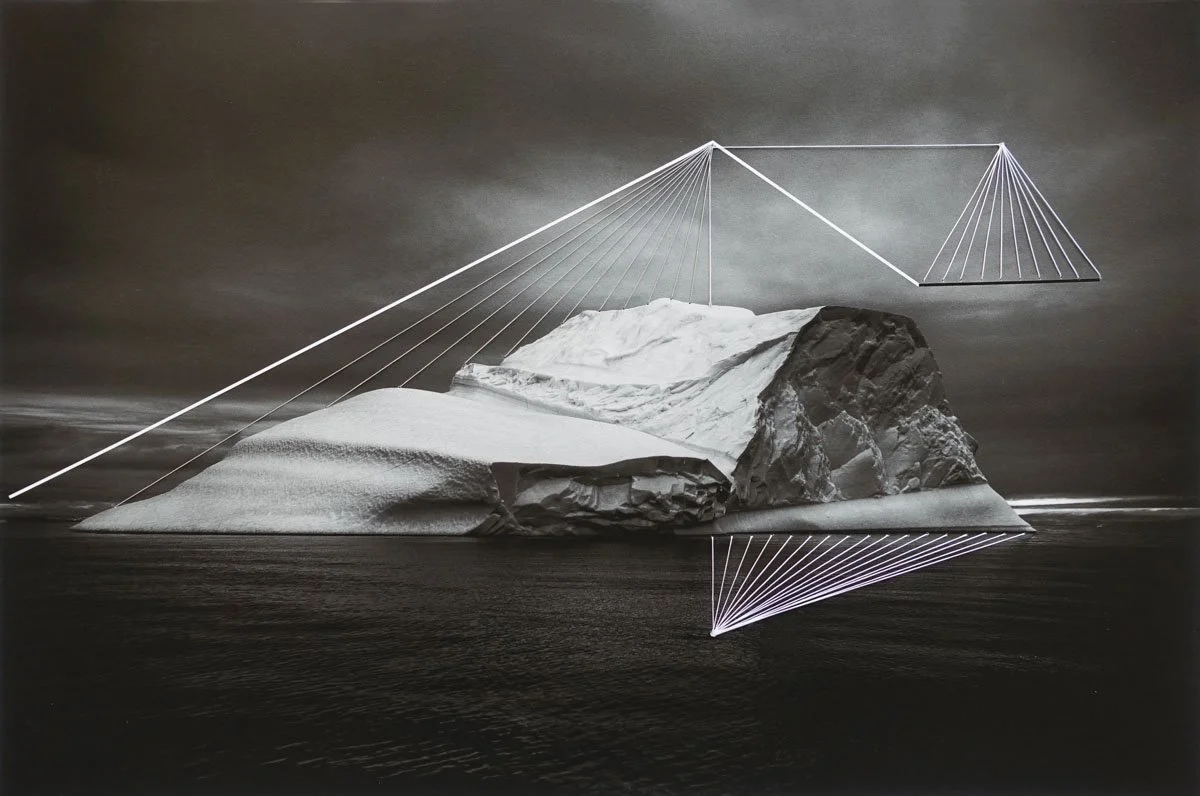
Adriene, Hughes, Threaded Iceberg BW No. 1, 2019, 8”x12” image | 11”x14” sheet | 14.5”x19.5” frame, Archival Pigment Print on Cotton Rag with Cotton Quilting Thread
In this interview, artist Adriene Hughes discusses her evocative photographic practice, which combines infrared imaging and embroidery to explore the unseen connections between humans and the natural world. Infrared photography makes visible forms of light that human eyes cannot detect, recasting familiar landscapes in unexpected and vivid hues while opening a window onto dimensions of the natural world that typically remain hidden from us. For Hughes, these visual transformations offer a powerful metaphor for the subtle forms of communication within nature that we are only beginning to understand.
Our conversation ranges across the experiences that have reshaped her perspective and informed her creative practice, including a visit to a glacier and her diagnosis of breast cancer. These profoundly different encounters invite reflection on vulnerability, transformation, and our relationship to the living world. Through her work, Hughes encourages us to look beyond what is immediately visible and consider the hidden languages, unexpected connections, and new ways of seeing that emerge when we learn to pay attention.
Margaret LeJeune: Before we talk about the work you’re making now, I’d love to go back to the beginning. Who was Adriene Hughes before she became a photographer? Where did your relationship with art and image-making begin? Do you remember an early experience with making or looking at images that stayed with you?
Adriene Hughes: I was a military child. We moved often during my early years, and because of that I was shy. When I was ten years old I asked for art oil paints and paint brushes. Instead of a canvas, my father cut blocks of plywood from a leftover home project. I remember painting a portrait of my dog and another of a single-stem rose in a vase. I’m sure I painted other things, but my memory fails me.
At the age of twelve, I took a summer school class where I had my first exposure to film photography. The teacher took my portrait, and I had to print the portrait in the school darkroom. I was already enamored with our family photographs taken with the Kodak Brownie camera, but sadly my parents were not invested in memory-making. I was the only one in the family that would use the camera for important events - I’m sure that’s where my obsession with photography began.
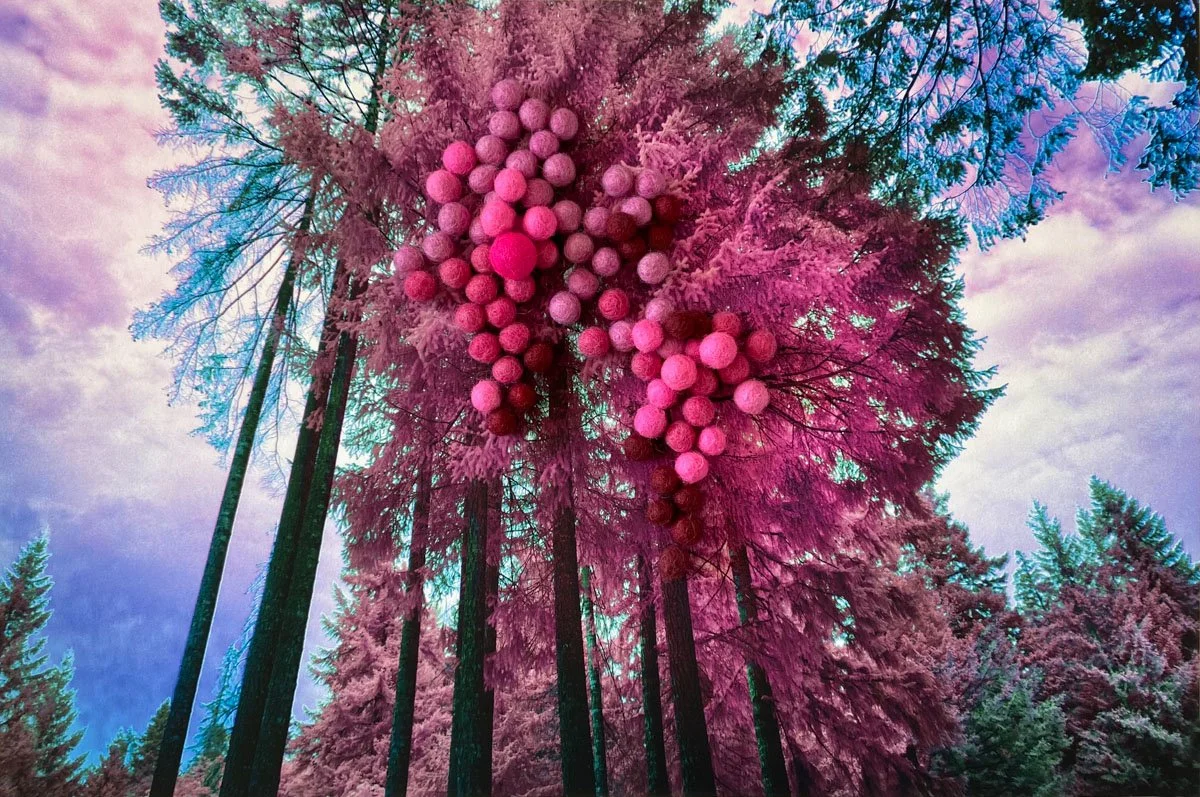
Adriene Hughes, The Secret Life of Trees II / Image #01, 2021, 13” x 20” | 17” x 24” sheet | 21 x 28” framed, Archival Pigment Print on Cotton Rag with Wool Felt
ML: You eventually pursued an MFA at the School of the Museum of Fine Arts, Boston, and Tufts University. What was that period of your life like and how did graduate school change your understanding of yourself as an artist?
AH: I attended the School of the Museum of Fine Arts at the age of 37 without a background in formal art education. I found graduate school extremely intimidating and challenging because I was trying to imagine what my life was supposed to be within an art school setting. Everyone I was studying with (my cohort class) already understood the canon of postmodern theory. The first year I was drowning to catch up with the others. Academics aside, what I eventually came to understand was that art school made me more conscious of the artistic process. It taught me to stay with an idea longer, to allow questions to unfold, and to pay attention to what emerged rather than trying to control the outcome. I learned that not knowing exactly where an idea was going could actually be an important part of the creative process.
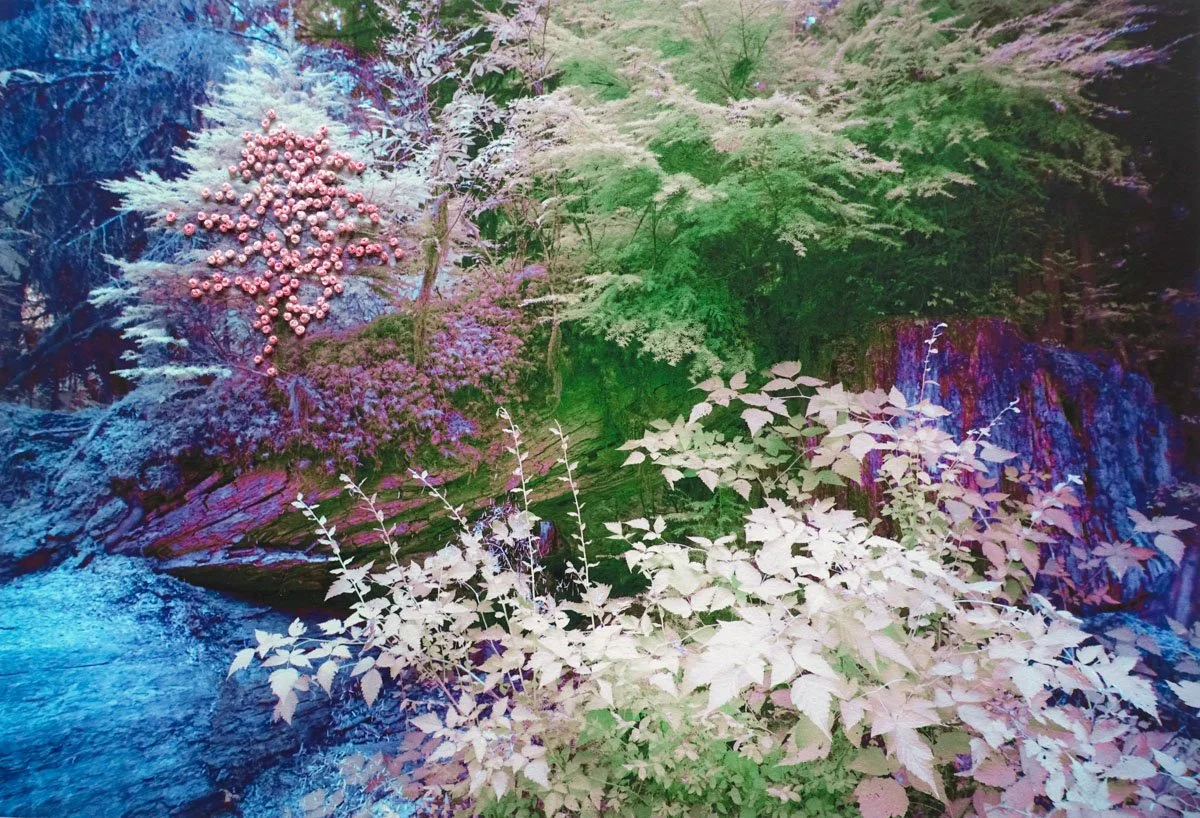
Adriene Hughes, The Secret Life of Trees I, Image #10, 2020, 8” x 12” image | 11”x14” sheet, Archival Pigment Print on Cotton Rag with Cotton Floss
ML: Your work seems to exist at the intersection of personal healing and environmental transformation. How did your experience with cancer change the way you see and photograph the landscape?
AH: Cancer changed the world for me because it changed my sense of self, vulnerability, and personal attention. When your body becomes a place of uncertainty, the outside world can suddenly feel very different. I became much more aware of the trees where I lived, the seasons (which rarely change in Southern California) and the cycles of growth, decay, regeneration—and of how much emotional transformation can happen in one’s recovery.
Cancer made me move in the world differently. I became interested in the evidence of nature—the things that might otherwise be overlooked. The camera allowed me to sit with uncertainty and, in a sense, to make a record of recovery. Cancer made me appreciate every day as best as I could. I know that’s a cliche, but it’s true.
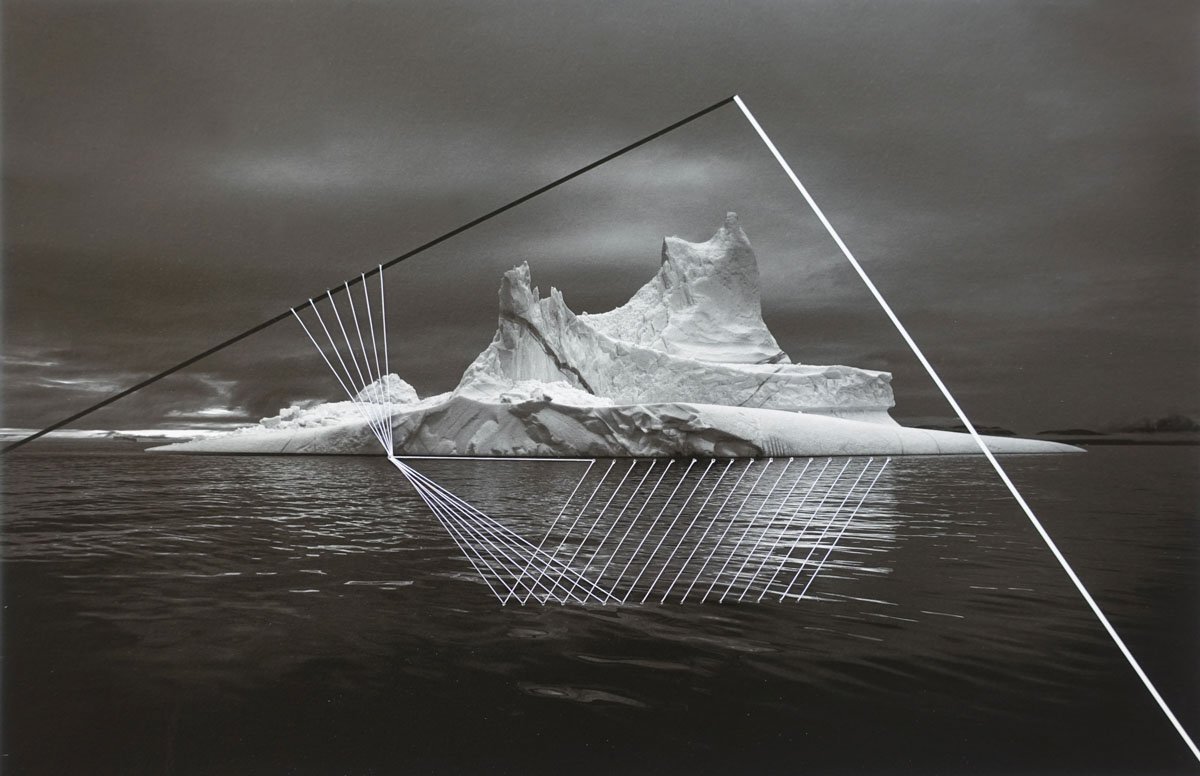
Adriene Hughes, Threaded Iceberg BW No. 6, 2019 8”x12” image | 11”x14” sheet | 14.5”x19.5” frame. Archival Pigment Print on Cotton Rag with Cotton Quilting Thread
ML: You describe your trip to Alaska, and specifically standing on a glacier, as a pivotal moment in your creative life. What happened for you in that landscape that was different from simply looking at a beautiful place?
AH: Standing on the glacier was life altering because I was confronted with a scale of space and time that was completely outside my own experience. It was stunningly beautiful, but the beauty wasn't the point. I could feel that I was standing on something ancient and alive, something that was changing even as I stood on its body, cracking with deep crevices and losing its girth from heat and global warming.
That experience shifted the way I understood landscape. I stopped thinking of it simply as something to photograph and began thinking about it as something I was participating in—a place with its own history, memory, vulnerability, and transformation. The glacier made those ideas physically present. It was humbling, and after my experience with cancer I felt more invested with the environmental scale of a place. I felt the impermanence and power of a glacier. And that was life changing.
ML: You’ve written that you feel as though you “belong” in the landscapes you photograph. What does that sense of belonging mean to you, particularly at a time when many of these environments are themselves under threat?
AH: Belonging, for me, is a spiritual recognition. When I say that I feel I belong in the landscapes I have moved within, I mean that I recognize something of myself in the vulnerability and the capacity of the physical scale of earth. Whatever it might be, the land reminds me that we are not separate from the natural world. Just the opposite, we are very much embedded heart and soul.
That feeling has become more complicated as I've become more conscious of how threatened the world has become. There is a kind of intimacy that comes with knowing that the earth that one admires is fragile and falling apart. You look differently at the life around you. You pay attention differently.
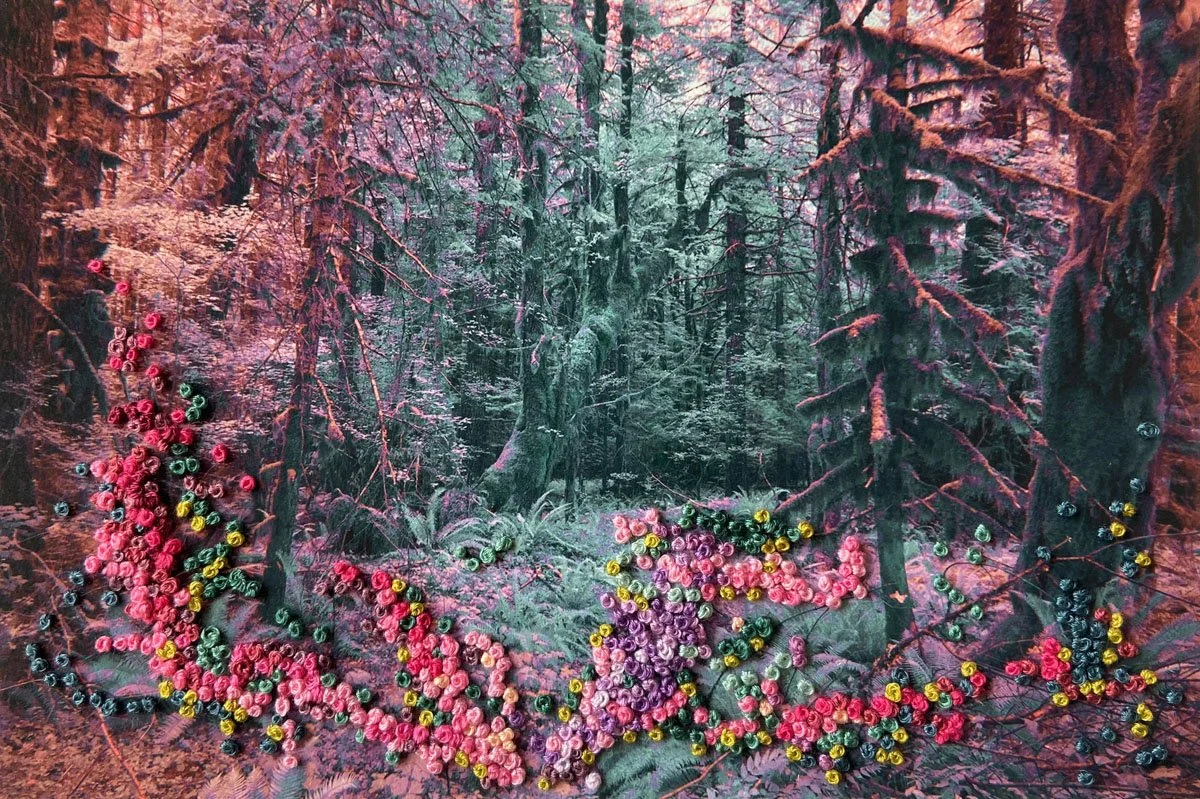
Adriene Hughes, The Secret Life of Trees I, Image #06.2, 2019, "5” x 7” image | 9" x 11" sheet, Archival Pigment Print on Cotton Rag with Cotton Floss
ML: There is an interesting tension in your work between photography as documentary evidence and photography as an intensely subjective, emotional medium. How do you negotiate those two roles?
AH: I try not to resolve the intersection of documentary evidence vs. the emotional relationship with land. I’m interested in the fact that a photograph can be both a record of something that is physically there and a record of my experience of being there. I'm not claiming, “This is exactly what this place is.” I'm saying, “This is what I saw, and this is how this place affected me on a spiritual level.” That distinction is important. The emotional weight of witnessing is a combination of both documentary and the spiritual.
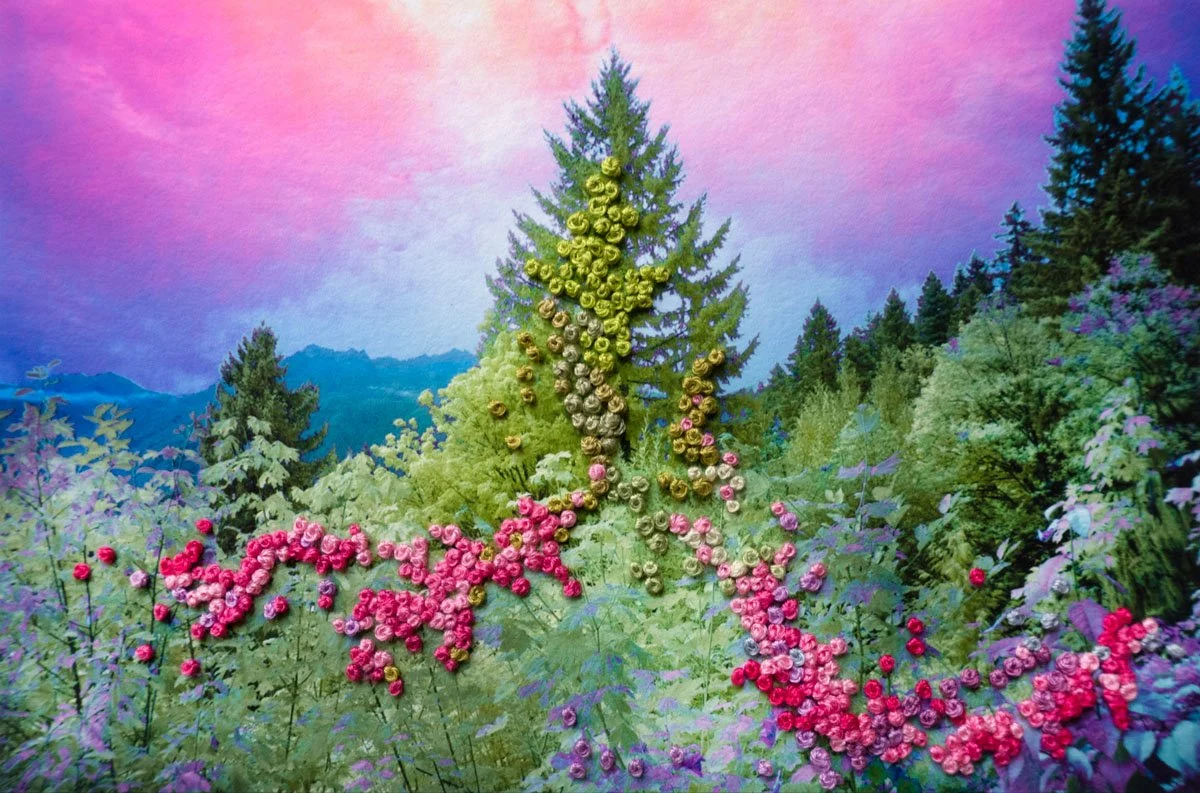
Adriene Hughes, The Secret Life of Trees I, Image #01, 2020, "5” x 7” image | 9" x 11" sheet, Archival Pigment Print on Cotton Rag with Cotton Floss
ML: In The Secret Lives of Trees, you interpret the colors produced through infrared photography as a kind of visual manifestation of communication between trees. Can you talk about the relationship between scientific knowledge and artistic intuition/imagination in your process?
AH: Though I appreciate scientific knowledge about one’s artistic practice, I lean into the intuition before I begin to analyze anything. Scientific knowledge and artistic intuition aren't truly opposing forces, they occupy different but very connected parts of the process of understanding.
As an example, infrared photography reveals wavelengths of light that our eyes can't see and produces the extraordinary shifts in color that I captured in my work in The Secret Life of Trees. Infrared light is a scientific fact. And knowing something about the biology of trees—the ways they communicate through a mycelium network, exchange resources, and respond to stress during droughts and forest fires—gave me a factual framework. But when responding to the colors in the images in a more intuitive way, science can’t speak to the psychic knowledge I gleaned from the forest. I think that's one of the great possibilities of art: it can take something we know factually and allow us to experience it differently. Science can tell us what is happening beneath the surface; photography can make us wonder what it might feel like to inhabit that unseen spirit world.
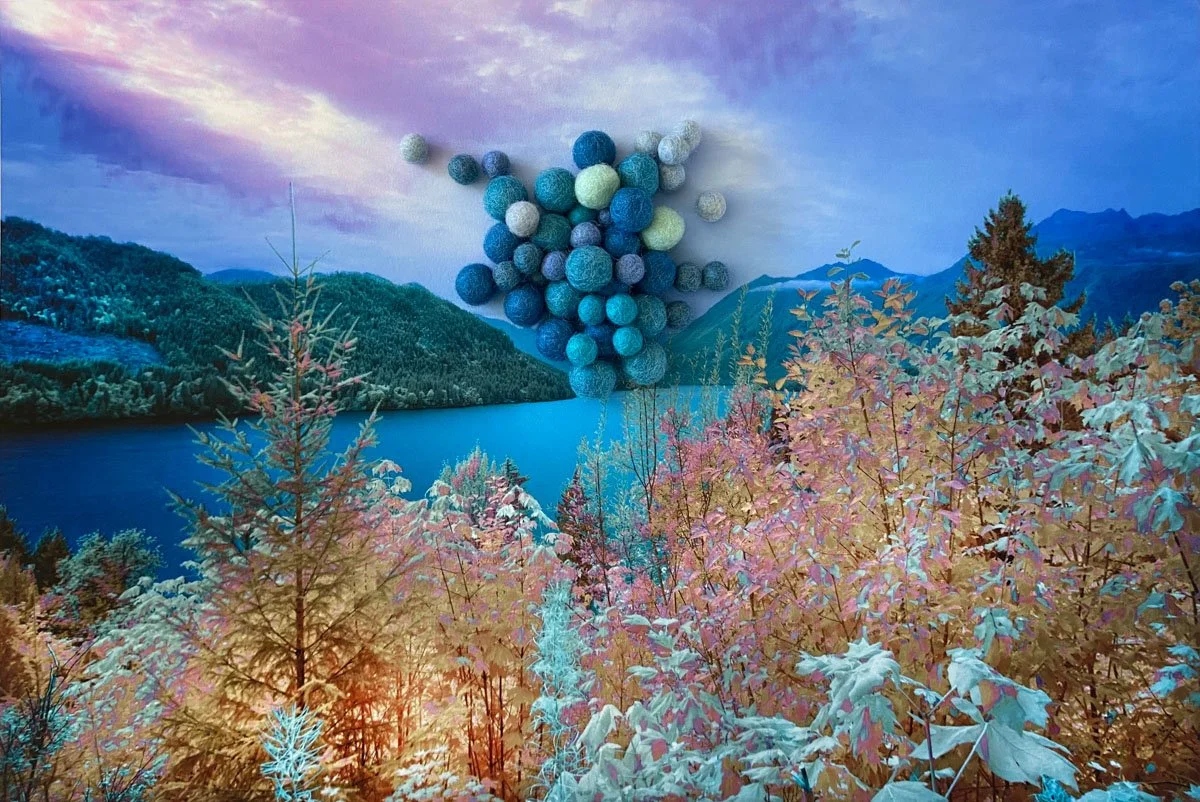
Adriene Hughes, The Secret Life of Trees II / Image #06, 2021, 12” x 18” | 13”x19” sheet, Archival Pigment Print on Cotton Rag with Wool Felt
ML: The fungal networks connecting trees have become an important metaphor in your work. What do you think these networks can teach us about interconnectedness, not only within forests, but within human communities and ecosystems more broadly?
AH: What fascinates me about fungal networks is the idea that an ecosystem can be sustained by relationships that are largely invisible. Beneath the forest floor, there is an intricate web of exchange and connection, where the health of one organism is tied to the health of many others. This challenges the very human tendency to think in terms of separate, individual entities.
We often celebrate our independence as humans, but none of us actually exists independently. We depend on networks of care, knowledge, resources, memory, and generosity—many of which remain invisible until something disrupts them. I am currently a caretaker for my senior parents, and this lesson is hitting hard. It has been a difficult time watching my genius father falter as his mind decays. It is a brutal lesson in memory and loss.
I don't want to turn the fungal network into a simplistic metaphor for humans living in an emotional tangle; I have many friends whose lives are painfully disrupted as they care for their parents financially and emotionally. Even so, recognizing that our lives are entangled, much like nature, is paramount whether we acknowledge it or not.
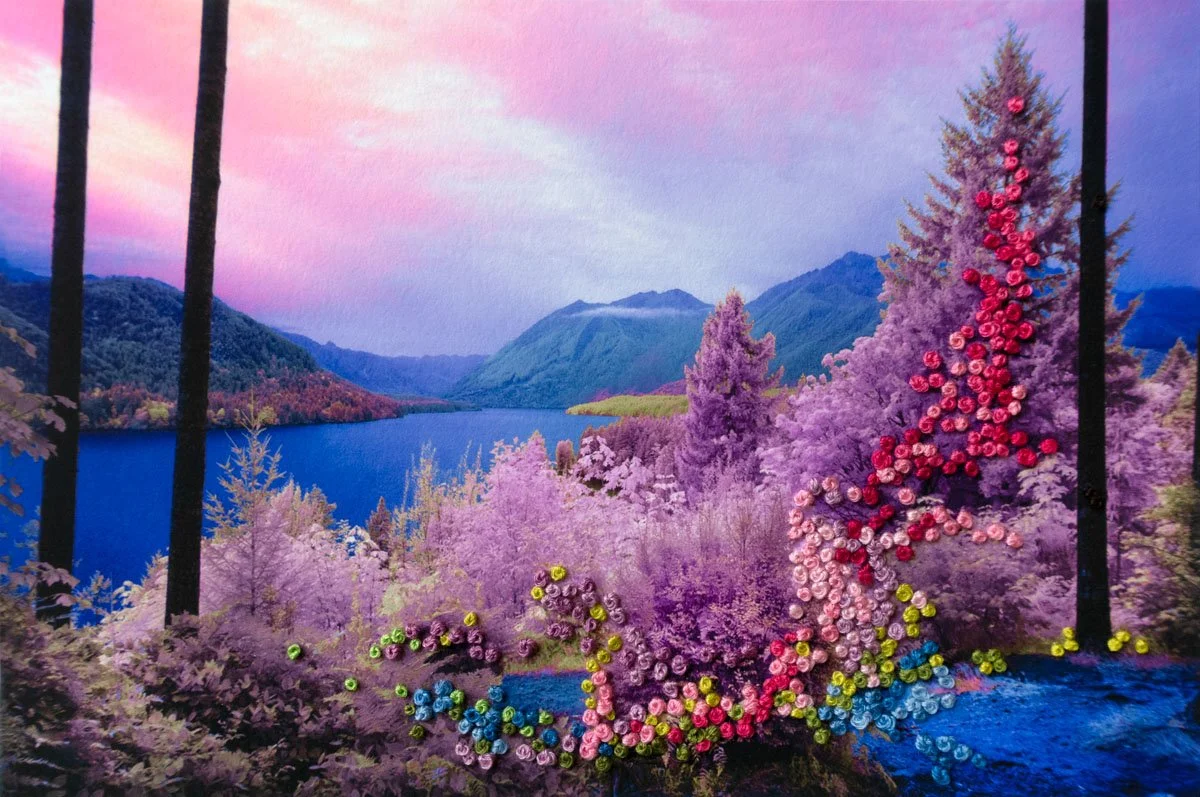
Adriene Hughes, The Secret Life of Trees I, Image #02, 2020, "5” x 7” image | 9" x 11" sheet, Archival Pigment Print on Cotton Rag with Cotton Floss
ML: Embroidery plays a significant role in The Secret Lives of Trees and your other projects. What does stitching allow you to communicate that photography alone cannot?
AH: Photography can happen in an instant, but embroidery asks me to feel the meaning—to physically move through an image with my hands to tell a story the camera could not communicate. The slow process of embroidery, living within a time-based practice, becomes a part of the meaning of the work.
Additionally, embroidery adds a level of what I call psychic downloads: colors and geometric patterns that communicate a connection to an image that is more felt than seen. In The Secret Lives of Trees, that felt especially important because the work is concerned with relationships that are not visible. The thread gives those invisible connections a physical form. It can move across the photographic surface in a way that doesn't simply describe what I'm seeing, but creates another layer of emotional interpretation.
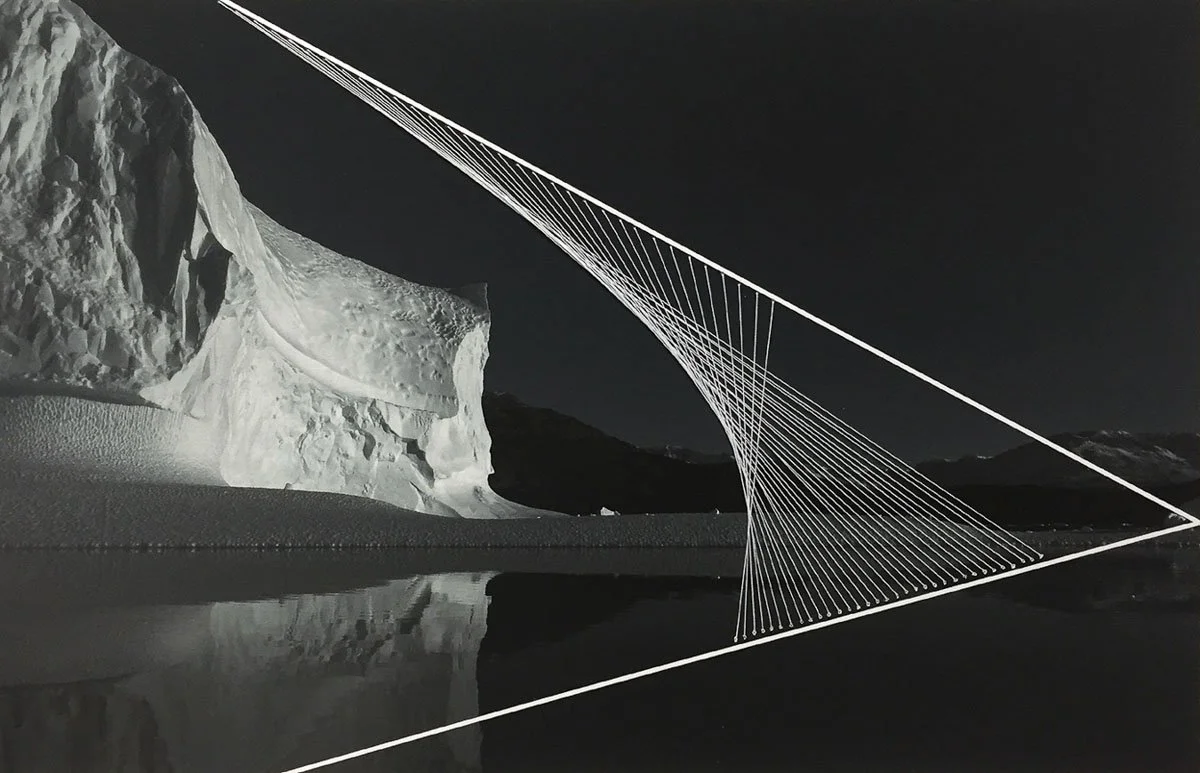
Adriene Hughes, Scoresbysund, Greenland #7, 2016-2017, 8”x12” image | 11”x14” sheet | 14.5”x19.5” frame, Archival Pigment Print on Cotton Rag with Cotton Quilting Thread
ML: You describe embroidery as a historically feminized craft and say that incorporating it allows you to “lay claim to the photographic landscape” on your own terms. How does gender and the history of craft inform your practice?
AH: Embroidery has traditionally been associated with women's domestic labor—once viewed as proof of a woman's success in marriage, as well as a practical necessity for household repairs. Often undervalued as "craft" rather than recognized as fine art, embroidery, quilting, and weaving were historically dismissed as mere means for survival. Photography, meanwhile, has carried a different kind of cultural authority, particularly around ideas of technology, objectivity, and a tradition of white male dominance and mastery in camerawork.
Bringing these two mediums together allows me to complicate that hierarchy. I am taking an image-making process that has its own history of authority, and intervening in it with a practice that has often been dismissed as decorative or domestic. The physical act of stitching into the photograph becomes a way of asserting my presence within the image.
That is what I mean by "laying claim." I am not simply photographing a landscape and presenting it as an objective, detached view; I am physically entering the image and altering it. The needle leaves evidence of my time, making the act of looking—and the person doing the looking—impossible to ignore.
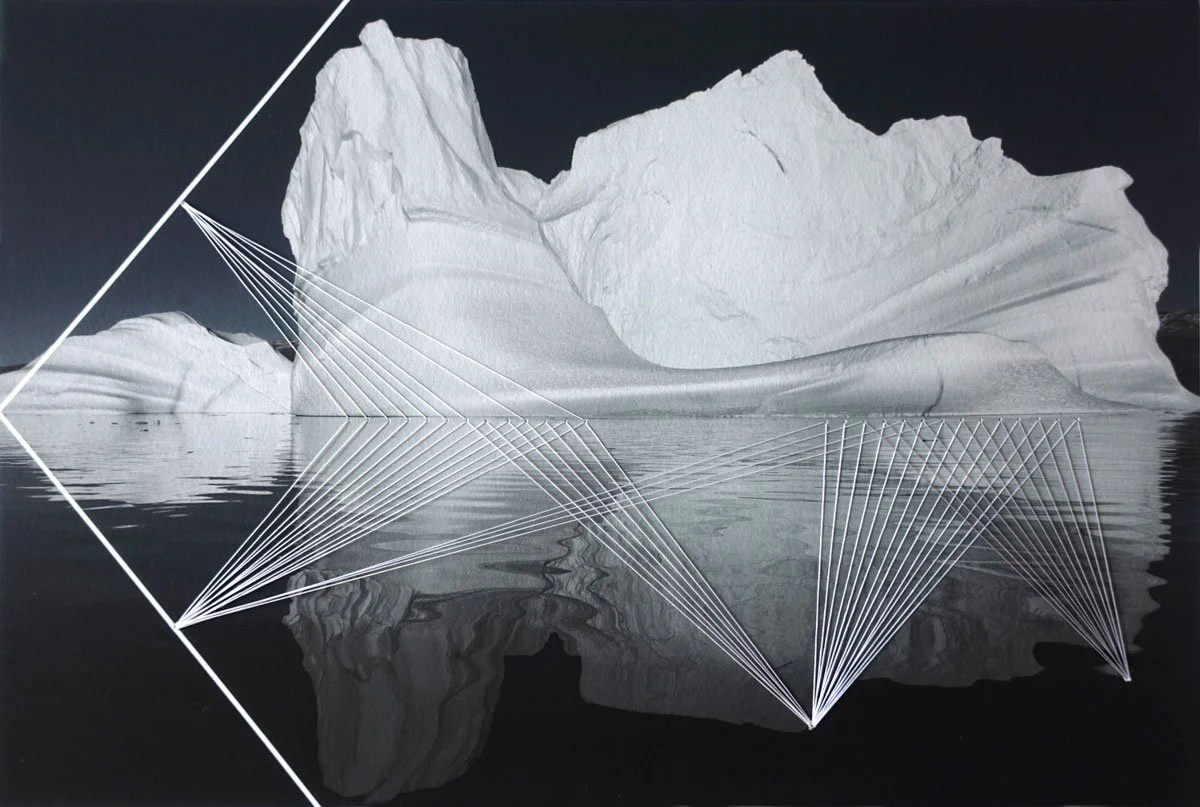
Adriene Hughes, Scoresbysund, Greenland #16, 2019, 8”x12” image | 11”x14” sheet | 14.5”x19.5” frame, Archival Pigment Print on Cotton Rag with Cotton Quilting Thread
ML: In Threaded Icebergs and your Greenland work, you connect the Arctic to reincarnation, ancestry, memory, and your own experience of being reborn after cancer. How do you understand the relationship between personal memory and the deep time of the geological landscape?
AH: Reincarnation, for me, is literal. It's a way of thinking about transformation: how our soul can end in one form and continue in another. When you are present in front of an iceberg or an arctic landscape, you are encountering something that predates your physical existence by an unimaginable amount. Your own life suddenly feels very small, but not necessarily insignificant. Instead, it becomes part of a much larger thread of life after life, knowing that you have come before and you will come again. After cancer, I became acutely aware of my own body as a place where time could be divided into a “before” and “after.” I am a breast cancer survivor of twenty-three years and I still think of my life, at times, divided by that experience. But the arctic was a rebirth of a proportional size. The geological landscape gave me a way to think about that experience without reducing it to a purely personal story. Ice is constantly changing, breaking apart, traveling, melting, and becoming something else. And so are we in our human state. Our bodies carry the evidence of enormous amounts of time within it, we are always in a state of continual motion just like nature.
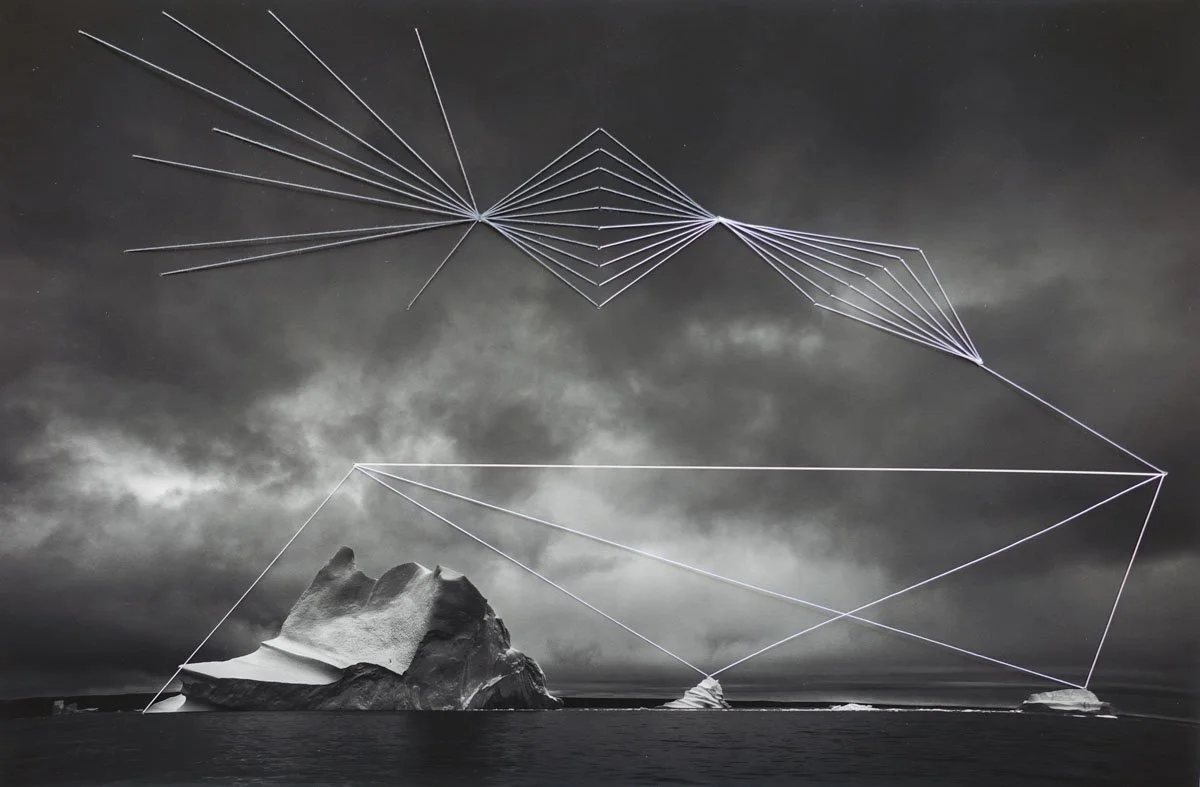
Adriene Hughes, Threaded Iceberg BW No. 2, 2019, 8”x12” image | 11”x14” sheet | 14.5”x19.5” frame, Archival Pigment Print on Cotton Rag with Cotton Quilting Thread
ML: You speak about the Arctic as a place you have felt connected to since childhood. Do you think that connection is primarily emotional, spiritual, ancestral? Or is it something else?
AH: The connection to the arctic feels emotional, but it has gradually become something more expansive—partly spiritual, partly intuitive, and very much connected to a memory that one cannot put their finger on.
It is true, since childhood I've had a strong sense that nordic environments felt familiar to me, even before I could have explained why. There was a feeling of recognition that didn't seem to come from knowledge of place. When I eventually encountered the arctic landscape in person, it felt less like discovering somewhere completely foreign and more like encountering something I had been carrying internally for a long time. It was an extremely moving time in my life.
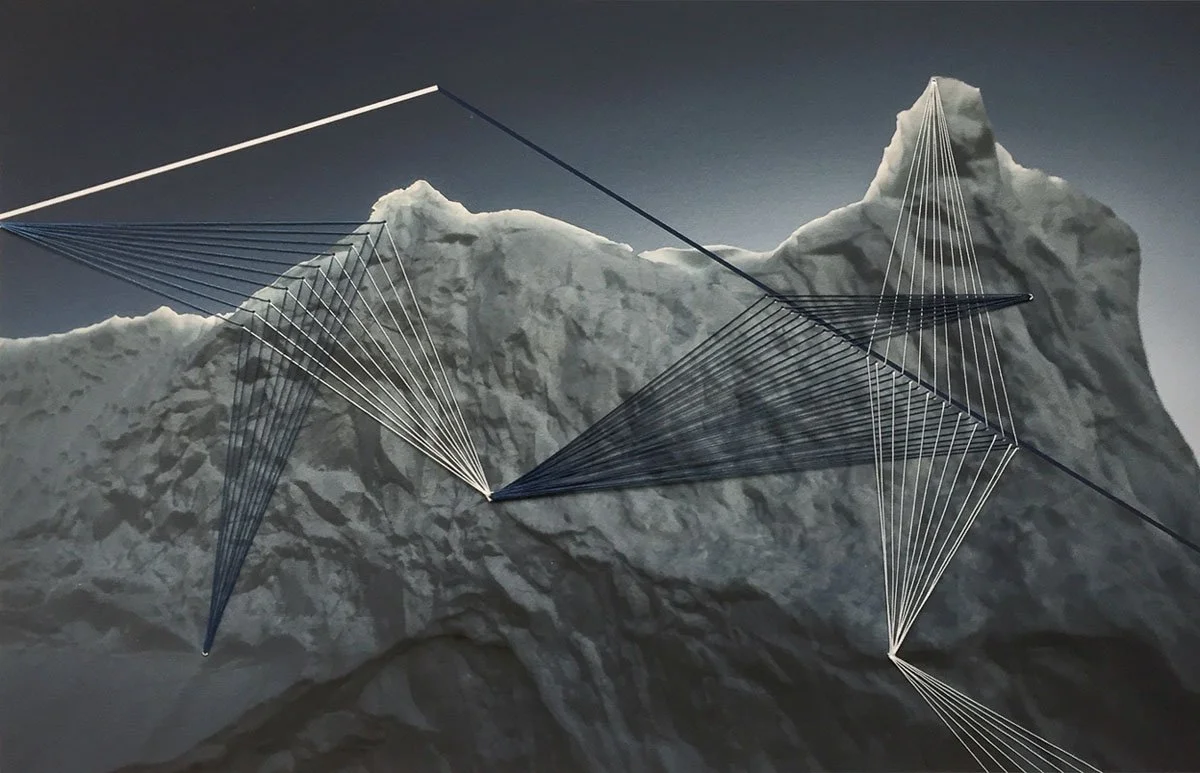
Adriene Hughes, Scoresbysund, Greenland #2, 2016-2017, 8”x12” image | 11”x14” sheet | 14.5”x19.5” frame, Archival Pigment Print on Cotton Rag with Cotton Quilting Thread
ML: Your Greenland work is both deeply contemplative and deeply urgent. How do you balance the sublime beauty of a threatened landscape with the responsibility to communicate the seriousness of climate change?
AH: I don't think beauty and urgency have to be opposites. In fact, I believe beauty is part of what makes the urgency possible. When we encounter something as extraordinary (such as the Greenland landscape) we can form an emotional relationship with it—and once we care about something, its vulnerability becomes much harder to ignore. I don't want beauty to become a way of avoiding the difficult truth of climate change. The poles are melting at extraordinary rates and I mourn over the loss of balance and beauty. Holding those two realities together is essential to the work.
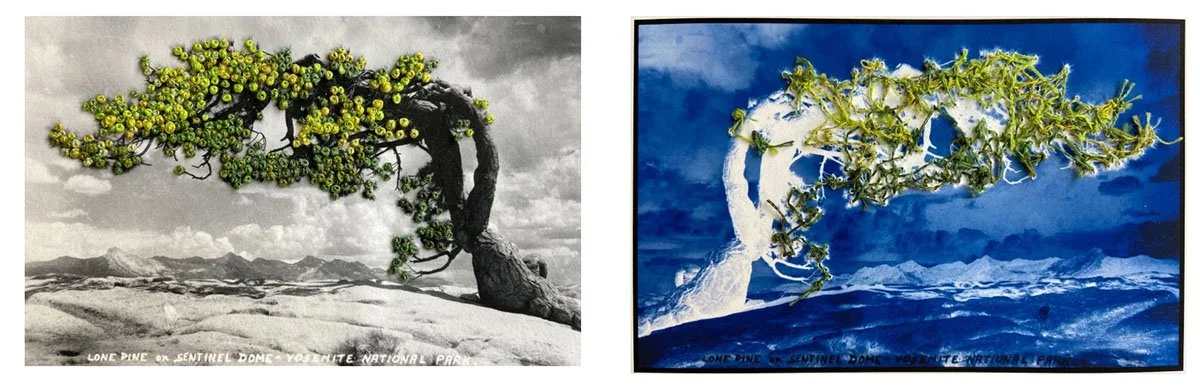
Adriene Hughes, Jeffrey Pine, Sentinel Dome, Yosemite National Park, Black and White, Image #2 / Front & Back images side by side, 3.3” x 5”, Hahnemuhle 100% Cotton Rag Paper, Cotton Floss Embroidery Thread
ML: In The Lone Sentinel, the fallen Jeffrey Pine becomes a kind of monument to environmental loss. What drew you to this particular tree, and what does a single dead tree allow you to say about climate change that statistics and scientific data cannot?
AH: The Jeffrey Pine had once been a living presence on Sentinel Dome. The tree had been lost to drought in 1977, and I was especially interested in the tree as a kind of witness to the drought in California. A single tree can carry an enormous amount of emotional information. You can look at its shape and imagine it alive; you can see the evidence of its death; and you can hold those two images in your mind at the same time. That tension between life and death became central to the work. The project uses vintage postcard imagery, printed on both sides and embroidered, so that even the physical object contains contrasting versions of the tree—positive and negative, presence and absence. Statistics are essential for understanding climate change, but they're abstract to many people. A number can tell us how much temperature has risen or how much habitat has been lost, but it doesn't necessarily give us a relationship with what that loss means. A single tree can do something different. It gives loss a sapce. It gives us something to mourn, remember, and imagine. We can recognize the tree as an individual rather than simply as one unit within a population.
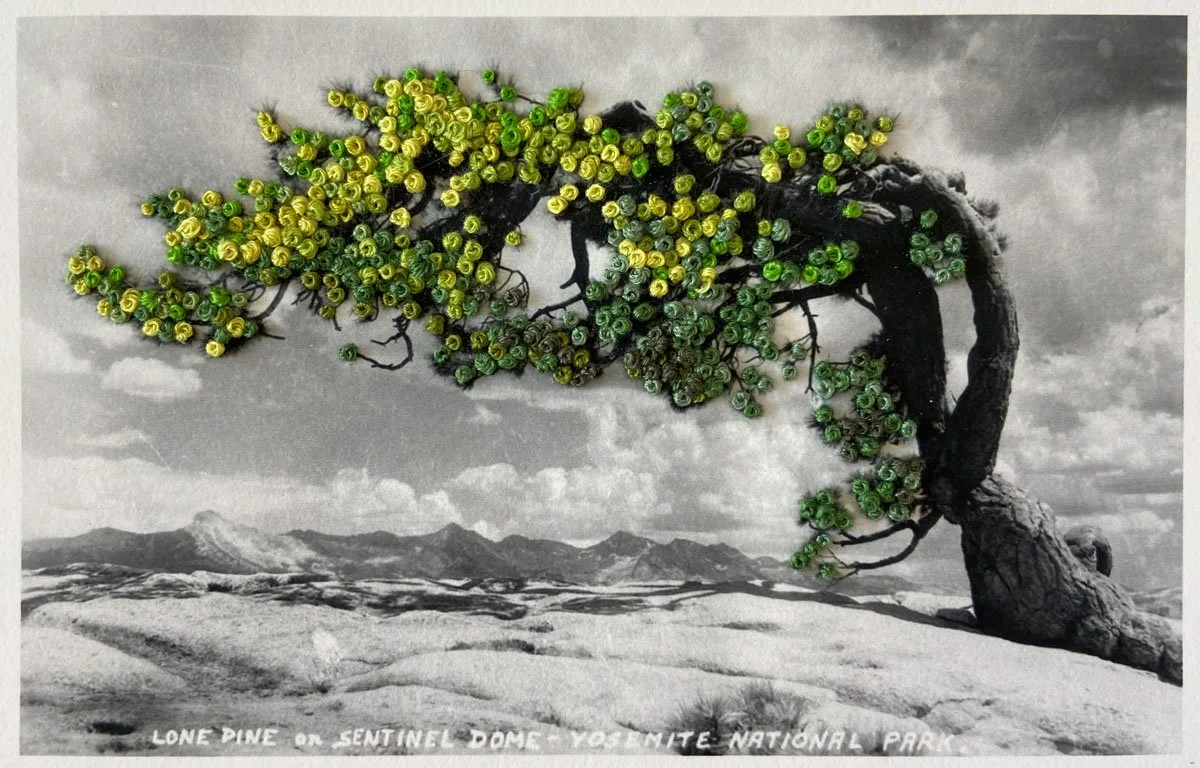
Adriene Hughes, Black and White, Image #2 / Front Jeffrey Pine, Sentinel Dome, Yosemite National Park, 3.3” x 5” Double Sided Image, Hahnemuhle 100% Cotton Rag Paper, Cotton Floss Embroidery Thread
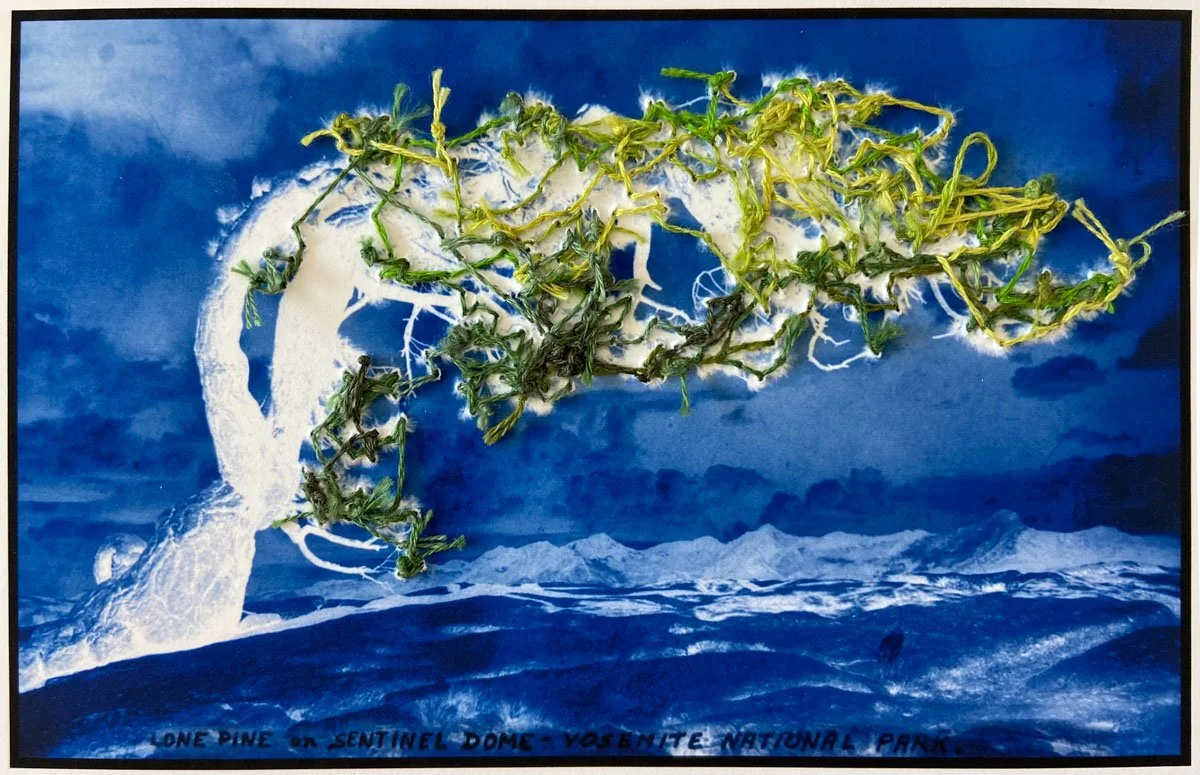
Adriene Hughes, Black and White, Image #2 / Reverse Orientation, Jeffrey Pine, Sentinel Dome, Yosemite National Park, 3.3” x 5” Double Sided Image, Hahnemuhle 100% Cotton Rag Paper, Cotton Floss Embroidery Thread
As a side note: a high school classmate became a park ranger in Yosemite. He told me a touching story how he would sleep at night under the Lone Sentinel - this was before it passed to climate change. He told me how much it meant to have that experience, and how he mourns the loss of that tree. I just wanted to share that even this one person holds dear the memory of this iconic sentinel.
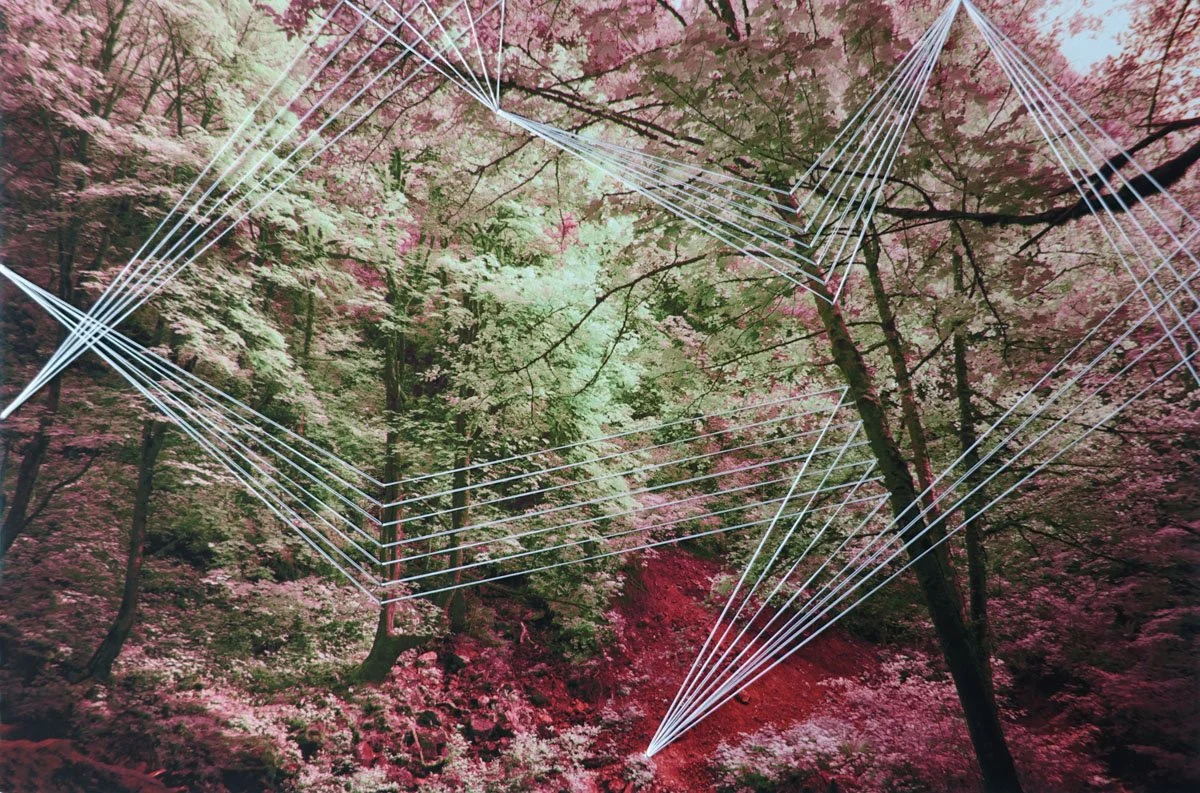
Adriene Hughes, Threaded Wildfire No. 3, 2019, 8”x12” image | 11”x14” sheet | 14.5”x19.5” frame, Archival Pigment Print on Cotton Rag with Cotton Quilting Thread
ML: Your California Desert work considers your own “backyard” as an environment shaped by drought, migration, erosion, and changing climate. How has working closer to home, or as Lucy Lippard calls it, The Lure of the Local, changed your understanding of what an endangered landscape looks like?
AH: Working closer to home has made me realize that an endangered landscape doesn't necessarily announce itself as endangered. We tend to imagine an environmental crisis as something distant—melting glaciers, dramatic fires, a dry riverbed. But when I began paying sustained attention to the California desert and to places in my own backyard, I started seeing vulnerability in much more obvious ways.
The local landscape carries evidence of drought and erosion, but it also carries layers of human history. You begin to notice how the landscape has been shaped not only by natural processes but by who has moved through it, who has settled there, what has been extracted from it, and what has been altered or left behind.
And I think that's ultimately what the Southern California environment has taught me: endangered landscapes are everywhere. Sometimes they're places we travel thousands of miles to witness, and sometimes they're the places outside our own doors. The challenge is learning to look closely enough to recognize what is changing before it becomes a headline—or a memory.
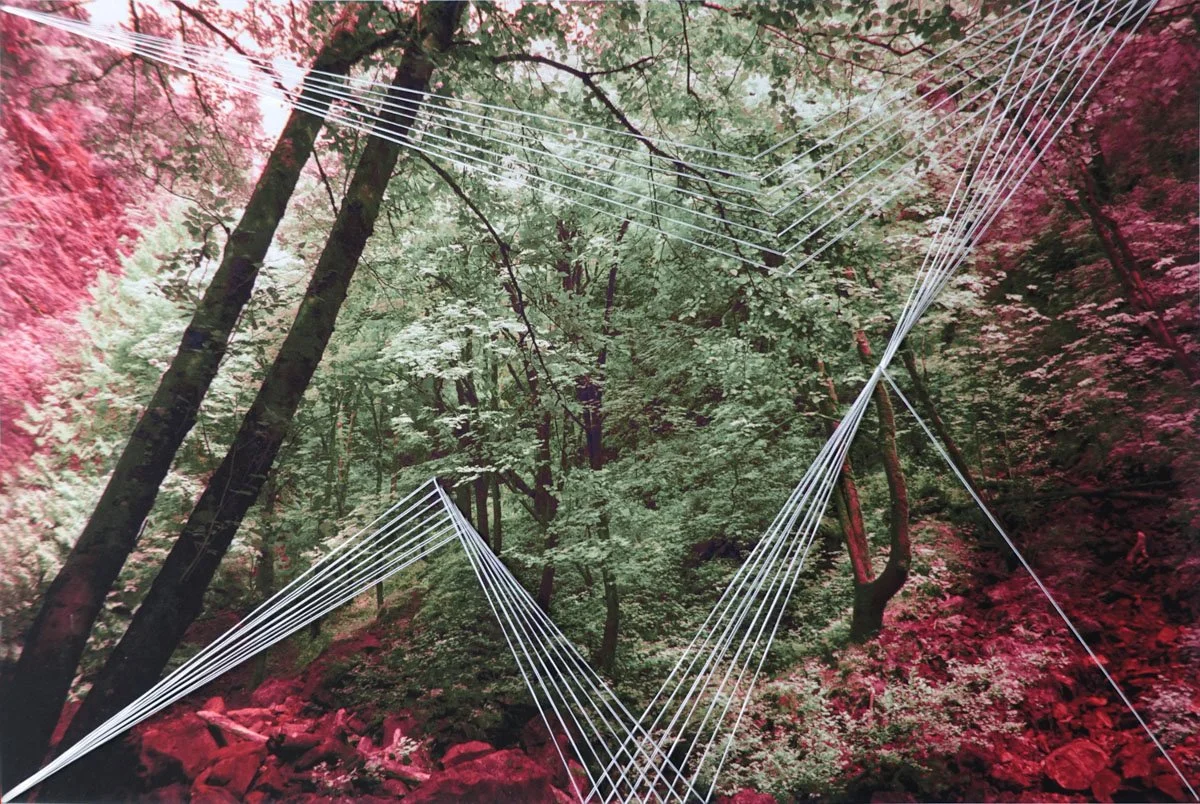
Adriene Hughes, Threaded Wildfire No. 5, 2019, 8”x12” image | 11”x14” sheet | 14.5”x19.5” frame, Archival Pigment Print on Cotton Rag with Cotton Quilting Thread
ML: You’ve said that scientific research is “paramount” while the visual occupies the role of documentary evidence. What role do you believe artists can play in conversations about climate change that scientists, journalists, or policymakers may not be able to play?
AH: I see the artist's role as a visual complement to science. Scientific research is paramount because it gives us the evidence and the knowledge of what is happening. My role isn't to replace that knowledge, but to create another way of visualizing it.
For me, photography can create an emotional relationship with something that might otherwise remain intellectually distant. A glacier, a dead tree, or a drought-stricken landscape becomes a particular place rather than an abstract statistic. And once we develop a relationship with a place, we may begin to think differently about our responsibility toward it.
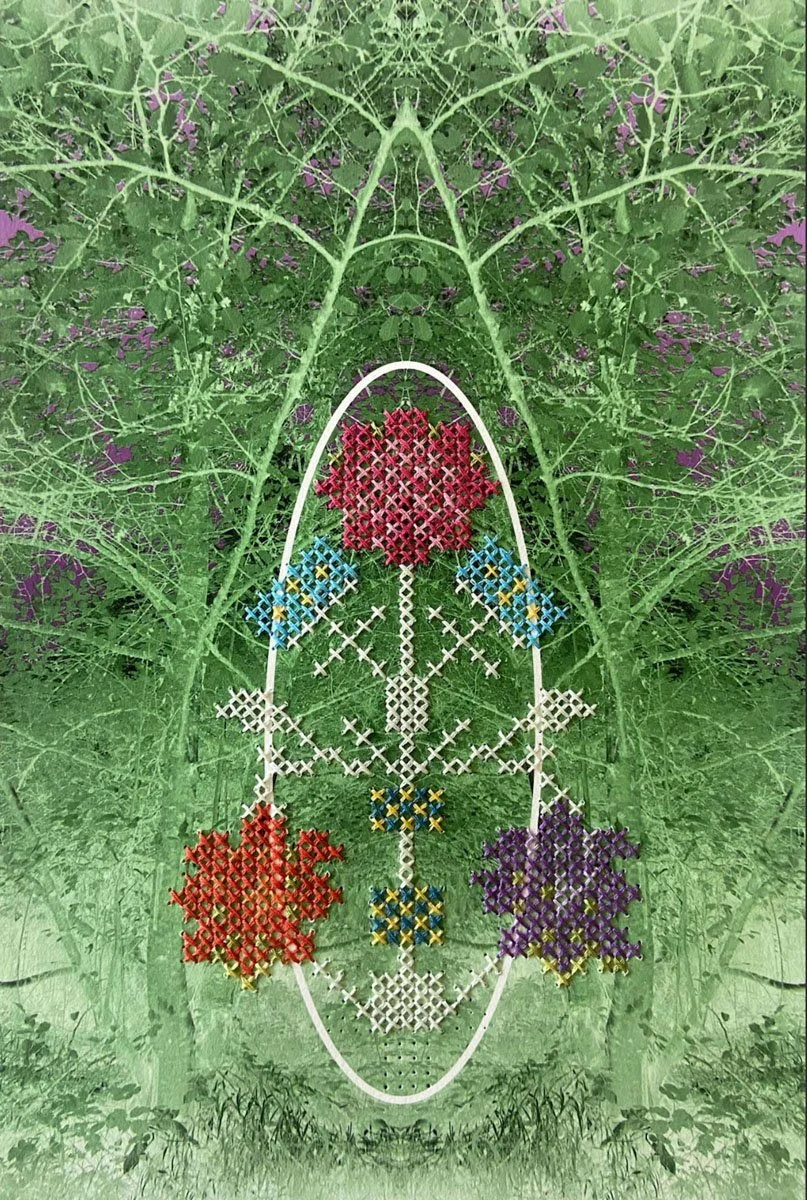
Adriene Hughes, Quantum Physics, No. 2, 2026, 8”x12” image | 11”x15” sheet, Archival Pigment Print on Cotton Rag with Cotton Floss Embroidery Thread
ML: What are you curious about right now? What are you reading, watching, listening to, or thinking about that is feeding your creative practice?
AH: I am currently reading LAND by Maggie O’Farrell.(1) It’s a haunting and lovely novel about a mystical experience with an ancient spring in a small grove of trees. What the book reminds me as an artist is that there is the mystery in the world everywhere around us, to live in the present and to allow magic to happen. I appreciate that the lesson is in the history of place, the land containing magic, and to realize we are here but for a moment.
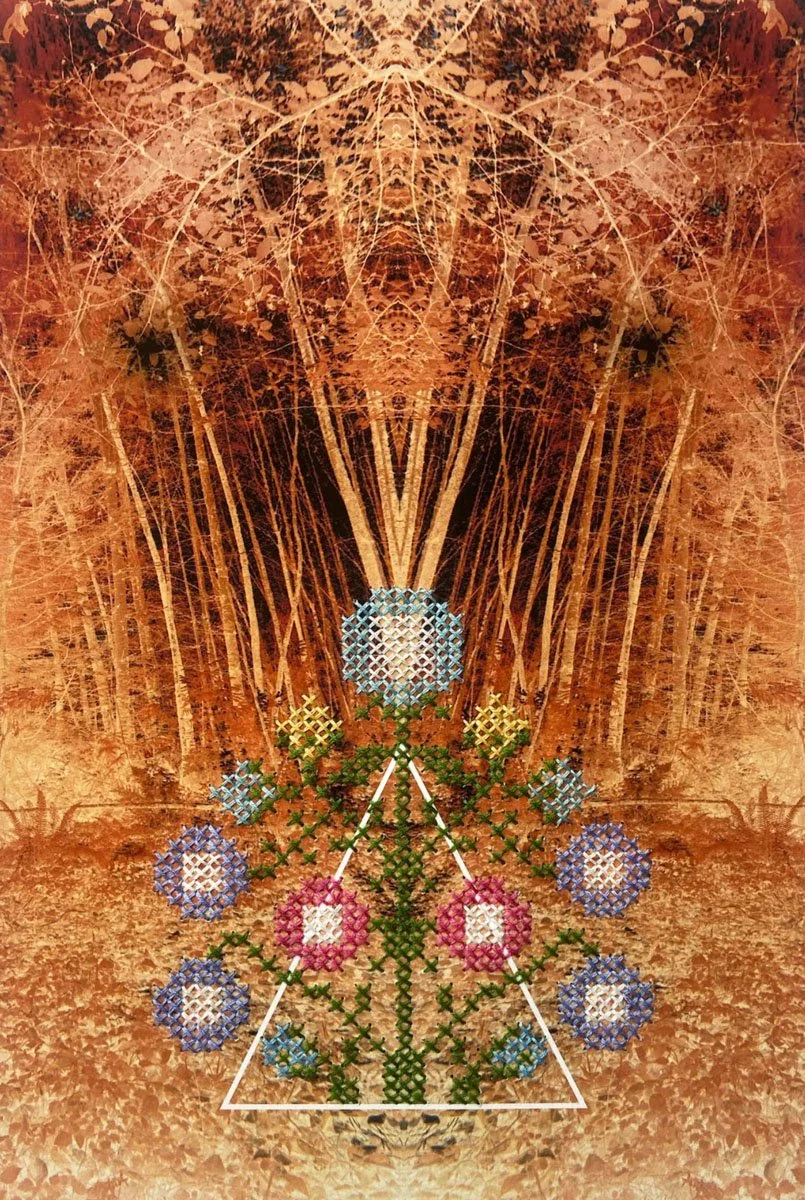
Adriene Hughes, Quantum Physics, No. 3, 2026 8”x12” image | 11”x15” sheet, Archival Pigment Print on Cotton Rag with Cotton Floss Embroidery Thread
ML: After working for years with landscapes that are changing or disappearing, what has this work taught you about hope? And what, if anything, do you think art can do to move people from witnessing environmental loss toward action?
AH: Hope isn't the same thing as optimism. Optimism can suggest that everything will ultimately be okay. The landscapes I've spent time with (and live within) does not allow me that kind of certainty. Ice melts, forests change, species disappear, and some losses cannot be reversed. Hope, for me, is something more active. It's the decision to remain attentive and engaged even when you understand that you can't control the outcome. The landscape I live in, and the landscapes I have experienced, have taught me that change is inevitable, but that doesn't mean our choices to engage in art concerning climate change end up meaningless.
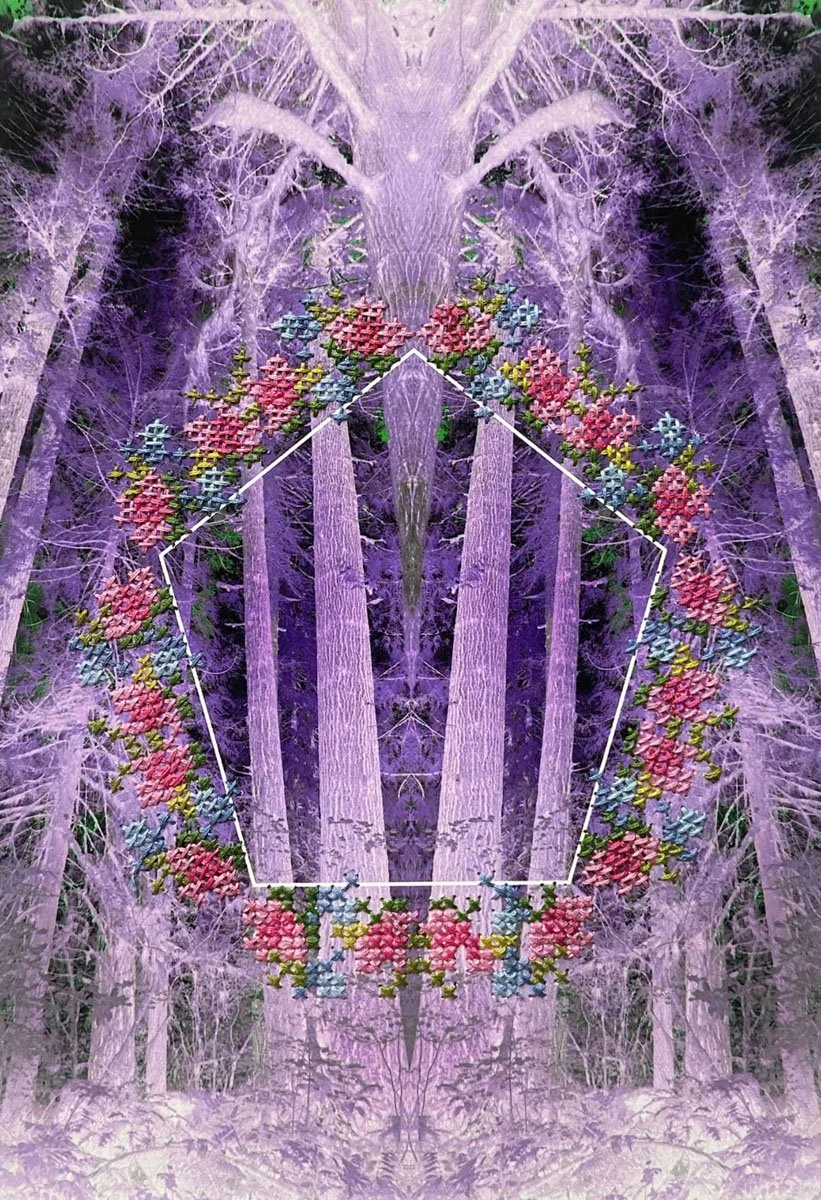
Adriene Hughes, Quantum Physics, No. 1, 2026, 8”x12” image | 11”x15” sheet, Archival Pigment Print on Cotton Rag with Cotton Floss Embroidery Thread
ML: Is there anything else you would like to share?
AH: I am currently working on a project concerning "forest energy" and the embroidered replication of the "tree of life" as seen in historical works created by women as part of their spiritual upbringing. It often represents the interconnectedness of all living things, the cycle of life, death, and rebirth. The fact that women frequently created embroidered tree structures speaks to its deep cultural significance and its role in spiritual education and practice.
The shapes of Platonic solids incorporated into these images are seen as portals into the magic of the forest. Plato believed Platonic solids were the fundamental building blocks of the universe; in sacred geometry, these shapes are viewed as blueprints of creation and are believed to contain the underlying patterns of the natural world. The intersection between forest energy, the precise embroidery of the Tree of Life, and Plato’s understanding of the universe is intriguing and something I am deeply interested in pursuing.
Maggie O’Farrell, Land (New York: Alfred A. Knopf, 2026).