
DM Witman
DM Witman is a transdisciplinary artist whose practice moves through the urgencies of the polycrisis with rigor, imagination, and care. Working across expanded photographic processes, video, objects, and installation, she explores climate disruption at the intersections of presence and absence - balancing archival impulse with ephemerality. Her work functions as witness and memorial, synthesizing what feels existentially immediate: a lament for what has been lost and a call to cultivate stewardship for what remains. Witman’s work has been exhibited in over 120 solo and group exhibitions nationally and internationally, and she has been awarded residencies at Ellis-Beauregard Foundation (Maine), Monson Arts (Maine), and How to Flatten A Mountain (Ireland). She is the recipient of grants from the Maine Arts Commission, The Kindling Fund and Warhol Foundation, The John Anson Kittredge Fund, and the Puffin Foundation. Her work is held in the permanent collections of the Museum of Fine Arts, Houston; the Portland Museum of Art (Maine); and CICA Museum (Korea), among others, and she is affiliated with photo-eye Gallery (New Mexico) and the Maine Museum of Photographic Arts (Maine). Witman holds an MFA from Maine Media College and a BS in Environmental Science from Kutztown University.
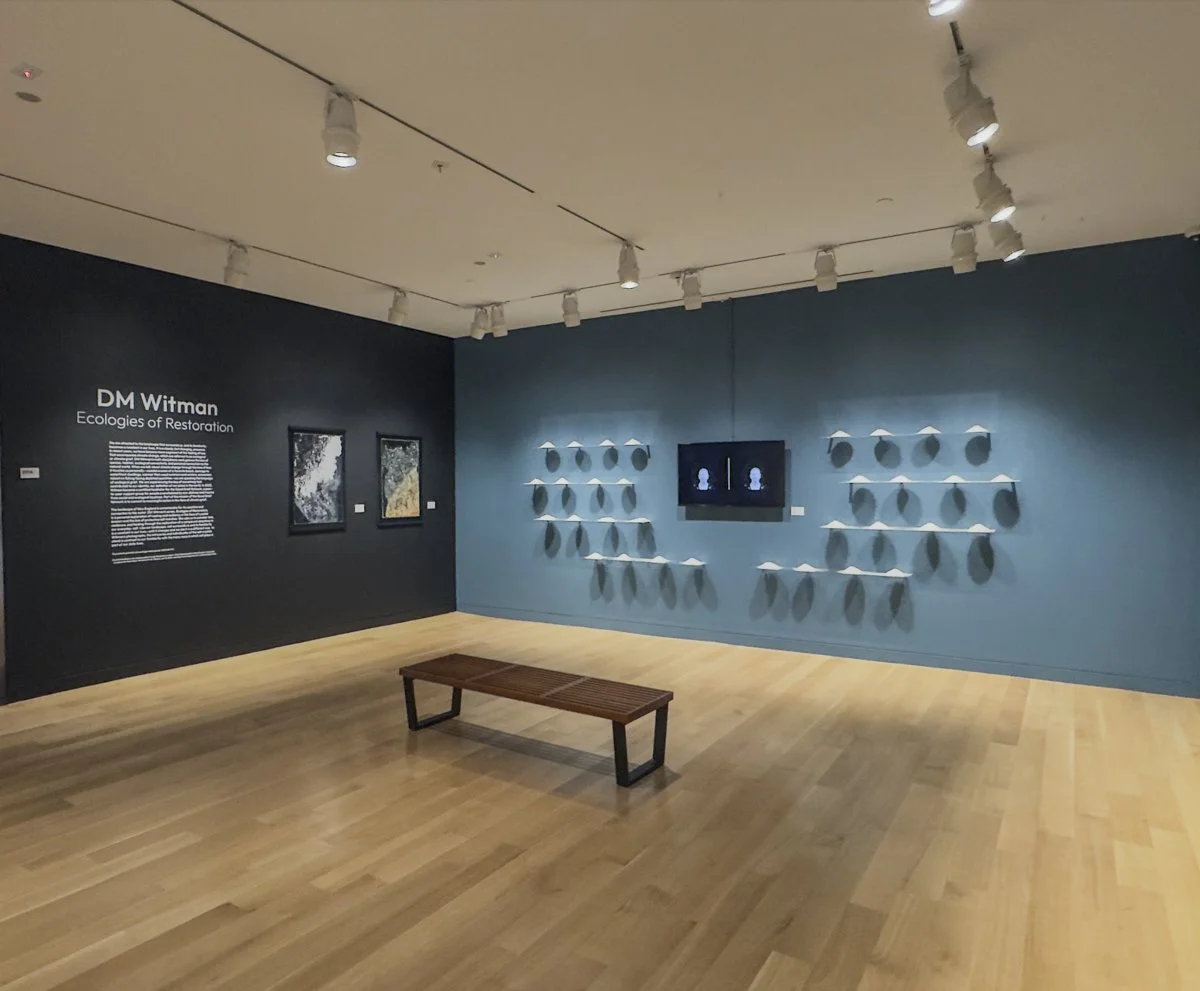
Installation View, Ecologies of Restoration by DM Witman, Danforth Art Museum, 2024
Margaret LeJeune: I first learned of DM Witman’s work when I was invited to curate an exhibition titled Agency for Broto: Art-Climate-Science’s 2021 conference, a project of the Cape Cod Center for Sustainability. The questions which drove my curatorial process included “what exists at the intersection of empowerment, the climate crisis, and radical empathy? what does agency look like in a post-human world? and, can it be ascribed to non-human species, rivers and/or ecosystems?” Witman’s video work Witness, which was included in the exhibition, addresses environmental disruption and humanity’s role in global degradation. In this work, a nude figure is seen perched atop a block of ice that changes color through the duration of the piece as the sounds of a reverberating boat engine and cracking ice intensifies. Next to the figure, a video of waves crashing ashore within a sterile oval frame suggests nature as compartmentalized artifice. This work can be viewed here.
Since then, I have followed Witman’s work closely. In 2023, I invited her to have a solo exhibition, Solastalgia Times, at the Red Door Gallery at Bradley University. And in 2024 we began to share space more regularly as we worked together as members of the Board of Directors for the Society for Photographic Education. The conversation below reflects my curiosity to learn more about DM’s motivations and processes in her work on environmental grief and ecological shifts.
ML: Thank you for taking the time to speak with me about your creative practice for the GroundTruth archive. One of the most compelling things about your work is how it visualizes grief, healing, and ecological loss. When did you first recognize mourning as an ecological condition rather than only a personal one?
DM: I first felt it when I worked as a field environmental scientist, it was by experience. The field work I conducted was for baseline studies and permitting for infrastructure projects. This was in my early 20s. Quite quickly I became acutely aware of change, destruction, transformation of the natural and semi-natural spaces. I didn’t have a name for it, but it was very real and at times incredibly intense. It wasn’t until many years later that I became aware that it could be more than my singular experience, that eco-distress and mourning is really an existential issue. This was shortly after working on the series “Melt”.
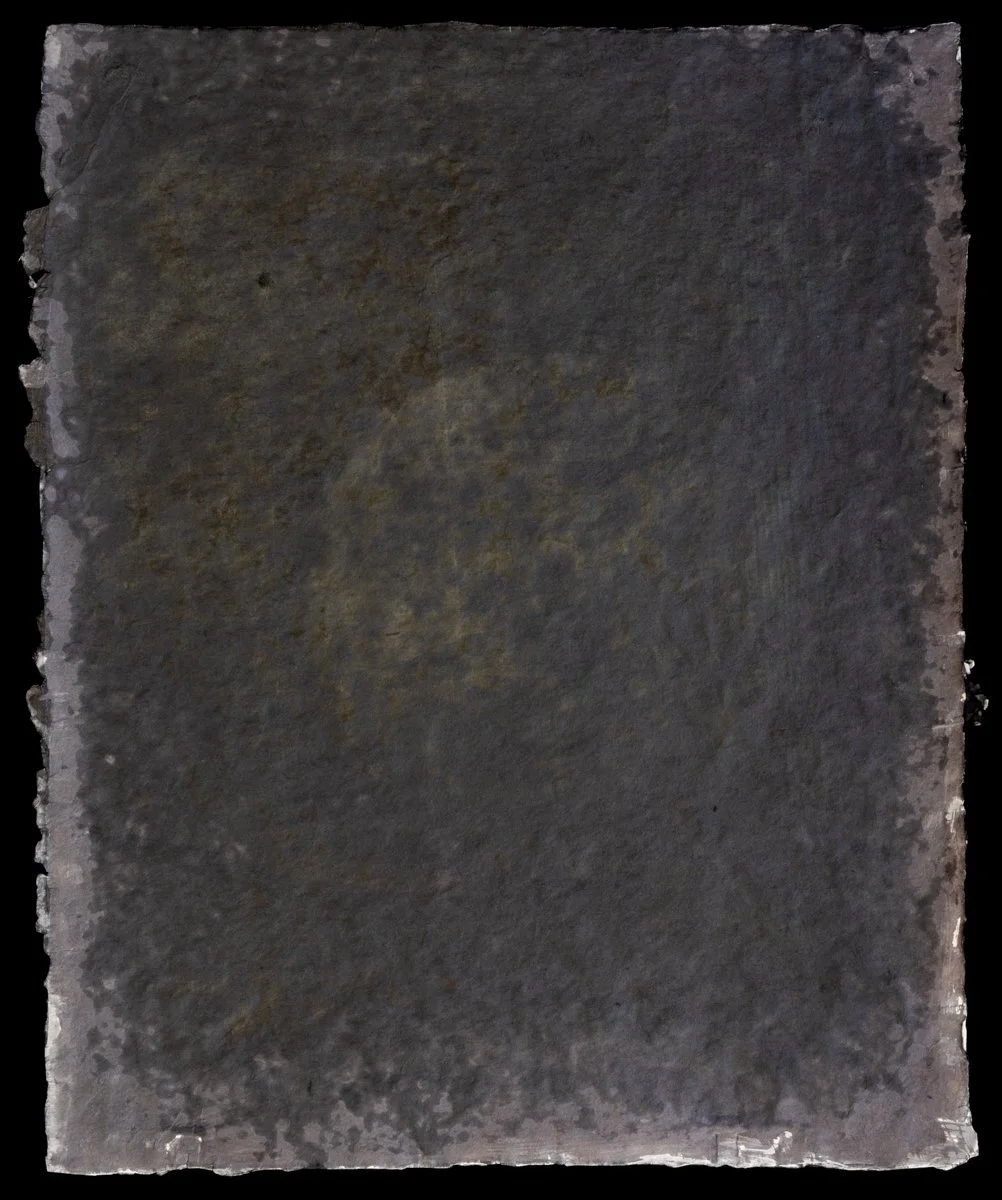
DM Witman, eom no. 1 from the series Ecologies of Mourning, 2023-24, 18 x 15”, unique gold-toned salted-paper on handmade abaca
ML: In Ecologies of Mourning, you describe grief and healing as non-linear and liminal. How does photography, particularly process-based and material experimentation, allow you to hold that ambiguity?
“I have learned a great deal about loss and mourning, through experience and research. There are a number of psychological and social models which provide for an understanding of how humans process and experience loss–in each there is the element of time. And how this unfolds over time is unique to each of us. ”
DM: I have learned a great deal about loss and mourning, through experience and research. There are a number of psychological and social models which provide for an understanding of how humans process and experience loss–in each there is the element of time. And how this unfolds over time is unique to each of us. When I work with materials, photographic or not, time is an essential component. Allowing materials to respond and unfold, is directly tied to the idea and/or experience at hand. Life is ambiguous, it is change over time, it is dynamic, as are our bodies and everything else (mostly)around us. This liminal place of working, allows me to consciously sit in this space of ambiguity and attempt to understand.
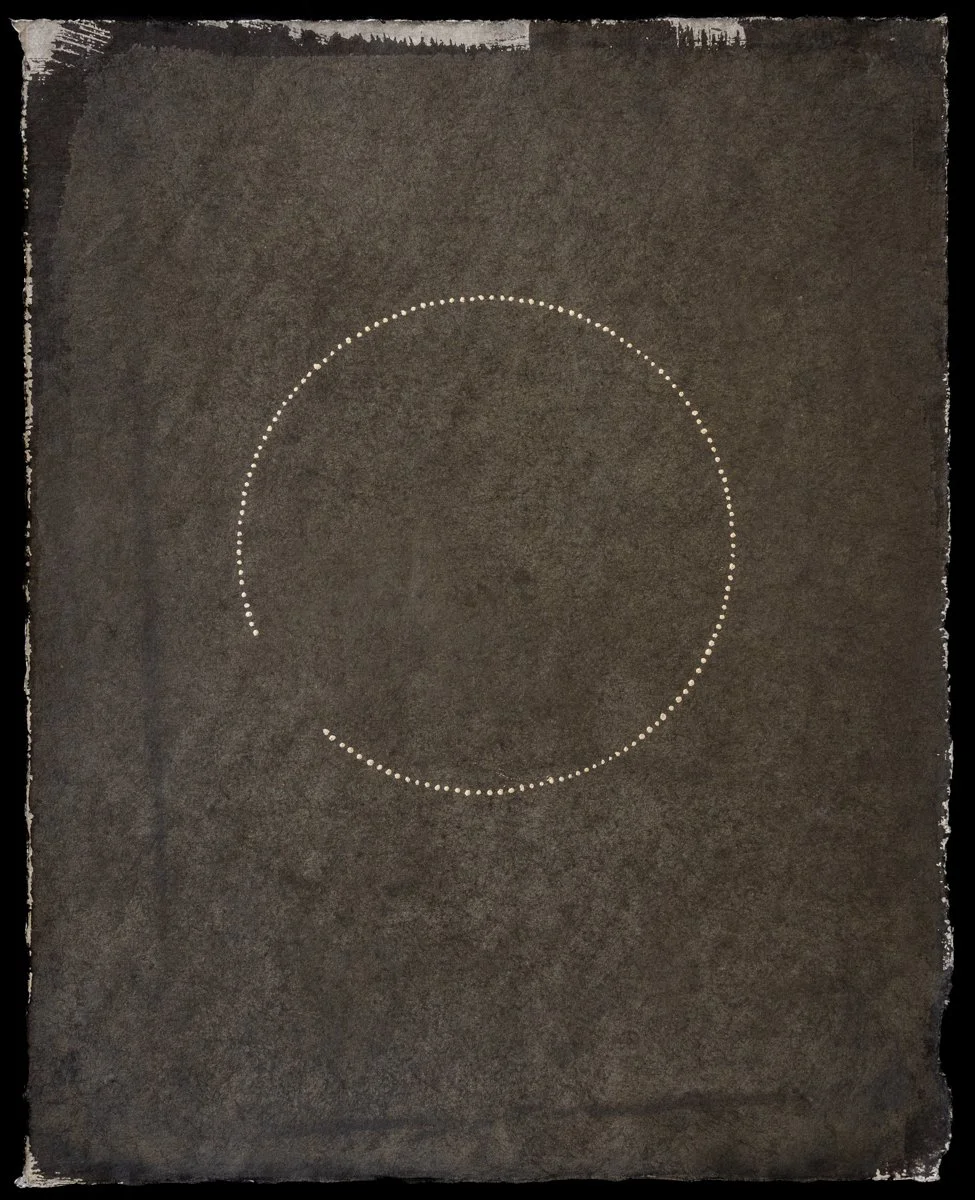
DM Witman, eom no. 25 from the series Ecologies of Mourning, 2023-24, unique gold-toned salted-paper on kozo with 23k gold leaf
ML: Salt appears repeatedly in Ecologies of Mourning and Ecologies of Restoration. What drew you to salt as both a material and a metaphor for loss, resilience, and transformation?
DM: There are likely tens of thousands of possibilities of salts that can exist. Mostly when we reference “salt”, the default is table salt or sodium chloride. That same compound, sodium chloride is found in the human body, at roughly 0.4% of our body weight. Salt is found in our bodies, in the land and water, and even air. Salt is everywhere. Humans have used salt for survival, ritual, religious practices, and medicine, etc. I had been working with the salted-paper photographic process quite a bit over the years, and the metaphor, the possibilities became an outgrowth of that work, I suppose. I would weigh out the salt and admire the piles on the scale and consider its ubiquity, and it’s omni-presence. We need salt to live, to build and sustain our bodies as well as much of life, and yet too much can be fatal. It’s an interesting substance filled with possibilities to regrow, to build, to preserve, to decompose. As I was exploring various properties of salt, the characteristic of it being able to “grow”, to form new crystalline structures and become something more than its simple compound resonated with me.
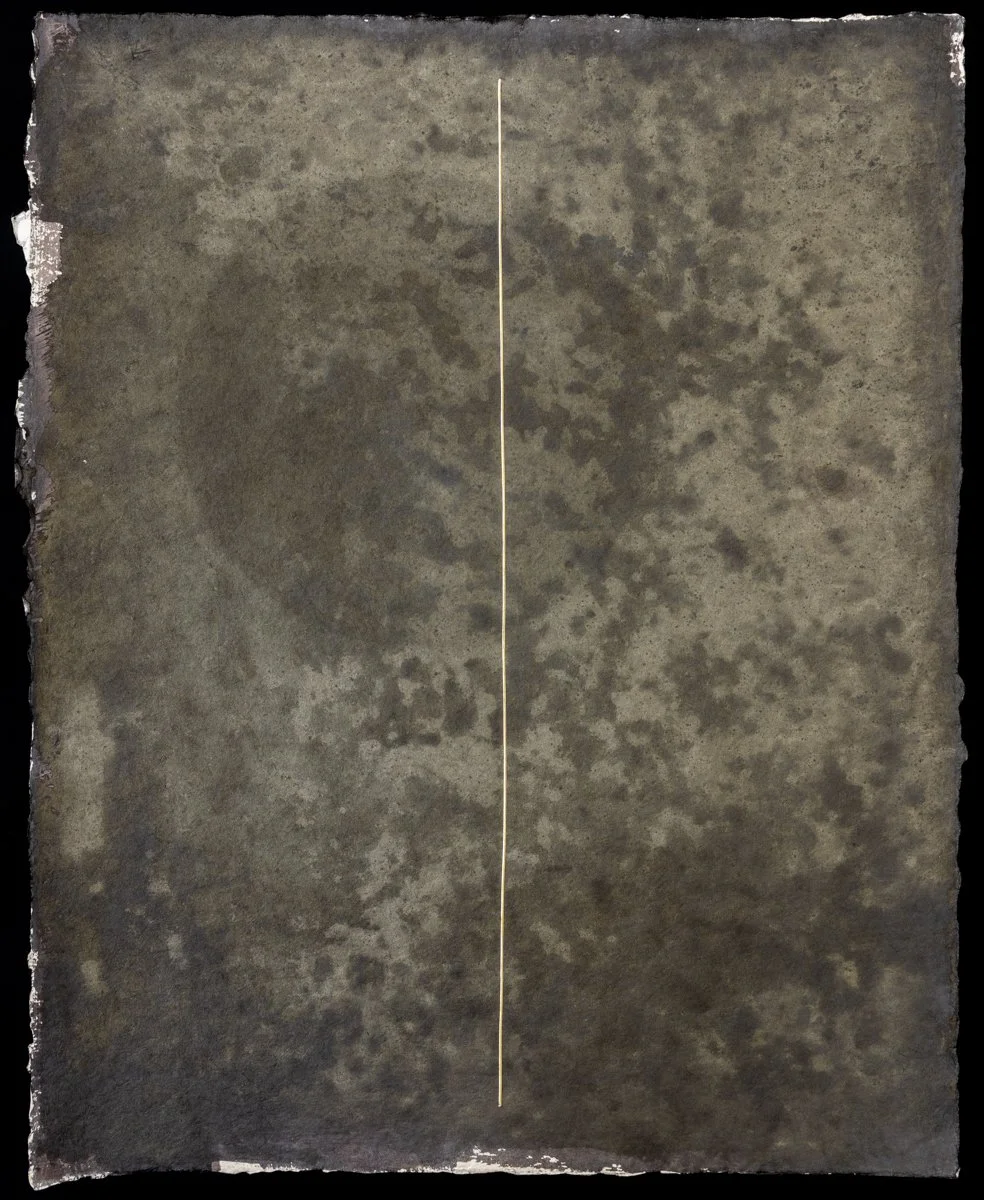
DM Witman, eom no. 45 from the series Ecologies of Mourning, 2023-24, unique gold-toned salted-paper on handmade abaca with vintage gold metal thread
ML: You work with handmade papers, silver, and metal threads, materials with their own histories and vulnerabilities. How do material choices function as collaborators in your practice rather than neutral tools?
DM: I do consider materials carefully, sometimes at the beginning of the idea, and other times, their importance and implications emerge as I am working. Much of the possibility of the work comes from the possibilities of the material itself. As I become more familiar with the material, I can understand the limitations and possibilities. I enjoy the process in this way as a collaborator, or even consider myself as a facilitator at times.
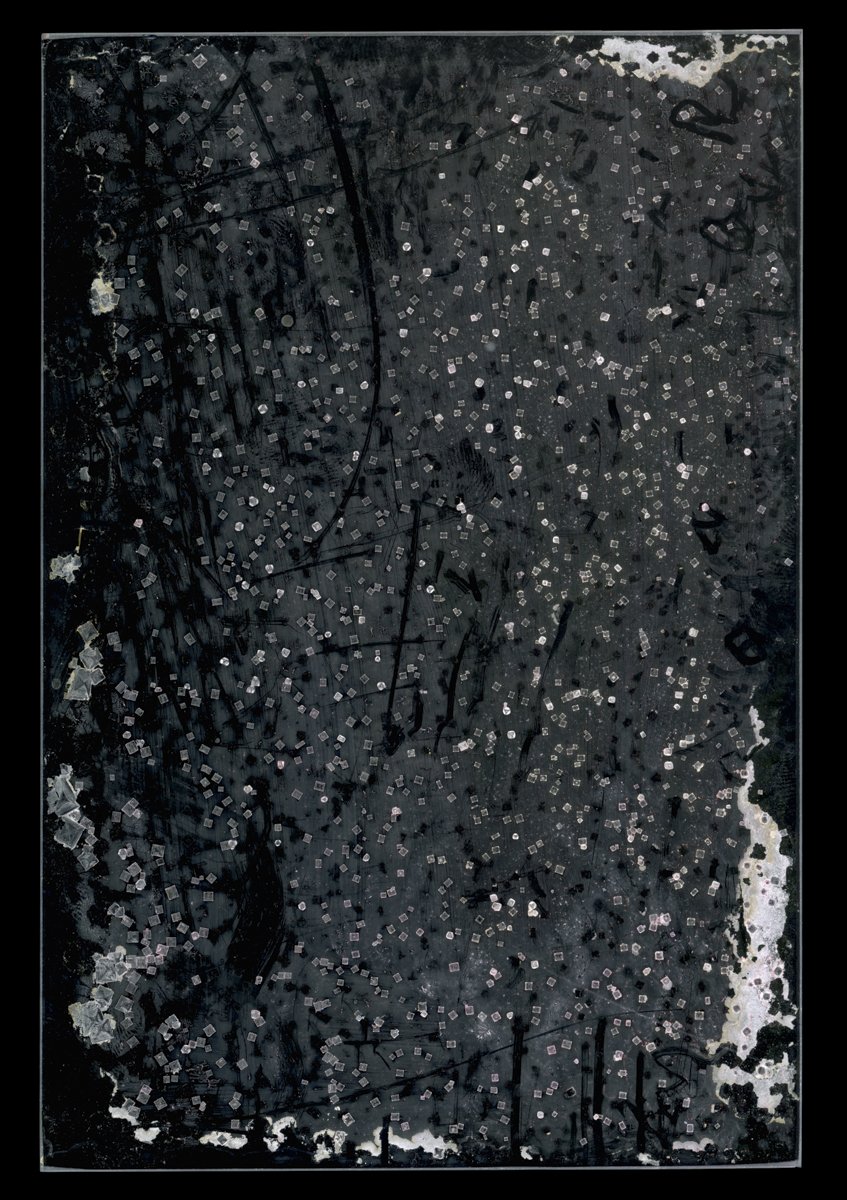
DM Witman, eor no. 14 from the series Ecologies of Restoration, 2023-24, hand-cultured salt crystals
ML: Ecologies of Restoration positions healing as a counterpoint to grief. Do you see restoration as something that returns us to a prior state or as something that requires permanent change?
“There was a time when I saw the restoration work as a “counter” to grief, but with time I have come to understand it as a “companion” to loss. ”
DM: There was a time when I saw the restoration work as a “counter” to grief, but with time I have come to understand it as a “companion” to loss. There have been times when I have desperately wanted to be on some magical “other side” of loss, but that isn’t how I understand and experience grief processes. These are two sides of the same coin–both exist, both are valid natural experiences. When I used the term “restoration”, I was mostly considering the human experience, about a return to some state of being in the world which didn’t require the constant examination of loss.
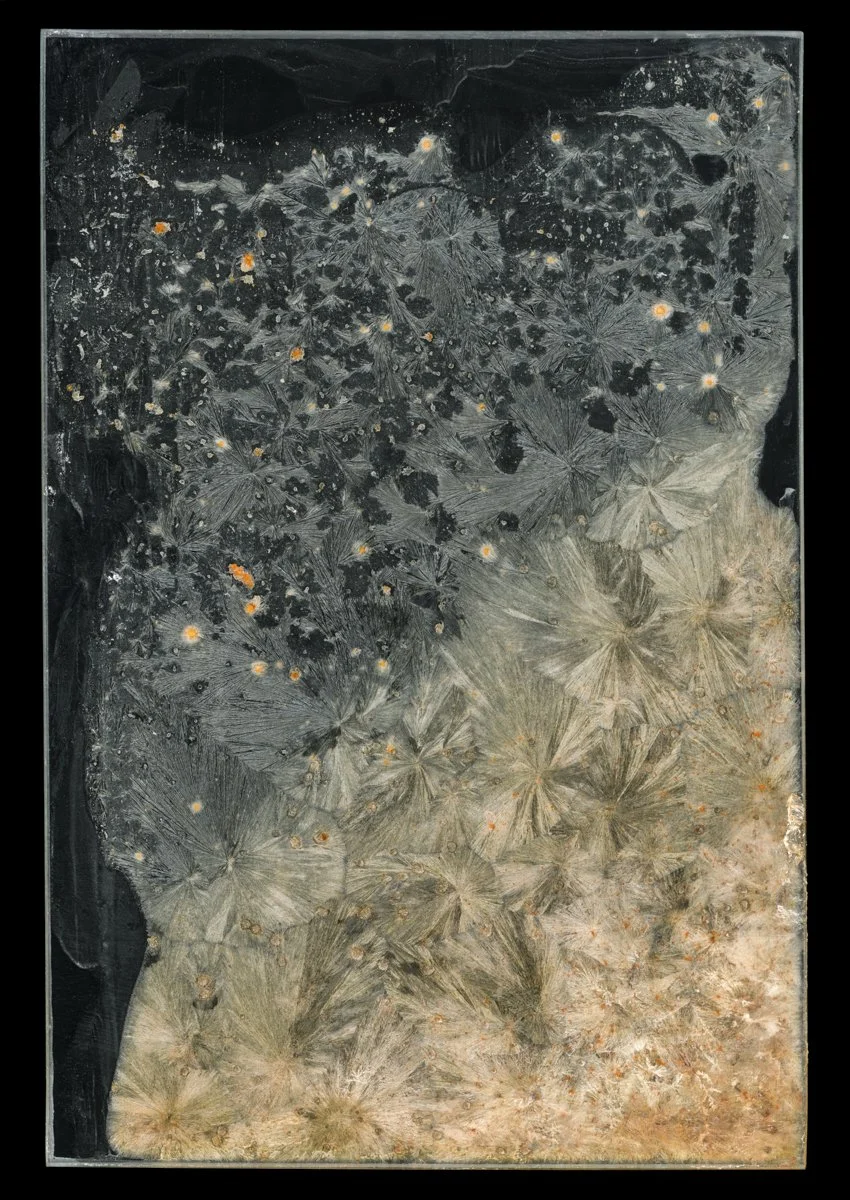
DM Witman, eor no. 23 from the series Ecologies of Restoration, 2023-24, hand-cultured salt crystals
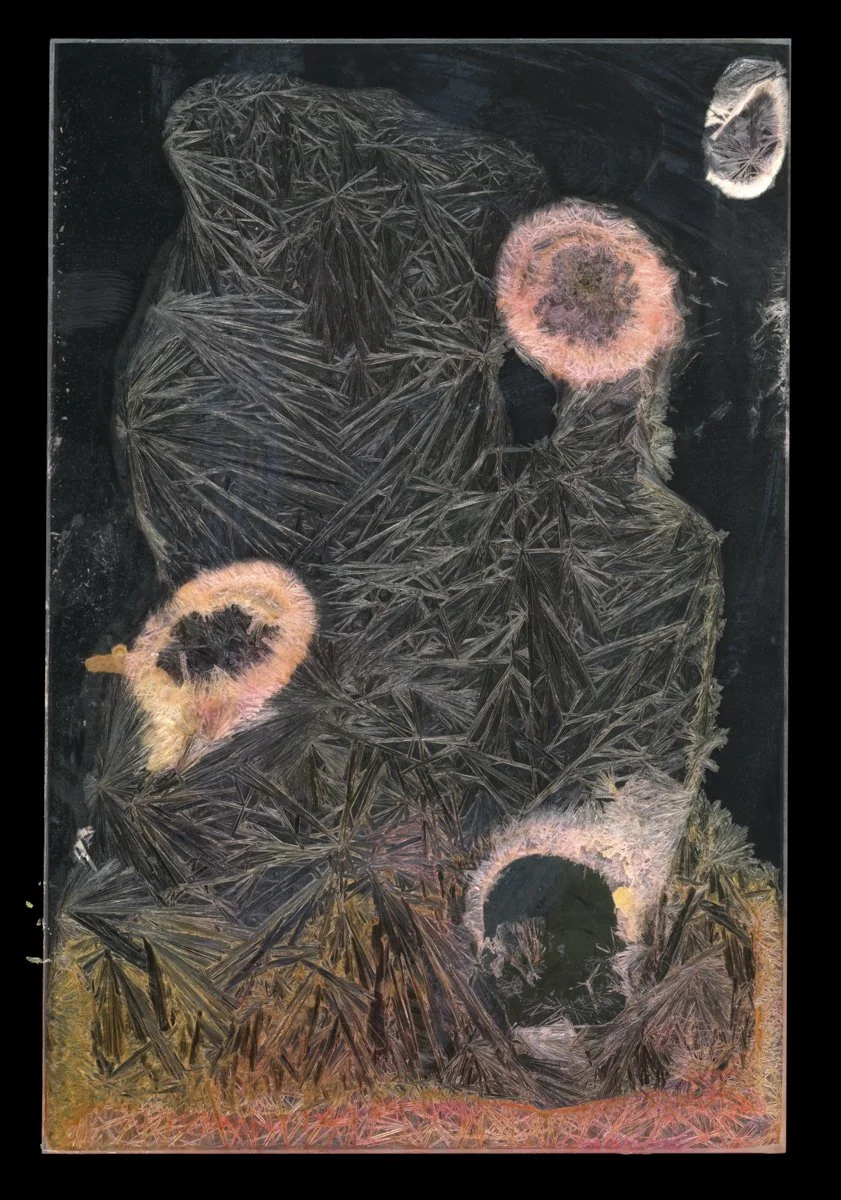
DM Witman, eor no. 25 from the series Ecologies of Restoration, 2023-24, hand-cultured salt crystals
ML: Icebergs in Arctic Elegies are presented as both monumental and already gone. How do you negotiate beauty and disappearance without aestheticizing loss?
DM: A central concern of my creative practice is the exploration of presence/absence, and often this work involves ephemerality–of materials, of states of being, of the actual image. These aspects are existential in nature and are essential to me, my consideration of life, the interrogation. I’m not sure how I exactly navigate this, but just to note that I hope I do. I hope the work isn’t aestheticizing loss.
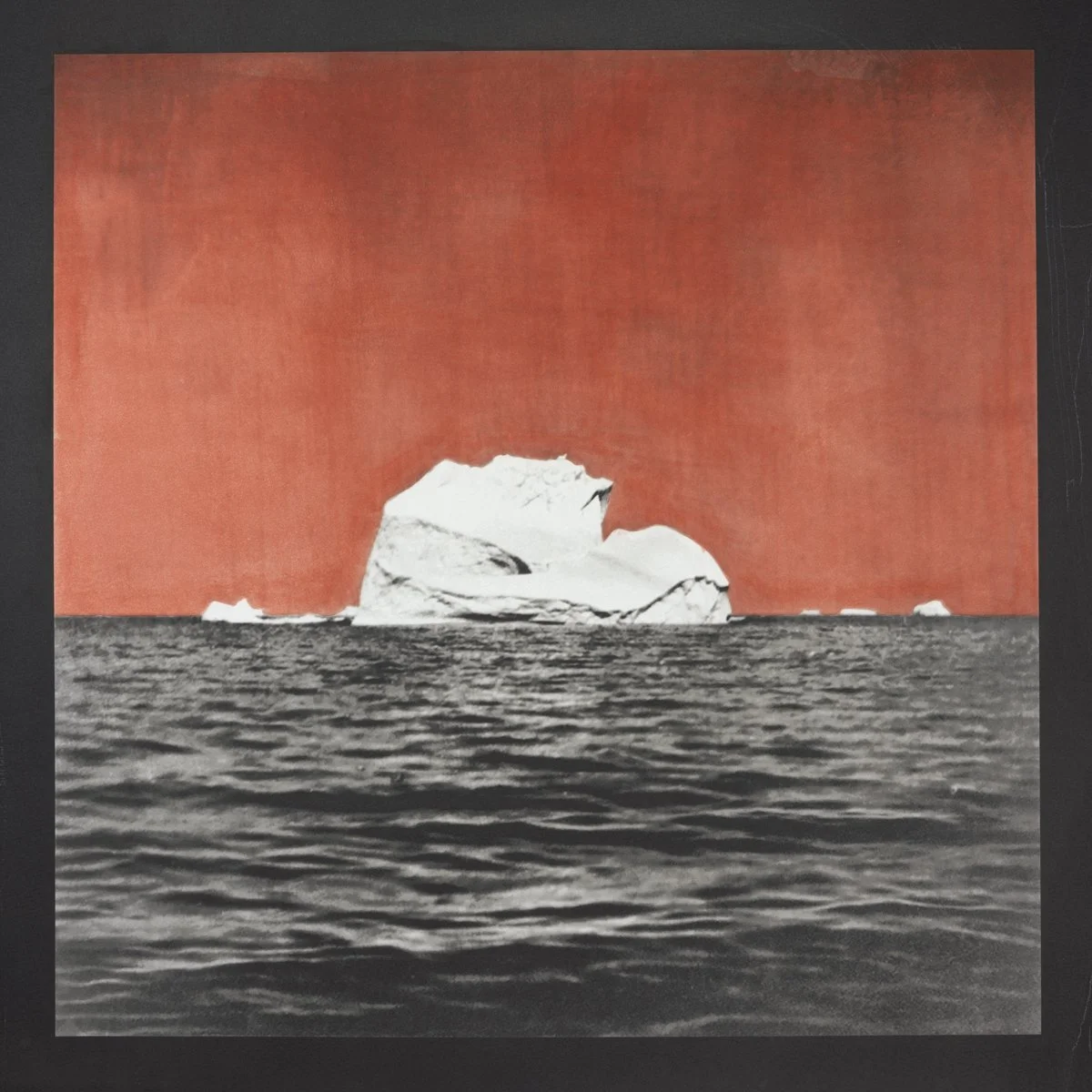
DM Witman, Elegy I from the series Arctic Elegy, 2019, gold-toned salted-paper photography & gum-bichromate with gouache
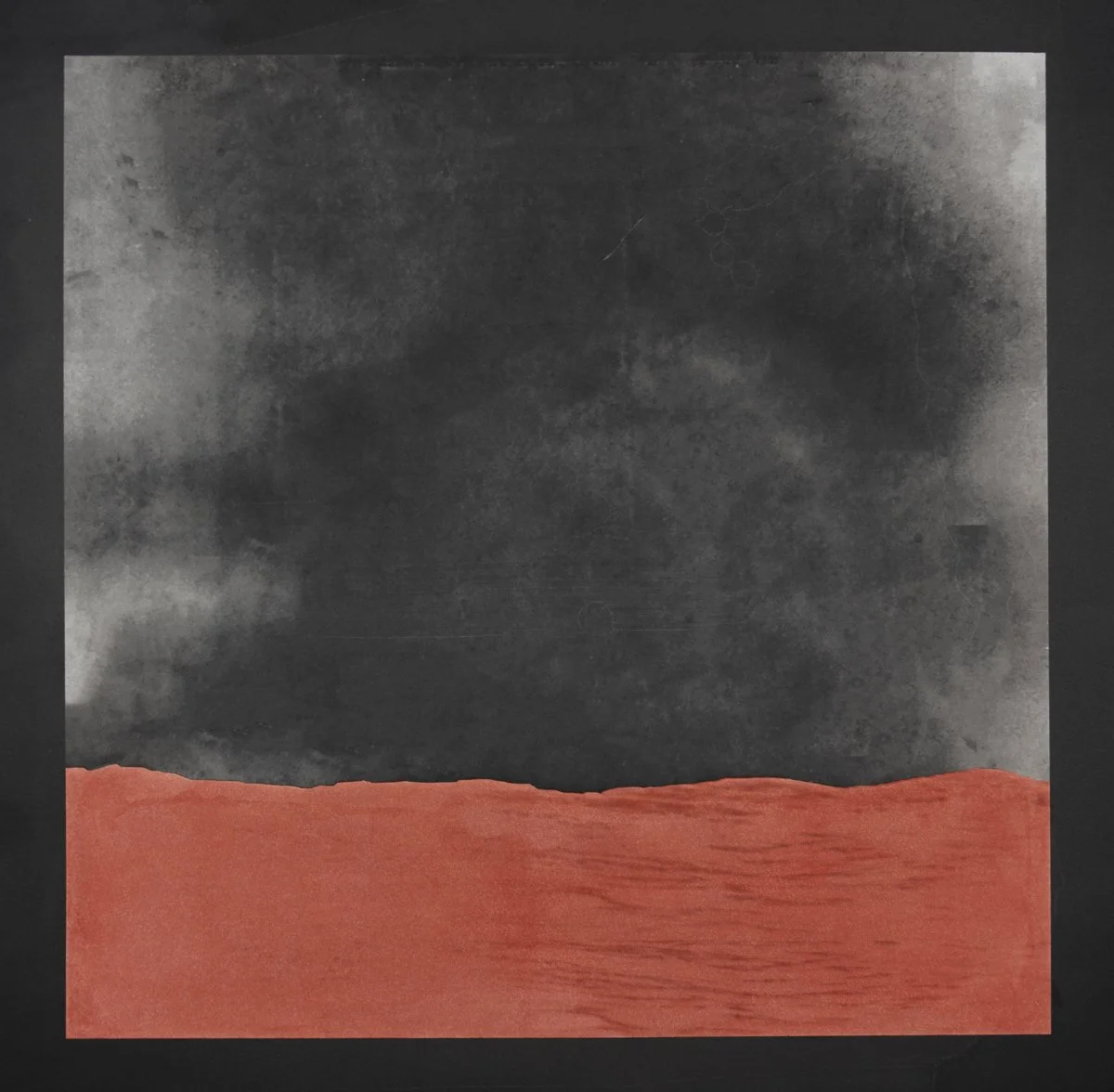
DM Witman, Elegy II from the series Arctic Elegy, 2019, 19 x 19”, gold-toned salted-paper photography & gum-bichromate with gouache
ML: Your background as a field biologist is central to your series Index. How has scientific training shaped the way you observe, classify, and memorialize ecological systems?
“Understanding the relationship of one thing to another, understanding systems–this is what ecology is about–relationships, connectedness, one change affects something else, nothing is isolated. As an artist, I can parse, synthesize, or aggregate from my lived experience and previous training to create something new.”
DM: I love science. Science provided me with the tools to refine my skills as an observer, taught me process and methodology. These skills transfer quite well to other areas of our human life–that of discovery, making, inventing, and communicating. Memorialization comes from understanding. In order to honor or preserve something or someone, we have to know about it, understand it, be able to describe it. Understanding the relationship of one thing to another, understanding systems–this is what ecology is about–relationships, connectedness, one change affects something else, nothing is isolated. As an artist, I can parse, synthesize, or aggregate from my lived experience and previous training to create something new.
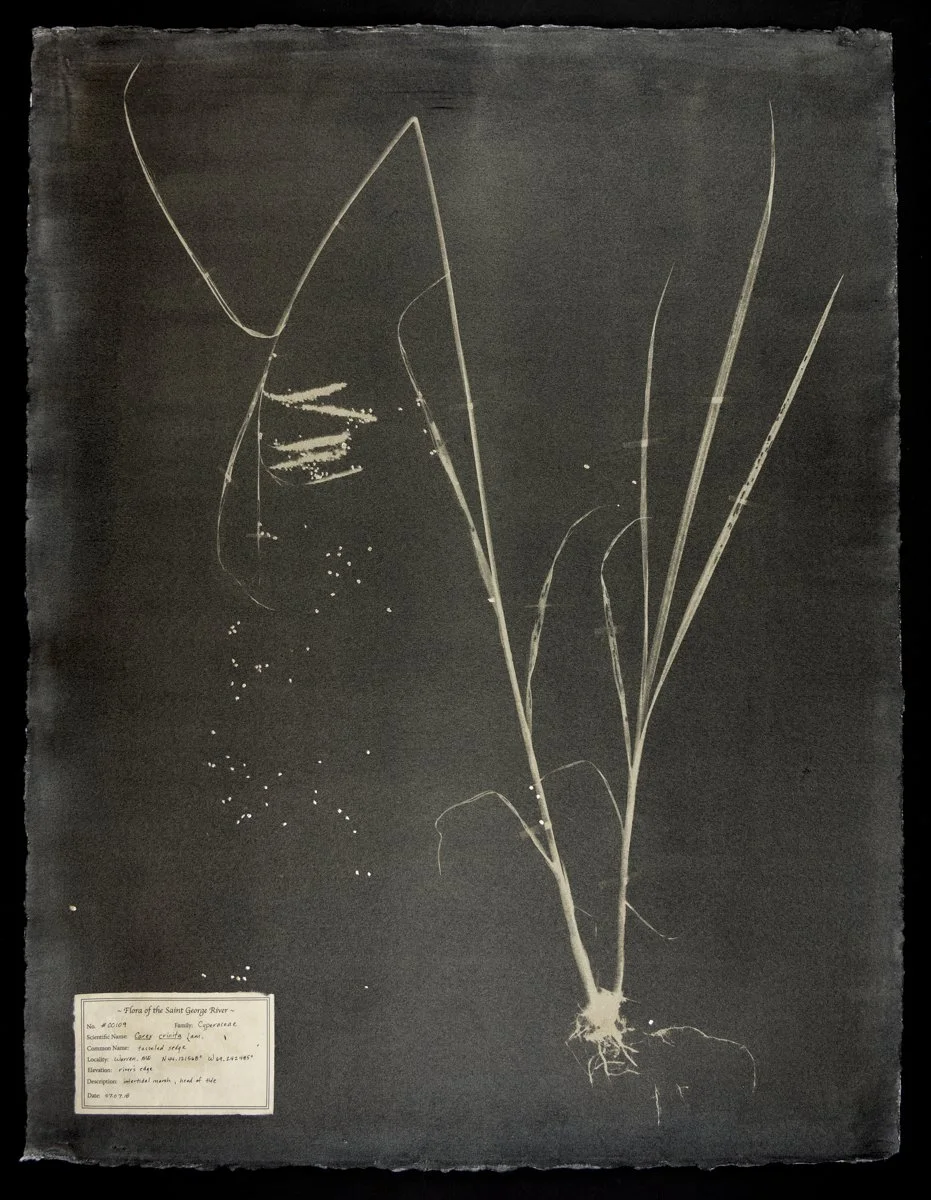
DM Witman, #00109 Carex crinita from the series Index, 2018, 25.75 x 19.75”, gum-bichromate, gouache, gold leaf, kitakata, Rives BFK
ML: The photograms in Index reference herbarium records and scientific archives. What does it mean to create an archive for a future in which the subject may no longer exist?
DM: Herbariums have been important to me in many ways–my first encounter was as an undergraduate student. I developed a research project where I cataloged the Biology Department’s herbarium which contained 19th and early 20th century records. I found it exciting to be able to look at a plant attached to a sheet of paper that once existed regionally to the University. So much information contained in a narrow metal cabinet that smelled sweetly like straw. I then reviewed each record in reference to rare, threatened and endangered species lists to learn if any of the plants were imperiled. I found that several within the collection were indeed “listed”. Records like this provide a snapshot about a particular location at a particular moment in time, about something. Like the photographic instant, they no longer exist (in their native habitat but can still be seen in this metal cabinet–to understand, to consider, to study). This is one of the functions of an archive. And I very much saw the work in Index, in this way.
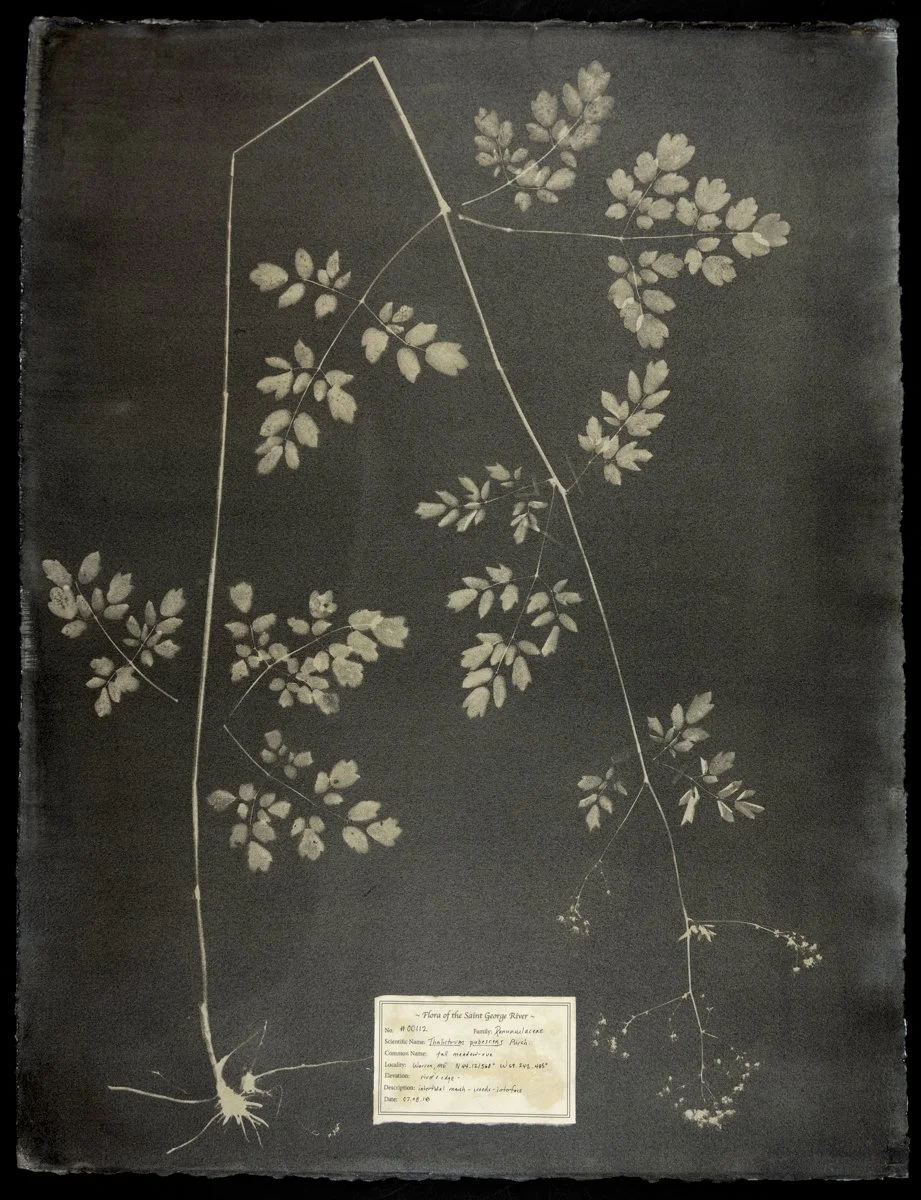
DM Witman, #00112 Thalictrum pubescens from the series Index, 2018, 25.75 x 19.75”, gum-bichromate, gouache, kitakata, Rives BFK
ML: Much of your work operates at the intersection of presence and absence. How do you visually articulate what cannot be fully seen, measured, or recovered?
DM: Yes, this space is one in which I am continually trying to understand, and not sure I ever will figure it out. It drives me to create. Sometimes I am more successful than others.
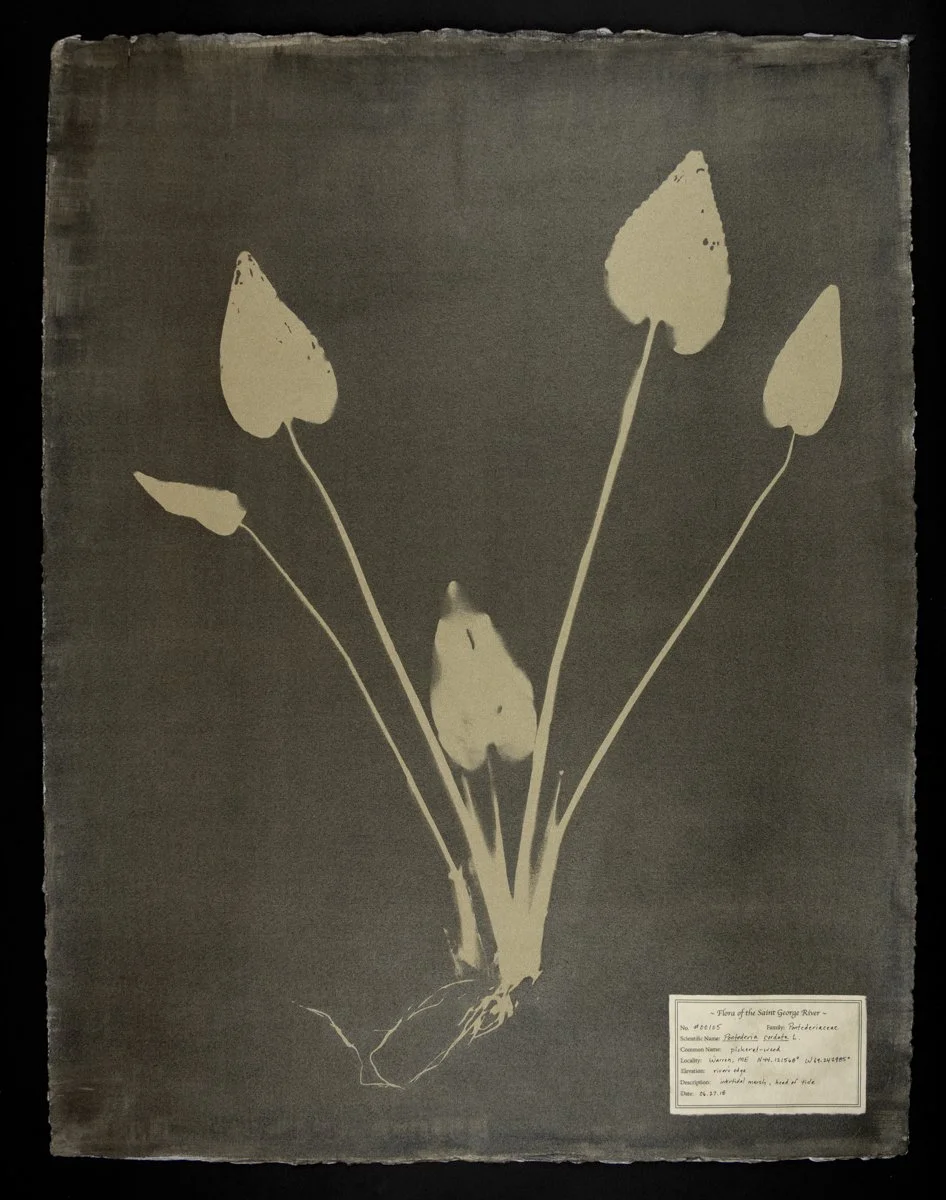
DM Witman, #00105 Pontederia cordata from the series Index, 2018, 25.75 x 19.75”, gum-bichromate, gouache, kitakata, Rives BFK
ML: As a transdisciplinary artist, how do you decide when a project requires photography alone, and when it needs installation, video, or other forms?
DM: As my practice has evolved, I have become more comfortable in an expanded practice. The ideas and materials often manifest in tandem. I’m not concerned with everything I touch having to be photographic. The work becomes what it needs to be.
ML: Climate grief is being increasingly discussed yet is often portrayed as a private issue. How do you see your work contributing to a shared or communal language around ecological mourning?
“Grief is a normal response. Climate disruption is not a normal phenomenon. Can we not expect that as lives are changed–whole landscapes and communities burned to the ground, entire coastal areas submerged under water, people dying from heat exposure, people losing their jobs, and their identities because of these changes–should we not expect people to grieve these losses?”
DM: Eco-distress is real and only in the past few years it has come into the public lexicon. Grief is a normal response. Climate disruption is not a normal phenomenon. Can we not expect that as lives are changed–whole landscapes and communities burned to the ground, entire coastal areas submerged under water, people dying from heat exposure, people losing their jobs, and their identities because of these changes–should we not expect people to grieve these losses? Unfortunately, the current social media practices don’t allow individuals the time and space to move through this, but there are glimmers of change. Prior to the mid-19th century in the West, mourning was a communal practice, an event of care and concern for others. The most recent waves of floods and fires appear to have invoked more of a communal experience and response, perhaps this will last beyond the immediate disaster. I hope that my explorations and sharing will allow others to acknowledge their own experiences as well as that of others, to know that it is a normal response, and that it is okay to feel what you feel.
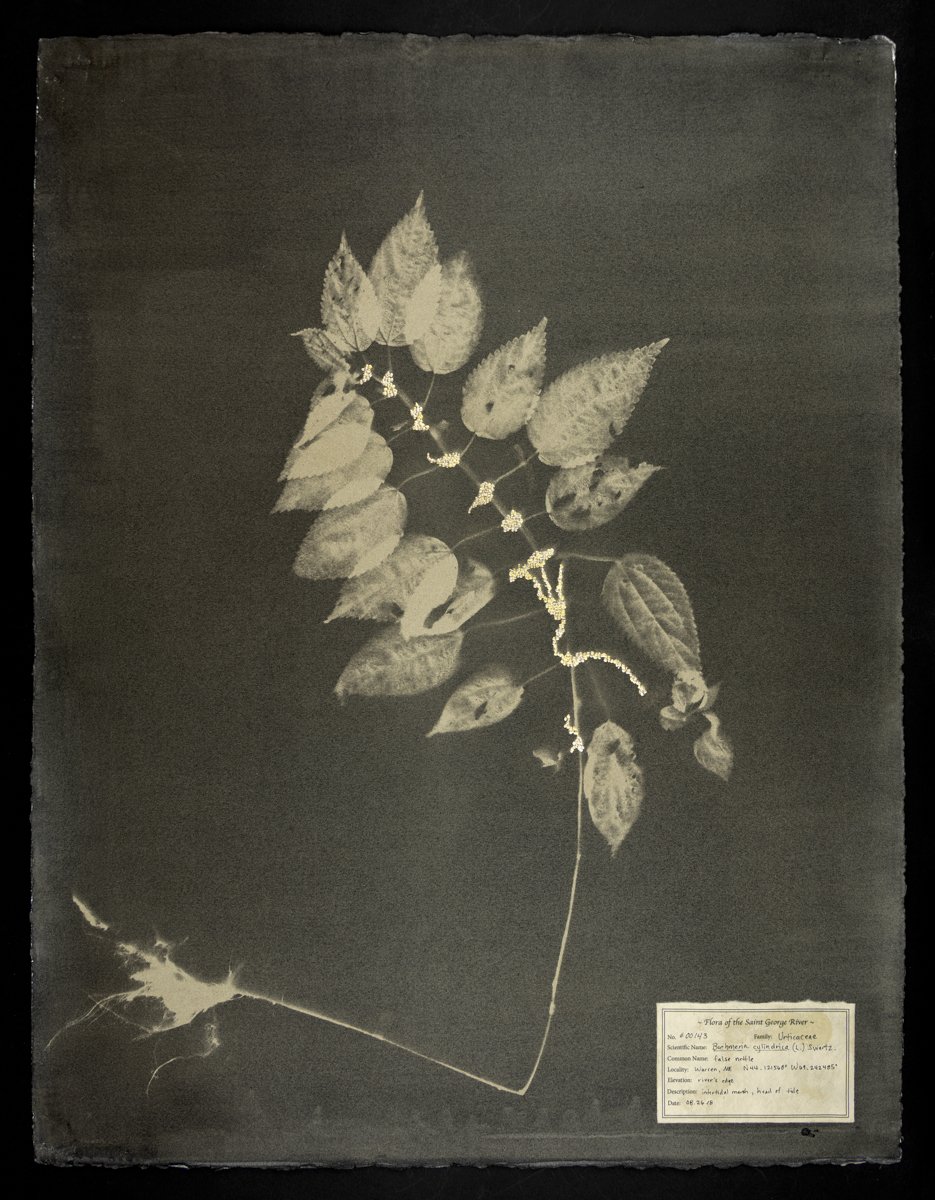
DM Witman, #00143 Boehmeria cylindrica from the series Index, 2018, 25.75 x 19.75”, gum-bichromate, gouache, gold leaf, kitakata, Rives BFK
ML: As a woman working in the environmental space, have you found that care, vulnerability, and mourning are treated differently than more extractive or heroic narratives of landscape?
DM: Definitely. These ideas are more difficult topics to deal with, internal spaces, personal experiences, not the most tangible of subjects. I do believe that these are difficult conversations, they can be uncomfortable as ultimately, we are dealing with existential concerns. When a person is confronted with environmental issues through a photograph of a polar bear clinging to a small patch of ice, the message is clear and someone can respond (or not to that). However, when someone is presented a work which is dark in color with an emerging ellipse (Ecologies of Mourning), this is more challenging as the imagery isn’t instant, it challenges the viewer to understand my intentions as an artist and perhaps confront their own feelings/experience. I am leaving space. This is not easy for most people–confronting one’s own mortality, humanity’s future (and failures), and that of the planet.
ML: Outside of the visual arts, are there particular writers or thinkers who have accompanied you, intellectually or emotionally, as you navigate grief, ecological change, and our relationships with more-than-human worlds?
DM: There are so many others who have helped to shape by understanding of the world along the way. One of my earliest influences that I still reference is Aldo Leopold’s “A Sand County Almanac”(1), as it was this collection of essays that introduced me to the power of observation, and that I could use my proclivity for observation to better understand the world around me. Others include Rebecca Solnit, Robin Wall Kimmerer, Arnold Berleant, Alan Lightman, and Donna Haraway. I prefer paper for my reading because I like to underline and highlight whatever seems important for me to remember at that moment. I frequently go back to these resources for continued insight.
ML: Your practice is deeply relational, to place, materials, and people. What groups, organizations, or networks have been pivotal in fostering dialogue, support, and exchange within your creative life?
DM: I am very interested in organizations such as the ecoartspace, Good Grief Network, and all of the artists that I meet along the way. These networks of friendships and acquaintances are incredibly important.
ML: Thank you for your time and for sharing your work with the GroundTruth community. For readers who want to learn more about DM’s work, check out the links below.
Leopold, Aldo. 2020. A Sand County Almanac. New York, NY: Oxford University Press.