
Amanda Breitbach
Amanda Breitbach is an artist, educator, and mother whose creative research examines the complex relationships between people and land. Informed by her upbringing on a family farm and ranch in eastern Montana, her work is grounded in place-based inquiry and an ongoing engagement with environmental and social systems. Her current project, Oil and Water, investigates competing interests and ecological tensions along the Texas Gulf Coast. Breitbach’s interdisciplinary background includes service as an agroforestry volunteer with the United States Peace Corps in West Africa, as well as professional experience as a newspaper photographer, reporter, and freelance writer. She holds bachelor’s degrees in photography and French from Montana State University and an MFA from the University of Nebraska–Lincoln. She currently serves as an Associate Professor of Art at Stephen F. Austin State University.
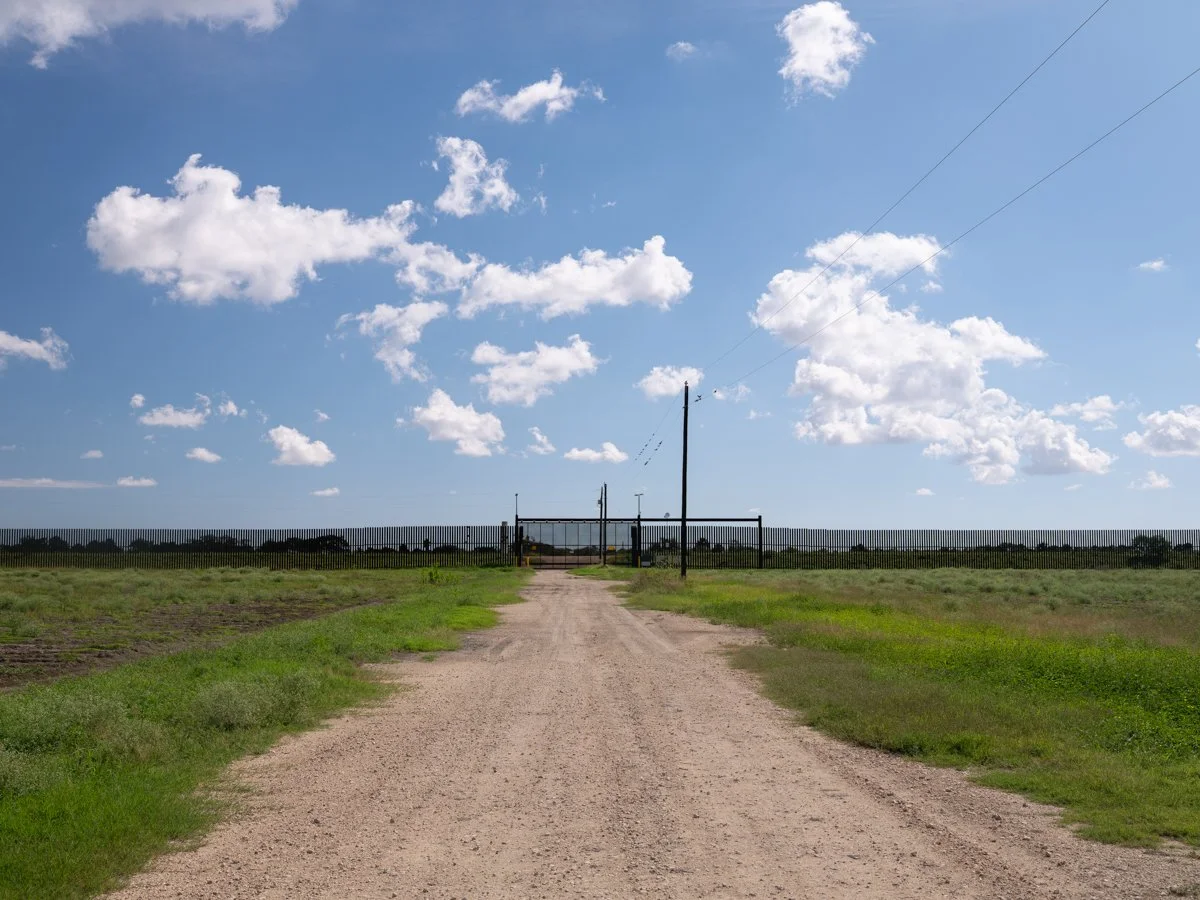
Amanda Breitbach, Border Wall, South Point Colonia, 2025, 22”x30”, archival inkjet print
Margaret LeJeune: I have followed Amanda Breitbach’s work since first encountering her presentation of Land/People at a Society for Photographic Education conference during her graduate studies at the University of Nebraska–Lincoln. The images she presented conveyed a compelling sense of place - one that was authentic, deeply personal, and richly complex. Ranging from expansive panoramas of pastures and cultivated fields to intimate interior scenes of kitchens and bedrooms, the project offers a nuanced and evocative portrayal of agricultural life in the rural Midwest.
In our conversation in early 2026, we examine the ways in which her relationship to place informs and shapes her creative practice, while also exploring the processes and conceptual underpinnings of her current series, Oil and Water.
ML: Please describe how growing up on a family farm and ranch in eastern Montana shaped your understanding of land and influenced your photographic practice?
AB: Maybe the biggest thing is just that I grew up recognizing how humans are tied to land - for food, for livelihood, for identity and inspiration. I spent a lot of time outside, playing with my cousins, gardening with my mom, helping with farm jobs when I was old enough to be useful. I was always interested in history, and our family history is tied to that landscape, so I grew up thinking about myself as part of that. My creative practice reflects those influences and my curiosity about the relationships between people and land.
Amanda Breitbach, Offshore Oil Wells, Gulf of Mexico, 2024, triptych, each 13”x19”, screenprint over inkjet print
ML: What initially drew you to the Texas coastline in 2019, and how did Oil and Water begin to take shape as a long-term project?
AB: I moved to Texas in 2017, and initially I visited the coast with my family, as a tourist. As a prairie person, I think I responded to the open landscape – being able to see the horizon, the sense of a vast, powerful sky. I was surprised by the proximity of oil and gas infrastructure to wildlife refuges and parks, and so I began photographing. I started to think of it as a serious project when I wrote my first grant application to photograph on the Bolivar Peninsula in spring 2020, and it has grown steadily since then.
ML: How does the prairie landscape invite different questions about ecology, time, or presence compared to coastal environments?
“Prairie ecology is all about the deep entwined roots of the plant ecosystem, the layers of soil. It invites questions about time and connection.”
AB: The prairie is subtle. You have to spend time in the landscape to see its beauty – it’s not going to hit you as you speed through on the interstate. Because I grew up in it, the prairie is a calming environment to me. It feels earthy and quiet. There aren’t many people, so it’s a place where you can be present and spend time with your own thoughts. Human history seems visible – from the roads and property lines to the neat houses and abandoned foundations. Prairie ecology is all about the deep entwined roots of the plant ecosystem, the layers of soil. It invites questions about time and connection.
The coast is louder, more populated, and constantly changing. Many people appreciate the beauty of beaches and the ocean, but fewer people explore the bays and industrial communities. It can be hard to see history because the wind and the water continually consume and cover its traces. The constant movement is invigorating and beautiful, and it invites questions about change. You can still find quiet pockets in the wildlife refuges or parks to feel present, where the only sounds come from wildlife.
Amanda Breitbach, Bought Out, Corpus Christi, 2022, 22×30”, archival inkjet print
ML: How do you approach photographing places that are simultaneously ecologically fragile and economically dependent on extractive industries?
AB: Wherever I’m photographing, I want to approach both people and place with curiosity and respect. I read and do research before doing field work, and I learn from the people I meet when I’m out photographing. The Texas coast is a working landscape, and in that way, it’s not unlike the landscape where I grew up. People are doing the best they can, and it’s not easy to make a living. When you think about it, all of our communities are economically dependent on extractive industries, so we can’t judge anyone else for their part in the system.
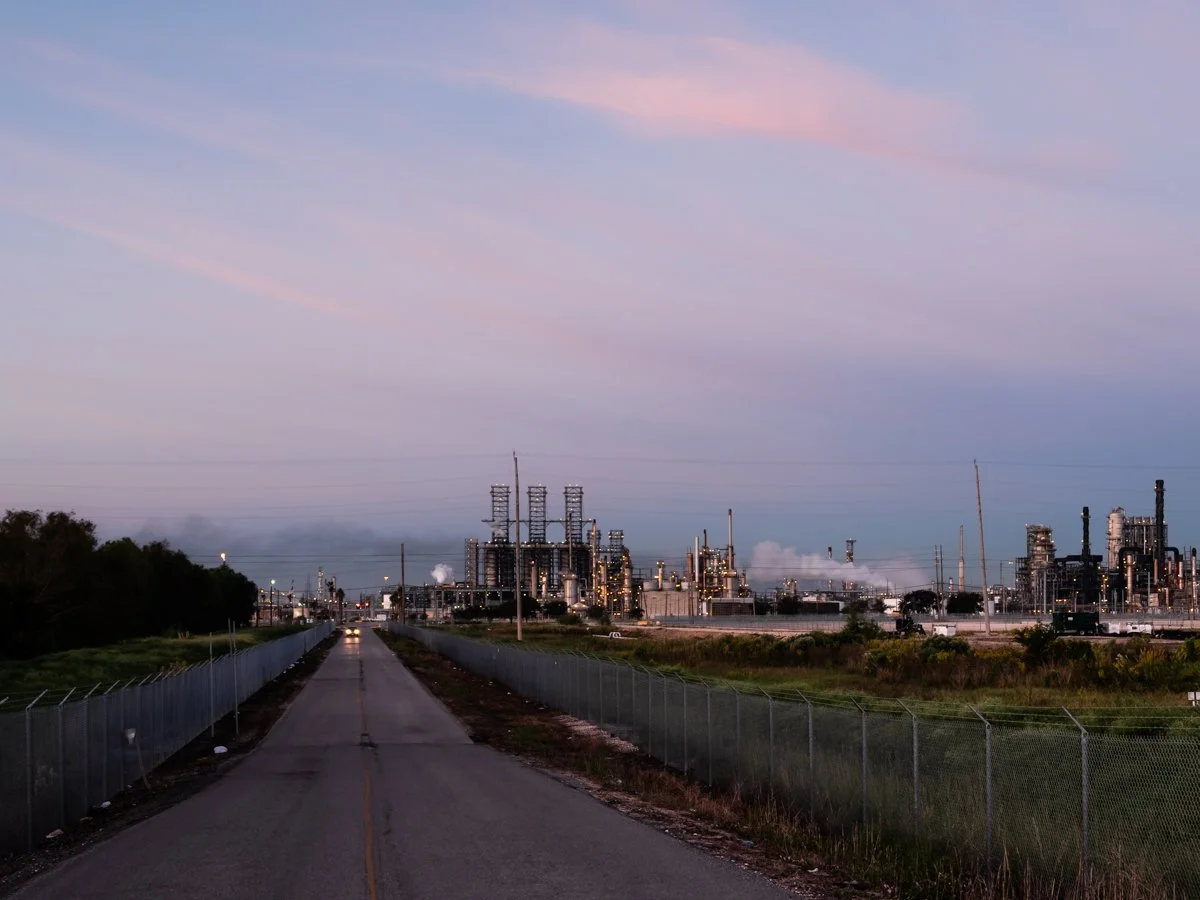
Amanda Breitbach, Motiva Refinery, Port Arthur, 2021, 22×30”, archival inkjet print
ML: Can you talk about your experience photographing near oil refineries and export terminals, particularly in communities like Port Arthur, and how residents and workers responded to your presence?
AB: Refineries and plants are usually difficult to access - lots of private entrances and tall fences. Sometimes I see a road on the map that I think will be a good place to photograph from, but I can’t actually get there. I often photograph early in the morning, so I’m driving around in the dark, trying to find a good place to photograph. Because I’m out so early and I’m trying to avoid being challenged, I don’t usually interact with people in those spaces. If I’m photographing with the drone, it’s different. In that situation, I’m looking at the map for places where the airspace isn’t restricted and I won’t be trespassing from my location on the ground. In Port Arthur, I was lucky to find a community park not far from the Motiva refinery, which is the largest refinery in North America. Airspace is restricted directly above the refinery, but I could see the facility from the park. I only fly in daylight, but I was photographing during regular work hours, so I didn’t interact with many local residents at the time. Most of the people that I’ve photographed have been fishermen, scientists, tourists. Of course, I don’t photograph anyone without their consent. I can appreciate that it’s complicated for someone who works in oil and gas or a scientist who relies on that industry for research funding to be photographed for a project that could be seen as critical of the industry.
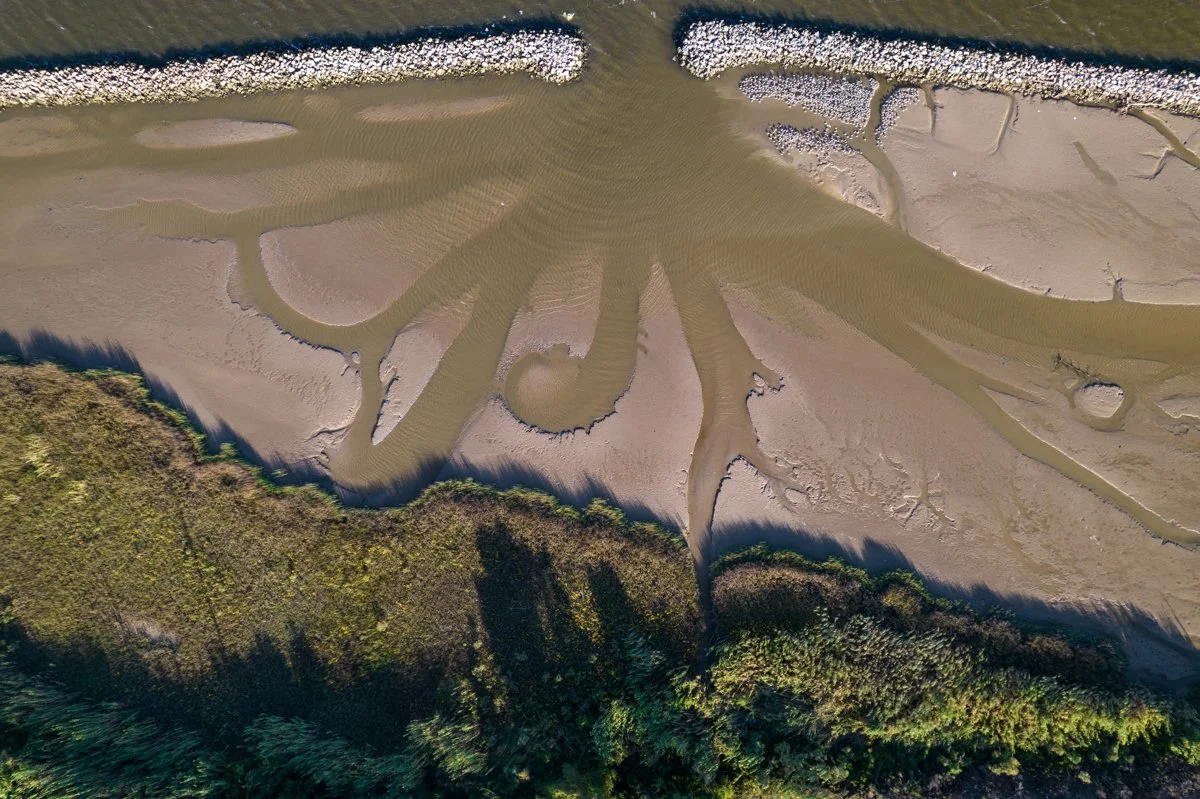
Amanda Breitbach, Erosion Control Structure, Pleasure Island, 2021, 18×24” archival inkjet print
ML: Your images are captured with both traditional cameras and camera drones. How does each tool shape your perspective on the landscape and the stories you tell?
AB: I started photographing with drones a few years after I began teaching at Stephen F. Austin State University. Several of my colleagues here used drones in their work, and we began working together to incorporate drone photography into photography classes as a way to give students marketable skills and a different perspective. Teaching with drones naturally led to using them in my own research. For this project, I have used drones as a tool to photograph things that you can’t see from the ground. For example, photographing the Motiva refinery from the air helped represent its massive size and its proximity to people’s homes. Similarly, photographing the boom spread to contain an oil spill gave some hint of the scale of the problem and showed the natural environment that it was affecting. For me, photographing from the ground generally feels more emotional and immediate. Those images represent human experience and perspective. This project needs both – the broad view and the intimate.
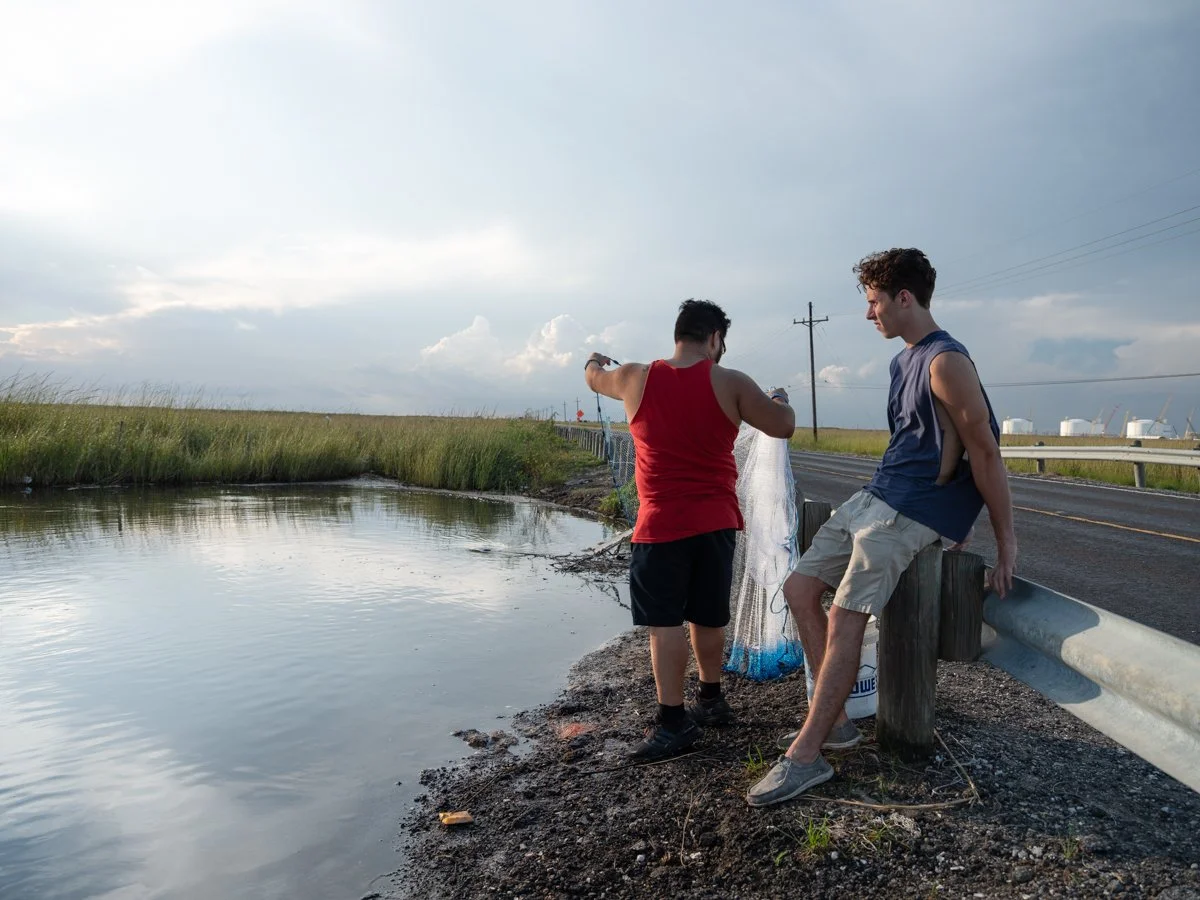
Amanda Breitbach, Casting for Bait, Sabine Pass, 2021, 22×30”, archival inkjet print
ML: Birds, fishermen, scientists, sea turtles, and industrial infrastructure all appear in Oil and Water. How do you decide what or who becomes part of the visual narrative?
AB: I’ve spent a lot of time reading and looking at maps. Once I decided that I wanted the project to cover the whole Texas coast, I needed to figure out what the essential elements were in each region – what I needed to represent to tell that story. Each time I make a trip to photograph, I’m coming up with a general itinerary of where I’m going, who I’m going to talk to, how to use my time efficiently. After I make the images, I’m evaluating them for their visual impact and their place in the story. I don’t want the project to feel repetitive or two-dimensional. Recently, I’ve been working on a book of the project, so as I lay it out I’m looking with a critical eye for what’s missing and what could be better.
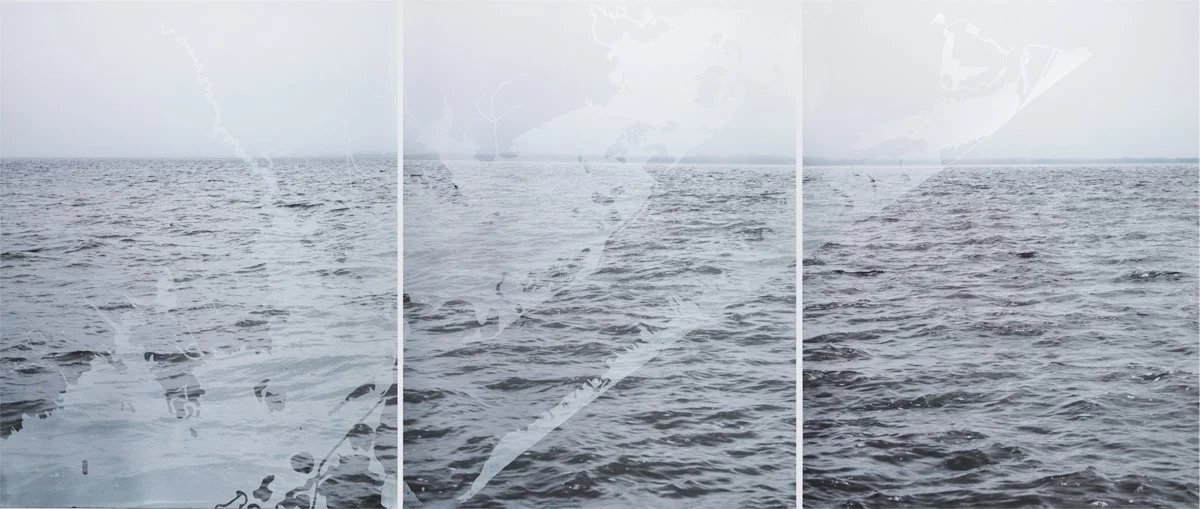
Amanda Breitbach, Sea Level Rise, Galveston Island, 2024, triptych, each 13”x19”, screenprint over inkjet print
ML: What role does time play in your practice, both in terms of returning to locations and in addressing slow-moving environmental change?
AB: I’ve been working on this project since 2019, and I’ve visited most of the locations that I’ve photographed at least twice - once to scout out the possibilities and again to photograph. I’d like to be able to visit and photograph more, but I have to balance my research with my everyday life as a teacher and a mom, so there’s never enough time. Sometimes there are major, visible changes that affect the places I’ve photographed. For example, they completed the new Harbor Bridge in Corpus Christi last summer. I photographed in Corpus in winter 2022-23, when the bridge was still under construction and learned about the Hillcrest community, a historic black community that was cut in half by the project (after decades of industrial encroachment). Hillcrest residents were offered a buy-out by the Port of Corpus Christi, but some residents stayed. I would like to visit and photograph there again to see how the bridge opening has affected that community.
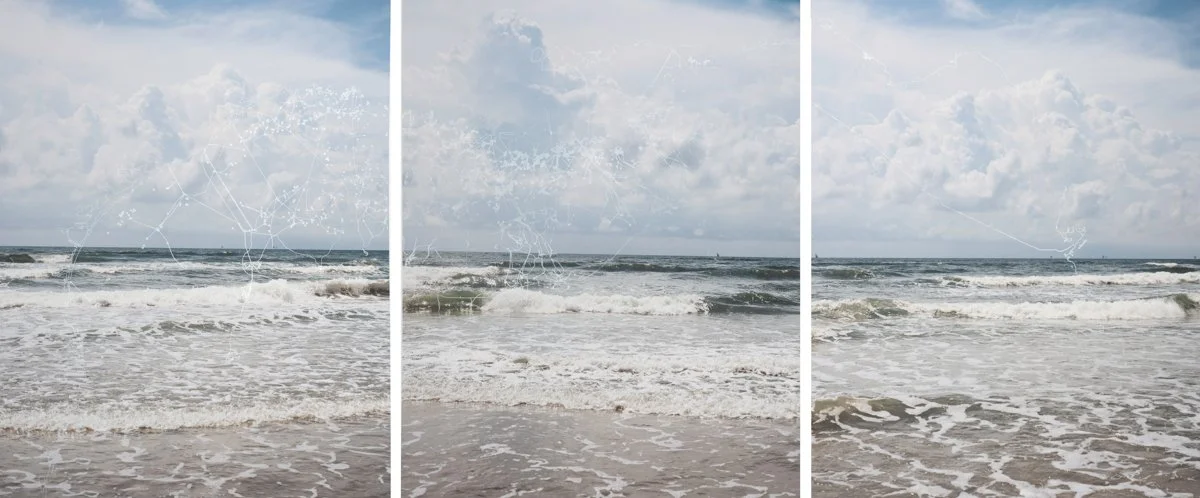
I’ve needed time to develop this project, to learn about the coast and figure out what I have to say about it, but at the same time, I feel an urgency to do something immediate and tangible that addresses climate change. That’s where the piece Sea Level Rise, Galveston Island came from. I was struggling with the problem of how to photograph something that isn’t visible. When you look at a coastal community, you can’t see the threat of sea level rise. I started looking at maps of projected sea level rise created by the National Oceanic and Atmospheric Administration (NOAA). I have been an admirer of the book Petrochemical America by Richard Misrach and Kate Orff (1) for years, and looking at the illustrations in that book gave me the idea of combining data with photographs. For that piece, I chose to screen print the map of projected sea level rise by 2120 over a triptych of photographs of Galveston Island, seen from the mainland. The ink is colorless but pearlescent, so the overlay is almost invisible unless light creates a direct reflection from the print’s surface. I hope the final prints communicate the unseen nature of many threats to the coast and engage viewers who notice that their perception of the work depends on where they stand in relation to it.
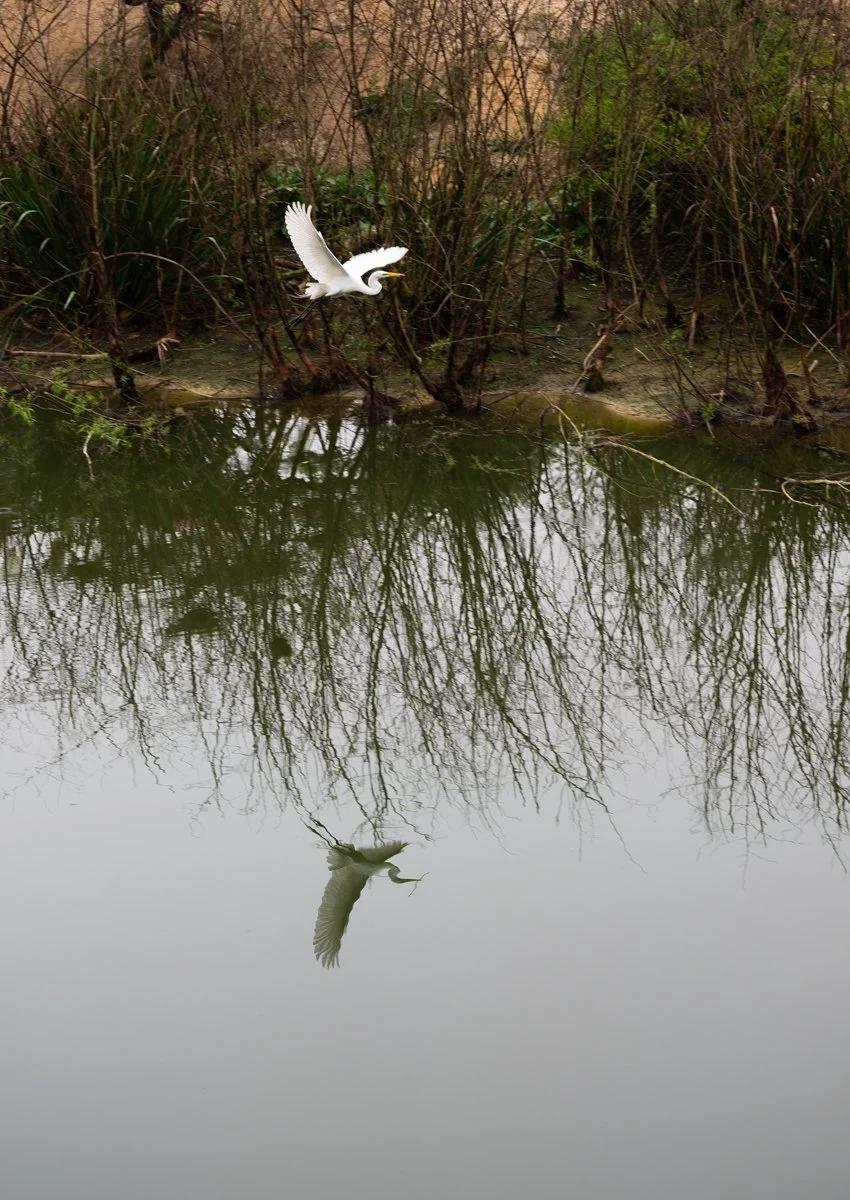
Amanda Breitbach, Great Egret, Smith Oaks Sanctuary, 2020, 30×22”, archival inkjet print
ML: In what ways does Oil and Water engage with ideas of scale, from individual species or people, to global energy systems?
AB: I hope that this work engages with a range of scales, from intimate to global. When I started making photographs for this project, my attention was mostly on visible oil and gas infrastructure, contrasted with beautiful coastal landscapes and wildlife. As I read and learned about the Texas oil and gas industry, I realized how important it is globally. Texas refines almost half of all the oil extracted in the United States. Three of the largest oil terminals in the U.S. are located on the Texas coast, and in February the president approved a new deepwater oil terminal on the Texas coast that would have an export capacity of 1 million barrels of crude oil per day. That research led me to photograph some of the major refineries on the coast and to start puzzling over how to make images about offshore infrastructure that I couldn’t access.
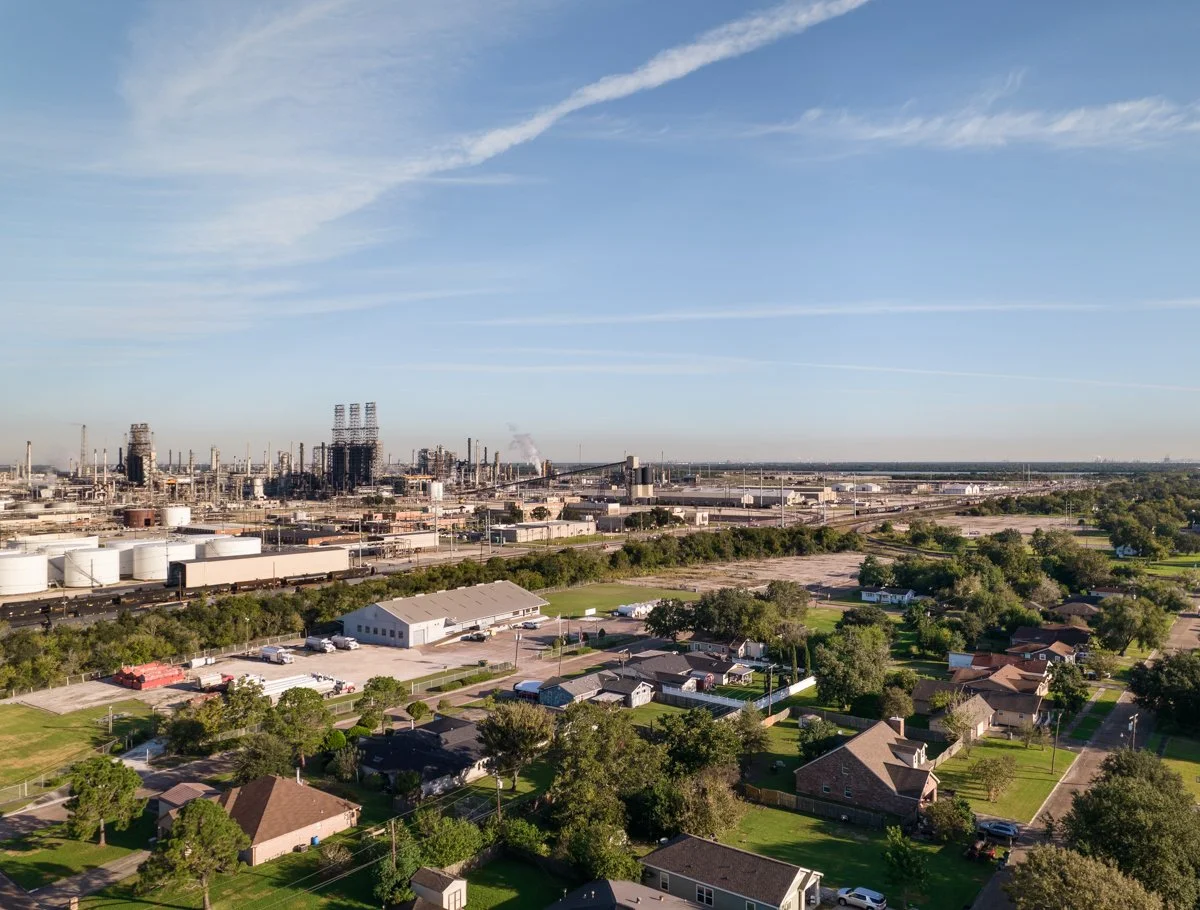
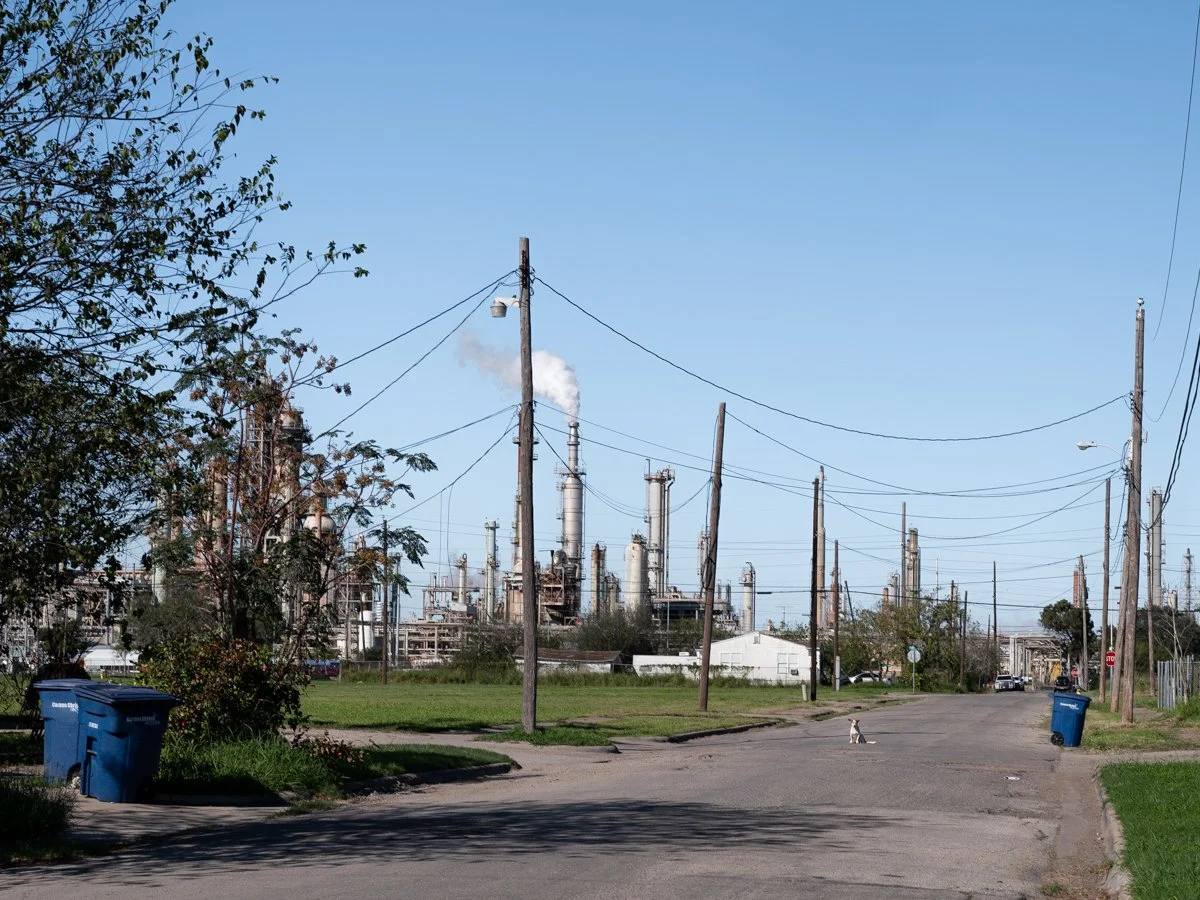
Amanda Breitbach, Motiva Refinery and Neighborhood, Port Arthur, 2021, 18×24”, archival inkjet print
“We drive more, live further from our workplaces, and consume more goods in part because of the cheap availability of oil and gas. Plastics made from petroleum are a major driver of consumer waste, so plastic pollution is also driven by the petroleum industry. The more I think about it, the bigger the umbrella of Oil and Water becomes.”
In 2022, I spoke with Dr. Paul Montagna, chair of hydroecology at the Harte Research Institute. He encouraged me to look more closely at the encroachment of roads, homes, and businesses taking over what used to be wild places and made the point that wildlife often coexists relatively well with drilling lands and offshore rigs. When I thought more deeply about roads, home and business development, I could see that they were all directly linked to fossil fuel consumption. We drive more, live further from our workplaces, and consume more goods in part because of the cheap availability of oil and gas. Plastics made from petroleum are a major driver of consumer waste, so plastic pollution is also driven by the petroleum industry. The more I think about it, the bigger the umbrella of Oil and Water becomes.
ML: How does your role as a professor influence your artistic practice?
AB: As a teacher, it’s part of my job to think about the world my students are entering and to try to prepare them for it. That requires me to learn new technology and to keep my skills commercially relevant. Learning to use new tools and software leads me to explore different directions in my research than I might if I didn’t feel that responsibility. At the same time, I also see the importance of understanding and learning to use analogue photographic tools, and I am fortunate to be able to share those with students as well. Teaching a broad range of processes stretches me as an artist and gives me a bigger toolbox to work with.
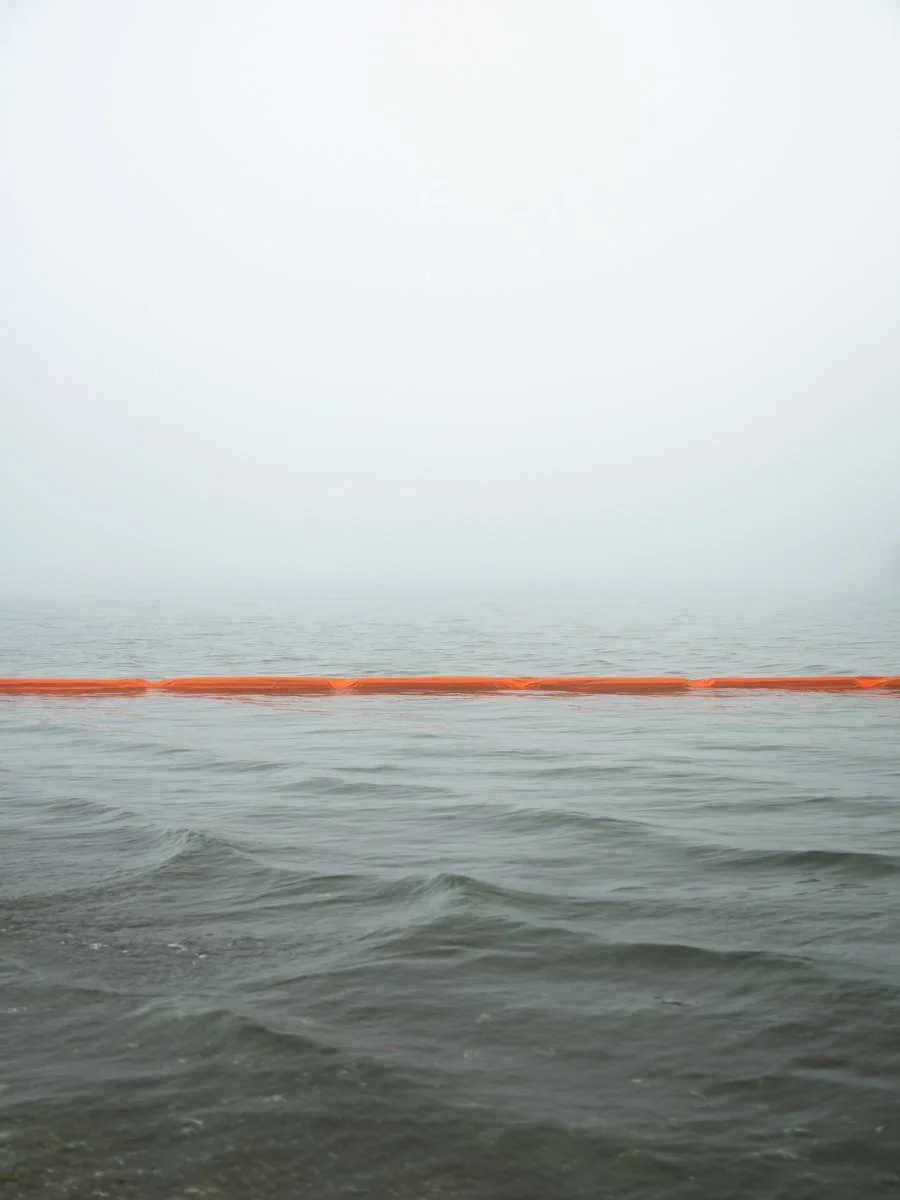
Amanda Breitbach, Christmas Eve Oil Spill, Corpus Christi Bay, 2023, 30×22”, archival inkjet print
ML: How has becoming a mother influenced the questions you ask in your work and the way you think about environmental responsibility and the future?
“My work is rooted in curiosity about the relationships between people and land, and part of my process is asking questions about power and control.”
AB: I think being a mother makes the future more tangible. I didn’t anticipate how becoming a mom would impact my stress level, and part of that sense of anxiety is concern about the future that my children will inhabit. I want to believe that humans will learn to consume less and conserve more, but so far that’s not the direction we’re moving in. Sometimes it’s disheartening to read the news or to look around at our culture, but as a parent you don’t have the option of giving up. It’s my responsibility to model curiosity and appreciation for nature and a sustainable lifestyle that minimizes my negative impacts. It’s also my job to teach my kids to question power and see hypocrisy (in themselves and others). My work is rooted in curiosity about the relationships between people and land, and part of my process is asking questions about power and control. As an artist and a mom, my fears are counterbalanced by my experience of beauty and the sense of responsibility to live well.
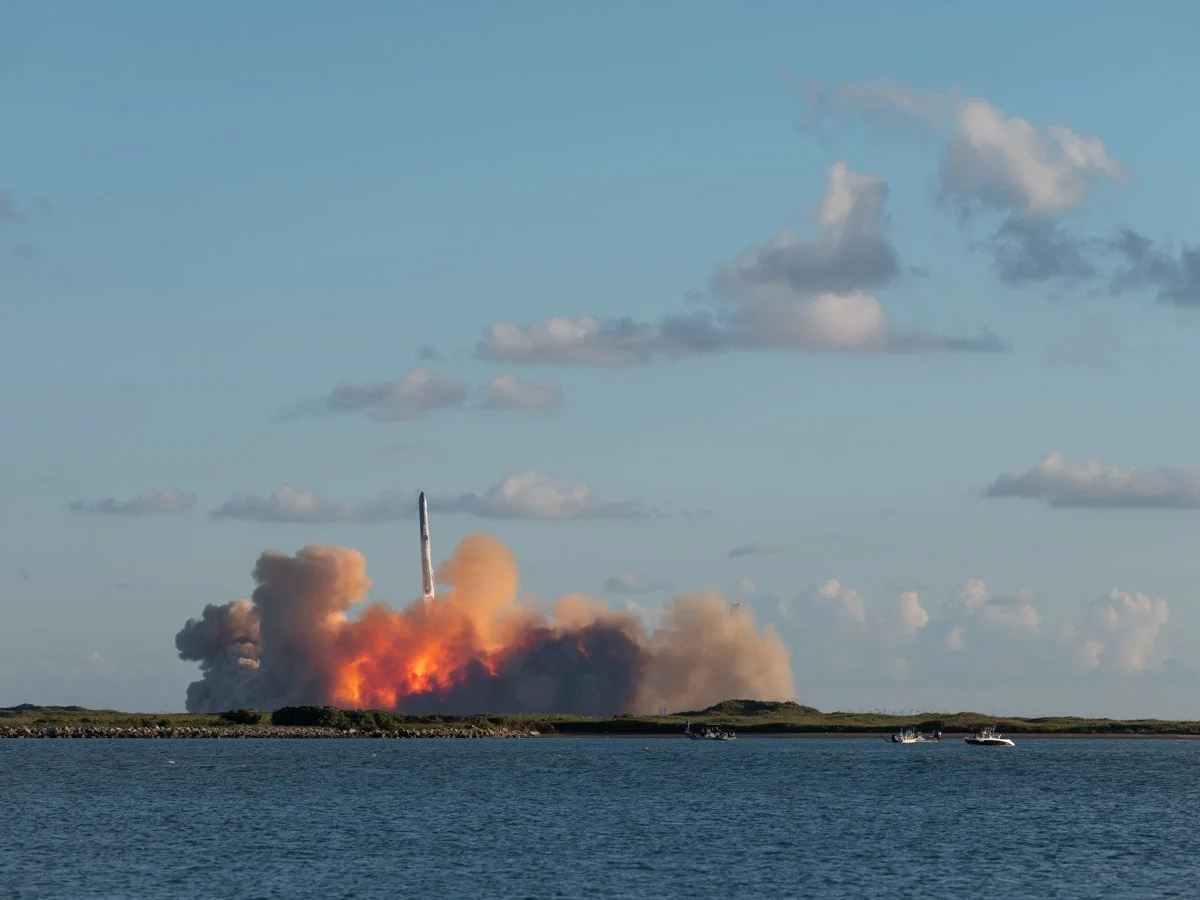
Amanda Breitbach, Launch of Starship 10, Boca Chica Beach, 2025, 22×30”, archival inkjet print
ML: What do you hope audiences, especially those who live far from the Texas coast, take away from engaging with Oil and Water?
AB: The Texas coast offers a powerful illustration of the conflicts between humans and the environment. Ultimately, I hope that my work increases appreciation and respect for the non-human world, while also provoking reflection about our exploitation of natural resources and the consequences of those actions.
ML: Thank you for your time and attention, both of which are especially valuable commodities in the present moment. To learn more about Amanda’s work, please consult the links below to her website and Instagram account.
Misrach, Richard, and Kate Orff. Petrochemical America. New York: Aperture, 2012.